Salesforce Highlights Strengths in Innovation and Relationships at Agentforce World Tour

On Feb. 25, 2026, TBR attended Salesforce’s Agentforce World Tour event in Sydney along with 10,000 Salesforce professionals, clients, alliance partners and analysts. The following reflects TBR’s observations and discussions during the event as well as our ongoing assessment of Salesforce and its ecosystem partners. TBR’s Salesforce analysis can be found in its quarterly vendor reports, the Cloud and Software Applications Benchmark, and the Adobe and Salesforce Ecosystem Report.

‘Everyone is looking to agency [agentic AI] to drive their companies forward’

During a panel discussion with Salesforce clients, Australian business leaders and Salesforce executives discussed best practices for enterprisewide agentic AI adoption and for scaling pilots. Panelists mentioned common ideas such as ensuring clear ownership of projects and agents, defining desired outcomes at the start of any engagement, and co-locating technology teams with business teams (this blog and others from TBR dive into best practices for IT services companies, consultancies, technology vendors and enterprises with respect to agentic AI adoption).
 
One Salesforce leader noted that clients have expressed frustration that AI has simply allowed them to write better emails. Salesforce, he added, is working to show ROI at scale and “get more production value out of these products.” In TBR’s view, AI adoption sentiments expressed in keynotes, panel discussions, and show-floor discussions with Agentforce attendees reflect common themes around well-understood best practices, concerns and fears about enterprisewide adoption, and confidence that 2026 will deliver clear, measurable and significant ROI from agentic AI investments. This last point may reflect the setting and vibe of the event, although many of the specific use cases described by Salesforce professionals and Australian clients reinforced an overall sense about agentic AI.

‘As a leader, if you think AI is going to replace people, you have more problems than [adopting] AI’

At another point during the panel discussion, the CEO of an Australian student accommodation business described the leadership challenges inherent in adopting AI at scale, both within her company and in her experience speaking with fellow CEOs in Australia. She commented that the most significant hurdles were rooted in business processes and people, not in the technology, and that leaders who failed to consider enterprise resilience from a business perspective would likely fail to gain significant benefits from adopting AI-enabled solutions.
 
This CEO’s comments echoed the sentiment expressed by Sanjna Parulekar, SVP of product marketing at Salesforce, who said “context is king” (in adopting agentic AI) and that companies should focus on business workflows, particularly as large language models increasingly examine business workflows. Parulekar also noted that understanding AI-driven change management, including changes in roles and responsibilities, could help companies break down silos and more rapidly transform their business models.
 
In TBR’s view, the quote in this section’s subhead perfectly captures this CEO’s dilemma at present: AI promises a productivity boost when bots replace people, but successful adoption at scale seems to require more people with different skills. Digital full-time employees (FTEs) are not yet cheaper than human FTEs, but slow-rolling adoption seems untenable. What to do? For Salesforce, and the company’s consulting partners in attendance at Agentforce, the answers are clear: more software, more platforms and more AI, all aimed at solving business problems, not just adding technology for technology’s sake.

Salesforce in the public sector

In a special breakout session, Salesforce’s local and global public sector leaders made three critical points about the company’s overall public sector strategy and recent performance:

  1. Licensing and permitting have been taking off as a use case, frequently tied to efforts to accelerate economic development.
  2. Governments across all levels have been looking for consolidation, from point solutions to a platform, especially in the U.S.
  3. As part of Salesforce’s public sector push in the U.S., the company has been providing partner-like training to employees at government agencies, disrupting traditional systems integrators. Notably, according to Salesforce, U.S. federal government agencies are increasingly looking to Salesforce to be the prime contractor on technology-centric engagements.

 
With the recent hype around the “death of SaaS” and other pressures on the business models of technology companies, Salesforce’s growing presence, success, and apparent disruption of competitors and alliance partners alike underscore Salesforce’s strengths in creating stickier client relationships and continually innovating, two qualities essential in the agentic AI age.
 
TBR’s overall takeaway from a day with Salesforce in Australia: Software is not dead. SaaS is not dead. Different wrappers, innovative use cases and deeply embedded relationships, both personal and technological, underscore Salesforce’s strength.

Telecom Edge Compute Market Forecast

TBR Spotlight Reports represent an excerpt of TBR’s full subscription research. Full reports and the complete data sets that underpin benchmarks, market forecasts and ecosystem reports are available as part of TBR’s subscription service. Click here to receive all new Spotlight Reports in your inbox.

Telco, cableco and hyperscaler spend on edge compute infrastructure will grow at a TBR-projected CAGR of 13.4% from 2024 to 2029 to reach $52.5B

TBR estimates telecom edge compute infrastructure investment will reach $52.5 billion in 2029, driven primarily by network transformation ― especially vRAN deployments ― by telcos and deployments by telcos and hyperscalers eager to extract economic value from AI and other distributed computing use cases.
 
The edge computing market is developing more slowly than originally expected due to several factors, particularly the lack of proven revenue-generating use cases. Future ROI on edge compute investments is uncertain as opportunities such as monetizing AI inferencing at the edge remain unproven. vRAN, the primary telco use case for edge compute, provides some cost efficiencies but offers limited net-new revenue-generation opportunities.
 
Hyperscaler spend growth will more than double the combined telco and cableco growth during the forecast period, as this cohort will pivot spend from central to edge build-outs to achieve the latency and quality of service that new network use cases will require, as well as to handle AI inferencing workloads.
 

Hyperscalers deprioritized edge cloud build-outs as they double down on AI training, which drives central data center investment; AI inferencing will leverage edge computing

Though hyperscalers are still increasing investment in edge data centers, their top priority is building out central data centers to train and support their AI models, as central data centers are best suited to support the large amount of power and space GPU servers require to do AI model training; data storage also requires space. Further, hyperscalers require more data center capacity to support their cloud services businesses and new use cases enabled by technologies such as AI.
 
To mitigate some of the economic and technical challenges associated with building out edge computing infrastructure at scale, hyperscalers intend to leverage key technological innovations in central cloud. For example, hyperscalers are conducting R&D and investing in Arm-based chips (which are more energy-efficient than x86 chips, the predominant chip used in data centers today) as well as in new cooling technologies such as liquid immersion. Hyperscalers are also focused on developing new renewable energy resources and exploring promising technologies such as SMR (small modular reactors) and geothermal to provide a steady stream of energy to power their data centers. TBR expects hyperscalers will leverage most of these innovations in central data centers before incorporating them into edge data centers.
 

If you believe you have access to the full research via your employer’s enterprise license or would like to learn how to access the full research, click the Access Research button.

Access Research

Hyperscalers have been focused on AI training in central data centers, but emphasis will shift to building out edge infrastructure to handle AI inferencing

Hyperscalers are building out their distributed computing and intelligent connectivity infrastructure platforms to capitalize on key use cases such as AR/VR and, more broadly, the digital ecosystem transcendence across key aspects of people’s lives (see TBR’s 2H25 Hyperscaler Digital Ecosystem Market Landscape for more information). Hyperscalers’ end goal is to enable ambient computing. TBR estimates trillions of dollars in economic value will be created by the intersection of distributed computing and intelligent connectivity through this decade, and we believe hyperscalers are positioning to capture an outsized portion of this market opportunity.


TBR believes hyperscaler distributed computing platforms, which encompass central and edge data centers as well as on-device computing, will be leveraged to run the intelligence layer of their respective global networks. For example, cloud-native, virtualized network functions, such as the mobile core, will reside in this distributed computing platform, supporting the transport and access layers of the network.

vRAN supports edge compute spend by CSPs such as Verizon and, until recently, DISH; Telus is the leading CSP in Canada in vRAN investment

Canada-based operators are taking a wait-and-see approach before making significant investments in edge infrastructure. These operators have, however, begun to invest in vRAN — and, more broadly, network transformation via virtualization and cloudification — with Telus making a strong commitment to the technology through an agreement with Samsung reached in February 2024, and Canada-based operators taking part in sovereign cloud efforts via offerings such as Bell AI Fabric.
 
AT&T, Verizon, Amazon, Microsoft and Google will spend the most on edge infrastructure in North America through the forecast period. 

vRAN is the largest edge compute use case for telcos, and Verizon is among the leaders in this space as the company announced it has deployed over 22,900 vRAN sites as of early 2025 in markets across the country. Samsung and Ericsson are rolling out vRAN solutions in Verizon’s C-Band-based 5G network.
 
Other U.S.-based companies, especially Apple, Meta Platforms, Comcast, Lumen and T-Mobile, are also investing in edge infrastructure but at a lower scale compared to the five aforementioned companies.
 
DISH has extensively deployed vRAN, though the company is dismantling its mobile access network.
 
Comcast has spent the most compared to other cablecos on edge infrastructure to date as the operator pushes forward with its network transformation. Other cablecos, such as Charter, Cox, Altice and Liberty Global, are following in Comcast’s footsteps. However, in general, cablecos will lag hyperscalers and telcos in the edge compute opportunity. As of October, Comcast had rolled out over 50,000 edge compute servers and 1,300 vCMTS physical points of deployments.

vRAN deployments largely drive local CSP edge compute spend; hyperscaler investment is materializing more slowly than previously anticipated due to a shift in their priorities

vRAN underpins local edge compute spend volume, with support to date provided by rollout initiatives at key operators such as China’s CSPs, Rakuten, Verizon and Japan’s Tier 1 CSPs. The proliferation of vRAN across more CSPs will drive growth during the forecast period.


Tower sites are especially pertinent to edge computing due to their proximity to population areas, availability of power, backhaul and last-mile access, and physical security.
 
Towercos have not seen the master lease agreements that hyperscalers were expected to sign with strategic shared infrastructure owner (SIO) partners to locate their edge stacks at the base of cell sites materialize at scale as hyperscalers pursue other avenues, such as satellites.
 
SIOs (such as tower companies, data center colocation providers and neutral host providers) are becoming increasingly important aggregation points for AI-related traffic and connectivity demand. Their facilities often serve as hubs where hyperscalers, neoclouds, enterprises and AI service providers interconnect, driving demand for high-capacity fiber, wavelength services, dark fiber and low-latency metro and long-haul transport. As AI workloads scale and become more distributed, SIOs are influencing where network investment is required and where new interconnection-rich locations emerge within metropolitan and regional markets.
 
Telcos have largely ceded this opportunity to SIOs because they have been divesting their tower and land assets to generate cash for network equipment, pay down debt, buy more spectrum and fund capex. As such, telcos will increasingly rely on SIOs for locating a portion of their edge sites.

U.S. Wireless Market Outlook for 2026

M&A, pricing pressures and leadership shifts reshape the competitive landscape

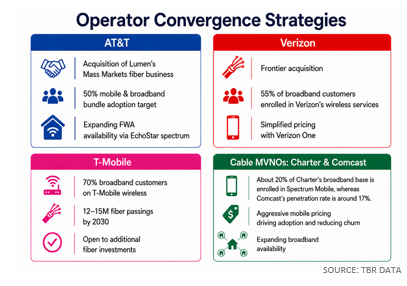
Acquisitions, expansion of mobile broadband bundling strategies and continued network investment remain priorities for U.S. wireless operators as they navigate an increasingly competitive market.
 
Competitive pricing — particularly from cable MVNOs — is intensifying, while Verizon is revamping its go-to-market strategy to reaccelerate subscriber growth. At the same time, differentiated connectivity services, including direct-to-device (D2D) satellite offerings and emerging network slicing capabilities, are becoming key competitive levers. Additionally, leadership changes at Verizon and T-Mobile are expected to accelerate cost-cutting efforts, AI implementation and operational restructuring initiatives.
 
In the below TBR Insights Live session, TBR Senior Analyst Steve Vachon shares key insights into the evolving U.S. wireless market and what market shifts mean for U.S. operators in 2026 and beyond.


Watch and learn:

  • How M&A activity and convergence strategies are reshaping the competitive landscape of the U.S. wireless market
  • How pricing strategies and service offerings are shifting in the U.S., and the impact on subscriber growth for U.S. operators
  • How recent CEO appointments and leadership changes will impact capital allocation, cost efficiencies and AI initiatives for U.S. operators
  • How these trends will impact wireless revenue growth, profitability and capex in 2026

This TBR Insights Live session is available on demand on our YouTube channel. Visit this link to download the presentation’s slide deck.
 
If you’d like to further explore the data mentioned in this TBR Insights Live session, sign up for a free trial of TBR Insight Center™ today.
 
TBR Insights Live sessions are held typically on Thursdays at 1 p.m. ET and include a 15-minute Q&A session following the main presentation. Previous sessions can be viewed anytime on TBR’s Webinar Portal.

KPMG Collaborates with Microsoft to Develop Governed Agent Operating Model at Scale

KPMG and Microsoft and the next phase of partner-led AI transformation

KPMG is repositioning itself from a Microsoft Dynamics-centric systems integrator to a broader AI-led transformation partner that has extensive experience with Microsoft technologies. As KPMG’s Microsoft alliance moves toward an AI-era operating model measured by sustained adoption and governed outcomes, the strategic questions for partners and competitors are centered on whether KPMG’s governance-led, platform-enabled approach becomes a repeatable bet in regulated and board programs — and, if so, how quickly peers can counter with comparable operational frameworks and field-ready narratives.
 
Recently, TBR had a chance to hear directly from KPMG’s Microsoft alliance leaders including Cherie Gartner, Global Lead Partner for Microsoft, KPMG LLP; Marco Amoedo, Global Chief Technology Officer, Microsoft, KPMG International; and Sven Rohl, Global Microsoft AI Business Solutions Lead, KPMG International, about how KPMG’s 20-plus-year alliance with Microsoft has evolved into a 360-degree relationship, framed by four interrelated fields of play including Reimagining the Enterprise, Platforms with Purpose, Modernization at Scale, and Secure by Design Enterprise. The following analysis reflects on this discussion and TBR’s ongoing research on KPMG and the Big Four, including our semiannual Management Consulting Benchmark and ecosystem intelligence reports.

Trust beyond scale

Framing the alliance as a global 360-degree relationship is a familiar phrase in alliance management, but KPMG tries to use the phrase differently, beyond just a relationship and more as a structure that enables shared accountability. Building off a decade-plus-long collaboration around Microsoft Dynamics applications, KPMG has now made Azure consumption the center of gravity, and executives described the metric as “the underpinning layer.” Aligning its internal success criteria with how Microsoft measures platform expansion means KPMG is implicitly shifting what it asks clients to do: not just approve a program and go live, but rather adopt, consume, expand and operate.
 
In the AI era, that distinction can become decisive as all parties look for pilots to be projectized. With KPMG firms managing a pool of over 40,000 Microsoft-trained consultants, including over 6,800 Dynamics experts and more than 14,000 Microsoft certifications, the KPMG global organization reinforced the scale of and commitment to the relationship by reemphasizing a multiyear, deliberate diversification push to grow Azure-led work. Certifications and specializations are not only a proof point but also a metric within KPMG’s multibillion-dollar investment with Microsoft, where Azure consumption remains a KPI to measure success.
 
We see this as a subtle but important narrative blend where KPMG is not disowning the legacy but rather using it as proof of proximity to business systems while moving the growth story upstream into cloud, data, security and AI. We believe if KPMG is successful with its messaging, the result will be a partner story that is designed to meet the next procurement threshold: Show me you can run this safely and prove it is worth it.
 
Further, rather than organizing around discrete Microsoft products (e.g., Azure, Dynamics, M365), KPMG is also designing integrated offerings that map to the go-to-market motions of Microsoft’s solution areas including Cloud & AI platforms, AI business solutions, and Security. We view these offerings as an opportunity for KPMG to deploy its Powered Enterprise framework structured around transformation discussions that begin with business priorities and end with one or more technology solutions, rather than leading with technology.
 
Although this approach is not unique to KPMG, it allows the firm to lean on its value proposition, something partners appreciate as they look to avoid coopetition. With knowledge management also testing the trust and alignment among partners, solution architects within KPMG and Microsoft are helping the companies build a robust foundation. Growth acceleration will come from ensuring field sellers within both organizations are equally able to tell each partner’s story as well as their own.
 

Platform-enabled integrated offerings bring the partners closer together

As the AI market moves from proof of concept to a portfolio of agents embedded into core workflows, buyers’ concerns are changing. They are now seeking vendors that are less focused on deploying solutions and more on helping them address concerns around governance and data residency control without disrupting the architecture, cost calculations, or operating processes across a multivendor environment, all while avoiding turning the program into a fragile dependency chain. This is where most AI transformation narratives collapse.
 
Vendors typically over-index on capability demonstrations and under-invest in the operating model. That weakness is precisely where KPMG firms are investing. The firm’s broader operating model strategy — its efforts to standardize, consolidate and reduce fragmentation across its global organization of member firms — starts to matter even more in this context especially as AI at scale punishes decentralization. KPMG’s direction is designed to make “One KPMG” more real operationally as the firm recognizes that this is the only way to make agentic delivery repeatable as it seeks to act more like a platform-led business.

The core bet: productizing transformation and productizing trust

KPMG’s alliance partnership with Microsoft is built around two assets that function as the firm’s packaging layer for the AI era: KPMG Velocity and KPMG Workbench. KPMG Velocity provides AI-enabled products and services through a platform ecosystem that integrates KPMG’s insights, methods, expertise, capabilities and data with advanced technology. KPMG Workbench is the firm’s global AI platform, designed to scale global adoption and integration of AI and underpin KPMG client delivery solutions.
 
For KPMG, the key strategic point is not the existence of Velocity, as peers similarly package methods in platforms, but rather what Velocity is positioned to do: make Microsoft’s technology consumable in terms of measurable outcomes. The most important aspect of KPMG Workbench is not that it uses AI but rather the kinds of capabilities the platform offers that signal production readiness, especially those targeting skeptical buyers, as Workbench is designed to address key questions around trust and compliance, economics and sovereignty.
 
In summary, if KPMG Velocity is the packaging layer that makes transformation repeatable, KPMG Workbench is the operating layer that makes transformation defensible. KPMG now has the opportunity to use these platforms consistently across member firms, both with Microsoft and with other key partners.

The alliance motion that matters: Azure-central, multivendor, and designed for reality

Another strategic message KPMG’s Microsoft alliance leaders discussed is that they do not expect buyers to lean on a single vendor, even if Microsoft is the anchor. They repeatedly emphasized a multiparty ecosystem go-to-market strategy with Microsoft alongside SAP, ServiceNow and others. The pattern is consistent with the emergence of the multiparty alliance construct that TBR has observed within the past 18 to 24 months and has discussed at length within our Ecosystem Intelligence research stream.
 
Overall, KPMG treats Azure as the compute and platform foundation but acknowledges that the enterprise estate is triangulated by design. This is an important positioning, especially as the market has shifted from platform selection to platform negotiation where large enterprises will not rip and replace existing solutions but will look for vendors that can orchestrate their tech stack. Any vendor that assumes it can win by forcing a monoculture could lose relevance.
 
KPMG’s approach is therefore less Microsoft-only than it is Azure-central. It is a strategy built for deal reality and positions the firm to create outcomes without demanding architectural purity. This strategy could strengthen KPMG’s reputation with procurement departments, especially in regulated environments, where buyers must balance modernization with risk management and existing vendor commitments.

Reconciling outcome-based consulting with consumption-based cloud

During the briefing, KPMG highlighted two approaches that close the gap with its aspiration to drive outcome-based pricing at scale: where every solution must deliver a measurable return, and where Azure is the core growth metric of Microsoft’s consumption-based economics. This leads to a defensive dynamic where clients increasingly expect AI-enabled efficiencies to translate into lower costs and fewer people, forcing KPMG to justify its pricing by clearly demonstrating the value of its platforms and IP, and an offensive dynamic, in which the firm invests heavily in managed services and Consulting as a Service models that bundle AI-driven solutions with ongoing delivery, aligning more naturally with Microsoft’s consumption-led view.
 
These two shifts are reflected in KPMG’s expansion of subscription-based offerings, such as KPMG Clara, KPMG Digital Gateway for Tax and a KPMG Digital Gateway for Law, and sector-specific AI managed services (e.g., trade surveillance and fraud monitoring for banks) built on KPMG platforms and Azure. These efforts are supported by new go-to-market capabilities like partner and staff sales academies focused on solution and subscription selling and the introduction of dedicated technology sellers in some member firms — changes that mirror hyperscaler and ISV selling motions. For KPMG to succeed at scale, it will likely need to continue evolving culturally and operationally beyond its traditional alliance partnership model, a shift the firm has already begun to address.

Long-term structural changes can help KPMG stay relevant with Microsoft as a copilot

Over the next 12 to 24 months, we expect professional services vendors’ partner strategies and enterprise buying to reorganize around roles and operating standards. First, partner segmentation will harden. Enterprises will increasingly select multiple partners for distinct roles: scale operators to industrialize, governance lighthouses to de-risk production and specialists to provide domain depth. The “one partner does everything” narrative will weaken.
 
Second, consumption will be scrutinized through a value lens. Azure consumption will become less about quota and more about the quality of the investment. Workbench-style telemetry and metering are early indicators of where buyer expectations are heading: cost attribution and measurable value per agent, per workflow and per portfolio.
 
Third, commercial models will shift faster toward managed operations and subscription-like constructs. Although value and usage are measurable and continually optimized, time-and-materials commercial constructs will become harder to defend as the default model.
 
Beyond 24 months, the most consequential shift is that “assurance-grade” operations may become a prerequisite for transformation itself. As agents operate inside financial processes, HR, security and supply chains, buyers will demand auditability and governance in ways that resemble assurance disciplines. The linkage of KPMG Workbench across advisory and audit-adjacent contexts is not incidental and hints at how KPMG believes it can compete.
 
At the same time, sovereignty-by-design becomes procurement leverage. Data residency routing and region-specific controls are not just technical features, but they will become deal accelerants, particularly in Europe and regulated industries. Finally, the source of lock-in shifts. The sticky asset will not be the implementation project but rather the operating standard: governance models, telemetry dashboards, value measurement frameworks and agent life cycle processes. Whoever defines those standards will own the long-term relationship, even if the underlying technology is theoretically interchangeable.
 
KPMG is positioning its Microsoft alliance for the next phase of enterprise AI adoption, in which production readiness, governance and demonstrable value are expected to differentiate winners from laggards. KPMG Velocity is framed as the mechanism for making transformation repeatable, while KPMG Workbench is positioned as the means to make transformation governable and auditable. Within this narrative, Azure consumption functions as the key performance indicator aligning KPMG’s incentives with Microsoft’s platform economics, and a multivendor triangulation strategy aligns KPMG’s go-to-market approach with enterprise buyer realities.
 
If KPMG can convert these elements into field-ready plays and consistently repeatable client outcomes, it may emerge as a uniquely valuable Microsoft partner for regulated, board-visible programs, shifting competitive pressure onto peers to differentiate through operational trust rather than delivery scale. Overall, KPMG appears to be attempting to move the competitive battleground from implementation speed to governed operations. If the market evolves in this direction, partners and competitors will need to clarify their roles and demonstrate credibility in an environment where agentic transformation is treated less as a discrete project and more as a continuously governed system.

What 2026 Holds for Consulting & IT Services

From AI hype to revenue reality

Disruption from AI adoption, shifting commercial models and macroeconomic pressure will shape the overall market for professional services, including consulting, systems integration and managed services, in 2026. TBR clients have been asking: How fast and how significant will profitable revenue come from AI-related services and adjacent professional services? How will commercial models change? How much longer will time-and-materials and pyramid staffing models last? And what is the timing expectation for a return to double-digit growth based on our decades of data on these markets?
 
TBR’s focus has always been on individual companies. Understanding, and even predicting, market trends is only the starting point. Our analysis goes deeper into what trends, disruptions and opportunities mean for the 50-plus companies in TBR’s Professional Services coverage. Predictions help set the framework for thinking about the future, while company-specific analysis provides the context for every player in the consulting, IT services and technology ecosystem.
 
In the below TBR Insights Live session, Principal Analyst & Practice Manager Patrick Heffernan and TBR’s Professional Services team discuss which macro trends will shape demand for consulting and IT services over the next five years, how companies have positioned themselves for accelerated AI adoption, and which companies will outpace peers and why.
 

This TBR Insights Live session is available on demand on our YouTube channel. Visit this link to download the presentation’s slide deck.
 
If you’d like to further explore the data mentioned in this TBR Insights Live session, sign up for a free trial of TBR Insight Center™ today.
 
TBR Insights Live sessions are held typically on Thursdays at 1 p.m. ET and include a 15-minute Q&A session following the main presentation. Previous sessions can be viewed anytime on TBR’s Webinar Portal.

Federal IT Spending Trends: Why Growth Is Contracting and Where It Is Shifting

TBR estimates the federal IT market will reach nearly $140 billion in total market value by CY30, growing at a 2.2% CAGR between CY26 and CY30. After federal IT spending surpassed $126 billion in CY24, the Trump administration’s Department of Government Efficiency (DOGE) and the 43-day federal shutdown upended the federal IT market, severely disrupting federal technology procurement, particularly in the civilian space. Growth slowed significantly in CY25, and TBR projects overall federal IT spending will contract in CY26, primarily due to continued softness in civilian IT spending. IT spending in the defense and intelligence segment remained essentially stable in CY25, and growth will accelerate to midsingle-digit rates by CY27.
 
TBR anticipates the civilian IT market will remain very challenging in federal fiscal year (FFY) 2026 with continued volatility in agency IT budgets, unexpected stoppages on ongoing programs, and continued scope reductions or outright cancellations of discretionary, consulting-focused spending. Stabilization in the civilian market might not occur until FFY27, but this remains unclear. Conversely, the Trump administration has proposed a double-digit increase in defense spending, which will flow through to IT budgets in the Department of Defense (DOD) and Intelligence Community (IC), particularly in areas of national security (e.g., missile defense, enhancing cybersecurity offense as well as defense and border security), which will receive top priority. Federal IT acquisition is also slowly pivoting to embrace outcome-based contracting, while the DOD looks to accelerate IT purchasing by adopting new and innovative IT procurement approaches.

DOGE’s aggressive review of consulting contracts and the advisory aspects of IT services awards in FFY25 may have negative downstream consequences for IT transformation engagements

Scenario 1: What if DOGE-related termination and scope reduction of consulting contracts in FFY25 negatively impact broader digital transformation engagements in subsequent years?

TBR estimates that as much as 90% of DOGE-related terminations were for services (not product) contracts, affecting over $20 billion worth of engagements in FFY25. TBR believes tighter scrutiny of advisory work is now the standard in federal IT and professional services procurement, and this will remain the case for the foreseeable future. Several federal systems integrators (FSIs), particularly those hardest hit by the cancellations or scale-backs of consulting contracts in FFY25, are now apprehensive about how the new normal in federal IT procurement could impact future engagements.
 
Contractors fear that because DOGE’s definitions of “consulting services” were imprecise and ambiguous, even services contracts that are predominantly technology-based could be subject to gratuitous or needless scrutiny, especially given the heightened pressure that vendors will be under to clearly demonstrate how new IT programs will streamline operations and reduce operating costs.
 
To avoid having legitimate IT services erroneously reclassified as nonessential “consulting services,” FSIs will reframe IT transformation engagements to emphasize operational improvement, directly link fees to measurable outcomes and increase leverage of reusable modernization platforms. Vendors will also more heavily underscore the AI and cybersecurity components of an engagement while productizing more elements of their respective portfolios.
 
The traditionally advisory aspects of a digital transformation or IT services engagement will have to be deemphasized, or provided pro bono, potentially eroding margins and future margin opportunities. FSIs will need to defend pricing by directly tying billing to customer savings as efficiency requirements continue to expand across the federal IT landscape. Federal IT contractors across the board will also have to lean heavily into the embrace of outcome-based, fixed-price contracting in federal IT procurement.
 
CACI stands out to TBR as an FSI uniquely positioned to adapt to the evolving environment, as its portfolio has steadily shifted toward more platform- and product-based solutions over the last several years, while the company has been evolving its delivery model to be more software-centric, IP-heavy and outcome-focused. Despite having adopted more of a consultative mindset in recent years, CGI Federal has also been promoting longer-term, platform-based solutions (and winning strategic engagements with these offerings) to modernize and streamline federal financial, supply chain and procurement systems — an approach that may enable the company to avoid having its technology-based offerings mistakenly interpreted as nonessential consulting services. Leidos has been expanding its suite of repeatable digital solutions to enhance project governance and the predictability of program workflows and costs, while increasingly splitting up parts of larger contracts and rescoping to deliver according to outcome-based criteria.

Federal IT decision makers may slow their adoption of AI if deployments do not produce results; uncertainty in the federal market could result in greater responsibility for FSIs

Scenario 2: What if there is not a meaningful, instant ROI on AI?

Technology integration drives production scaling and is traditionally a core competency of commercial vendors. The challenge for these companies ultimately lies in demonstrating meaningful value and at scale. Although proprietary AI platforms are table stakes for them, a study by the Massachusetts Institute of Technology in July 2025 discovered that only 5% of enterprise AI deployments were able to produce a quantifiable ROI.

Scenario 3: What if hyperscalers become more risk-averse?

As FSIs’ contracts came under scrutiny from DOGE and the 43-day government shutdown throttled vendors’ operations, hyperscalers also experienced disruptions. Given the federal market’s recent instability, hyperscalers like Amazon Web Services and Microsoft may ultimately become more risk-averse.
 
Several FSIs such as ICF International have leaned into commercial energy and other areas to mitigate the material impact of these disturbances. Similarly, hyperscalers could try to reduce their risk by limiting their exposure. Hyperscalers may be more selective with bidding, pursuing fewer opportunities where the cloud service providers are the primes. Hyperscalers would also shift their rapidly evolving partnership models to make FSIs bear more accountability, potentially trimming vendors’ top and bottom lines by forcing them to manage the expanded delivery risk and take on greater workloads. Additionally, the demand for cleared talent — particularly cloud security engineers — would surge, further pressuring FSIs’ margins.

New Research: Federal IT Services Market Forecast

Technology Business Research, Inc., is pleased to announce the launch of the Federal IT Services Market Forecast, the first market forecast in our Federal IT Services research area.
 
“The extreme volatility in the federal IT market in 2025, after a multiyear run of unprecedented growth, has left federal IT vendors and their partners scrambling to make sense of how future near- and long-term technology investments by the world’s largest single buyer of IT and IT services will play out,” said TBR Senior Analyst and report co-author John Caucis.
 
“Our new Federal IT Services Market Forecast provides TBR’s unique insights, developed through the lens of the leading federal systems integrators (FSIs), regarding federal IT spending trends over the next five years and how the industry’s largest IT contractors will adapt to shifting federal technology investment patterns.”
 
Focusing on the top 11 companies serving the U.S. federal government’s IT services needs — Accenture, Booz Allen Hamilton, CACI, CGI, IBM Consulting, ICF International, Leidos, KBRWyle, General Dynamics Technologies, Maximus and SAIC — this report includes five-year CAGR analysis for each covered company and analysis of both the civilian sector and the defense and intelligence sector.
 
The first publication of this annual report is now available. If you would like to learn how to access the full research, click here.


TBR Launches Federal IT Services Market Forecast

HAMPTON, N.H. (March 30, 2026)
 
Technology Business Research, Inc., is pleased to announce the launch of the Federal IT Services Market Forecast, the first market forecast in our Federal IT Services research area.
 
“The extreme volatility in the federal IT market in 2025, after a multiyear run of unprecedented growth, has left federal IT vendors and their partners scrambling to make sense of how future near- and long-term technology investments by the world’s largest single buyer of IT and IT services will play out,” said TBR Senior Analyst and report co-author John Caucis.
 
“Our new Federal IT Services Market Forecast provides TBR’s unique insights, developed through the lens of the leading federal systems integrators (FSIs), regarding federal IT spending trends over the next five years and how the industry’s largest IT contractors will adapt to shifting federal technology investment patterns.”
 
Focusing on the top 11 companies serving the U.S. federal government’s IT services needs — Accenture, Booz Allen Hamilton, CACI, CGI, IBM Consulting, ICF International, Leidos, KBRWyle, General Dynamics Technologies, Maximus and SAIC — this report includes five-year CAGR analysis for each covered company and analysis of both the civilian sector and the defense and intelligence sector.
 
The first publication of this annual report is now available. If you believe you have access to the full research via your employer’s enterprise license or would like to learn how to access the full research, click here.

Explore deeper data and analysis

With TBR Insight Center’s interactive data visualization tool, your team can quickly adapt thousands of federal IT services data points for tailored competitive analysis, go-to-market strategy and executive briefings. The tool enables you to curate relevant quantitative insights by company, business unit and/or market segment, creating a report specific to your needs and ensuring consistent frameworks across projects.
 
Click here to explore Insight Center’s data visualization tool, or start your free trial today to access this one-of-a-kind digital-first intelligence platform.

Governance Becomes a Prerequisite for Success with AI 

Governance was a recurring theme across content sessions and executive meetings at Mobile World Congress 2026. As telecom operators move from experimentation to operational in AI, creating a corporatewide, centralized framework for data management, model oversight and regulatory compliance is becoming essential. Without clear governance, AI initiatives often remain fragmented across business units, leading to inconsistent outcomes, duplicated efforts and limited enterprise impact.
 
The challenge is that most telecom operators still lack a horizontal governance model for both AI and data. Data ownership is often siloed, policies vary by department and there is limited visibility into how models are trained, deployed and monitored. This fragmentation makes it difficult to scale AI beyond isolated pilots and increases operational, regulatory and reputational risk.


Telecom operators with strong C-suite sponsorship are best positioned to overcome these challenges. Executive backing helps enforce common standards, prioritize enterprisewide data initiatives and ensure AI programs are aligned with broader digital transformation objectives. Without this level of leadership support, governance efforts often stall as organizational silos resist change.
 
Leading telcos are beginning to formalize governance by creating centralized data offices and appointing chief data officers responsible for enterprisewide data strategy and governance. In practice, robust governance is quickly becoming a prerequisite for AI. Organizations that establish clear frameworks for data quality, access, security and accountability will be far better positioned to operationalize AI at scale and consistently generate business value.

More from Mobile World Congress 2026

MWC26 made clear that the telecom industry is entering a new phase shaped by the convergence of AI, geopolitics and digital infrastructure. While AI dominated the conversation, the broader narrative that emerged centered on control, resilience and trust in an increasingly complex digital environment.
 
Click here to read our lead telecom analyst’s full recap of Mobile World Congress 2026.

Moving from Use Cases to AI Value: Infosys Focuses on Portfolio, Partner and Talent Readiness

U.S. Analyst and Advisor Meet 2026, New York City, March 5, 2026 — Infosys hosted industry analysts and advisers for an afternoon in the newly branded Infosys Theater within Madison Square Garden. Using client stories amplified through technology partner support to reinforce Infosys’ role in the IT services, cloud and enterprise AI market, company executives consistently noted that enterprise AI success depends on combining strong data foundations, responsible governance, talent transformation, domain-specific use cases and partner-led execution, which can help turn AI from isolated experimentation into measurable business value.  


Americas’ scale and market maturity present an opportunity for Infosys to treat AI as a horizontal capability rather than an ad hoc solution

Similar to previous meetings, the event began with an update on the company’s strategy and performance in the Americas region. Anant Adya, EVP and head of Americas Delivery, led the presentation, highlighting key elements of the company’s success in the region, such as its hub-first strategy, including the addition of a hub in Costa Rica. Adya described the hubs as serving four roles: innovation, client cocreation, centers of excellence, and training and enablement. He specifically mentioned the hub in Hartford, Conn., which focuses on insurance and healthcare domain solutions and client prototyping, as well as a ServiceNow Center of Excellence, which focuses on onboarding and training local university students and other talent.
 
A key nuance in Adya’s presentation at last year’s event was Infosys’ positioning of AI and moving from the earlier pentagon-shaped strategy to a new hexagon-shaped strategy centered on AI. The message was that AI is no longer a horizontal add-on but is now meant to reshape the full services value chain. He emphasized that enterprise data readiness is the critical prerequisite, with cloud already assumed and data becoming the true launchpad for AI at scale. He used several client examples to illustrate the strategy in action: AI-infused managed services for a packaging company, AI-first manufacturing operations for a semiconductor client, AI-led SAP transformation for a utility, and AI-enabled wealth operations for a financial services firm. Across those examples, the focus was on measurable business outcomes like productivity, manufacturing uptime, revenue impact, and value creation, not just IT efficiency.
 
TBR appreciated these examples as we see them as a bridge into opportunities for Infosys to drive awareness of its broader capabilities and strengthen relationships among enterprises. We believe that pivoting from driving AI conversations centered on efficiency improvement to discussing business growth at scale will pressure-test Infosys’ commercial model readiness, especially as the former leads buyers to expect perpetual cost savings, thus pressuring Infosys’ margins, while the latter provides a pathway for increasing volume, delivered by fewer employees.
 

India-centric Vendors Low-cost Headcount vs. Operating Margin (Source: TBR)


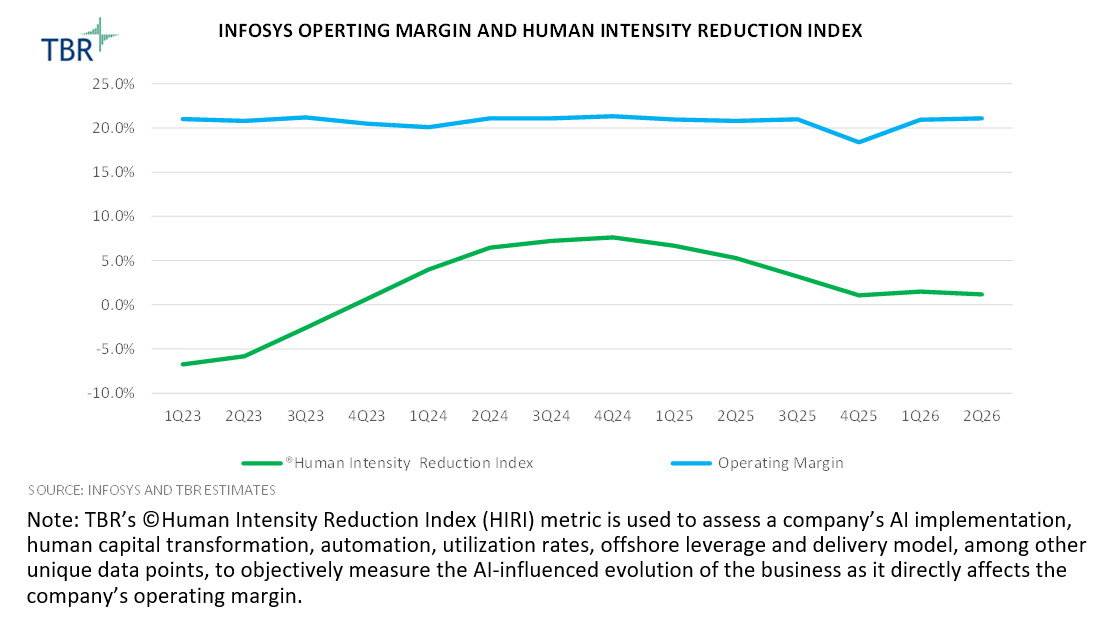
Infosys has maintained an operating margin within its guided range of 20% to 22% for a few years, yet headcount growth began to rebound in 4Q25, at 4.2% year-to-year, following several quarters of decline. Additionally, grouping partners into strategic foundation partners, conventional core partners, and innovation-edge AI partners highlighted Infosys’ recognition of the value of the ecosystem and the importance of where each party plays. Aligning to core strengths from both a capability and a messaging perspective can help Infosys and partners demonstrate depth and strengthen trust with buyers who seek mutual accountability and understanding of go-to-market priorities.

Crystalizing AI talent strategy will provide Infosys with the necessary support to drive business value at scale

Following Adya’s strategy update, Ranjana Joshi, AVP and HR leader, Americas, discussed how Infosys is redesigning its workforce model for an AI-first services business. Although TBR has previously heard some of the details Joshi outlined, it was apparent that Infosys has crystallized what comes next in developing an AI-ready workforce. Infosys is building the talent strategy around three pillars: a new talent operating model, which she described as an “ambidextrous” model; a new career model; and a new talent development model.
 
According to Joshi, these pillars are set to help Infosys do two things at once: “augment the whole organization with AI while also building deeper engineering and domain expertise to deliver AI-first services.” Under its new “ambidextrous” approach, Infosys is changing how it hires. The company is shifting toward recruiting more specialized talent, including specialist programmers from U.S. campuses, alongside continued hiring of full-stack engineers and domain experts.
 
Additionally, Infosys continues to invest in internal bridge programs and hands-on sandbox-based development paths to ensure it develops the right-skilled bench. Meanwhile, career paths are being redesigned away from the traditional linear ladder. Instead of the old one-dimensional path from engineer to executive, Infosys has set up a Y-shaped career structure. One track is for the broad workforce that is AI-augmented, and the other is a specialist stream for people with deep engineering, domain and functional expertise. Further, the company is adding distinguished specialists in roles such as AI strategist and responsible AI engineer. These professionals are meant to act as catalysts who accelerate innovation and create specialist ecosystems around them.
 
Although these are important investments, especially as Infosys looks to build messaging centered on AI-readiness at scale, peers often cite numbers that suggest the majority of their workforce is AI-ready, challenging it to differentiate. Infosys’ opportunity lies in its ability to develop an AI-ready sales bench, especially as the technology forces it to act more like a software company than a traditional services company. We view Infosys’ investments in forward-deployed engineers (FDEs) as a bridge into an AI-ready sales force. Striking the right balance between pushing AI-first sales and managing relationships with ecosystem partners will be key, as going too far into selling tech could sour relationships with partners that try to do the same.

Helping clients scale, orchestrate and operationalize AI for business value will test Infosys’ commercial and operating model readiness

Throughout the rest of the afternoon, Infosys’ executives, clients and partners continued their efforts to separate hype from reality regarding scaling enterprise AI adoption. Compared to previous events, Infosys’ emphasis on domain-specific use cases amplified through panel discussions across financial services, energy, insurance, consumer packaged goods and life sciences strengthened the company’s message and AI strategy.
 
Joydeep Mukherjee, EVP and global head, Data & Analytics, Digital & Creative Services; and Srinivas Gopal, VP and Global Business Head – Data, Analytics & AI, noted that the market has moved beyond AI experimentation and is now demanding measurable enterprise value. Mukherjee’s core point was that most companies still struggle to scale AI because they are held back by weak strategy, fragmented data, governance gaps, integration challenges, and immaturity in their operating models. Scaling AI requires a coordinated blueprint spanning value discovery, operating model design, technology readiness, performance management, responsible AI and talent transformation.
 
Gopal built upon that point by showing what the next stage looks like in practice: agentic AI applied to real business processes, where enterprises use data products, intelligence layers and orchestrated agents to improve decision making, accelerate workflows and create business outcomes faster. Across both sessions, the message was that enterprise value does not come from isolated pilots or stand-alone agents but rather from combining strong data foundations, contextual business knowledge, governance and production-scale execution. This message also highlighted the breadth of Infosys’ capabilities in helping customers make that shift with Infosys Topaz as the orchestration layer.
 
In TBR’s 4Q25 Infosys report, we wrote: “Infosys’ recent cluster of GenAI [generative AI] announcements signals a deliberate pivot from AI-enabled services toward an agent-first delivery platform strategy, with Topaz Fabric positioned as the control plane. By pairing Fabric with hyperscaler-native capabilities like Amazon Q Developer for IT modernization and productivity, while embracing emerging AI software engineer tooling through Cognition’s Devin and scaling vertical agents such as its energy-operations solution on the Microsoft stack, Infosys is effectively building a multipartner operating model that can meet customers where they are without ceding the orchestration layer.
 
For competitors, differentiation is shifting from headcount, pricing and even domain expertise toward agent operational maturity, where productizing services compresses delivery timelines and forces a margin reset. For alliance partners, the upside (and risk) is that fabric-owning SIs become high-leverage distribution for platforms and models, while increasingly establishing the integration patterns, governance standards and customer experience — shifting partnerships from joint marketing to control of the runtime and commercial attach adds value.”
 
According to TBR’s December 2025 Digital Transformation: Voice of the Customer Research report, the market is signaling that vendors are getting better at packaging and surfacing IP, but monetization is still anchored to services constructs, not product economics, especially as automation and AI start to do a greater share of the work.
 
Against that backdrop, Infosys’ recent AI investments look like an attempt to bridge this gap rather than leap over it. The inflection point to watch is whether Infosys can translate its agent-first strategy into commercial pioneers that buyers can procure — clear SKUs, governance guarantees, and outcome and/or consumption mechanisms that do not simply relabel labor. If Infosys can prove repeatable productivity and quality gains and then price around outcomes with credible controls, it can move from AI-enabled services to a platform-led model that aligns with where buyers say they want vendors to go but have not consistently shifted toward yet in terms of their procurement behavior.
 
Alternatively, Infosys’ AI announcements can be interpreted as commercial positioning ahead of change. Topaz Fabric, agents and FDEs absolutely help industrialize delivery, but they also create a convenient story in which Infosys can claim platform-led differentiation while still monetizing primarily through large, multiyear services contracts. The recent launch of AI-enabled global capability center (GCC) framing, in particular, can be read in one of two ways: Either it is a structured route to platformizing captive operations, or it is a mechanism to lock in demand and defend wallet share by embedding Infosys’ tooling, processes and governance so deeply that switching becomes hard without changing the pricing model as much as the marketing implies. The near-term expectation is that Infosys will capture value the way the industry typically does during transitions: sell transformation rhetoric, deliver productivity gains, and then negotiate hard to keep most of the savings — or recycle those savings into scope expansion rather than price reductions.

Domain-aligned services backed by relentless and quality service execution will help Infosys sustain trust with key buyers

Across the panel discussions, speakers noted that most organizations have already experimented with pilots and proofs of concept. The real challenge now is turning those isolated efforts into repeatable, enterprisewide capabilities. Panelists described this as an execution problem as much as a technology challenge, requiring alignment across strategy, operating model, governance, data and talent.
 
Within a financial services discussion, banking was presented as one of the sectors most ready to use AI because it can improve both growth and efficiency while also supporting resilience and compliance. The insurance panel showed how AI is being applied in a regulated industry through underwriting, pricing, unstructured data extraction, faster service and operational efficiency. The insurance leaders repeatedly stressed that in the human-plus-AI equation, especially in specialty insurance, AI can speed intake and improve accuracy, but the knowledge and judgment of experts still matter for decision making and evaluating risk.
 
The energy discussion centered on the growing complexity of energy and commodity markets and the role Infosys wants to play in that transformation. Speakers described energy trading and risk management as a stabilizing force in volatile markets, especially as geopolitical disruption, AI-driven power demand and shifting wholesale-retail dynamics make forecasting and execution more difficult. Infosys’ acquisition of MRE Consulting, which featured prominently during the panel, will play a key role in strengthening trust with existing buyers and expanding the company’s addressable market opportunity across EMEA and APAC. Infosys’ Energy, Utilities, Resources and Services (EURS) vertical share of revenue has hovered around 13% to 14% of Infosys’ total sales. We believe MRE Consulting, along with future similar investments in the vertical, will help boost that share to between 16% and 17%, similar to how manufacturing grew from around 10% of Infosys’ total sales in 2020 when it signed its megadeal with Daimler to now hovering close to 17%.

Balancing steady services-enabled revenue growth with new product sales channels will test Infosys’ otherwise strong culture

Over the next 12 to 18 months, we will keep a close eye on whether Infosys can convert AI breadth into depth, which will be evidenced by higher attach rates of Topaz Fabric in large programs, clearer packaging and commercial models for GCC platformization, and consistent outcome metrics (not just activity metrics) tied to modernization, data readiness and workflow redesign.
 
Infosys has an opportunity to stand out from its peer group if it can make Fabric the default operating layer for agent delivery and use FDEs to accelerate time to value, creating durable differentiation versus peers, as many of them are still largely focused on tooling plus services. Key risks include execution complexity, partner dependence blurring differentiation, and value-capture pressure if Infosys is forced to compete on price, relinquishing the value of the productivity gains it gives clients. Additionally, the use of FDEs, even on a smaller scale than Infosys’ traditional labor arbitrage pyramid, can raise questions about the company’s use of a time-and-materials model versus agent-based wrapped pricing.
 
Further, accelerating revenue from value-based selling would bolster profitability but compel the company to recalibrate its staffing pyramid across legacy and new areas, pressure-testing attrition levels. Lastly, quick-hit wins within the agentic AI space could entice Infosys’ leadership to pursue a more aggressive product sales strategy, disrupting its ongoing success with traditional services deals. In an intense and rapidly changing competitive market for AI-enabled IT services solutions, Infosys has a fighting chance to stand out. And we think the company’s leadership and recent success will help Infosys separate from peers over the next few years
 
TBR will continue to cover Infosys across the IT services, ecosystems, cloud, and digital transformation spaces, including publishing quarterly reports that assess Infosys’ financial model, go-to-market strategy, and alliances and acquisitions strategies. For a comparison with Infosys’ peers and other IT services vendors, TBR includes Infosys in our quarterly IT Services Vendor Benchmark, our semiannual Global Delivery Benchmark and Cloud Ecosystem Report, and our annual Adobe and Salesforce Ecosystem Report, SAP, Oracle and Workday Ecosystem Report, and ServiceNow Ecosystem Report. Click here to learn more about accessing the data and analysis within these reports.

PwC Australia Demonstrates AI Really Does Equal Transparency and Trust

On Feb. 26, PwC Australia hosted more than a dozen analysts for a day of client stories and updates on the firm’s business in Australia and New Zealand. PwC’s leadership team included Rohit Antao, Advisory leader, PwC Australia; Dean Dimkin, Ecosystems & Alliances leader, PwC Australia; Karen Lonergan, chief people officer, PwC Australia; David Callaghan, CFO, PwC Australia; and Reggie Walker, PwC Global Account partner and Global Salesforce Alliance leader. The following reflects the discussions that day and TBR’s ongoing analysis of PwC, other Big Four firms, IT and professional services, and the overall technology ecosystem.
 
Throughout the day, analysts heard, in TBR’s view, a highly effective perspective from newly promoted PwC Australia Manager Saliha Rehanaz. In between sessions in which PwC partners and leaders presented client stories along with PwC clients and discussed the firm’s overall strategy, Rehanaz provided commentary from the perspective of someone doing the day-to-day hands-on work at the client site. She reflected on how she had experienced and worked through client challenges similar to those presented, and she added to the leaders’ strategy discussion, explaining how the high-level goals translated to everyday work at the firm. Rehanaz’s perspective helped TBR better understand how PwC Australia’s culture resonates with PwC professionals and clients. For a well-established firm with a brand rooted in trust and values, hearing a manager-level professional articulate PwC’s culture reflected exceptionally well on the firm as a whole.

“We are super match fit now”

Setting the stage for all the discussions to come, Antao acknowledged PwC Australia had “come through troubles” and undergone its own reinvention over the last few years, positioned now to “repair, rebuild and grow.” Although the firm previously had been spread too thin, by 2026 PwC had begun focusing on what the firm termed the “Right Segments, Right Clients, and Right Offerings,” with an emphasis on growing relationships and capabilities (and letting revenue growth result). Antao and other PwC leaders highlighted the firm’s culture, which enables curiosity, challenge (internally and with clients) and collaboration.
 
All told, PwC Australia heads into 2026, as the subhead notes, “super match fit” and ready for challenges, such as technology disruption and new competitors. Antao said the firm intends to be “Australia’s leading reinvention partner” by 2030 through executing on a strategy that emphasizes making bold choices (by client, by sector, by offerings) and playing to the firm’s strengths. PwC will change the way it delivers, especially with its technology alliances partners, and embed AI into “everything we do,” according to Antao.
 
In TBR’s view, all those strategies, elements and aspirations make sense. Execution comes next. PwC leaders, including Callaghan and Lonergan, raised a few execution and market challenges and provided insights into PwC’s approach. Antao noted that although PwC Australia’s Tax and Deals practices had well-established success with the country’s midmarket clients, Consulting had not traditionally pursued that segment. He intends to change that. Callaghan discussed shifting commercial and pricing models, acknowledging Australian clients are both more interested in and still nervous about engagements rooted in outcomes-based pricing.
 
Callaghan wondered aloud about how to “price in cost savings from AI in a three- or five-year deal” and suggested PwC’s shift to outcomes-based pricing would be with well-established clients and PwC capabilities. Lonergan and Antao both discussed talent challenges and strategies in the context of PwC’s 2030 aspirations, with Antao noting how newly aggressive, private-equity-backed competitors had created fresh challenges for PwC’s talent management. Lonergan said PwC’s brand centers on trust and the quality of PwC people.
 
In Australia, the firm has been adjusting the profiles of new hires, reflecting a dynamic market and changing client expectations. For example, previously most of the new hires in PwC Australia’s Assurance practice had backgrounds and skills in accounting. In the latest round of hiring, half of the recruits had no specific university-trained accounting skills but brought “other human skills.” Although Lonergan is unsure about the future shape of the talent pyramid, she reaffirmed new hires as “the lifeblood of professional services.”
 
Since ChatGPT’s explosion, TBR has asserted that AI equals transparency. PwC’s brand is trust, and clients can be assured that the firm consistently asks, “Is this the right thing to do? Is this the right tech?” PwC Australia unquestionably went through the fire and is now a more careful, thoughtful and purposeful firm at a time when many consultancies, IT services companies and technology vendors use AI to justify moving fast and maybe breaking things, just to keep pace. Trusted, purposeful and playing to strengths should be a more compelling approach. Antao said Australian CEOs’ “trust levels” around AI have grown significantly in the last two to three years. Even if PwC does not want to take any credit for shaping that change, the firm can benefit from being well positioned to take advantage of it.

Honesty, humor and adoption — three words rarely associated with banking

PwC highlighted client stories at the event, perhaps more than any previous event TBR has attended: seven client stories along with three PwC strategies and offerings sessions. Of the clients, four banks presented surprisingly different use cases for engaging with PwC:

    • One bank adopted a U.K.-based bank’s SaaS platform to launch a new, completely digital subsidiary bank and used PwC as the business and systems integration partner. PwC Australia and the client agreed on an “adopt, don’t adapt” mentality, which meant adopting Engine, U.K.-based Starling Bank’s SaaS platform, and not adapting the technology to common Australian practices or approaches, but did so to meet Australian regulations. If some Engine component had to be changed — adapted, rather than adopted — then PwC and the client team escalated that decision to the top level. Notably, PwC leveraged talent from PWC Australia, PwC UK and PwC Poland, but the client said colocating the bank’s people with PwC Australia’s professionals and some PwC UK professionals in the same building and on the same floor was critical to success.
    • A different bank used PwC for a Salesforce implementation, which was essentially a replatforming and simplification program to save the bank time and money. To win the work, PwC identified the specific people from within the bank and within PwC to work on the project — from both technology and business profiles — to align capabilities across all functions. PwC brought a “level of authenticity,” according to the lead PwC partner working with the bank, that others lacked. Further, PwC acknowledged there would be some pain in the project — as is true in every technology project — and addressed that expected pain with “honesty and humor.” So far, these two use cases are nice but maybe not noteworthy. What stood out for TBR was the lead PwC partner’s description of the transformation this engagement brought to the bank. Although it was not an immediate change in the bank’s business model, PwC considered the work “transformative” because success with this engagement led the bank to replicate the approach to technology stack modernization, to using out-of-the-box solutions, and to working with partners across other aspects of the bank. This was, according to the lead PwC partner, truly transformative and a cultural change as much as a technology one. PwC’s global Salesforce alliance leader, Walker, notably attended the analyst event, reinforcing the firm’s commitment to bringing global capabilities to bear in Australia.
    • A third bank client highlighted PwC’s ability to help adopt AI-enabled solutions in a highly regulated environment to scale quality assurance across cross-channel complaints while enhancing quality and compliance metrics. Among the lessons learned was the importance of delivery processes over AI process.
    • For a fourth bank, PwC Australia provided design, implementation, playbooks and the orchestration necessary to design the future operating model for an Agentic Security Operations Center. The bank’s chief information security officer explained his need for consolidation and simplification and said PwC’s help enabled the bank to “iteratively test, learn and build this out” and demonstrate value quarterly. Notably, this engagement included PwC India and PwC US working with PwC Australia.

Two themes from these banking client use cases stand out for TBR. First, at least two examples showcased PwC’s ability to deliver globally to local clients, bringing PwC assets and capabilities from outside the country to complement PwC Australia. More of this will be necessary for PwC to continue competing successfully with Big Four peers and become Australia’s leading reinvention partner. PwC separately briefed the gathered analysts about the evolution of the Concourse platform, which, according to Dimkin, “unlocks our global power.” TBR will provide analysis on that development in a separate report. Second, significant digital transformation has typically entailed business model reinvention, not simply adopting new technologies. PwC’s banking client use cases demonstrate meaningful transformation can be as simple as shifting an enterprise’s culture around how to adopt technology and how to leverage consultancies, if those cultural changes then enable broader business model evolution.

Simplification is all the rage

An additional client story highlighted another common theme through the event: simplification. In an AI era with seemingly relentless complexity dressed up as productivity gains, PwC Australia’s clients echoed each other in calling for, and getting from PwC, more simplification in the technology stack, in AI adoption and in understanding how to evolve their business models. An insurance company’s story began with a history of PwC delivering business-unit-specific platforms, which transformed the client’s technology stack and repeatedly returned value on the investment.
 
Capable delivery and consistent results made PwC the insurance company’s partner of choice, particularly when implementing Salesforce, Guidewire and MuleSoft solutions. Notably, the PwC-enabled tech stack transformation supported the insurance company’s organic growth and strategic acquisition strategy. According to the client’s COO (an uncommon role to be presenting at an analyst event), the IT environment and technology stack were explicitly part of the M&A due diligence and eventual ability to acquire. TBR has only very rarely heard similar case studies of IT environment alignment being a key acquisition factor.

Professional services remains rooted in people

Bringing people together across an enterprise into a successful technology change became a common theme in the client stories and PwC presentation. Although this is hardly unique to consultancies, a few examples showcased how fundamental this approach is to PwC Australia. As mentioned in the second banking client example, PwC proactively matched people from the client and within the firm prior to winning the work, demonstrating PwC’s approach would include both business and technology leads and stay rooted in the people aspects of technology change.
 
In another client example, the PwC team recognized the need to begin the engagement with business process subject matter experts, not AI or technology experts, to successfully bring along the affected business units. And in one final example, PwC helped the client empower internal AI evangelists to build their own agents and accelerate AI adoption throughout the enterprise. Across these examples and the other client stories, PwC clearly understood the firm’s strengths as a technology orchestrator and business model reinvention specialist — strengths made more resonant to clients based on PwC Australia’s own recent experience.