
Who Will Win the AI Services Race in the Next Wave of AI?
TBR FourCast is a quarterly blog series examining and comparing the performance, strategies and industry standing of four IT services companies. The series also highlights standouts and laggards, according to TBR’s quarterly revenue projections and geography estimates. This quarter, we look at Accenture, Capgemini, HCLTech and IBM Consulting and compare how their underlying data strategies, especially related to engineering and integration, prepares them for advanced AI adoption. In these quarterly blog posts, TBR typically analyzes which company has the best revenue growth strategy, often focusing on revenue potential over resilience, the latter of which TBR intends to focus on this quarter.
AI is only as good as your data
The four IT services companies featured in this FourCast were selected because of their strong engineering and industry-specific capabilities, maturity of advanced AI solutions, and exposure to the manufacturing, industrials, automotive and energy sectors. These qualities place these companies in a rather unique position to capture demand for emerging technologies, industry-specific solutions, agentic AI and, eventually, physical AI, which TBR believes will all become defining growth characteristics over the next five years. As clients and vendors have realized, AI is only as good as the data, and vendors have been forced to refine their data capabilities. The four companies have augmented their data capabilities mainly through acquisitions.
Accenture has also worked closely with partners. According to TBR’s 4Q25 Accenture report, “using data-led discussions to drive both transformation and generative AI (GenAI)-specific opportunities will fuel Accenture’s next wave of revenue growth.” Accenture, flexing its strength in alliance structure, launched the Accenture Palantir Business Group, equipped with Accenture’s and Palantir’s forward deployed engineers (FDEs) as well as 2,000 Accenture professionals trained in Palantir’s technology. The collaboration brings data integration and platform engineering deeper into operations.
Additionally, Accenture acquired Faculty, which focuses on applied AI, data science and decision intelligence and could be viewed as the U.K.’s equivalent of Palantir. IBM acquired Confluent, equipping the company with data-streaming and real-time data integration capabilities. IBM’s purchase of Hakkoda enhanced IBM Consulting’s data transformation services. Both of these purchases will help IBM pursue additional consulting work. Capgemini’s acquisition of Syniti improves its enterprise data management software, and the purchase of WNS provides a large base for agentic AI delivery. Integrating agentic AI capabilities into the company’s fabric will help improve Capgemini’s performance and productivity. HCLTech’s recent acquisitions of Wobby, Jaspersoft and Telco Solutions will all bring new data and analytics capabilities.
FDEs, physical AI, and the next industrial revolution
After building out strong data capabilities, the next step is to industrialize solutions by adding engineering skills and establishing greater proximity to manufacturing and heavy industry clients. Capgemini and Accenture have a significant portion of their revenue in industrial solutions, manufacturing, automotive, energy, utilities & chemicals, at 29% and 24% of revenue in 4Q25, respectively. With Capgemini’s most recent announced acquisition of Piterion, the company will integrate AI and analytics capabilities with Piterion’s product lifecycle management and manufacturing operations management.
Capgemini also uses technology partners to innovate. For example, the collaboration with Orano on a humanoid robot for nuclear environments enhances Capgemini’s credibility around critical national infrastructure and sovereign industries, particularly the nuclear energy sector in France and in Europe, where the company has an established position. Accenture has built out its Industry X capabilities with acquisitions like AOX and SYSTEM, which have supported growth within its industrial solutions, manufacturing, automotive, energy, utilities & chemicals segment. Accenture’s investments in engineering and manufacturing reflect an effort to move toward higher-value projects and future demand.
A focus on industry-specific solutions in manufacturing and engineering will manifest in two important ways: FDEs and physical AI. FDEs enable vendors to work more closely with clients and offer a more embedded approach. Palantir was the first to popularize the model. According to a former Palantir software engineer, “At Palantir, they say ‘Do whatever it takes to make the client happy.’ … If it means like short-term losses for Palantir … building out a whole new feature or software product just for that one specific customer … they say, ‘Go for it.’ … [we] work with them side by side and gain a lot of political leverage and capital, which just essentially means trust with these customers to then land these bigger contracts.”
Clients in heavy industry will need support with orchestration across complex ecosystems and with integrating robotics, automation and advanced AI technologies across supply chain, production and management. Vendors need to offer these capabilities to ensure clients can understand the promised productivity boosts of AI and to achieve sufficient cohesion across operations. Although Accenture leads the pack in establishing FDEs, TBR expects the other three featured companies to follow, particularly Capgemini. New alliance and operating models bring new commercial models, such as Accenture’s Palantir Business Group, which highlights its efforts to productize services.
Second, opportunities to deploy physical AI are emerging due to the knowledge gaps created by staffing shortages as well as the rapid demand for new energy resources, particularly nuclear. The need for quick construction and operations will lend itself to using AI decision making and sensors enabled by physical AI. Accenture is perhaps the best positioned to capture demand for physical AI, given the company’s engineering capabilities, exposure to the sector, and most importantly, its traction. The company partnered with the Department of Energy’s Genesis Mission, which focuses on AI and data center technologies. HCLTech is also well positioned to capture physical AI revenue, with its focus on industry-specific solutions and the launch of its Physical AI Innovation Lab with NVIDIA. If Accenture, Capgemini, HCLTech and IBM Consulting can build physical AI capabilities, they will be the first to benefit from the next AI wave and potentially the next industrial revolution.
Navigating go-to-market disruption with productized services
The rise of advanced AI solutions is leading to productized services. In TBR’s view, IBM Consulting and Accenture lead in operation and commercial model disruption, as they are most willing to change their current operations. At first glance this may seem like a bold move, but it is a necessary one. Being at the forefront of advanced AI technologies means being the most vulnerable to pricing disruption. IBM Consulting is becoming focused on repeatable, platform-enabled delivery models, which lowers its dependence on scarce senior talent and supports tighter bench management. IBM Consulting leverages the IBM Consulting Advantage platforms as well as IBM Enterprise Advantage services to standardize delivery, effectively reducing labor intensity. The platform-enabled delivery model is driving IBM Consulting’s growth and improving companywide margins, yet maintaining this type of delivery model long-term requires retaining skilled talent across industries and core technologies.
Similarly, Accenture is experimenting with an IP-enabled commercial model and is also doing something a little bit different: The company launched its Reinvention Services, helping enterprises to reimagine business processes with large-scale transformations. These services integrate advanced technologies such as cloud computing, AI, data analytics and automation with industry expertise to drive measurable business outcomes, marking a shift from the traditional services model to one focused on repeatable IP. Accenture Reinvention Services will help the company take a platform-forward approach, which should improve its operating margin over time.
However, Accenture will need to ensure client satisfaction, particularly around ROI, to maintain its momentum and keep its competitive edge. HCLTech has taken a similar approach as Accenture through its 4R strategy: reinvent organizational design, redefine processes, reshape talent and reimagine core technology. HCLTech is in a particularly vulnerable situation with the increase of productized services. These types of services make competitive pricing more attainable. Leaning on its 4R strategy to deliver new solutions, especially through AI Force, will be important to overcoming competitive pricing and establishing a strong AI delivery strategy.
Capgemini is scaling its RAISE (Reliable AI Solution Engineering) platform, which is fundamentally reshaping the company’s operating model by industrializing how it builds and delivers AI solutions at scale. Instead of relying on labor-intensive, time-and-materials engagements, the firm can package RAISE as a tool kit, platform and “AI agents gallery.” IBM tends to be more risk-averse than many of its peers, including Accenture. IBM Consulting is focusing on platform-enabled delivery, which is driving revenue growth and incremental improvements in operating margin. However, it is notable that IBM is not disrupting its operating model as radically as Accenture. AI creates opportunities for IBM Consulting around delivering complex, multiyear engagements where the business acts as an orchestrator across technology, data and ecosystem partners. Although Capgemini will increase revenue faster than IBM, IBM’s traction in AI-enabled platforms may provide more stability.
Resilience requires discipline beyond AI hype cycles
IBM Consulting’s more modest growth over the next five years reflects its focus on higher-margin contracts such as AI-enabled operations, hybrid cloud migration and application modernization. IBM Consulting will continue to position itself as an AI orchestrator. IBM Consulting has been less visible in large, traditional transformation projects, such as ERP modernization and core system overhauls, compared to peers such as Accenture and Capgemini.
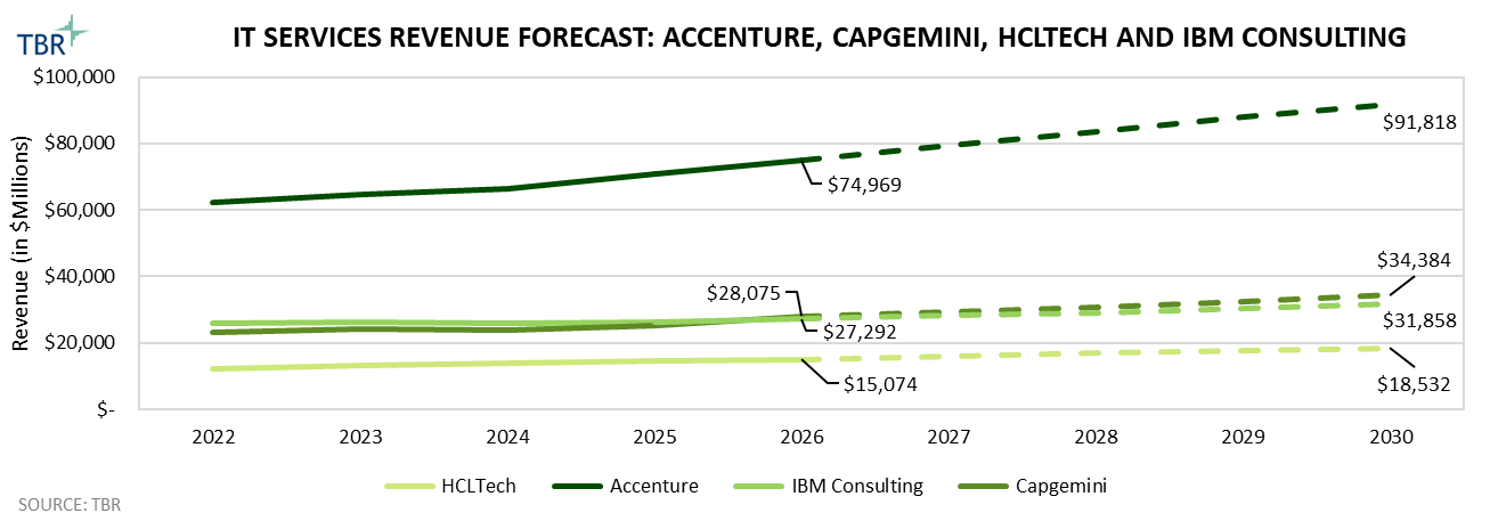
Nevertheless, TBR believes IBM Consulting’s focus on complex orchestration will provide stability long-term. TBR believes Capgemini will grow at a higher CAGR from 2025 to 2030 than IBM Consulting, at 6.3% compared to 4%, owing largely to its exposure to the manufacturing sector and engineering capabilities, AI-enabled intelligent operations, sovereign cloud, industry-specific transformation and inorganic revenue from WNS. Capgemini’s R&D efforts in robotics, advanced AI, and data engineering push the company to capture new revenue, but this leaves the company with more execution risks, such as integration challenges and restructuring costs.
HCLTech’s revenue accelerated in 2025, owing largely to its success in application services, physical AI, AI Factory, and data intelligence portfolio. TBR expects HCLTech’s five-year CAGR to reach 5%, with continued growth in its engineering and R&D services segment from acquisitions and strong demand. TBR expects Accenture to grow at a slightly faster rate over the next five years, with a 5.4% CAGR. Although the company has traction in advanced AI and is at the forefront of innovation, Accenture is far from having the resilience to enable it to reach sustainable nonlinear revenue growth. Until it develops this resilience, Accenture will need to prove its new commercial and operating model.
It is important for companies to keep a long-term view. It is easy to fall into each new AI hype wave: GenAI, agentic AI and now physical AI. Yet vendors must remember their lessons learned from prior industry-transforming waves such as cloud. Vendors promised cheaper run costs with cloud adoption, but many clients actually have higher run costs. With AI, vendors must find a way to deliver meaningful productivity gains.
In addition, vendors must consider how pricing model evolution will affect client relationships downstream. Although it is essential to move quickly to be competitive, change happens gradually and perhaps not as radically as some expect. Positive change will happen for those vendors that take the time necessary for operation transformation, including calibrating investor and client expectations, working closely with clients to build meaningful outcomes. Maintaining client proximity will guide vendors in determining which portfolio offerings are most useful and which contract types clients are willing to accept.

 Technology Business Research, Inc.