KPMG-Salesforce Partnership: Evolving from Implementation to Agentic Outcome

A strategic fit that can test innovation and outcome delivery readiness

KPMG’s alliance with Salesforce has moved from a high-growth implementation practice into a relationship increasingly defined by enterprise trust, measurable outcomes and the ability to operationalize agentic AI. Since entering Salesforce’s ecosystem in late 2019, KPMG has scaled the alliance to over 1,300 practitioners across more than 30 countries and is now repositioning the relationship around Agentforce-led transformation, AI-ready data foundations, and run/optimize operating models that sustain adoption. This shift mirrors a broader ecosystem trend: Leading platforms are prioritizing depth with a smaller set of preferred partners and evaluating alliances on their ability to drive usage, value realization and governance — not simply project throughput.
 
On Jan. 20, TBR spoke with KPMG’s Matthew Fidler, Global Salesforce Platform leader, U.S. Salesforce Platform & Alliance leader; and Andrew Dunn, Global Salesforce Alliance director, about the evolving relationship between KPMG and Salesforce. The following analysis reflects on this discussion and TBR’s ongoing research around KPMG and the Big Four, including our semiannual Management Consulting Benchmark and ecosystem intelligence reports.
 

Prediction: AI Momentum Forces Deeper Alliances in 2026

2026 will be a transitional year defined by technology ecosystem expansions — multiparty alliances spanning IT, OT, devices, edge and silicon; industrial/physical AI acceleration, especially at the edge and in manufacturing; and strategic bottlenecks as skill shortages and infrastructure gaps slow sovereign AI adoption. TBR expects significant changes in how technology vendors collaborate and compete, which lays the groundwork for broader, more integrated AI ecosystems.


Client stickiness will depend on KPMG’s ability to demonstrate depth around Salesforce capabilities

KPMG entered the Salesforce partner ecosystem at the end of 2019 and quickly scaled the relationship through a combination of organic capability build-outs and targeted inorganic investments. The alliance has been characterized by aggressive certification growth, expansion into core CRM clouds and industry clouds, and an increasing focus on AI-related capabilities. KPMG also extended its footprint in EMEA through the acquisition of iCom in France to accelerate regional delivery capacity.
 
From an ecosystem standpoint, KPMG’s positioning emphasizes depth over breadth. Rather than pursuing every Salesforce product adjacency, the firm prioritizes sectors where its brand and domain expertise offer an advantage (as confirmed by Salesforce feedback), especially in financial services, healthcare and life sciences, and the public sector. In addition, KPMG frames Salesforce programs as enterprise transformations, not stand-alone technology implementations, a setup that is not unique to KPMG but gives the firm an opportunity to act as more of a business integrator.
 
According to TBR’s October 2025 Adobe and Salesforce Ecosystem report, partner success is increasingly anchored in trust and clarity as platforms are narrowing their focus on fewer strategic partners while expecting those partners to lead with a unified narrative and deliver measurable outcomes. Two implications of this trend matter most for the KPMG-Salesforce partnership.
 
First, generative AI (GenAI) and agentic delivery are creating a managed services battleground. Buyers are less willing to treat AI as a phase two add-on; they expect continuous optimization, governance and data foundation work to be integrated into the program from day one. This behavior favors partners that can industrialize repeatable assets (agent templates, reference architectures and data-readiness checklists) and run them operationally after the go-live.
 
Second, misalignment between vendor and partner messaging is becoming a risk. Inconsistent positioning across the field confuses clients and erodes confidence in the ecosystem. For KPMG and Salesforce, this elevates the importance of two-way enablement: shared account planning, consistent value narratives, and clear role delineation for strategy, implementation and post-go-live operations.
 
In short, the partnership’s differentiation will be judged less by breadth of services and more by whether KPMG can act as an outcome operator for Salesforce’s Agentforce and data platform agenda — improving adoption, consumption and governance.

Salesforce’s Agentforce provides a new path for KPMG to grow the business but only if commercials are aligned

Salesforce’s Agentforce push is reducing the time between platform adoption and measurable business outcomes, but it is also raising the bar for data readiness, integration and governance. The hard part of CRM transformation is both upstream (data harmonization, integration, identity, policy) and downstream (change management, adoption analytics, continuous optimization). For Salesforce, the upstream challenge is particularly relevant. Years of expansion into adjacent workflows, via both acquisition and internal development, along with less focus on tying the whole portfolio together, have made data harmonization a serious barrier. The acquisition of Informatica was driven in part by the need to offer a native platform that could overcome this hurdle, but Salesforce has not necessarily solved the upstream challenge yet. Given AI’s dependence on quality data and cross-workflow capability, this will be a critical obstacle Salesforce must overcome as it works to scale Agentforce adoption. In this environment, partners must treat AI as an operating model program, not a feature deployment.
 
In parallel, Salesforce’s partner model is shifting toward consumption-led measurements and AI-era enterprise license constructs, increasing the importance of adoption and sustained usage. This will create a commercial and governance inflection point. GenAI improves transparency around productivity and cycle-time benefits. At the same time, customers are increasingly questioning traditional time-and-materials billing models for agent-led work. For KPMG, alliance success will increasingly depend on pairing implementation excellence with credible activation motions (value instrumentation, managed services and consumption-aligned commercial models) and tight joint enablement so the field sellers tell one consistent story.

Partner-told use cases pave the way for future right-to-win areas

To build stakeholder trust, KPMG has begun translating Agentforce into client stories and Salesforce use cases as the firm looks to win new buyer personas. For example, a joint Agentforce-driven onboarding approach for a healthcare client compressed a process from 17 days to under five minutes on average, with the majority of cases requiring zero human touch. The use case is notable because it couples orchestration with risk and decision logic and demonstrates rapid time to value. Additionally, KPMG’s work with a global consumer brand illustrates how Agentforce can augment contact center operations, including scoring 100% of interactions against quality rubrics, automating returns workflows and reducing seasonal labor needs during peak periods. KPMG is also acting as an SI to Salesforce as the latter applies agents to its security review and controls workflows, reducing review cycle time from hours to minutes. This reinforces KPMG’s credibility in regulated workflows and creates reusable assets for clients. Last, following Salesforce’s acquisition of Informatica, KPMG reorganized internally to align Salesforce, MuleSoft and Informatica under one practice and is seeing increased field attention for master data management and data foundation projects — conditions that are increasingly prerequisites for reliable agent deployments.
 
Two of the aforementioned use cases stand out: KPMG acting as an SI for Salesforce; and KPMG’s internal reorganization to align its Salesforce, MuleSoft and Informatica capabilities. The first example reflects a customer-zero approach, which is among the most widely used approaches for consultancies to demonstrate value and trust and scale through the 360-degree relationship. Although this method is not unique to KPMG, it resonates with clients seeking reassurance that third-party providers trust each other.
 
The second example extends beyond operational efficiencies as realignment allows for a better multiparty alliance construct, which can lead to higher win rates. In our special report Informatica’s Alliance Strategy: Powering GSIs, Scaling AI and Strengthening the Data Ecosystem TBR analysts spoke with Richard Ganley, senior vice president, Global Partners, who shared the following: “We looked at basically all the opportunities that we’d had in our system, which we’d either won or we’d lost over the past two years. And we found if we didn’t work with a partner, our win rate was around 17%. If we worked with one partner, it went up to 47%, which kind of makes sense because we’ve got somebody in there speaking up for us, recommending us. But if we worked with two partners, and by two we mean one from the GSI and one from the ecosystem … the win rate goes up to 83%.” With Informatica among KPMG’s top partners, KPMG has an opportunity to build a deeper moat within the data management space, which we believe will remain the battleground for client share in the short to midterm.
 
As enterprise AI projects grow more complex and interdependent, multiparty alliances are becoming a preferred delivery mode. Salesforce is responding by forming deeper relationships with hyperscalers and global systems integrators, and by shifting from referral-based partnerships toward integrated frameworks that combine infrastructure, data and services into unified operating motions. This creates an opportunity for KPMG to build reusable components and industry-specific agent templates while also taking responsibility for trust, risk management and compliance to align its data and AI strategy with Salesforce’s and to make  multiparty alliances more natively integrated and programmatic.

Doubling down on agentic AI will test KPMG’s culture and readiness to transform its operating and commercial model

As the firm looks to secure its long-term play given the rapidly evolving nature of agentic AI, in the past year KPMG has accelerated its portfolio and go-to-market transformation by embedding AI across internal operations and client services, fueled by a large amount of capex investment from within KPMG’s partner ecosystem. We believe deepening its relationship with Salesforce and integrating Agentforce into the firm’s daily operations will enable consultants to accelerate speed to value. The use of Agentforce in an era led by Microsoft Copilot and OpenAI hints at the rise of hybrid AI and how vendors are preparing for buyers to use several AI platforms rather than settling for just one.
 
We believe KPMG’s trust, risk, compliance and industry operating-model capabilities map well to these requirements, particularly in regulated environments. The firm’s cocreation mechanisms (incubator-style engagements and Ignition Center experiences) can shorten the time from pilot to production, but differentiation will depend on repeatability and operationalization: packaged agent patterns, reference architectures and managed services that demonstrate sustained KPI movement. Equally important, the partnership should treat messaging alignment as an operational discipline — shared plays, account governance and value narratives that are consistent across Salesforce sellers, KPMG teams and client stakeholders. Last, using new commercial models where KPMG can leverage Salesforce-ready solutions as a loss leader to get paid on a per-usage basis can help the firm demonstrate pricing agility and expand its addressable opportunities with more price-sensitive midsize clients.
 
According to TBR’s October 2025 Adobe and Salesforce Ecosystem report: “As both tech and services partners look to diversify sales channels, the opportunity SMB clients present will lead to new alliance partner relationships, especially with startups and/or specialized vendors, thus challenging the status quo. Services vendors have an opportunity to maintain trust by using tech vendors’ marketplaces to drive portfolio awareness. Tech vendors need to maintain commercial agility as SIs are getting smarter about building their own off-the-shelf solutions and focusing on contextualization.”
 
KPMG’s ambition to establish a stronger foothold in the GenAI space — and to use the technology to deepen client relationships — could, in time, place an additional strain on the firm’s operating model. Building, selling and managing software-like solutions introduces new requirements around talent, product management and pricing that differ from traditional consulting motions. That said, KPMG appears to be taking steps to address some of these potential challenges, which may help reduce internal friction as the shift takes hold. In parallel, the growing appeal of managed services may continue to offer a relatively straightforward path to near-term revenue, but it does not necessarily have to come at the expense of GenAI momentum. If KPMG can align incentives and capacity planning with its GenAI priorities, partners may be less likely to default to “quicker win” engagements — and the firm may be better positioned to reinforce, rather than dilute, its consulting value proposition.

Accelerating stakeholder trust remains KPMG’s top priority as the firm leans on Salesforce amid ongoing market challenges

Deepening relationships with strategic alliance partners such as Salesforce will bolster KPMG’s trust within the ecosystem, helping it increase client stickiness as clients more often look for depth than scale in the AI era. Although KPMG has a tall order in business model transformation, the firm is not alone. In the next two years, AI-ready platforms such as KPMG Velocity and KPMG Workbench, backed by common governance and an ongoing commitment to funding and positioning with clients, will accelerate KPMG’s efforts to move beyond the traditional time-and-materials operating model. Although it can be challenging to address change at scale, getting the right framework in place, including establishing common KPIs and deeper collaboration with Salesforce, will give KPMG the necessary building blocks to move away from its historically risk-averse culture rooted in audit and assurance.
 
The best way for KPMG to differentiate will be to package reusable assets, generate outcomes (adoption and consumption) and establish joint field enablement so the KPMG-Salesforce story is consistent from boardroom strategy through post-go-live operations. If KPMG executes on all of these efforts, the firm can become one of Salesforce’s most strategic partners in AI- and data-intensive sectors, helping move deals from “CRM projects” to enterprise transformations measured in data leverage, AI impact, and realized business outcomes and, in turn, driving durable platform consumption.


Consulting Will Rebound in 2026

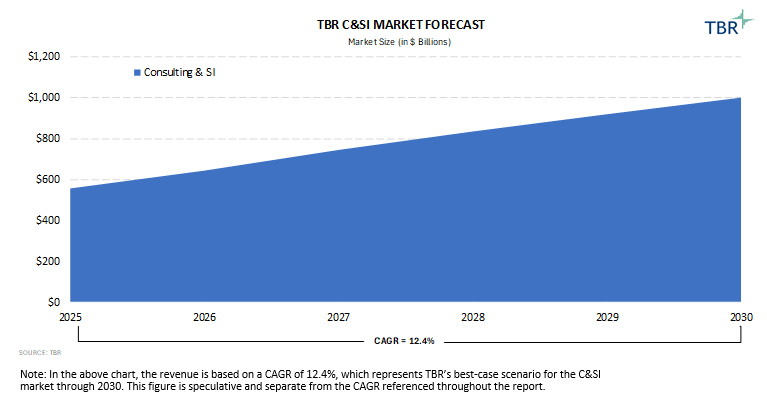
After a period of relative softness, consulting revenues are expected to rebound to high-single- or low-double-digit growth as pervasive uncertainty pushes enterprises to seek external guidance. Demand will be particularly strong around risk mitigation, strategic planning and AI adoption, positioning forward-deployed engineers (FDEs), supply chain management (SCM) and people advisory services as leading revenue drivers in 2026.

Managed services shifts from delivery model to growth engine

AI-driven complexity will accelerate demand for consulting, particularly around data modernization, transparency, and helping enterprises understand the organizational impact of new software and AI capabilities. Popularized by Palantir, the FDE model will continue to permeate across IT services companies and consultancies in 2026, primarily as a marketing term but also backed by actual organizational changes, new hires, and adjusted ways of delivering value to clients.
 

AI integration work is increasingly performed by FDEs — engineers positioned close to clients who translate AI systems into business outcomes. Demand for FDEs is exploding, and hyperscalers and GSIs are building these roles, with Infosys viewed as an early leader and McKinsey & Co., Boston Consulting Group (BCG) and KPMG expected to position FDEs as premium integration talent. FDEs will likely follow the pattern of data scientists and other specialized roles within IT services companies and consultancies, responding to market demand and providing companies and firms with a new way to describe their AI-enabled offerings and solutions.
 

Listen now: 2026 Predictions for Managed Services, featuring Principal Analyst Bozhidar Hristov


Higher consulting demand will also come in an increasingly unstable geopolitical and economic world. Although uncertainty fueled by immigration issues, tariffs, fluctuating interest rates, and political instability dampened IT services and consulting growth in 2025, TBR expects an upturn in consulting revenues in 2026 even as those underlying conditions worsen. Navigating stormy seas demands a proven crew and trusted advisers; anyone can sail a ship in calm waters. TBR has seen a steady rise in investments into supply chain consulting, including increasing capabilities around the underlying technologies, such as blockchain and analytics. Combined with increasing investments in cybersecurity, TBR anticipates the three fastest-growing areas in consulting in 2026 will be risk mitigation (SCM and cyber, especially), strategy, and AI adoption.
 

But keep an eye on human capital management consulting. The IT services companies and consultancies will spend the next few years sorting out their own staffing models, adjusting the traditional apprentice-model pyramids to reflect AI-enabled roles and responsibilities changes (here come the obelisks). And these companies and firms will bring their lessons learned to enterprise clients, particularly around building highly functioning human-plus-robot teams, adjusting promotion and compensation packages, and budgeting for the expected higher costs of adopting AI at scale.
 

In all this consulting growth, TBR expects the leaders will be those IT services companies and consultancies that have refined and scaled their managed services offerings. This may come as a surprise to the longtime strategy consultants in leadership positions at many of these firms, but TBR’s research indicates revenue and growth at leading IT services companies and consultancies have been increasingly tapping into consulting opportunities identified through ongoing managed services engagements. Who knows more about underlying problems than the people working day-to-day with the client in their environment? TBR anticipates greater investment in managed services offerings and increased leadership attention paid to how those engagements underpin sustained consulting revenue growth. Managed services is no longer your mess for less but a Trojan horse for higher-margin consulting.
 

Explore more 2026 predictions for managed services in our special report In 2026, Managed Services Shifts from Delivery Model to Growth Engine.

The AI Alliance Shift: How 2026 Will Reshape Partner Ecosystems

TBR Insights Live session: TBR’s ecosystem intelligence experts discuss how AI-driven sales and marketing will reshape ecosystems, how AI alliances will impact operational technology and what will challenge the scaling of sovereign AI.

Bad Debt Expenses Will Rise for CSPs in 2026

The telecom industry will adapt to a K-shaped economy in 2026

In a K-shaped economy that increasingly separates financial winners from losers, the majority of households and businesses on the lower arm of the “K” are under mounting financial strain and are finding it more difficult to pay their bills. As these economic pressures persist, communications service providers (CSPs) should expect bad debt expenses to continue rising, with the potential to meet, or even exceed, levels experienced during the Great Recession.
 

CSPs’ expenses related to bad debt have been steadily increasing since plunging to record lows during the height of the COVID-19 pandemic in 2021, when an unprecedented amount of government stimulus provided a financial windfall to households and businesses across the U.S. (and in many other countries through their respective stimulus programs), enabling many to improve their debt situations.
CSPs’ bad debts have now exceeded the mean of pre-pandemic, normal levels and are likely to reach levels unseen since the Great Recession. A key leading indicator of bad debt expense is what some operators report and refer to as “provision for credit losses,” which is the amount of money owed to CSPs that they expect to write off.
 

Provision for Credit Losses as a Percentage of Total Revenue_TBR

Several headwinds are occurring concurrently, which will push bad debt expenses higher for CSPs

  • The resumption of student loan payments as of June 2025, which has made it more difficult for households to manage their finances, evident in the stark increase in subprime car loan delinquencies and a spike in home foreclosures
  • Inflation increasing costs of basic life necessities and business needs
  • Tariffs impacting consumers and businesses, feeding inflation and forcing tough financial decisions
  • Job losses and a generally anemic job market (directly and indirectly, due to AI and general business restructurings and bankruptcies)
  • Immigration policy changes — deportations and voluntary emigrations lead to unpaid bills, including phone and internet bills
  • Interest rates remain high relative to the post-Great Recession new-normal level, making it more challenging to pay back interest-bearing loans
  • Paring back of social safety nets — SNAP, WIC and other food security benefits, and government-provided or subsidized healthcare programs
  • Bankruptcies surging across the business spectrum; bankruptcies can lead to restructured debt loads or partial or full nonpayment if the entity liquidates

Overall, most households and SMBs are increasingly struggling to pay their bills, as evidenced by essential expenses like car and mortgage payments becoming harder to manage. Because cars, homes, phones and internet service are essentials, bad debt expense is likely to continue rising through 2026, and telecom providers will feel the impact.
 

Explore additional predictions for the telecom industry in 2026 in our special report The Telecom Industry Will Aapt to a K-shaped Economy in 2026.

How Will Advanced AI Impact Pricing, Labor Practices and Client Expectations?

TBR FourCast is a quarterly blog series examining and comparing the performance, strategies and industry standing of four IT services companies. The series also highlights standouts and laggards, according to TBR’s quarterly revenue projections and geography estimates. This quarter, we look at Infosys, Tata Consultancy Services, HCLTech and Accenture and compare how their advanced AI and labor strategies position them for revenue growth.

 
Advanced AI may be front and center in IT services strategy, but execution challenges remain a familiar story. Despite ongoing hype around unlocking new efficiencies and nonlinear growth, IT services firms continue to grapple with the reality of needing labor arbitrage in the short term and meeting client expectations. The distance between strategic intent and operational reality is less about reluctance to adopt AI and more about IT services companies’ timing, risk management, and the need to protect revenue streams today while betting on the future potential of advanced AI.

AI-first in strategy, labor-arbitrage in practice

Although all IT services companies aim to leverage advanced AI to improve margins and propel revenue growth, in the short term some are still relying on headcount growth to execute on deals. For example, even though advanced AI remains core to HCLTech’s delivery strategy and in February the company announced a goal to double revenue with half the number of employees, HCLTech has added a total of 10,032 freshers over the past three quarters.
 
Similarly, Infosys has increased headcount in preparation for executing on large deals, as evidenced by its announcement of hiring a total of 12,000 freshers over 2Q25 and 3Q25. In contrast, Tata Consultancy Services (TCS) and Accenture experienced headcount declines in 4Q25, marking the first drop for Accenture since 2010. Yet the quarterly decrease for both companies may reflect the worsening macroeconomic conditions rather than decisions to downsize headcount. If anything, companies are preparing for ongoing demand fluctuations as clients remain cost-conscious.
 
According to TBR’s 3Q25 IT Services Vendor Benchmark, offshore and nearshore headcount continues to grow among the 30 covered vendors, increasing 1.2% in 3Q25 as opposed to a 1% decline in onshore headcount in the same period, indicating the labor arbitrage model is alive and well, at least for now. Accenture, HCLTech, Infosys and TCS are all expanding their reliance on global delivery centers, including for in-demand skills such as AI, causing increased demand for highly skilled workers. Most companies have reported some AI training numbers, such as TCS stating that 159,000 of its more than 580,000 employees have been trained on AI. However, the reported numbers reflect a significant portion of companies’ employee base, raising questions about the depth of knowledge. TBR believes the training is just deep enough to lend credibility to the marketing.

BPO companies are the first to face a transformative wave of AI delivery implications: Can they impress clients while keeping them happy?

The four covered IT services companies are all top contenders in the business process outsourcing (BPO) space, making advanced AI essential for these companies right now. CEO of HCLTech C Vijaykumar stated on the company’s CY3Q25 earnings call, “As mentioned on Investor Day, the biggest impact will be in the BPO business, where productivity gains could reach 40 to 50%.” According to TBR’s estimates (see Figure 1), Accenture has the largest BPO segment, followed by TCS, HCLTech, and Infosys. With BPO having the most initial risk of cannibalization to traditional revenue, these companies will be the first to test how to adapt their commercial models. Although delivery remains largely time-and-materials-based, IT services companies such as Accenture are moving to a fixed-price model, a potential bridge to outcome-based pricing.
 
Yet cost-conscious clients are beginning to demand lower pricing due to the use of AI and automation, forcing IT services companies to compete on price even as they look to improve margins. This is creating pressure to realize ROI internally while appeasing clients on price and service quality. According to TBR’s 4Q25 Infosys Earnings Response, Infosys views its agentic AI “as a productivity and monetization lever rather than a growth engine that fundamentally reshapes the revenue mix.” Persistent macroeconomic uncertainties remain both a blessing and a curse for vendors. On the one hand, clients are becoming more curious about the benefits of advanced AI adoption, particularly agentic AI, providing more sales for IT services companies. On the other hand, clients are demanding a growing share of the resulting cost savings as price discounts, negatively impacting vendors’ margins.
 

2025 BPO Revenue Graph

Figure 1: 2025 BPO Revenue for Accenture, HCLTech, Infosys and TCS (Source: Company Data and TBR Estimates)


So, what approach should companies take to maximize potential growth, protect margins and ROI, and manage client expectations? Although companies are racing to keep pace with the competition in offering hyperscaler-enabled agentic capabilities as well as large language model-enabled solutions with companies such as Anthropic and OpenAI, establishing proprietary solutions will be important to differentiate and demonstrate advanced AI proficiency. Companies may have difficulty finding a healthy balance between focusing on proprietary solutions that set themselves apart and delivering key partner-enabled solutions that clients have come to expect and trust.
 
Perhaps more importantly, IT services companies will need a well-thought-out strategy to deepen client relationships while keeping AI top of mind as a value-add rather than a purely cost-conscious tool. Slimming headcount, for example, is undoubtedly an end goal for Accenture, HCLTech, Infosys and TCS, but maintaining the right strategic onshore locations to keep a human touch and not cutting headcount too quickly will be essential to retain employees and institutional knowledge. This will help uphold the company’s service quality, but if IT services companies can leverage AI to augment service delivery rather than market solely as one-size-fits-all stand-alone solutions, this could generate more demand. Further, protecting the value of services will strengthen companies’ contract negotiating power.

Conclusion

HCLTech is among the few IT services companies that have reported advanced AI revenue. In 3Q25 HCLTech announced it received $100 million in advanced AI revenue. On Accenture’s 4Q25 earnings call, the company reported advanced AI revenue of $1.1 billion, but leadership later noted that this metric will no longer be reported because advanced AI has become integrated across much of the company’s operations. This also implies concerns of revenue cannibalization — especially if Accenture cannot introduce fixed pricing fast enough. TBR believes companies need to have a well-planned pricing strategy in addition to a holistic approach to ensure a healthy long-term trajectory.
 
HCLTech follows this approach in part through its industry- or task-specific solutions that focus on solving a problem. Product launches throughout 2025 reflected this point, including HCLTech Insight, an agentic AI solution built with Google Cloud to support manufacturers with data analytics, and Physical AI with SAP, which enables optimization across warehouse operations, fleet management and 3D reality capture. TBR believes this strategy, although not entirely unique, has contributed to HCLTech’s consistent financial performance and strong bookings.
 
TCS takes the opposite approach in some ways, using AI to augment existing platforms rather than releasing stand-alone AI solutions. Although this may help TCS navigate revenue disruption in the short term as its client-facing solutions retain their names and functions, over time TCS may need to define its AI strategy better and market a more compelling story about how it can help clients solve problems with innovative solutions. Nevertheless, TCS’ IP-driven AI strategy will undoubtedly be a strength. Infosys may have a better narrative around AI aligning as it shifts its strategy to focus on outcomes.
 
Additionally, similarly to TCS, according to TBR’s 3Q25 Infosys report, “Successful positioning and usage of industry- and function-aligned proprietary and partner-enabled agents could help Infosys stay grounded, which could strengthen trust with clients and partners and help drive sales rather than entering uncharted territory in a GenAI [generative AI] market that is in a hypergrowth phase.” Importantly, TCS and Infosys have not reported AI revenue numbers. TBR believes the two companies may be withholding this data because it may be less than HCLTech’s and Accenture’s figures. With Accenture no longer reporting the metric, TCS and Infosys may be less likely to provide the information.
 

IT Services Revenue Forecast for Accenture, HCLTech, Infosys and TCS Graph

Figure 2: IT Services Revenue Forecast: Accenture, HCLTech, Infosys and TCS (Source: TBR)


How will the three India-centric vendors fare against Accenture, which has vigorously invested in AI IP, particularly in industry-specific solutions such as the AI agents in AI Refinery? Although India-centrics’ clients may not have the same expectation as Accenture’s clients, the vendors will need to make sure they are prioritizing client outcomes and creating a meaningful narrative. Leaning into this approach will be particularly important as Accenture’s undeniable size in BPO provides it with an ideal testing ground for agentic AI. TBR could see Accenture making a similar acquisition as Capgemini did with WNS, such as by acquiring Genpact or EXL, which would sharpen its competitive edge. Ultimately, future success will depend on how effectively IT services companies translate AI adoption into differentiated, outcome-driven offerings without eroding client trust or margins. Those that balance proprietary innovation with partner ecosystems while resetting commercial expectations will be best positioned as AI reshapes cost structures and value creation.

AI Alliances Will Increasingly Target OT

New and expanding partnerships are increasingly targeting the convergence of IT and OT, as system integrators (SIs) align with OEMs, manufacturing ISVs and silicon providers. This momentum is driven by the strong growth potential in high-tech manufacturing, where solutions that improve accuracy, efficiency and safety can be deployed on-site without reliance on rack-scale compute systems in neoclouds or Tier 1 clouds. As a result, while AI has long operated at the edge, these partnerships will accelerate both the sophistication of AI-driven use cases and the pace of solution framework development.

A host of use cases are ripe for disruption in OT

NVIDIA AI platforms, including NIM Agent Blueprints and NVIDIA Omniverse, lay a foundation on which partners can build. Partnerships representing a blend of IT and OT capabilities — including NVIDIA, SIs, manufacturing-centric ISVs and OEMs — will bring together new capabilities.
 

SIs are a key piece of the puzzle to bridge IT and OT. Although NVIDIA provides a platform, the complexity exceeds what most IT teams can manage. The SI also must act as a bridge between IT and OT technologies, skill sets and cultures. Expanding partnerships with industrial automation leaders such as Siemens is central to this.
 

As constraints around the ability to quickly build out AI factories become clearer, edge workloads will be an AI opportunity relatively unencumbered by these restrictions.
 

High-tech manufacturing represents a strong opportunity for AI adoption globally. Within the U.S., edge AI will be positioned as a focal point for the era of modern manufacturing.
 

In addition to the GPU-enabled edge servers available in the market, NVIDIA’s upcoming launches of RTX AI server and IGX Thor edge computer, which do not require liquid cooling, will accelerate interest in AI use cases on premises and at the edge.
 

Other silicon providers, namely Qualcomm, will launch products designed for manufacturing and robotics in 2026. However, a strong software platform from which SI partners can build on is a necessity for success.
 

TBR expects other industry verticals, including pharma and biotech, will replicate these partnership approaches.
 

Enterprise Edge Spending Forecast by Segment (Source: TBR)


Explore more 2026 predictions for alliances and partnerships by downloading our special report 2026 Will be a Pivotal Year as AI Momentum Drives Deeper Ecosystem Alliances.

Agentic AI Adoption Is Pressuring Security Architectures to Converge

Microsoft distribution edge and AWS and Google integration moves are reshaping competitive dynamics

The emerging pattern of multicloud security consolidation has direct implications for both Amazon Web Services (AWS) and Microsoft, as enterprises reassess detection pipelines, governance models and operating frameworks heading into 2026. Although AWS remains well positioned in analytics-heavy workloads, the company needs to reevaluate its long-established “building block” approach, especially as peers deliver more integrated platforms. For Microsoft, its strengths will continue to be with organizations where Microsoft 365 already anchors their identity and collaboration strategies.

Interoperability in agentic systems calls for greater interoperability in security

Security has been a top concern among enterprises for years, and that history of investment has often translated into sprawling security estates, posing a challenge for AI adoption. If agentic AI systems are going to work across platforms, security needs to work across platforms as well.
 
At Ignite 2025, Microsoft outlined a path intended to pull customers toward a more unified operating model. Tighter integrations across the company’s Defender, Sentinel and Purview offerings as well as the new Agent 365 control plane were a major development. However, announcements stating Security Copilot capacity will be bundled with both Microsoft 365 E5 and expanded Sentinel connectors for AWS really caught TBR’s attention. Sentinel’s updated AWS integration now uses an S3- and SQS-based model that ingests CloudTrail, GuardDuty, VPC Flow Logs and selected CloudWatch exports through an AWS Identity and Access Management role, allowing those signals to be correlated with Microsoft-native alerts in a unified analytics and response workflow. Creating more streamlined cross-cloud security signals Microsoft’s clear expectation that customers centralize analytics, automate more of the SOC and apply enterprise-level governance to AI agents rather than allow fragmented, team-level management.
 
AWS and Google are also responding to cross-cloud telemetry challenges. AWS has broadened Security Lake into a hub that can ingest and normalize signals from a wide ecosystem, including tools such as CrowdStrike, Palo Alto Networks Prisma Cloud, Wiz, Lacework, SentinelOne, Zscaler, Okta, Cisco Secure Firewall, ExtraHop, Vectra AI, Splunk, IBM QRadar, Datadog and Sumo Logic. Security Lake standardizes these feeds via OCSF (open cybersecurity scheme framework) and allows downstream analytics through OpenSearch Service or partner SIEMs (security information and event management).
 
Google Security Operations has taken a different path, building a SIEM and SOAR (security orchestration, automation and response) platform with a large connector catalog spanning GuardDuty, Security Hub, CloudTrail, Azure Active Directory, Carbon Black, network-security vendors, CSPM (cloud security posture management) tools and a wide set of SaaS and identity integrations. These connectors feed normalized telemetry directly into SecOps’ analytics and playbook engine, enabling orchestration and automated response across heterogeneous environments. The strength of Google’s approach lies in its broad ingestion and automation capabilities, though its native alignment remains strongest where organizations standardize on Google Workspace and Cloud Identity.
 
With each vendor pursuing new security integrations, Microsoft’s greatest point of differentiation is its distribution advantage. The company’s security capabilities sit on top of the widespread Microsoft 365 and Entra ID install base, giving Microsoft direct access to identity, endpoint and collaboration signals without requiring separate platform deployment. Moreover, partners can attach services to an installed base rather than drive net-new platform adoption, enabling faster scale and lower friction. AWS and Google can compete on analytics, automation or integration, though arguably both lack the access to enterprise control points that Microsoft derives from its productivity stack.

Explore deeper data and analysis

Although the cloud ecosystems market is complex, it is the backbone of the broader digital transformation (DT) opportunity. As a result, studying the relationship between services vendors and technology vendors provides a glimpse into some of the key issues many participants face as they work toward the same outcome: winning both market share and mindshare. As it leverages insights across all of TBR’s practices, the Cloud Ecosystem Report can help you better understand the nuanced trends and forces at play within cloud, professional services and other IT markets.
 
With TBR Insight Center’s interactive data visualization feature, your team can quickly adapt thousands of data points for their competitive analysis, go-to-market strategy, and executive briefings. The tool enables users to curate relevant quantitative insights by company, business unit and/or market segment, creating a report specific to your needs and ensuring consistent frameworks across projects.
 
Explore Insight Center’s data visualization tool with the video below, and start your free trial today to access this one-of-a-kind tool.
 

TBR Insight Center™ Data Visualization Tool


Telecom Industry Will Adapt to K-shaped Economy in 2026

TBR Insights Live session, TBR Telecom Principal Analyst Chris Antlitz shares an in-depth review of our 2026 Telecom Predictions special report, Telecom Industry Will Adapt to K-shaped Economy in 2026. This session examines what the K-shaped economy means for communication service provider (CSP) balance sheets, customer behavior and competitive strategy, and how scaled providers can adjust to protect growth and margins.

The U.S. doesn’t have a Spectrum Shortage — It has a Utilization Problem

The mobile industry continues to beat the drum for more spectrum, but it should instead focus on fully utilizing the spectrum already allocated. TBR notes there are vast tranches of spectrum in the U.S. market that are broadly underutilized, either for technical or economic reasons. And challenges will only worsen as the industry aims to bring upper midband frequencies into the fray, which have greater propagation challenges and are less suited for macro coverage.
 

The U.S. needs to do a better job, guided by government institutions like the Federal Communications Commission, of utilizing Citizens Broadband Radio Service (CBRS), C-Band, 6GHz and mmWave bands, which are woefully underutilized today. For example, only a relatively small portion of midband spectrum has been deployed in the U.S. market to date, implying that well over half of it has not yet been put to use. (CSPs are either sitting on it or hoarding it.)
 

Most 4G and 5G network traffic in the U.S. today runs over low bands, such as 600MHz to 800MHz, and the lower midband (1GHz to 2.6GHz, especially 2.5GHz), with C-Band increasing but still far from its full utilization potential. MmWave bands hold promise, but for economic and technical reasons, they were used only in very specific situations, mostly for LAN capacity.
 

Additionally, spectrum warehousing entities like EchoStar (which recently reluctantly agreed to sell a portion of its vast spectrum holdings to Starlink and AT&T) and private equities are still sitting on large tranches of unused spectrum. The government should redirect its efforts toward addressing these market dislocations rather than straining to bring new spectrum to a market that might not even be used (case in point, CBRS). This should be a mandatory government push because dislocations created by negative externalities of capitalism threaten to keep the U.S. behind China in key technological domains; specifically, corporations with a scarcity mindset are hoarding, but not necessarily using, the spectrum resources they have. The U.S. is already behind China across several key technologies (e.g., 5G, hypersonic missiles, electric batteries and vehicles, rare earth element processing). It is unacceptable for the U.S. to fall behind on 6G as well.
 

Explore TBR’s 2026 predictions for the telecom industry in our latest special report, Telecom Industry Will Adapt to K-shaped Economy in 2026.


2026 Predictions: AI Momentum Drives Deeper Ecosystem Alliances

2026 will be a transitional year defined by technology ecosystem expansions — multiparty alliances spanning IT, OT, devices, edge and silicon; industrial/physical AI acceleration, especially at the edge and in manufacturing; and strategic bottlenecks as skill shortages and infrastructure gaps slow sovereign AI adoption. TBR expects significant changes in how technology vendors collaborate and compete, which lays the groundwork for broader, more integrated AI ecosystems. This is an optimistic prediction. Multiparty alliances require exceptional leadership, shared understanding of commercial models and transparency among partners, and AI aids only the last of these. The human component remains the most significant roadblock. IT-OT convergence and a surge in connected everything have been a TBR (and broader market) prediction for years, and while “signs point to yes,” as the Magic 8 Ball says, 2026 could be another year of disappointing progress, as hype around physical AI could far outpace reality.