
 Technology Business Research, Inc.
Trust at Speed: EY’s Mobility Practice Is a Catalyst for AI-era Workforce Transformation
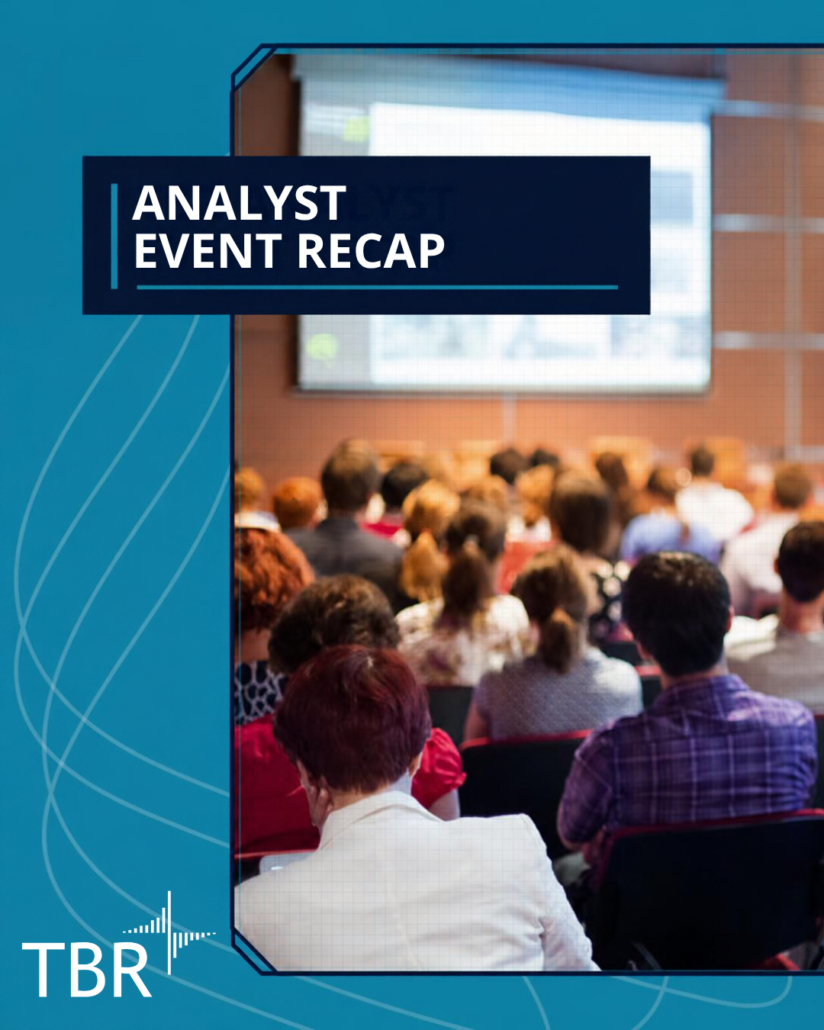
Earlier this year EY hosted more than 250 people from over 115 companies and 20 countries at the EY Global Workforce Conference in Rome. Over three days, TBR spoke with EY leaders such as Gerard Osei-Bonsu, Global People Advisory Services Tax leader; Maureen Flood, Global People Advisory Services Tax partner; and David Rooney, EY Germany partner, as well as human resources leaders from large and small companies and representatives from EY’s technology partners. The following includes details from the event as well as TBR’s ongoing analysis of EY, people advisory services, and consultancies.
Speed and trust anchor EY’s Mobility growth opportunity
Speed and trust equal momentum. From the opening presentation through every main-stage speech, panel discussion and breakout, EY leaders repeatedly came back to this formulation to reinforce the event’s core message: In an AI age, trust separates good from bad, success from failure, adoption from resistance. EY’s own research supports this formulation. The firm’s 2026 Mobility Reimagined Survey found that “high-trust mobility functions are 1.9 times more likely to report speed in deploying to new markets, 1.7 times more likely to report speed in policy decision-making, and 1.6 times more likely to get significantly positive ROI from their mobility investments.”
Gerard Osei-Bonsu, Global People Advisory Services Tax leader, described speed as quicker answers and faster decisions allowing changes at speed, although many companies remain more reactive than proactive. He said building trust requires strategic integration, operational effectiveness and satisfying employee experiences, all rooted in reliable data and technology. And critically, “speed without trust fails.”
Osei-Bonsu’s framing of speed and trust informed seemingly every other EY professional’s presentation and resonated with the clients TBR spoke with during the event (as well as EY’s leaders’ remarks during the firm’s Global Analyst Summit, which was also held in May). A few EY leaders and EY clients described a plethora of unreliable technologies and vendors in the Mobility and People Advisory Services space that are generating uncertainty around policies, risks and AI.
This counterpoint to EY’s trust narrative creates, in TBR’s view, an excellent environment for EY’s global workforce strategy, connecting mobility, payroll, immigration, rewards, workforce planning and technology, to continue growing. As the trusted adviser bringing speed, reliability and governance, the practice should experience ongoing revenue acceleration and remain among the strongest components of EY’s tax, audit and consulting portfolios.
Microsoft remains the technology backbone of EY’s Mobility strategy
Echoing last year’s event in Barcelona, Spain, EY’s strategic alliance with Microsoft permeated many of the presentations, use cases and discussions, with EY professionals reinforcing that the firm’s Mobility solutions are, almost exclusively, built on Microsoft’s platform. EY’s mobility, technology and industry expertise, orchestrated on Microsoft’s platform, provides EY’s clients with improved employee experiences across a range of mobility issues and journeys.
Critically, according to multiple EY partners, the firm’s tight alliance with Microsoft enables faster innovation of both EY’s proprietary solutions and Microsoft’s platform. A Microsoft leader attending the conference summed it up as “cocreated transformation, built-on experience and developed trust.” An EY leader noted that the firm delivers services around data and AI “at speed and with trust” baked in, lending EY “credibility, global scale and proven outcomes” that peers and competitors would struggle to replicate. Osei-Bonsu noted that “none of us have the blueprints” for everything, making technology alliances critical to EY’s success. He added that within the Mobility space a diverse set of players and ecosystem partners rely on EY and Microsoft to provide a kind of “centrifugal, gravitational” force powered by EY’s combination of workforce expertise, data, governance, technology and AI-enabled delivery.
In TBR’s write-up of the event last year, our assessment of Microsoft as EY’s most-strategic partner included a hedge that “EY noted expectations that other technology alliance partners, including ServiceNow, will become increasingly strategic to Mobility.” Discussions in Rome show Microsoft remains EY’s predominant technology alliance partner, perhaps even more so than a year ago, leading TBR to believe the EY-Microsoft partnership continues to underpin Mobility and provides a client-zero use case EY can share with clients as well as an example, within EY, of the advantages of partnering tightly and nearly exclusively with a technology provider like Microsoft.
TBR continues to see Mobility and People Advisory Services as catalysts for change within EY, further evidenced by Microsoft’s role in the Mobility practice. (Note: In May EY and Microsoft announced a $1 billion-plus, five-year initiative, including integrated EY teams and Microsoft forward-deployed engineers focused on scaling enterprise AI.)
EY brings CHROs deeper into M&A by connecting people, tax and technology
In an M&A-focused breakout session, Flood and EY colleagues discussed challenges around including talent management within a typical M&A process. Flood commented that human resources leaders often get left out of the loop during due diligence, potentially lowering the value of an acquisition (by increasing onboarding and assimilation expenses or failing to see red flags), echoing a sentiment TBR has heard from chief technology officers and IT directors lamenting the costs needed to fit an acquired assets technology into an existing environment.
On a positive note, Flood said the chief human resources officers (CHROs) at EY’s clients more frequently have a seat at the M&A table for workforce value creation and workforce integration, although typically only at companies already focused on changes to their people and organization, not just their tech. In TBR’s view, EY has a well-established brand around M&A and, notably, divestitures, and can leverage that experience and credibility to consult around the people aspects, not simply the technology and financials.
The firm’s HR Mobility Tax practice, for example, can play a more significant role in transaction evaluation and due diligence, provided EY’s clients fully appreciate the breadth of EY’s services beyond traditional M&A. In TBR’s view, greater adoption of AI by EY and the firm’s clients will, because of the transparency-enhancing nature of AI, accelerate broader consideration of human resources challenges and opportunities during M&A engagements, boost exposure and boost revenue for EY’s Mobility practice. CHROs will not make the final purchasing decisions, but EY will help them to increasingly be expected at the table.
Payroll software: EY’s Trojan horse for scaling IP
In a special session with TBR, Sheri Sullivan, Global Payroll Operate leader, and EY professionals discussed EY’s bet on developing a software platform designed to “demystify” payroll. Sullivan explained that humans frequently serve as the bottleneck in payroll processes, creating an opening for a trusted, auditable AI-enabled solution. With multiple trusted and accurate data sources, AI can generate useful payroll analysis and manage payroll systems.
As customer zero for the software, EY has been learning the limitations and seeing the benefits, all of which Sullivan and her team have begun to bring to clients. As of the Rome conference, EY’s client list for this AI-enabled product remains small, and the firm continues to test different commercial models, with the expectation scaling would begin in earnest before the end of 2026. In TBR’s view, even a relatively small client base and modest revenue stream from a payroll services platform could be significantly disruptive within the firm and the market.
While learning to perfect selling software from within a professional services firm, the payroll practice could be demonstrating to other parts of EY how to adopt, transform and monetize IP. TBR recognizes EY has been in the software-selling business for a couple of decades, but not at scale and not in the AI age. If that were to change, payroll services would be a likely catalyst. Across the broader market, every single company runs payroll. A trusted services provider, with a legacy brand around audit, tax, governance and risk, and enabled by proven AI, could displace smaller competitors, particularly among large clients that already work with EY. In short, TBR looks forward to hearing soon that EY’s global payroll services practice has become the firm’s fastest-growing revenue line.
One critical aspect of this event, as noted by TBR in previous years, has been EY’s near refusal to sell itself or ask attendees to explicitly describe their experiences and relationships with EY.
But EY did not present this capability as a customer-zero use case that clients could buy. Instead, EY partners stressed that the firm focused on Mobility as having evolved beyond logistics to include talent development, upskilling and adjusting the entire firm to new skills demands: Mobility within EY as part of improving the firm (and quietly conveying to clients “You could do this, too.”).
EY turns trust into an advantage in an uncertain workforce technology market
EY’s 2025 Barcelona message aged well, but in TBR’s view, mobility has progressed from being human-centric and tech-enabled to trust-dependent, AI-scaled and demonstrably business-critical. EY can increasingly combine employee experience, managed services, regulatory expertise, and its deepening alliance with Microsoft to demonstrate that trusted data and AI can deliver measurable outcomes in this space.
TBR walked away from the event with five themes:
- The need to connect Mobility within a company to the company’s business overall echoed a decade-plus of consulting advice to CTOs and IT directors to be part of the business and not simply a cost center. EY has been hammering home the lessons learned from those technology consulting engagements and helping CHRO and tax executive clients become better internal business partners.
- AI is a tool, not an answer. The week prior to the Rome conference, TBR attended EY’s Global Analyst Summit in New York and heard repeatedly that AI serves a purpose in an organization but cannot be the answer to every business problem, despite the relentless hype since the release of ChatGPT. As a firm, EY has a compelling and mature AI message.
- Unreliable technology, too many vendors, and growing uncertainty in the Mobility and broader People Advisory Services space open tremendous opportunities for a trusted, proven Mobility provider, such as EY. And in Rome, it was not just EY leaders making the case but also clients. During one breakout session poll, only 47% of respondents said their technology platforms are “reliable.” The opening for EY is clear.
- An EY software solution for payroll could significantly disrupt the payroll services market while helping EY overall become more adept at running a software practice within a professional services firm. TBR has seen some of EY’s peers fail at precisely that challenge, but EY’s leaders in this effort spoke knowingly about the mines scattered across the space while also bursting with passion for solving payroll problems with an EY software tool. Watch this space.
- Immigration issues show no signs of abating in 2026 or beyond, providing more opportunities for EY to bring a mix of tax and consulting services to a growing number of clients. Several conference sessions highlighted immigration’s role in enabling access to talent, supporting workforce strategy and navigating future workforce challenges. As AI threatens to upend employment across a number of tech jobs typically associated with low-cost locations at the same time enterprises realize they lack much needed in-house AI talent, immigration challenges may morph in new ways, boosting demand for a trusted adviser.
EY remains ambitious about its revenue targets for People Advisory Services, and TBR’s assessment from 2025 still rings true: “Companies keep recruiting, hiring, paying, rewarding, moving, repatriating, retiring and hiring in an endless loop … [so] absent the worst possible global political and economic scenarios, including a drastic curtailment of global mobility, TBR believes that ambition is perhaps a bit too modest.”
Technology and macroeconomic trends favor EY’s Mobility practice. Perhaps just as significantly, so do trends across professional services, including AI adoption, business model disruption, commercial model shifts, and an all-around recognition that the largest consultancies need to change to meet clients’ changing demands and AI-enabled expectations. For the last three years, TBR has heard from both EY leaders and EY clients that the firm’s Mobility practice is already a catalyst for that change.
 Technology Business Research, Inc.
 Canva Pro
 Alemedia.ID, via Canva Pro
 Elnur, via Canva Pro
 Getty Images, via Canva Pro
 Technology Business Research, Inc.