
Lenovo’s AI-Native Support Services Transformation: From Reactive Support to Intelligent Service Orchestration
Support services are outgrowing traditional operating models
Enterprises are under pressure to do more with less. Infrastructure estates are becoming more complex, user expectations are rising and support organizations are being asked to deliver faster, more personalized and more consistent support across varying geographies, device types and service channels.
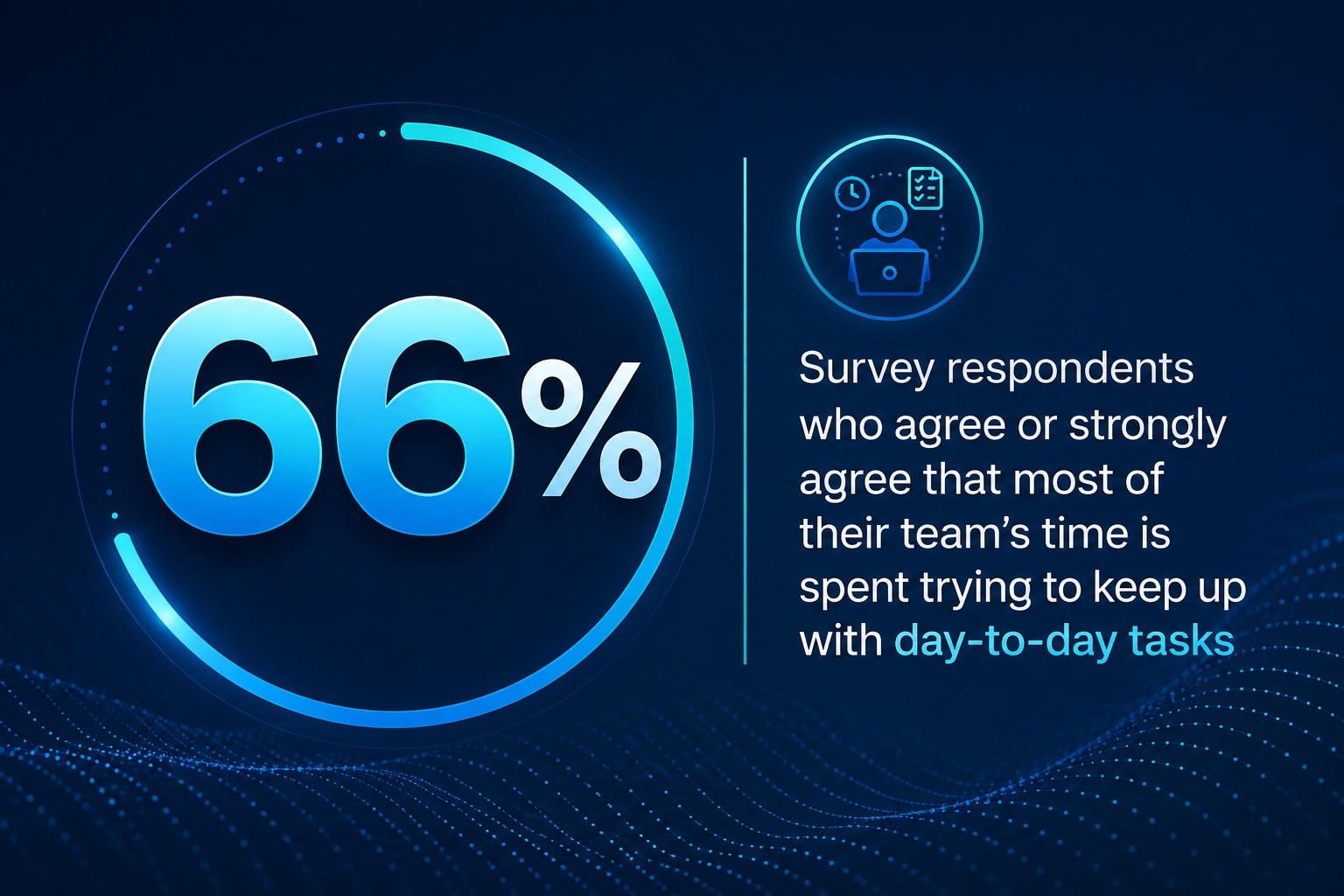
TBR’s 2026 Infrastructure Strategy survey reflects this operational burden, with 66% of respondents agreeing or strongly agreeing that most of their team’s time is spent trying to keep up with day-to-day tasks.
Additionally, according to respondents, shortages of skilled IT staff remain a major compounding constraint. The result is a widening gap between what customers expect from support services and what traditional operating models can consistently deliver.
This gap creates a structural challenge for support organizations. Traditional models were built around reactive engagement: A customer experiences an issue and opens a ticket or contacts support, and the organization then works to diagnose and resolve the problem. That approach can address individual incidents but struggles to scale in a world where customers expect digital-native, always-on support experiences and where operational complexity continues to grow.
AI offers a path forward, but AI tool adoption alone is insufficient. For instance, some organizations are deploying chatbots, introducing agent-assist tools or automating narrow workflows, but the true difficulty is making AI deliver measurable operational value at scale. That requires an end-to-end support delivery model that connects knowledge, workflows, customer interactions, field execution, supply chain planning and human expertise within a single coordinated system.
Lenovo’s International Services Support organization has intentionally approached AI adoption and implementation through this broader, more complex framing, leveraging its engineering-centric DNA and internal test-bed culture.
The company has used AI to redesign support delivery end to end, from customer interaction and diagnosis to resolution, field execution and supply chain coordination.
In effect, Lenovo has acted as customer zero through its own AI services transformation, using its global support operations to develop, test, refine and scale AI capabilities before applying that experience to develop a broader model that can serve as a practical reference for other organizations with large-scale support operations.
The result is a structured, multiyear transformation journey that has moved Lenovo from AI-assisted support toward AI-native service orchestration.
Lenovo’s global support operations serve as a proving ground for AI-native services
Lenovo understands the challenges support organizations face because it operates at a global scale. The company manages more than 500 million customer interactions per year, requiring multilingual capabilities and encompassing tens of millions of monthly queries and high-volume weekly support interactions and tickets.
At that scale, incremental improvements can produce meaningful business impact, but process optimization alone cannot address the full complexity of modern support delivery.
The core issue is the need to deliver fast, accurate and consistent support while reducing customer effort and improving internal efficiency. Customers want answers quickly, but they also want answers they can trust. They want personalized service without repeating information across channels. They want self-service when it works but still expect expert human support when issues are complex or high value.
These are the demands that traditional support models struggle to meet because expertise is often distributed across people, documents, systems and regions.
Without a unified intelligence layer, customers and support teams spend too much time searching for the right answer, creating inefficiency, inconsistency and unnecessary escalation.
Lenovo set out to rethink the services value chain. Its goal was to create an end-to-end, AI-enabled operating model that could connect previously siloed knowledge, data, systems and service functions, improve the customer experience, increase internal productivity, reduce unnecessary escalation and shift support delivery from reactive response to proactive and preventive care.
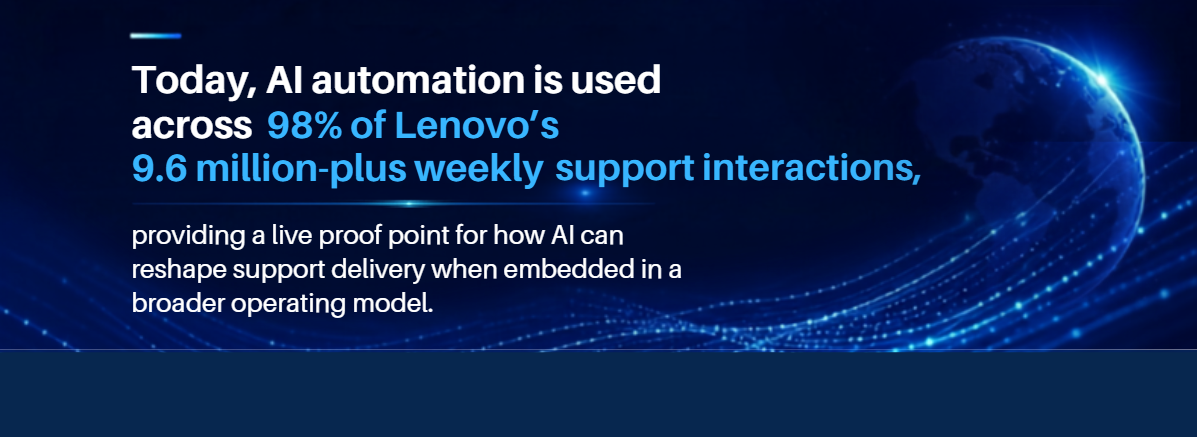
Today, AI automation is used across 98% of Lenovo’s 9.6 million-plus weekly support interactions, providing a live proof point for how AI can reshape support delivery when embedded in a broader operating model.
Lenovo’s Run with AI sits at the center of this transformation, connecting, orchestrating and automating workflows across customer engagement, intelligent diagnosis, predictive maintenance and supply chain optimization through an AI-driven service operations layer.
Run with AI is supported by unified knowledge management, AI agents, governance controls and human-in-the-loop decision structures that embed human judgment within automated workflows.
The model reflects several important shifts in how support services create value, with Lenovo using service intelligence to identify risks earlier and act before disruption occurs.
Lenovo’s model is also changing the division of labor between people and machines, with AI handling more routine execution while human support agents focus on exceptions, complex cases and higher-value interactions.
That changing division of labor is reinforced by Lenovo’s talent flywheel, which transforms traditional service teams into AI talent and converts their expertise into scalable AI assets.
AI reduces the time support professionals spend on routine activities, creating capacity for employees to solve complex problems, validate AI outputs, resolve exceptions and improve knowledge and workflows.
Their contributions strengthen the data, content, processes and controls on which its AI systems depend, creating a powerful engine that accelerates AI transformation.
Through unified knowledge management and internal use of large and small language models and retrieval-augmented generation solutions, Lenovo is breaking down knowledge silos by consolidating and converting distributed support expertise into reusable content that can be applied across countries, languages and support channels.
Lenovo has already built a unified knowledge base of more than 240,000 articles, helping the company deliver more consistent and scalable support while making expertise more transferable across global operations.
Together, these capabilities show how Lenovo is moving beyond discrete AI tools toward an AI-native services operating model, positioning support as an intelligent orchestration system rather than a reactive contact function.
Lenovo’s 3-phase path to AI-native service orchestration
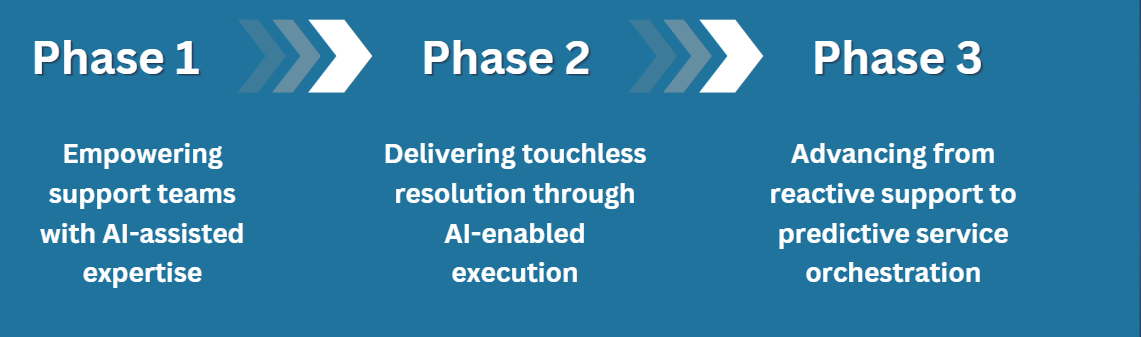
Lenovo’s AI-driven approach to its support operations is organized into three phases: AI empowering people, AI delivering solutions, and AI revolutionizing the service model.
Each phase reflects a deeper level of AI integration into support services, moving from human augmentation to workflow execution and finally to predictive and preventive service delivery.
The phases build on one another, with the capabilities and human roles developed in each phase continuing to support those that follow.
Lenovo has already progressed well into the third phase and continues to invest in expanding orchestration and automation across additional service workflows and use cases.
Grounded in Lenovo’s engineering-centric culture and informed by lessons from the company’s own support operations, the model reflects three paradigm shifts.
Initially, AI serves as a cognitive multiplier for support professionals, then it becomes an execution layer for touchless resolution and ultimately an intelligence layer for prevention.
For organizations with large-scale support operations, Lenovo’s three-phase model provides a way to assess how deeply AI is changing the operating model and which capabilities need to be developed next.
Maturity is reflected in whether trusted knowledge is available within support workflows, whether AI can reliably execute work across systems and whether predictive insight can be converted into coordinated action.
Phase 1
Empowering support teams with AI-assisted expertise
The first phase, AI empowering people, focuses on improving the effectiveness, consistency and productivity of human support teams. Lenovo describes this as the Assistive Era because AI acts primarily as a cognitive multiplier for customer support agents and engineers. It helps services professionals access relevant information, summarize cases, translate across languages, interpret customer intent and reduce the time spent searching for answers.
For support operators, this phase begins with making trusted expertise easier for employees to access and apply within existing workflows.
For Lenovo, this phase is built on foundational capabilities within what the company refers to as its Autonomous Orchestration Grid (AOG). Lenovo’s AOG brings together tools such as Agent Assist, copilots and unified knowledge management to strengthen information retrieval, diagnostics and resolution workflows.
Human support agents remain central to the support experience, but they are supported by systems that make them faster, more informed and more consistent. This is especially important in a global support organization where different regions, languages and product lines can create uneven access to data and knowledge.
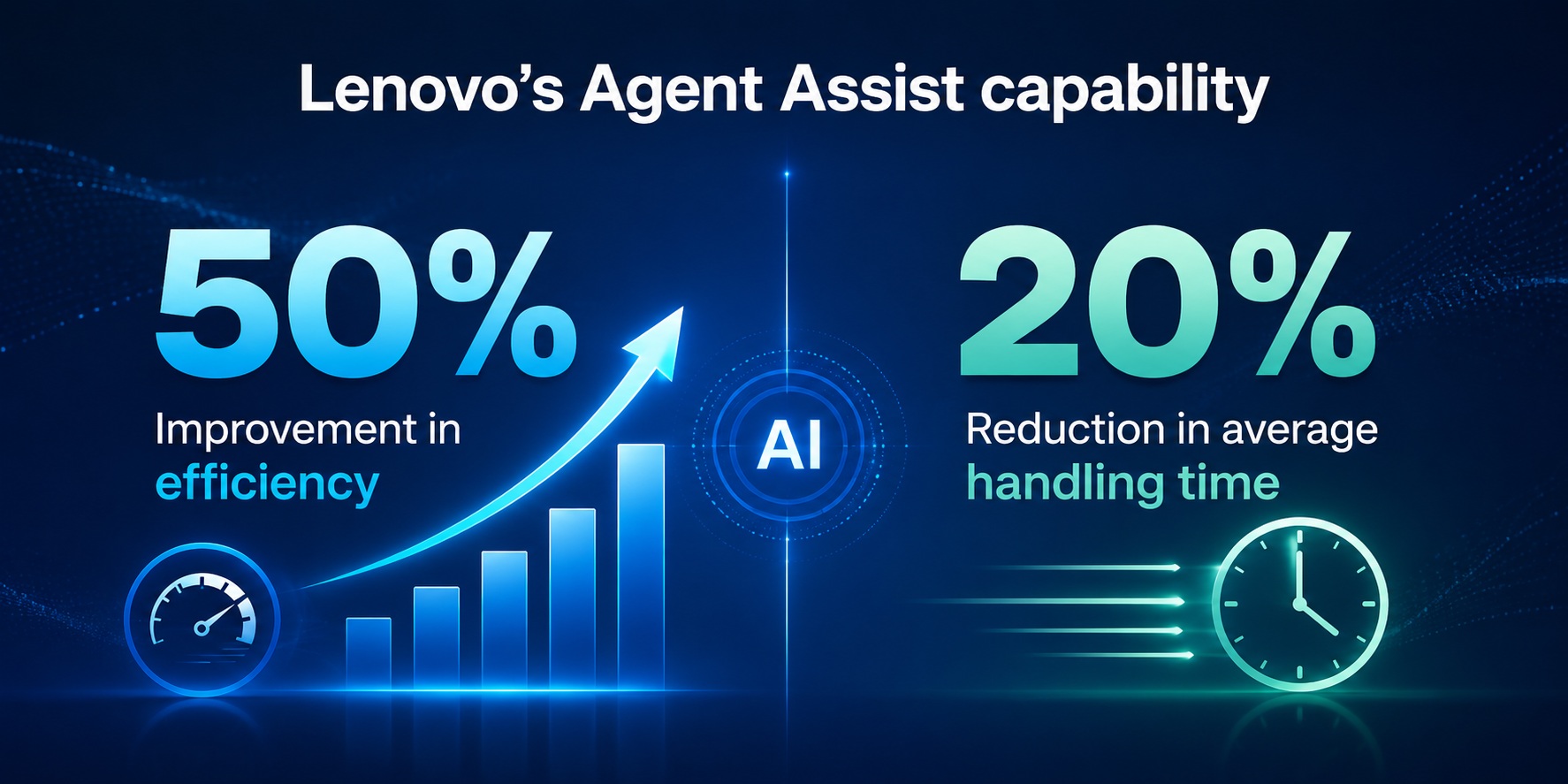
The paradigm shift in Phase 1 is that AI augments human expertise at scale. Lenovo’s Agent Assist capability exemplifies this, providing real-time next-best action guidance during support calls, and improving Lenovo’s efficiency by 50% and reducing average handling time by 20%. Making service data and knowledge reusable and scalable is also central to this phase. Newer customer support agents can resolve issues with greater confidence, while experienced agents can focus on more complex interactions. Most importantly, end customers benefit from more accurate and consistent responses.
Phase 2
Delivering touchless resolution through AI-enabled execution
The second phase, AI delivering solutions, moves from AI-assisted support toward AI-enabled execution. Lenovo describes this as the Touchless Era because AI begins to execute specific tasks, resolve routine issues and orchestrate low-touch or no-touch workflows. This shift depends on applying automation to repeatable workflows with clear decision boundaries and defined paths for human escalation.
In this phase, Lenovo builds on the foundation created by AOG to expand AI from knowledge support into direct workflow execution with capabilities such as Agentic Intelligent Resolver (AIR), Intelligent Voice Agent (IVA), automated warranty registration, AI-powered diagnosis and automated work-order creation.
These capabilities enable AI to move deeper into the service life cycle. AI can recognize intent, diagnose issues, trigger next steps and handle routine case activity while routing complex or lower-confidence cases to human support agents.
In Lenovo’s deployment, AIR has achieved a 50% first-contact fix rate while keeping transfers to human support agents below 5%, and IVA has delivered 97% intent-recognition accuracy with a 30% first-contact fix rate.
The paradigm shift in Phase 2 is what Lenovo calls Touchless Resolution Elasticity (TRE). TRE describes the ability to automate more of the end-to-end support life cycle while preserving the flexibility to route complex or sensitive cases to human support.
Issue recognition, remote diagnosis, case handling and resolution can increasingly be managed through AI-driven workflows, allowing Lenovo to handle high volumes of customer queries with less manual intervention. Routine work can be absorbed by AI systems, while human support capacity is reserved for higher-value exceptions.
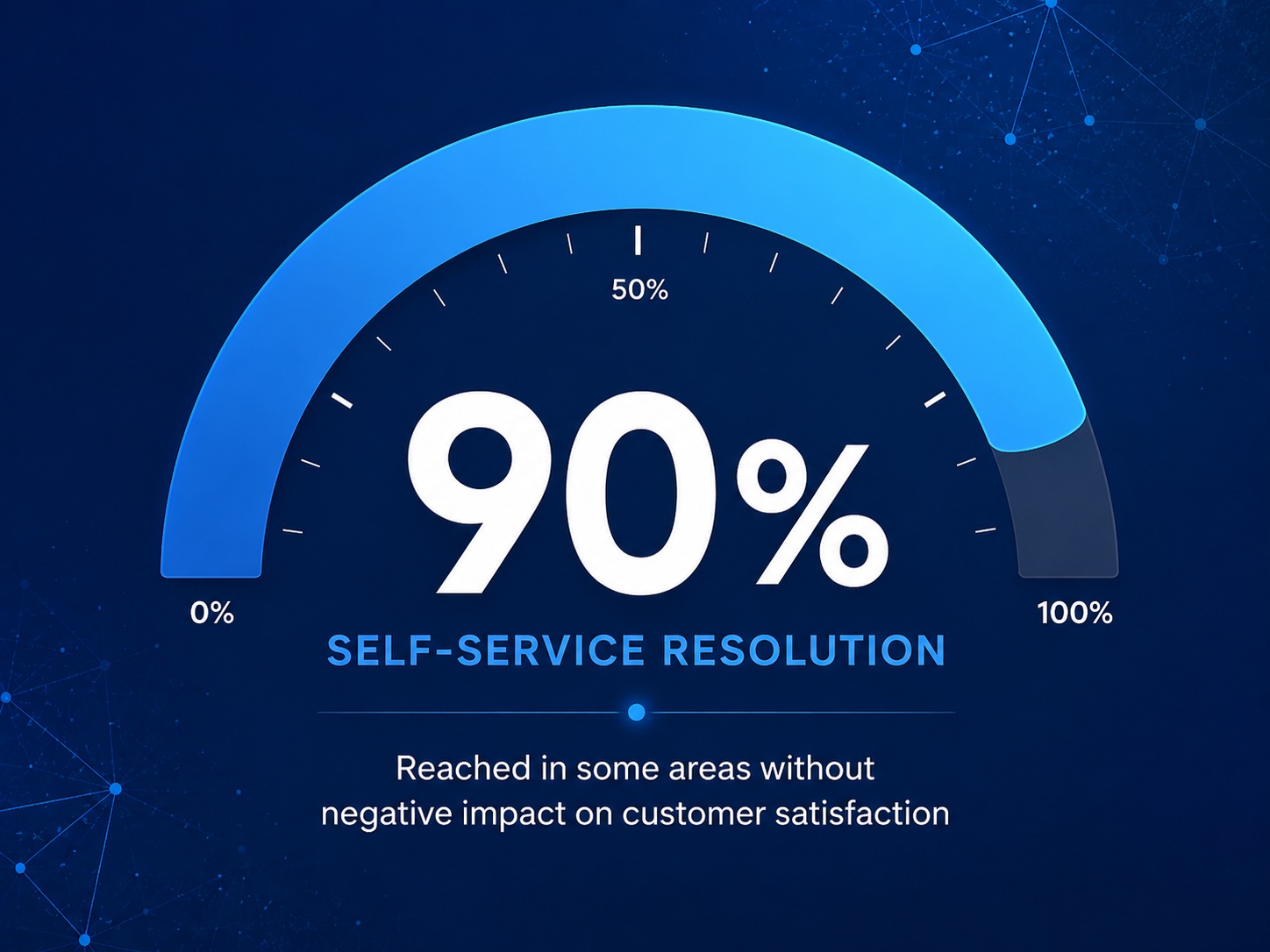
Lenovo’s results show the impact of this shift. Self-service resolution has reached 90% in some areas without negatively impacting customer satisfaction. Chat transfer rates have declined by more than 40%, the number of escalations has decreased by 70%, and average handling time has been reduced by approximately four minutes. These outcomes demonstrate how Lenovo is using automation to improve support economics and the customer experience simultaneously.
Phase 3
Advancing from reactive support to predictive service orchestration
The third phase, AI revolutionizing the service model, moves beyond support automation toward predictive, preventive and orchestrated service delivery.
Lenovo describes this as the Autopilot Era because the operating model is defined not only by how quickly an organization responds after issues occur but also by how effectively the organization can anticipate, prevent or resolve issues before they disrupt the customer.
At this stage, predictive insight must be translated into coordinated action across customer engagement, technical support, field service and supply chain systems.
For Lenovo, this phase is tied to the evolution of Run with AI and the company’s broader move toward super-agent orchestration.
Run with AI 1.0 focused on high-volume customer service interactions while Run with AI 2.0 expanded into broader service delivery and internal efficiency use cases. Run with AI 3.0 connects these AI building blocks through a unified orchestration layer.
For example, Lenovo has already developed more than 100 AI agents supporting customer support staff, engineers, internal teams and operations. The strategic direction of Run with AI is to integrate these building blocks into a more seamless experience where customers can access support through a single entry point and have issues resolved across all systems and workflows.
The paradigm shift in Phase 3 is referred to as Apriori-Native Prevention, which describes Lenovo’s move toward a model in which issues are identified and addressed before they impact customers. Using device telemetry, anomaly detection and predictive analytics, Lenovo can apply service intelligence to anticipate risk, guide operational decisions and reduce the need for reactive intervention.
Through this model, predictive intelligence identifies potential issues, agentic workflows trigger next steps, and unified knowledge drives diagnosis and resolution, while field service and supply chain systems can prepare parts, people and processes before a problem escalates.
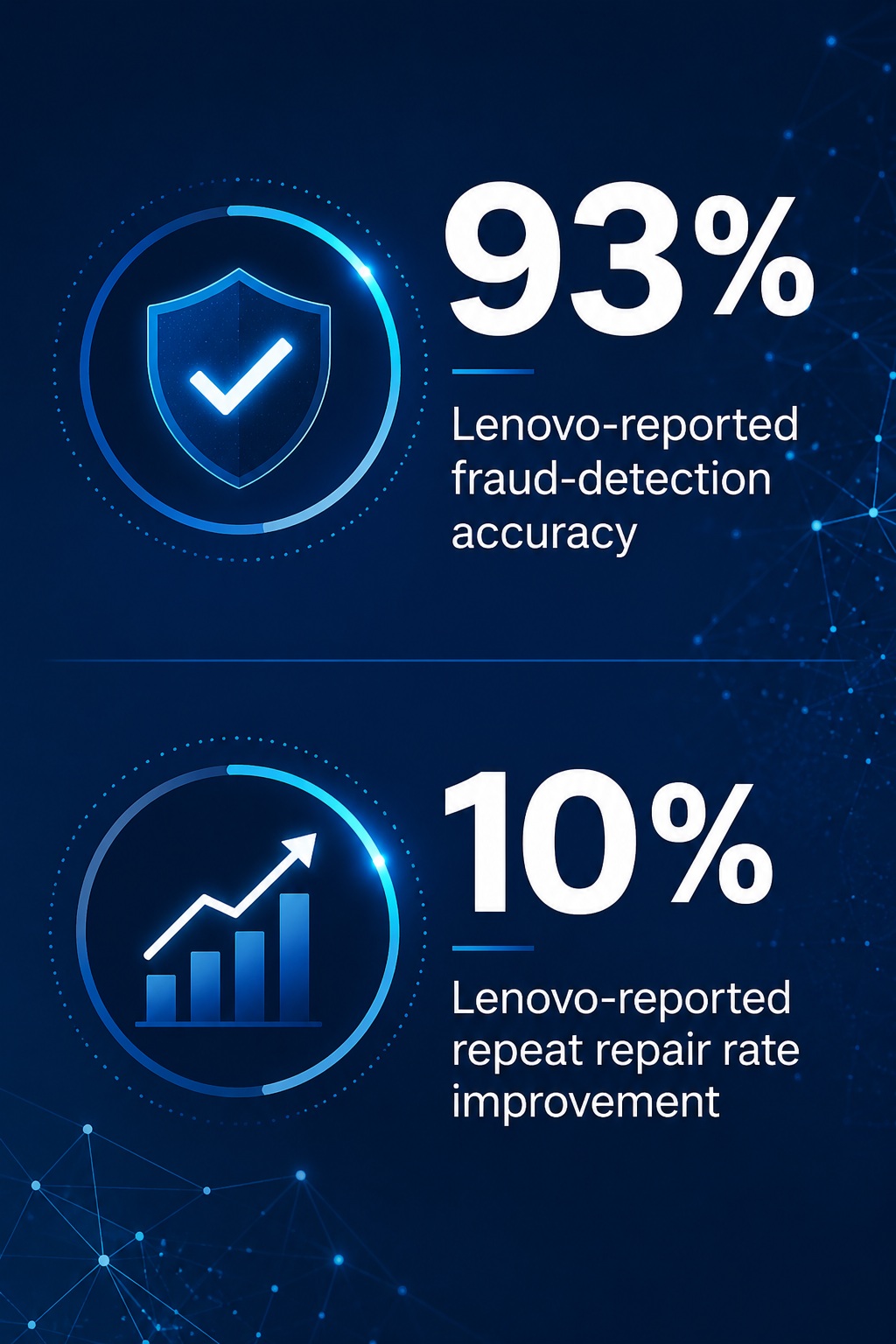
Lenovo is also expanding this coordinated approach into service execution and operational controls. Its AR/VR Repair Agent supports field technicians during repair activities, while AI-enabled fraud detection helps identify potentially unauthorized service activity.
Across these initiatives, Lenovo reports 93% fraud-detection accuracy and a 10% improvement in repeat repair rate.
Together, these capabilities help companies deliver a differentiated customer experience. Customers can receive faster answers, more proactive support and fewer disruptions.
In some cases, the highest-value support interaction may be the one the customer never needs to initiate because the issue was prevented or addressed before the customer became aware of it.
Phase 3 also reinforces the role of governance. As AI systems become more autonomous and more deeply embedded into support operations, trust, explainability and accountability become more important.
Lenovo combines human oversight, defined autonomy boundaries, confidence thresholds, guardrails, compliance controls and explainability requirements to ensure that greater AI autonomy does not come at the expense of customer trust and operational accountability.
Applying Lenovo’s transformation lessons to large-scale support operations
Lenovo’s strongest proof point is its successful deployment of this transformation model across its own global support operations, which mirror the conditions of many of its large clients, including high interaction volumes, global support requirements, multilingual service, complex product portfolios and distributed support teams.
Lenovo has also had to address the same adoption challenges these organizations face, from fragmented knowledge bases and legacy systems integration to process redesign, workforce change, governance and human oversight.
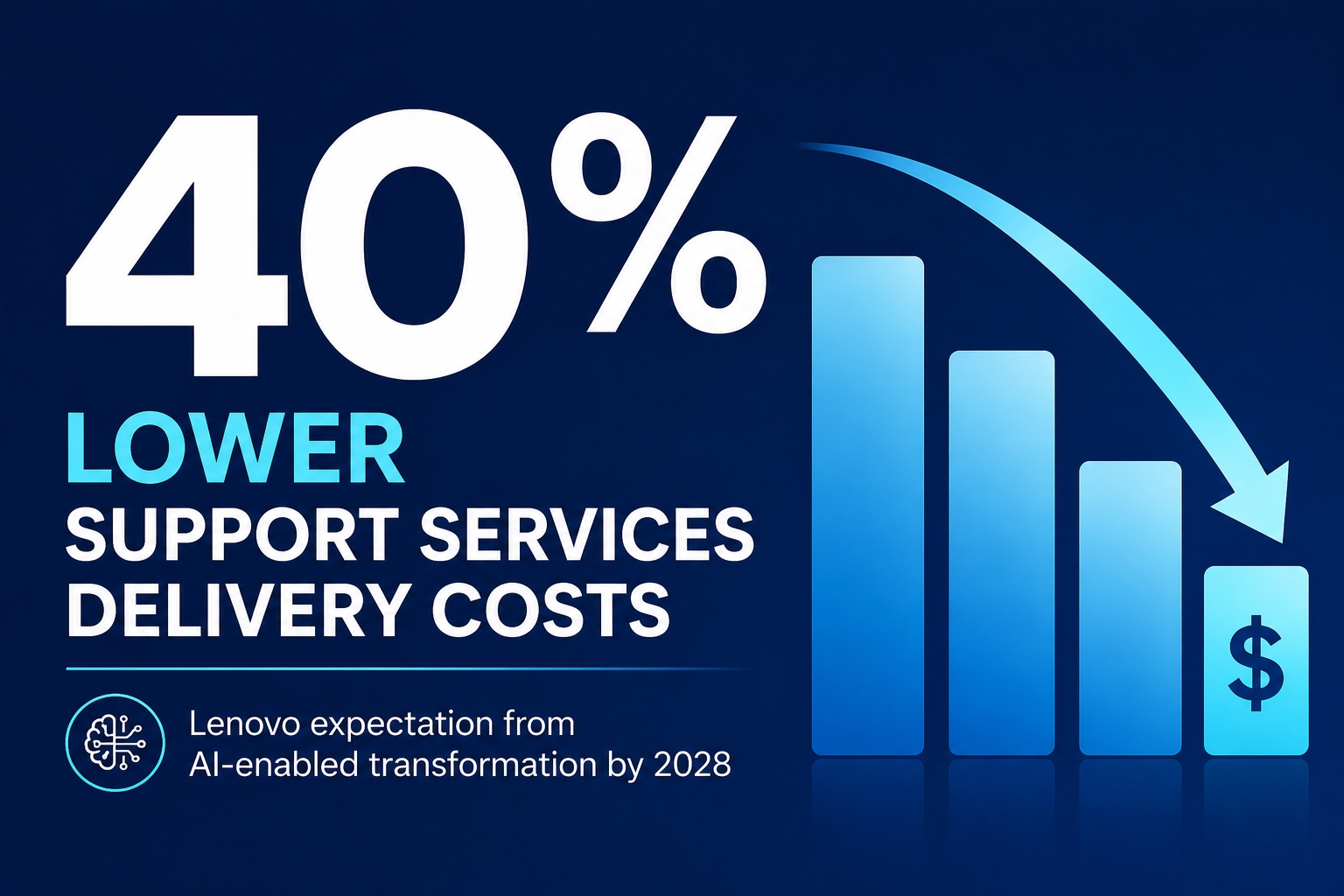
The value of Lenovo’s internal transformation is reflected in measurable operating results. Lenovo’s AI-enabled transformation has reduced support services delivery costs by 15%, and Lenovo expects that figure to reach 40% by 2028.
However, cost savings are only one measure of transformation success. Progress should also be assessed through operational and customer outcomes.
For the operator, relevant measures include employee capacity, cost to serve, first-contact resolution, escalation rates, repeat incidents and field-service efficiency. For the customer, relevant measures include resolution speed and consistency, the number of required support interactions and service disruption.
This transformation has earned Lenovo external recognition across AI innovation, customer engagement and service operations. Recent examples include a 2026 Business Intelligence Group AI Excellence Award in the Agentic AI category for Lenovo ISS’s Agentic Intelligent Resolver and recognition from Frost & Sullivan for Asia-Pacific AI Services Customer Value Leadership in 2025.
Lenovo’s experience also identifies several practical lessons for organizations modernizing their own support operations. For instance, data and knowledge foundations have to come first because AI cannot perform consistently when expertise remains fragmented across systems, regions and individuals.
Process design matters as much as model deployment because AI changes how work moves through the organization, including hand-offs, escalation paths and exception handling. Governance also has to be considered upfront because agentic systems require defined autonomy boundaries, confidence thresholds, compliance controls and accountability structures.
Just as important, automation has to preserve access to human expertise so routine needs can be resolved efficiently while complex or sensitive cases still reach the right specialists.
Taken together, Lenovo’s internal deployment, measurable results and transformation lessons provide a practical reference for applying a similar transformation across large-scale support operations. The most transferable element is Lenovo’s end-to-end, AI-enabled operating model, which organizations can adapt to their own environments by following the same progression: unifying knowledge and augmenting employees, orchestrating and automating connected workflows, and ultimately using predictive intelligence to prevent or resolve issues before the customer becomes aware of them.
The specific technologies and processes will vary, but the underlying approach of breaking down silos across knowledge, systems, workflows and service functions while preserving human judgment is broadly applicable to organizations managing complex, high-volume support environments.
Conclusion
AI is changing the economics and expectations of support services. Its value lies in making support more proactive, consistent and scalable while concentrating human expertise where judgment matters most. Lenovo’s transformation shows how this can work in practice.
In Phase 1, AI empowers people by giving customer support agents better access to knowledge and workflow support through the Autonomous Orchestration Grid. In Phase 2, AI delivers solutions by increasing Touchless Resolution Elasticity and allowing humans to focus on exceptions. In Phase 3, AI revolutionizes the service model by moving toward Apriori-Native Prevention, where predictive intelligence helps reduce disruptions before they occur.
The broad takeaway is that AI transformation goes beyond deploying isolated tools and requires redesigning the support services operating model around intelligence, automation, governance and human expertise.
Lenovo’s experience demonstrates that when AI is embedded thoughtfully into support workflows, it can improve both operational efficiency and customer experience. At maturity, this model enables support operators to handle greater support volumes through more effective use of human expertise.
Customers experience less downtime, fewer support interactions and faster, more consistent service as more issues are prevented or resolved before disruption. Technology is the engine. Human connection is the destination.
Lenovo’s AI-native support services transformation is designed to bring them together, using intelligent systems to reduce friction, prevent disruption and give people the context and capacity to deliver better support.
 Technology Business Research, Inc.