Bad Debt Expenses Will Rise for CSPs in 2026

The telecom industry will adapt to a K-shaped economy in 2026

In a K-shaped economy that increasingly separates financial winners from losers, the majority of households and businesses on the lower arm of the “K” are under mounting financial strain and are finding it more difficult to pay their bills. As these economic pressures persist, communications service providers (CSPs) should expect bad debt expenses to continue rising, with the potential to meet, or even exceed, levels experienced during the Great Recession.
 

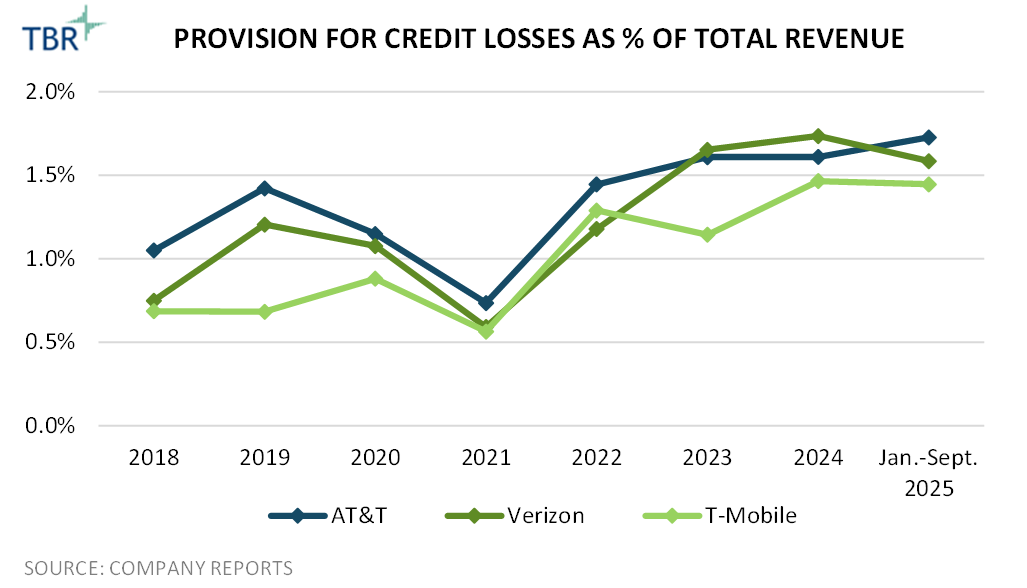
CSPs’ expenses related to bad debt have been steadily increasing since plunging to record lows during the height of the COVID-19 pandemic in 2021, when an unprecedented amount of government stimulus provided a financial windfall to households and businesses across the U.S. (and in many other countries through their respective stimulus programs), enabling many to improve their debt situations.
CSPs’ bad debts have now exceeded the mean of pre-pandemic, normal levels and are likely to reach levels unseen since the Great Recession. A key leading indicator of bad debt expense is what some operators report and refer to as “provision for credit losses,” which is the amount of money owed to CSPs that they expect to write off.
 

Provision for Credit Losses as a Percentage of Total Revenue_TBR

Several headwinds are occurring concurrently, which will push bad debt expenses higher for CSPs

  • The resumption of student loan payments as of June 2025, which has made it more difficult for households to manage their finances, evident in the stark increase in subprime car loan delinquencies and a spike in home foreclosures
  • Inflation increasing costs of basic life necessities and business needs
  • Tariffs impacting consumers and businesses, feeding inflation and forcing tough financial decisions
  • Job losses and a generally anemic job market (directly and indirectly, due to AI and general business restructurings and bankruptcies)
  • Immigration policy changes — deportations and voluntary emigrations lead to unpaid bills, including phone and internet bills
  • Interest rates remain high relative to the post-Great Recession new-normal level, making it more challenging to pay back interest-bearing loans
  • Paring back of social safety nets — SNAP, WIC and other food security benefits, and government-provided or subsidized healthcare programs
  • Bankruptcies surging across the business spectrum; bankruptcies can lead to restructured debt loads or partial or full nonpayment if the entity liquidates

Overall, most households and SMBs are increasingly struggling to pay their bills, as evidenced by essential expenses like car and mortgage payments becoming harder to manage. Because cars, homes, phones and internet service are essentials, bad debt expense is likely to continue rising through 2026, and telecom providers will feel the impact.
 

Explore additional predictions for the telecom industry in 2026 in our special report The Telecom Industry Will Aapt to a K-shaped Economy in 2026.

How Will Advanced AI Impact Pricing, Labor Practices and Client Expectations?

TBR FourCast is a quarterly blog series examining and comparing the performance, strategies and industry standing of four IT services companies. The series also highlights standouts and laggards, according to TBR’s quarterly revenue projections and geography estimates. This quarter, we look at Infosys, Tata Consultancy Services, HCLTech and Accenture and compare how their advanced AI and labor strategies position them for revenue growth.

 
Advanced AI may be front and center in IT services strategy, but execution challenges remain a familiar story. Despite ongoing hype around unlocking new efficiencies and nonlinear growth, IT services firms continue to grapple with the reality of needing labor arbitrage in the short term and meeting client expectations. The distance between strategic intent and operational reality is less about reluctance to adopt AI and more about IT services companies’ timing, risk management, and the need to protect revenue streams today while betting on the future potential of advanced AI.

AI-first in strategy, labor-arbitrage in practice

Although all IT services companies aim to leverage advanced AI to improve margins and propel revenue growth, in the short term some are still relying on headcount growth to execute on deals. For example, even though advanced AI remains core to HCLTech’s delivery strategy and in February the company announced a goal to double revenue with half the number of employees, HCLTech has added a total of 10,032 freshers over the past three quarters.
 
Similarly, Infosys has increased headcount in preparation for executing on large deals, as evidenced by its announcement of hiring a total of 12,000 freshers over 2Q25 and 3Q25. In contrast, Tata Consultancy Services (TCS) and Accenture experienced headcount declines in 4Q25, marking the first drop for Accenture since 2010. Yet the quarterly decrease for both companies may reflect the worsening macroeconomic conditions rather than decisions to downsize headcount. If anything, companies are preparing for ongoing demand fluctuations as clients remain cost-conscious.
 
According to TBR’s 3Q25 IT Services Vendor Benchmark, offshore and nearshore headcount continues to grow among the 30 covered vendors, increasing 1.2% in 3Q25 as opposed to a 1% decline in onshore headcount in the same period, indicating the labor arbitrage model is alive and well, at least for now. Accenture, HCLTech, Infosys and TCS are all expanding their reliance on global delivery centers, including for in-demand skills such as AI, causing increased demand for highly skilled workers. Most companies have reported some AI training numbers, such as TCS stating that 159,000 of its more than 580,000 employees have been trained on AI. However, the reported numbers reflect a significant portion of companies’ employee base, raising questions about the depth of knowledge. TBR believes the training is just deep enough to lend credibility to the marketing.

BPO companies are the first to face a transformative wave of AI delivery implications: Can they impress clients while keeping them happy?

The four covered IT services companies are all top contenders in the business process outsourcing (BPO) space, making advanced AI essential for these companies right now. CEO of HCLTech C Vijaykumar stated on the company’s CY3Q25 earnings call, “As mentioned on Investor Day, the biggest impact will be in the BPO business, where productivity gains could reach 40 to 50%.” According to TBR’s estimates (see Figure 1), Accenture has the largest BPO segment, followed by TCS, HCLTech, and Infosys. With BPO having the most initial risk of cannibalization to traditional revenue, these companies will be the first to test how to adapt their commercial models. Although delivery remains largely time-and-materials-based, IT services companies such as Accenture are moving to a fixed-price model, a potential bridge to outcome-based pricing.
 
Yet cost-conscious clients are beginning to demand lower pricing due to the use of AI and automation, forcing IT services companies to compete on price even as they look to improve margins. This is creating pressure to realize ROI internally while appeasing clients on price and service quality. According to TBR’s 4Q25 Infosys Earnings Response, Infosys views its agentic AI “as a productivity and monetization lever rather than a growth engine that fundamentally reshapes the revenue mix.” Persistent macroeconomic uncertainties remain both a blessing and a curse for vendors. On the one hand, clients are becoming more curious about the benefits of advanced AI adoption, particularly agentic AI, providing more sales for IT services companies. On the other hand, clients are demanding a growing share of the resulting cost savings as price discounts, negatively impacting vendors’ margins.
 

2025 BPO Revenue Graph

Figure 1: 2025 BPO Revenue for Accenture, HCLTech, Infosys and TCS (Source: Company Data and TBR Estimates)


So, what approach should companies take to maximize potential growth, protect margins and ROI, and manage client expectations? Although companies are racing to keep pace with the competition in offering hyperscaler-enabled agentic capabilities as well as large language model-enabled solutions with companies such as Anthropic and OpenAI, establishing proprietary solutions will be important to differentiate and demonstrate advanced AI proficiency. Companies may have difficulty finding a healthy balance between focusing on proprietary solutions that set themselves apart and delivering key partner-enabled solutions that clients have come to expect and trust.
 
Perhaps more importantly, IT services companies will need a well-thought-out strategy to deepen client relationships while keeping AI top of mind as a value-add rather than a purely cost-conscious tool. Slimming headcount, for example, is undoubtedly an end goal for Accenture, HCLTech, Infosys and TCS, but maintaining the right strategic onshore locations to keep a human touch and not cutting headcount too quickly will be essential to retain employees and institutional knowledge. This will help uphold the company’s service quality, but if IT services companies can leverage AI to augment service delivery rather than market solely as one-size-fits-all stand-alone solutions, this could generate more demand. Further, protecting the value of services will strengthen companies’ contract negotiating power.

Conclusion

HCLTech is among the few IT services companies that have reported advanced AI revenue. In 3Q25 HCLTech announced it received $100 million in advanced AI revenue. On Accenture’s 4Q25 earnings call, the company reported advanced AI revenue of $1.1 billion, but leadership later noted that this metric will no longer be reported because advanced AI has become integrated across much of the company’s operations. This also implies concerns of revenue cannibalization — especially if Accenture cannot introduce fixed pricing fast enough. TBR believes companies need to have a well-planned pricing strategy in addition to a holistic approach to ensure a healthy long-term trajectory.
 
HCLTech follows this approach in part through its industry- or task-specific solutions that focus on solving a problem. Product launches throughout 2025 reflected this point, including HCLTech Insight, an agentic AI solution built with Google Cloud to support manufacturers with data analytics, and Physical AI with SAP, which enables optimization across warehouse operations, fleet management and 3D reality capture. TBR believes this strategy, although not entirely unique, has contributed to HCLTech’s consistent financial performance and strong bookings.
 
TCS takes the opposite approach in some ways, using AI to augment existing platforms rather than releasing stand-alone AI solutions. Although this may help TCS navigate revenue disruption in the short term as its client-facing solutions retain their names and functions, over time TCS may need to define its AI strategy better and market a more compelling story about how it can help clients solve problems with innovative solutions. Nevertheless, TCS’ IP-driven AI strategy will undoubtedly be a strength. Infosys may have a better narrative around AI aligning as it shifts its strategy to focus on outcomes.
 
Additionally, similarly to TCS, according to TBR’s 3Q25 Infosys report, “Successful positioning and usage of industry- and function-aligned proprietary and partner-enabled agents could help Infosys stay grounded, which could strengthen trust with clients and partners and help drive sales rather than entering uncharted territory in a GenAI [generative AI] market that is in a hypergrowth phase.” Importantly, TCS and Infosys have not reported AI revenue numbers. TBR believes the two companies may be withholding this data because it may be less than HCLTech’s and Accenture’s figures. With Accenture no longer reporting the metric, TCS and Infosys may be less likely to provide the information.
 

IT Services Revenue Forecast for Accenture, HCLTech, Infosys and TCS Graph

Figure 2: IT Services Revenue Forecast: Accenture, HCLTech, Infosys and TCS (Source: TBR)


How will the three India-centric vendors fare against Accenture, which has vigorously invested in AI IP, particularly in industry-specific solutions such as the AI agents in AI Refinery? Although India-centrics’ clients may not have the same expectation as Accenture’s clients, the vendors will need to make sure they are prioritizing client outcomes and creating a meaningful narrative. Leaning into this approach will be particularly important as Accenture’s undeniable size in BPO provides it with an ideal testing ground for agentic AI. TBR could see Accenture making a similar acquisition as Capgemini did with WNS, such as by acquiring Genpact or EXL, which would sharpen its competitive edge. Ultimately, future success will depend on how effectively IT services companies translate AI adoption into differentiated, outcome-driven offerings without eroding client trust or margins. Those that balance proprietary innovation with partner ecosystems while resetting commercial expectations will be best positioned as AI reshapes cost structures and value creation.

AI Alliances Will Increasingly Target OT

New and expanding partnerships are increasingly targeting the convergence of IT and OT, as system integrators (SIs) align with OEMs, manufacturing ISVs and silicon providers. This momentum is driven by the strong growth potential in high-tech manufacturing, where solutions that improve accuracy, efficiency and safety can be deployed on-site without reliance on rack-scale compute systems in neoclouds or Tier 1 clouds. As a result, while AI has long operated at the edge, these partnerships will accelerate both the sophistication of AI-driven use cases and the pace of solution framework development.

A host of use cases are ripe for disruption in OT

NVIDIA AI platforms, including NIM Agent Blueprints and NVIDIA Omniverse, lay a foundation on which partners can build. Partnerships representing a blend of IT and OT capabilities — including NVIDIA, SIs, manufacturing-centric ISVs and OEMs — will bring together new capabilities.
 

SIs are a key piece of the puzzle to bridge IT and OT. Although NVIDIA provides a platform, the complexity exceeds what most IT teams can manage. The SI also must act as a bridge between IT and OT technologies, skill sets and cultures. Expanding partnerships with industrial automation leaders such as Siemens is central to this.
 

As constraints around the ability to quickly build out AI factories become clearer, edge workloads will be an AI opportunity relatively unencumbered by these restrictions.
 

High-tech manufacturing represents a strong opportunity for AI adoption globally. Within the U.S., edge AI will be positioned as a focal point for the era of modern manufacturing.
 

In addition to the GPU-enabled edge servers available in the market, NVIDIA’s upcoming launches of RTX AI server and IGX Thor edge computer, which do not require liquid cooling, will accelerate interest in AI use cases on premises and at the edge.
 

Other silicon providers, namely Qualcomm, will launch products designed for manufacturing and robotics in 2026. However, a strong software platform from which SI partners can build on is a necessity for success.
 

TBR expects other industry verticals, including pharma and biotech, will replicate these partnership approaches.
 

Enterprise Edge Spending Forecast by Segment (Source: TBR)


Explore more 2026 predictions for alliances and partnerships by downloading our special report 2026 Will be a Pivotal Year as AI Momentum Drives Deeper Ecosystem Alliances.

Agentic AI Adoption Is Pressuring Security Architectures to Converge

Microsoft distribution edge and AWS and Google integration moves are reshaping competitive dynamics

The emerging pattern of multicloud security consolidation has direct implications for both Amazon Web Services (AWS) and Microsoft, as enterprises reassess detection pipelines, governance models and operating frameworks heading into 2026. Although AWS remains well positioned in analytics-heavy workloads, the company needs to reevaluate its long-established “building block” approach, especially as peers deliver more integrated platforms. For Microsoft, its strengths will continue to be with organizations where Microsoft 365 already anchors their identity and collaboration strategies.

Interoperability in agentic systems calls for greater interoperability in security

Security has been a top concern among enterprises for years, and that history of investment has often translated into sprawling security estates, posing a challenge for AI adoption. If agentic AI systems are going to work across platforms, security needs to work across platforms as well.
 
At Ignite 2025, Microsoft outlined a path intended to pull customers toward a more unified operating model. Tighter integrations across the company’s Defender, Sentinel and Purview offerings as well as the new Agent 365 control plane were a major development. However, announcements stating Security Copilot capacity will be bundled with both Microsoft 365 E5 and expanded Sentinel connectors for AWS really caught TBR’s attention. Sentinel’s updated AWS integration now uses an S3- and SQS-based model that ingests CloudTrail, GuardDuty, VPC Flow Logs and selected CloudWatch exports through an AWS Identity and Access Management role, allowing those signals to be correlated with Microsoft-native alerts in a unified analytics and response workflow. Creating more streamlined cross-cloud security signals Microsoft’s clear expectation that customers centralize analytics, automate more of the SOC and apply enterprise-level governance to AI agents rather than allow fragmented, team-level management.
 
AWS and Google are also responding to cross-cloud telemetry challenges. AWS has broadened Security Lake into a hub that can ingest and normalize signals from a wide ecosystem, including tools such as CrowdStrike, Palo Alto Networks Prisma Cloud, Wiz, Lacework, SentinelOne, Zscaler, Okta, Cisco Secure Firewall, ExtraHop, Vectra AI, Splunk, IBM QRadar, Datadog and Sumo Logic. Security Lake standardizes these feeds via OCSF (open cybersecurity scheme framework) and allows downstream analytics through OpenSearch Service or partner SIEMs (security information and event management).
 
Google Security Operations has taken a different path, building a SIEM and SOAR (security orchestration, automation and response) platform with a large connector catalog spanning GuardDuty, Security Hub, CloudTrail, Azure Active Directory, Carbon Black, network-security vendors, CSPM (cloud security posture management) tools and a wide set of SaaS and identity integrations. These connectors feed normalized telemetry directly into SecOps’ analytics and playbook engine, enabling orchestration and automated response across heterogeneous environments. The strength of Google’s approach lies in its broad ingestion and automation capabilities, though its native alignment remains strongest where organizations standardize on Google Workspace and Cloud Identity.
 
With each vendor pursuing new security integrations, Microsoft’s greatest point of differentiation is its distribution advantage. The company’s security capabilities sit on top of the widespread Microsoft 365 and Entra ID install base, giving Microsoft direct access to identity, endpoint and collaboration signals without requiring separate platform deployment. Moreover, partners can attach services to an installed base rather than drive net-new platform adoption, enabling faster scale and lower friction. AWS and Google can compete on analytics, automation or integration, though arguably both lack the access to enterprise control points that Microsoft derives from its productivity stack.

Explore deeper data and analysis

Although the cloud ecosystems market is complex, it is the backbone of the broader digital transformation (DT) opportunity. As a result, studying the relationship between services vendors and technology vendors provides a glimpse into some of the key issues many participants face as they work toward the same outcome: winning both market share and mindshare. As it leverages insights across all of TBR’s practices, the Cloud Ecosystem Report can help you better understand the nuanced trends and forces at play within cloud, professional services and other IT markets.
 
With TBR Insight Center’s interactive data visualization feature, your team can quickly adapt thousands of data points for their competitive analysis, go-to-market strategy, and executive briefings. The tool enables users to curate relevant quantitative insights by company, business unit and/or market segment, creating a report specific to your needs and ensuring consistent frameworks across projects.
 
Explore Insight Center’s data visualization tool with the video below, and start your free trial today to access this one-of-a-kind tool.
 

TBR Insight Center™ Data Visualization Tool


Telecom Industry Will Adapt to K-shaped Economy in 2026

TBR Insights Live session, TBR Telecom Principal Analyst Chris Antlitz shares an in-depth review of our 2026 Telecom Predictions special report, Telecom Industry Will Adapt to K-shaped Economy in 2026. This session examines what the K-shaped economy means for communication service provider (CSP) balance sheets, customer behavior and competitive strategy, and how scaled providers can adjust to protect growth and margins.

The U.S. doesn’t have a Spectrum Shortage — It has a Utilization Problem

The mobile industry continues to beat the drum for more spectrum, but it should instead focus on fully utilizing the spectrum already allocated. TBR notes there are vast tranches of spectrum in the U.S. market that are broadly underutilized, either for technical or economic reasons. And challenges will only worsen as the industry aims to bring upper midband frequencies into the fray, which have greater propagation challenges and are less suited for macro coverage.
 

The U.S. needs to do a better job, guided by government institutions like the Federal Communications Commission, of utilizing Citizens Broadband Radio Service (CBRS), C-Band, 6GHz and mmWave bands, which are woefully underutilized today. For example, only a relatively small portion of midband spectrum has been deployed in the U.S. market to date, implying that well over half of it has not yet been put to use. (CSPs are either sitting on it or hoarding it.)
 

Most 4G and 5G network traffic in the U.S. today runs over low bands, such as 600MHz to 800MHz, and the lower midband (1GHz to 2.6GHz, especially 2.5GHz), with C-Band increasing but still far from its full utilization potential. MmWave bands hold promise, but for economic and technical reasons, they were used only in very specific situations, mostly for LAN capacity.
 

Additionally, spectrum warehousing entities like EchoStar (which recently reluctantly agreed to sell a portion of its vast spectrum holdings to Starlink and AT&T) and private equities are still sitting on large tranches of unused spectrum. The government should redirect its efforts toward addressing these market dislocations rather than straining to bring new spectrum to a market that might not even be used (case in point, CBRS). This should be a mandatory government push because dislocations created by negative externalities of capitalism threaten to keep the U.S. behind China in key technological domains; specifically, corporations with a scarcity mindset are hoarding, but not necessarily using, the spectrum resources they have. The U.S. is already behind China across several key technologies (e.g., 5G, hypersonic missiles, electric batteries and vehicles, rare earth element processing). It is unacceptable for the U.S. to fall behind on 6G as well.
 

Explore TBR’s 2026 predictions for the telecom industry in our latest special report, Telecom Industry Will Adapt to K-shaped Economy in 2026.


2026 Predictions: AI Momentum Drives Deeper Ecosystem Alliances

2026 will be a transitional year defined by technology ecosystem expansions — multiparty alliances spanning IT, OT, devices, edge and silicon; industrial/physical AI acceleration, especially at the edge and in manufacturing; and strategic bottlenecks as skill shortages and infrastructure gaps slow sovereign AI adoption. TBR expects significant changes in how technology vendors collaborate and compete, which lays the groundwork for broader, more integrated AI ecosystems. This is an optimistic prediction. Multiparty alliances require exceptional leadership, shared understanding of commercial models and transparency among partners, and AI aids only the last of these. The human component remains the most significant roadblock. IT-OT convergence and a surge in connected everything have been a TBR (and broader market) prediction for years, and while “signs point to yes,” as the Magic 8 Ball says, 2026 could be another year of disappointing progress, as hype around physical AI could far outpace reality.

2026 Predictions: Managed Services Shifts from Delivery Model to Growth Engine

The smartest IT services companies and consultancies will act on managed services as an entrée to consulting, a complete reversal of the traditional consulting to implementation to managed services model. Everyone should benefit from the increased demand for consulting in 2026. Still, most of the top IT services companies and consultancies will leverage their managed services relationships to capture new opportunities and further cement their stickiness with clients.

2026 Predictions: Will AI be the Death of SaaS?

Today, SaaS is far from dead, but it has reached an unmistakable inflection point. The model that reshaped enterprise software over the last 20 years has reached maturity just as a new layer of intelligence is forming above it. The result is a market that still depends on SaaS but no longer treats it as the strategic center of gravity. What once looked like a stable, compounding growth engine now looks more like baseline infrastructure supporting a different kind of workflow. As a result of this shift, the market is wondering whether SaaS applications will continue to define enterprise workflows or whether that role is shifting to AI-native platforms and agentic systems.

2026 Predictions: Telecom Industry Will Adapt to K-shaped Economy in 2026

The K-shaped economy that emerged during the COVID-19 pandemic will likely become more pronounced through 2026, and the telecom industry will need to adapt to this new economic reality. Based on balance-sheet strength, earnings power, and real, inflation-adjusted wage growth and revenue increases, as well as a host of other economic KPIs, the top 10% to 20% of households and businesses are doing exceptionally well financially (on average) while the bottom 80% to 90% of households and businesses are doing worse financially (on average) compared to historical metrics. In 2026 communication service providers (CSPs) will need to cater better to each arm of the “K” and better navigate the negative aspects of this ongoing economic situation.