
Trust at Speed: EY’s Mobility Practice Is a Catalyst for AI-era Workforce Transformation

Earlier this year EY hosted more than 250 people from over 115 companies and 20 countries at the EY Global Workforce Conference in Rome. Over three days, TBR spoke with EY leaders such as Gerard Osei-Bonsu, Global People Advisory Services Tax leader; Maureen Flood, Global People Advisory Services Tax partner; and David Rooney, EY Germany partner, as well as human resources leaders from large and small companies and representatives from EY’s technology partners. The following includes details from the event as well as TBR’s ongoing analysis of EY, people advisory services, and consultancies.

Speed and trust anchor EY’s Mobility growth opportunity

Speed and trust equal momentum. From the opening presentation through every main-stage speech, panel discussion and breakout, EY leaders repeatedly came back to this formulation to reinforce the event’s core message: In an AI age, trust separates good from bad, success from failure, adoption from resistance. EY’s own research supports this formulation. The firm’s 2026 Mobility Reimagined Survey found that “high-trust mobility functions are 1.9 times more likely to report speed in deploying to new markets, 1.7 times more likely to report speed in policy decision-making, and 1.6 times more likely to get significantly positive ROI from their mobility investments.”
 
Gerard Osei-Bonsu, Global People Advisory Services Tax leader, described speed as quicker answers and faster decisions allowing changes at speed, although many companies remain more reactive than proactive. He said building trust requires strategic integration, operational effectiveness and satisfying employee experiences, all rooted in reliable data and technology. And critically, “speed without trust fails.”
 
Osei-Bonsu’s framing of speed and trust informed seemingly every other EY professional’s presentation and resonated with the clients TBR spoke with during the event (as well as EY’s leaders’ remarks during the firm’s Global Analyst Summit, which was also held in May). A few EY leaders and EY clients described a plethora of unreliable technologies and vendors in the Mobility and People Advisory Services space that are generating uncertainty around policies, risks and AI.
 
This counterpoint to EY’s trust narrative creates, in TBR’s view, an excellent environment for EY’s global workforce strategy, connecting mobility, payroll, immigration, rewards, workforce planning and technology, to continue growing. As the trusted adviser bringing speed, reliability and governance, the practice should experience ongoing revenue acceleration and remain among the strongest components of EY’s tax, audit and consulting portfolios.

Microsoft remains the technology backbone of EY’s Mobility strategy

Echoing last year’s event in Barcelona, Spain, EY’s strategic alliance with Microsoft permeated many of the presentations, use cases and discussions, with EY professionals reinforcing that the firm’s Mobility solutions are, almost exclusively, built on Microsoft’s platform. EY’s mobility, technology and industry expertise, orchestrated on Microsoft’s platform, provides EY’s clients with improved employee experiences across a range of mobility issues and journeys.
 
Critically, according to multiple EY partners, the firm’s tight alliance with Microsoft enables faster innovation of both EY’s proprietary solutions and Microsoft’s platform. A Microsoft leader attending the conference summed it up as “cocreated transformation, built-on experience and developed trust.” An EY leader noted that the firm delivers services around data and AI “at speed and with trust” baked in, lending EY “credibility, global scale and proven outcomes” that peers and competitors would struggle to replicate. Osei-Bonsu noted that “none of us have the blueprints” for everything, making technology alliances critical to EY’s success. He added that within the Mobility space a diverse set of players and ecosystem partners rely on EY and Microsoft to provide a kind of “centrifugal, gravitational” force powered by EY’s combination of workforce expertise, data, governance, technology and AI-enabled delivery.
 
In TBR’s write-up of the event last year, our assessment of Microsoft as EY’s most-strategic partner included a hedge that “EY noted expectations that other technology alliance partners, including ServiceNow, will become increasingly strategic to Mobility.” Discussions in Rome show Microsoft remains EY’s predominant technology alliance partner, perhaps even more so than a year ago, leading TBR to believe the EY-Microsoft partnership continues to underpin Mobility and provides a client-zero use case EY can share with clients as well as an example, within EY, of the advantages of partnering tightly and nearly exclusively with a technology provider like Microsoft.
 
TBR continues to see Mobility and People Advisory Services as catalysts for change within EY, further evidenced by Microsoft’s role in the Mobility practice. (Note: In May EY and Microsoft announced a $1 billion-plus, five-year initiative, including integrated EY teams and Microsoft forward-deployed engineers focused on scaling enterprise AI.)

EY brings CHROs deeper into M&A by connecting people, tax and technology

In an M&A-focused breakout session, Flood and EY colleagues discussed challenges around including talent management within a typical M&A process. Flood commented that human resources leaders often get left out of the loop during due diligence, potentially lowering the value of an acquisition (by increasing onboarding and assimilation expenses or failing to see red flags), echoing a sentiment TBR has heard from chief technology officers and IT directors lamenting the costs needed to fit an acquired assets technology into an existing environment.
 
On a positive note, Flood said the chief human resources officers (CHROs) at EY’s clients more frequently have a seat at the M&A table for workforce value creation and workforce integration, although typically only at companies already focused on changes to their people and organization, not just their tech. In TBR’s view, EY has a well-established brand around M&A and, notably, divestitures, and can leverage that experience and credibility to consult around the people aspects, not simply the technology and financials.
 
The firm’s HR Mobility Tax practice, for example, can play a more significant role in transaction evaluation and due diligence, provided EY’s clients fully appreciate the breadth of EY’s services beyond traditional M&A. In TBR’s view, greater adoption of AI by EY and the firm’s clients will, because of the transparency-enhancing nature of AI, accelerate broader consideration of human resources challenges and opportunities during M&A engagements, boost exposure and boost revenue for EY’s Mobility practice. CHROs will not make the final purchasing decisions, but EY will help them to increasingly be expected at the table.

Payroll software: EY’s Trojan horse for scaling IP

In a special session with TBR, Sheri Sullivan, Global Payroll Operate leader, and EY professionals discussed EY’s bet on developing a software platform designed to “demystify” payroll. Sullivan explained that humans frequently serve as the bottleneck in payroll processes, creating an opening for a trusted, auditable AI-enabled solution. With multiple trusted and accurate data sources, AI can generate useful payroll analysis and manage payroll systems.
 
As customer zero for the software, EY has been learning the limitations and seeing the benefits, all of which Sullivan and her team have begun to bring to clients. As of the Rome conference, EY’s client list for this AI-enabled product remains small, and the firm continues to test different commercial models, with the expectation scaling would begin in earnest before the end of 2026. In TBR’s view, even a relatively small client base and modest revenue stream from a payroll services platform could be significantly disruptive within the firm and the market.
 
While learning to perfect selling software from within a professional services firm, the payroll practice could be demonstrating to other parts of EY how to adopt, transform and monetize IP. TBR recognizes EY has been in the software-selling business for a couple of decades, but not at scale and not in the AI age. If that were to change, payroll services would be a likely catalyst. Across the broader market, every single company runs payroll. A trusted services provider, with a legacy brand around audit, tax, governance and risk, and enabled by proven AI, could displace smaller competitors, particularly among large clients that already work with EY. In short, TBR looks forward to hearing soon that EY’s global payroll services practice has become the firm’s fastest-growing revenue line.
 
One critical aspect of this event, as noted by TBR in previous years, has been EY’s near refusal to sell itself or ask attendees to explicitly describe their experiences and relationships with EY.
 
But EY did not present this capability as a customer-zero use case that clients could buy. Instead, EY partners stressed that the firm focused on Mobility as having evolved beyond logistics to include talent development, upskilling and adjusting the entire firm to new skills demands: Mobility within EY as part of improving the firm (and quietly conveying to clients “You could do this, too.”).

EY turns trust into an advantage in an uncertain workforce technology market

EY’s 2025 Barcelona message aged well, but in TBR’s view, mobility has progressed from being human-centric and tech-enabled to trust-dependent, AI-scaled and demonstrably business-critical. EY can increasingly combine employee experience, managed services, regulatory expertise, and its deepening alliance with Microsoft to demonstrate that trusted data and AI can deliver measurable outcomes in this space.

TBR walked away from the event with five themes:

  1. The need to connect Mobility within a company to the company’s business overall echoed a decade-plus of consulting advice to CTOs and IT directors to be part of the business and not simply a cost center. EY has been hammering home the lessons learned from those technology consulting engagements and helping CHRO and tax executive clients become better internal business partners.
  2. AI is a tool, not an answer. The week prior to the Rome conference, TBR attended EY’s Global Analyst Summit in New York and heard repeatedly that AI serves a purpose in an organization but cannot be the answer to every business problem, despite the relentless hype since the release of ChatGPT. As a firm, EY has a compelling and mature AI message.
  3. Unreliable technology, too many vendors, and growing uncertainty in the Mobility and broader People Advisory Services space open tremendous opportunities for a trusted, proven Mobility provider, such as EY. And in Rome, it was not just EY leaders making the case but also clients. During one breakout session poll, only 47% of respondents said their technology platforms are “reliable.” The opening for EY is clear.
  4. An EY software solution for payroll could significantly disrupt the payroll services market while helping EY overall become more adept at running a software practice within a professional services firm. TBR has seen some of EY’s peers fail at precisely that challenge, but EY’s leaders in this effort spoke knowingly about the mines scattered across the space while also bursting with passion for solving payroll problems with an EY software tool. Watch this space.
  5. Immigration issues show no signs of abating in 2026 or beyond, providing more opportunities for EY to bring a mix of tax and consulting services to a growing number of clients. Several conference sessions highlighted immigration’s role in enabling access to talent, supporting workforce strategy and navigating future workforce challenges. As AI threatens to upend employment across a number of tech jobs typically associated with low-cost locations at the same time enterprises realize they lack much needed in-house AI talent, immigration challenges may morph in new ways, boosting demand for a trusted adviser.

EY remains ambitious about its revenue targets for People Advisory Services, and TBR’s assessment from 2025 still rings true: “Companies keep recruiting, hiring, paying, rewarding, moving, repatriating, retiring and hiring in an endless loop … [so] absent the worst possible global political and economic scenarios, including a drastic curtailment of global mobility, TBR believes that ambition is perhaps a bit too modest.”
 
Technology and macroeconomic trends favor EY’s Mobility practice. Perhaps just as significantly, so do trends across professional services, including AI adoption, business model disruption, commercial model shifts, and an all-around recognition that the largest consultancies need to change to meet clients’ changing demands and AI-enabled expectations. For the last three years, TBR has heard from both EY leaders and EY clients that the firm’s Mobility practice is already a catalyst for that change.
5G’s Next Act Is About Monetization, While 6G Builds on the 5G Foundation

5G moves from coverage to economic discipline

The telecom industry is entering a more disciplined phase of mobile network investment. Much of the early 5G buildout in developed markets is complete, and operators are now prioritizing capacity, efficiency and monetization over nationwide coverage. TBR expects global communication service provider (CSP) investment in 5G infrastructure to grow only incrementally, driven primarily by fixed wireless access (FWA), 5G-Advanced and 5G standalone (SA), while initial commercial 6G deployments could begin as soon as 2029. The transition is an evolution as operators seek to extract more value from existing 5G assets while preparing those same networks to support 6G.

FWA leads, but 5G SA remains the monetization bottleneck

FWA remains the clearest source of net-new 5G revenue. According to Ericsson’s June 2026 Mobility Report, there are 175 service providers globally offering 5G FWA, and TBR projects more than 400 million residential and commercial premises will be covered by 5G FWA by the end of 2029. FWA subscriber growth is prompting operators to add dedicated capacity, spectrum and network optimization as the excess mobile capacity that supported early FWA deployments is consumed.
 
The larger challenge is 5G SA. Of approximately 390 CSPs with commercial 5G, only about 90, or 23%, had launched 5G SA as of June 2026. This slow migration limits operators’ ability to monetize new capabilities such as network slicing, RedCap (Reduced Capability) and ultra-low-latency services. Commercial slicing is expanding into premium mobile, public safety, FWA, transportation and live events, but direct revenue remains minimal as most services are bundled into higher-tier plans.

5G-Advanced and AI-RAN create a bridge to 6G

Rather than triggering another broad hardware replacement cycle, 5G-Advanced will emphasize software, Massive MIMO and AI-enabled optimization. For example, AI for RAN is emerging as the first commercial AI-RAN opportunity, using AI to improve channel estimation, beam management, traffic forecasting and energy efficiency. Most deployments remain proofs of concept or field trials in 2026, with initial commercial deployments expected in 2027 and more meaningful vendor revenue beginning in 2028 and beyond. Nokia estimates AI-RAN could improve spectral efficiency by more than 2x by 2028.
 
These investments also establish the technical foundation for 6G. 3GPP (3rd Generation Partnership Project) Release 20 standards, expected in 2027, will continue 5G-Advanced development while studying 6G architecture, spectrum, AI integration and integrated sensing and communication (ISAC). 3GPP Release 21 is expected to establish the first formal 6G specifications, with final protocols in March 2029. TBR expects 6G to rely heavily on software upgrades to existing 5G radio and core infrastructure, supplemented by new spectrum, radios, accelerated computing and edge infrastructure.

6G broadens the operator opportunity beyond connectivity

The most important 6G shift will be commercial, not generational. ISAC can turn communications networks into sensing platforms capable of identifying location, velocity, elevation and moving objects, creating opportunities in drone detection, border security, transportation, industrial automation and emergency response. Importantly, operators do not need to wait for 6G as usable ISAC solutions can leverage 5G-Advanced and 5G core, with trials already underway and commercial deployments expected to begin in 2027.
 
National security could become an especially important catalyst for 6G as governments seek better ways to monitor lower airspace, where drones can evade traditional radar systems. ISAC can reuse much of the existing cellular infrastructure, including sites, spectrum, transport and some radios, but applications such as drone detection will require better elevation-domain coverage and investments in beamforming, sensing software, signal processing and edge computing. This creates incremental RAN investment opportunities while potentially allowing operators to monetize sensing data alongside distributed AI inference, network intelligence and APIs.
 
The commercial model remains uncertain. CSPs could operate sensing services themselves, while governments and militaries may deploy private ISAC systems that are at least partly co-located with commercial networks. Either model expands telecom infrastructure beyond carrying traffic toward networks that can also observe and interpret the physical environment.

TBR perspective: 6G will reward operators that finish the 5G job

TBR believes the path to 6G runs directly through unfinished 5G work. Operators that expand 5G SA, improve spectrum efficiency, commercialize differentiated connectivity and build programmable, AI-ready networks will be better positioned for an economical 6G migration. FWA will remain the near-term revenue anchor, but longer-term value will increasingly depend on whether CSPs can turn AI, sensing and network capabilities into standardized services that enterprises and governments can easily buy. The transition to 6G is about proving that operators can finally monetize the capabilities 5G was designed to enable.

Exploring KPMG’s Role in Quantum

In July KPMG hosted its 9th annual Tech and Innovation Symposium in Deer Valley, Utah, attended by more than 100 technology and business professionals, politicians, academics, KPMG technology alliance partners, KPMG professionals and a handful of analysts, including TBR. Three days of discussions, breakout sessions and informal chats covered AI, the space economy, quantum, cybersecurity, workforce transitions, the NBA, geopolitics and more. This is the second in a series of blogs focusing on specific elements, discussions and/or insights TBR noted during the event.

The urgency around quantum computing

“So right now, our quantum computers work … they do all the stuff that a regular computer does. They even show potential in many areas where we can demonstrate speed up, but we cannot justify an ROI with the existing quantum computers, and no one else can.” — Subodh Kulkarni, President & Chief Executive Officer, Rigetti Computing, during a panel discussion at the KPMG Tech and Innovation Symposium
 
If the hype around AI was a bit subdued this summer compared to last year’s event (see the first blog in this series), the urgency around quantum computing more than filled the gap. KPMG US CEO Tim Walsh’s initial question after the first expert speaker related to quantum. The opening breakout session for industry analysts, including TBR, focused on quantum, led by KPMG’s Aaron Kemp, senior director, Quantum Research, Enterprise Innovation. TBR found KPMG’s quantum message compelling, and maybe a touch frightening across three specific areas: post-quantum cryptography (PQC); quantum advisory; and quantum today, which, as the quote above makes clear, is here now.

Quantum’s disruption potential

“We received an RFI that really caught us caught us off guard about five years ago, asking a lot of deep questions about the coming PQC migration, what it was going to take for an organization to do that. We started looking at how are we going to answer those questions for our clients. PQC is obviously extremely complicated.” — Aaron Kemp, KPMG Senior Director, Quantum Research, Enterprise Innovation, during a panel session
 
In a discussion with TBR and during a couple of panels, Kemp stressed the massive disruptive potential of PQC. Likening the challenge to Y2K, he said IT services companies, consultancies and niche technology vendors would likely see huge opportunities in preparing for and then mitigating against the fallout from post-Q-day cybersecurity challenges. In TBR’s ongoing research and analysis of the U.S. federal sector IT services players, IBM, General Dynamics Information Technology, Booz Allen Hamilton, Accenture Federal Services and Leidos have been concentrating heavily on post-quantum cryptography, cryptographic agility, inventory and remediation services and quantum-safe networking. Even with those efforts focused on government buyers, the activities and investments by companies with significant commercial sector clients (such as Accenture and IBM) prove smart money has positioned for PQC opportunities.
 
During a panel discussion, Barak Bussel, co-founder of 7i Capital and board chair of the UCLA Center for Quantum Science and Engineering (CQSE), said, “We no longer can rely on the old kind of cryptography and the old encryption paradigms. We chatted about this before. We don’t use Enigma anymore. I mean, it’s a different world, and now it’s time to kind of migrate away from, you know, problems of factoring large numbers to a new kind of encryption methodologies that will take us to the next step.” Every panelist, and maybe every attendee at the Symposium, seemed certain that PQC and all that comes with it are frighteningly close.
 
“It’s estimated there’s 16,500 quantum researchers on the planet. When we separate those into the organizations, where does that talent come from, and how do you stay strategically aligned with quantum, the GPUs, AI, as we kind of move into this new paradigm of compute?” — Aaron Kemp, KPMG Senior Director, Quantum Research, Enterprise Innovation, during a panel session
 
According to Kemp, KPMG’s Quantum Advisory practice will focus on Fortune 200 companies, which will likely invest in their own quantum computing capabilities. In discussing this strategy with TBR and other analysts, Kemp noted the dearth of quantum talent, an assessment he echoed the following day during a panel discussion. To address that challenge, KPMG has been training professionals, particularly in the cybersecurity practice, on quantum capabilities and KPMG’s offerings.
 
The firm has also been advising clients on the near-term steps they can make to prepare for Q-day as well as for the business opportunities quantum computing will create in other sectors, such as academic research, government and life sciences. Kemp described a coming “massive opportunity” to retire technical debt, get rid of duplicate software licenses, clean up data, and streamline IT and cybersecurity within an enterprise — efforts KPMG can address with expertise and experience. In TBR’s view, KPMG’s quantum advisory story meets the moment: urgent, practical and preparing for an uncertain, but unquestionably disrupted, future. One nagging question remains for TBR: Is the rest of KPMG ready for quantum?

An analyst’s perspective: the calm before the storm

From my colleague, Principal Analyst Boz Hristov:
 
“PQC is a must-have discussion and investment, given the move to all-things-are-digital and especially the rise of digital currencies. We know blockchain solves for some of the cryptographies, but there are some strong, powerful quantum computers that could reverse the public keys to steal private ones and really defy the idea of blockchain. Given KPMG’s role in the financial services world — across its entire stack of offerings (tax, audit, consulting) — the firm needs to think about how to be part of the solution. Possibly the PQC play, which, in a perfect world, could battle bad actors and help blockchain-based crypto exchanges survive. Lots of GRC [governance, risk and compliance] opportunity here, no doubt. The challenge with PQC is that it can be expensive and very data heavy, making blockchain ledgers slow down and ultimately raise transaction fees. Migration hurdles can be another challenge as users would need to more often move to quantum-safe addresses.
 
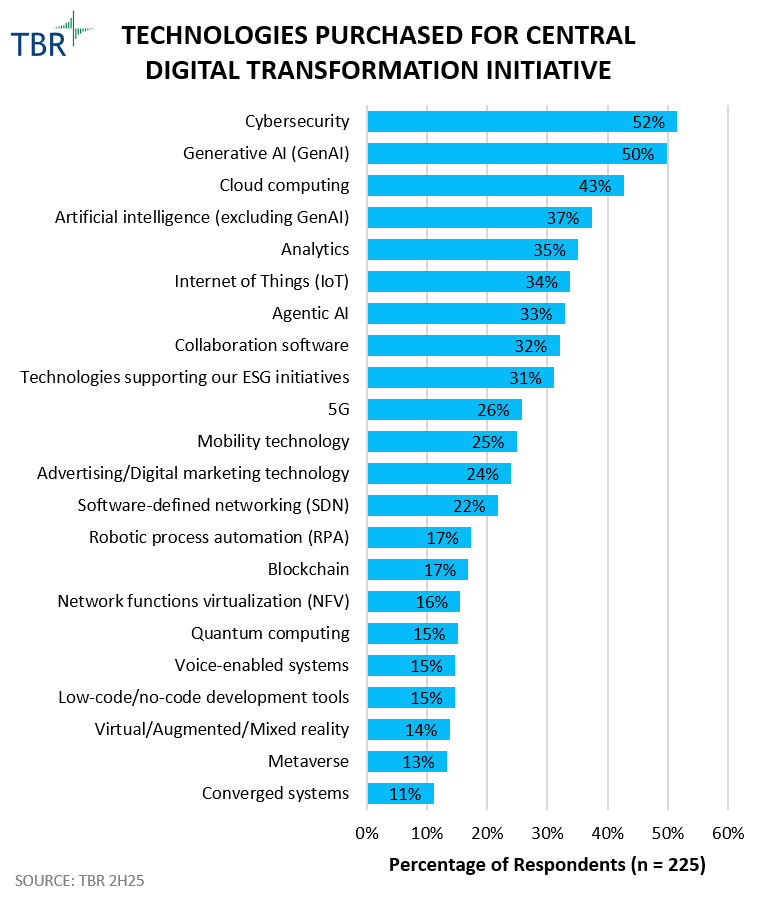
“What is the expected play? The good-old hybrid playbook usually helps: develop and run PQC standards that run on classical computers but resist quantum decryption. Although this may not be the state KPMG’s quantum professionals want to operate in, it would be the cheaper option when it comes to scaling. Quantum is exciting, and there is huge potential, but firms like KPMG need to avoid turning it into another blockchain where a technology was looking for a problem to solve. TBR’s December 2025 Digital Transformation: Voice of the Customer Research ​noted 15% of buyers procured quantum to support their digital transformation [DT] programs in 2025, down from 18% in 2024. Since we started conducting the survey seven years ago, quantum has continued to be in the bottom half of the tech enabling buyers’ DT initiatives: not disappearing but also not top of mind. The complexities of the tech might make current buyers even more uneasy, and I think generative AI has given them plenty of change management challenges. Perhaps the generational shift at the buyer side really needs to happen before quantum picks up steam. In the meantime, KPMG has an opportunity to educate and prepare its clients. May have to do some pro bono work. But if the timing is right, it could be KPMG’s Y2K moment in terms of its relationship with IT buyers.”
 

Technologies Purchased for Central Digital Transformation Initiatives

Technologies Purchased for Central Digital Transformation Initiative (Source: TBR)

Be curious

“Quantum’s been five years away for 30 years. Quantum is here. We’re actually working in it. So start looking into where it’s applicable in your organization. What’s going to drive for mandatory migrations, governance, but also what you do with it? And then be curious, which we’ve talked about this whole event. We don’t have a lot of algorithms yet. We don’t have a lot of ideas of what we can do with these. We talked yesterday about we’re going to give these to 18-year-olds with no biases of how computers work, and we’re going to see things we’ve never seen. So inspire your people to poke at it, to understand what’s going on. Get on, play with the free minutes that everybody can get, and accept that this is coming and is going to be part of our strategies going forward.” — Aaron Kemp, KPMG Senior Director, Quantum Research, Enterprise Innovation, during a panel session
 
During the discussion with analysts and on various panels, multiple quantum professionals extolled the idea of quantum computing operating alongside traditional and high-performance computing (HPC), allowing enterprise clients and others to select the best compute power and engine for the task. With TBR, Kemp mentioned IBM’s new data center combining HPC, Watson AI, and quantum computing as a model for helping clients use a “what fits, rather than a one-size-fits-all” approach. Kemp also said (maybe lamented?) that “quantum-enhanced solutions” are possible today, but the focus among quantum practitioners remains the hard problems only quantum may be able to solve, instead of the near-term practical uses.
 
During the larger panel discussion, as reflected in the quotes, the panelists described the current state as progressing faster than expected and delivering value, potentially, when paired with traditional computing capabilities. Pulling all the threads together, KPMG has positioned itself as ready to help clients prepare for when quantum shifts from an expensive idea to an immediate opportunity and threat. Can the firm create near-term revenue as PQC meets its Y2K moment, provide reliable and useful services through hybrid computing, and manage the ecosystem and orchestration layer in quantum? Maybe. At scale with clients? Likely. Are KPMG’s clients really ready for that? Are all of KPMG’s partners, principals and directors? Let’s see.
 
TBR doesn’t have quantum experts, and we don’t pretend to understand the physics. But we do understand business models and consulting. And KPMG appears to be in the right place to bring quantum value to its clients while expanding the firm’s reach, revenues and retention.

Holiday Shopping Is Becoming an AI Story: How Value-conscious Consumers, Rising Memory Costs and Connectivity Are Reshaping Retail

Consumers are spending, but value is winning

The 2026 holiday season is shaping up to be strong on paper. Mastercard Economics Institute expects U.S. retail sales, excluding automobiles and gas, to grow 5.5% year-to-year from Nov. 1 through Dec. 24, while Bain forecasts holiday sales will exceed $1 trillion for the first time. Yet the headline growth masks a more cautious consumer. Forbes reports that 31% of shoppers expect to increase their holiday budgets, but 53% of those spending more say that is because everything costs more, not because they have greater purchasing power. Bain similarly points to inflation, low savings and elevated credit card delinquencies as pressure points influencing spending decisions this holiday season. The result is a shopper willing to spend but increasingly focused on value.

AI is the new holiday shopping assistant

The search for value is accelerating consumer adoption of AI, as AI tools are seen as a means to more effectively locate and pursue greater value with purchasing decisions. Forbes reports that nearly two-thirds of U.S. shoppers expect AI to influence at least 30% of their holiday spending, with deal-finding, product comparisons and retailer selection among the leading use cases.
 
Bain found that 24% of online shoppers expect to begin their holiday search on generative AI platforms, up from 17% in 2025, while another 13% plan to use retailer-owned AI shopping agents. This demonstrates that consumers are lowering their caution around AI usage, as previously skeptical users are more willing to experiment with AI tools in the name of cost savings.
 
Additionally, Mastercard found that AI users tend to shop across a broader set of merchants and spend earlier in the holiday season. AI is therefore becoming an intermediary between consumers and brands. Though humans remain involved as the decision makers, AI enhances and extends the shopping experience to new brands, new shopping platforms and potentially new products.

The hidden cost of the AI shopping boom

The irony is that the same AI adoption helping consumers find value is increasing costs in consumer products such as electronics. Hyperscalers, neoscalers and neoclouds are accelerating AI infrastructure investment, increasing demand for ever-scarcer key memory and components, thus driving up these costs. Suppliers are prioritizing scarce capacity for server DRAM, high-bandwidth memory and enterprise storage, tightening supply for consumer applications. This dynamic will keep memory prices elevated and will continue to result in higher component costs for consumer electronics.
 
For retailers, AI can improve personalization and customer service, but the infrastructure required to deliver those capabilities comes with a rising cost.

Higher device costs add another holiday spending pressure point

The AI infrastructure boom could also reach holiday shoppers through higher smartphone costs. AI server demand is contributing to higher DRAM and NAND prices, and smartphone manufacturers have little appetite to absorb those increases, potentially pushing more costs to consumers at a time when value remains a priority. This creates a challenge for U.S. mobile network operators, which rely heavily on device promotions to drive upgrades and switching. The carriers still offer substantial smartphone discounts, but many of the largest offers require trade-ins, qualifying plans or new lines, with savings delivered through multiyear bill credits.
 
As device prices rise, holiday shoppers may delay upgrades or depend more heavily on financing and promotions, forcing operators to balance consumer affordability with the cost of more expensive device subsidies. The holiday quarter remains an important device sales period for U.S. operators. Consumers that are stretching an inflation-affected budget for the 2026 holiday season may find themselves delaying upgrades, especially if device prices increase further due to component cost growth.
 
Additionally, higher component costs will likely limit U.S. operators’ ability to discount as heavily as they have in years past.

Connectivity turns AI investment into a retail experience

As retailers invest more heavily in AI to capture increasingly value-conscious holiday shoppers, the effectiveness of those investments will depend on the infrastructure supporting them. AI recommendations, computer vision, mobile point-of-sale, real-time inventory and in-store personalization only create value when data can move reliably between devices, stores, edge systems and cloud platforms.
 
A 2026 Verizon Business study found that AI and machine learning applications are driving 67% of retailer network upgrades, while only 39% of retailers are satisfied with their edge computing support. Verizon is positioning 5G Business Internet and private networks for these workloads to address the gap in satisfaction.
 
AT&T’s Connected Spaces combines connectivity, edge infrastructure and Azure AI for environments including retail, and its collaboration with AWS connects fiber and 5G directly to cloud environments for business AI workloads.
 
T-Mobile similarly positions 5G, IoT and advanced network solutions for inventory management, mobile point-of-sale and computer vision. In this sense, connectivity becomes part of the same holiday spending story as retailers may compete through AI-enabled experiences, but networks ultimately determine how reliably those experiences reach consumers.

The holiday shopping cart now reaches back to the data center

Holiday shopping is becoming a useful snapshot of a much larger technology cycle. Consumers, who have been continuously squeezed by inflation for years, want better prices and more personalized experiences. Retailers are turning to AI to deliver both, and AI is driving investment in compute, memory, edge infrastructure and networks to support this shift in demand.
 
The connection from a shopper asking an AI assistant to find the best gift to a retailer’s cloud infrastructure, memory procurement and store connectivity may not be visible, but it is increasingly direct and essential as customers have higher expectations for seamless and positive customer experiences. For telecom operators, that makes retail AI more than an application trend. It is another reason reliable fiber, 5G, edge computing and resilient enterprise connectivity are becoming part of the commercial infrastructure behind everyday consumer experiences.

AI Is Changing Enterprise Networking, but Not All Disruption Looks the Same

AI has become a nearly universal component in enterprise networking product road maps

TBR’s latest research on AI disruption among enterprise network vendors addresses the gap in measuring how deeply AI is changing how these vendors operate by providing a quantitative assessment of Cisco, Hewlett Packard Enterprise (HPE) and Extreme Networks using TBR’s ©Human Intensity Reduction Index (HIRI). HIRI is a proprietary metric that provides a direct measure of a company’s AI, human capital, utilization, offshore leverage and delivery model evolution on its operating margin. The metric helps distinguish genuine business-model disruption from window-dressing AI announcements.
 
Our initial results show an industry in transition. HIRI and operating margins are improving across the peer group, but AI is only one part of the story. Restructuring efforts, revenue growth, subscription adoption and portfolio consolidation continue to strongly influence workforce productivity. Additionally, customer demand for AI-based solutions to support their own AI transformations boosts financial performance independent of the vendors’ internal AI investments.

HIRI helps separate AI-related activity from routine business operations changes

The three vendors illustrate different approaches to achieving the same fundamental goal. Cisco demonstrates the clearest evidence of AI directly handling work, including 145,000 customer support cases resolved without human intervention. Cisco has also publicly touted that AI agents are now available to all remaining employees following its latest round of layoffs. HPE is leveraging AI enhancements along with the Juniper integration, creating opportunities to reuse development resources across a much larger networking portfolio. Extreme Networks is taking a product-led approach, using Agent ONE and Platform ONE to advance autonomous networking and accelerate its transition toward a more SaaS-oriented business model.
 
HIRI is only part of the story, however. Through our research, we also examine how AI is disrupting vendors’ operating, commercial, delivery and partner models, layering a qualitative lens over quantitative metrics. This analysis makes it clear that AI is only part of the broader efficiency story for these vendors. One of the most important emerging AI-centric themes is the progression from AI assistants toward agentic and autonomous systems that can increasingly investigate, troubleshoot and execute network operations with less human intervention. These vendors are both producers and consumers of this technology, placing them all squarely at the center of this transformation. There are also very real, nontechnological roadblocks to this progress, namely FOBO (fear of becoming obsolete) and the underlying hesitation among end users to adopt and embrace AI, a challenge companies continue to seek to overcome.
 
TBR’s AI disruption research will continue to examine whether enterprise network vendors’ investments in AI are materially changing how they operate, generate revenue, deliver technology and engage their ecosystems. Access the current enterprise network vendor AI disruption data and analysis with a TBR Insight Center™ free trial.

Exploring KPMG’s Role in AI

In July KPMG hosted its 9th annual Tech and Innovation Symposium in Deer Valley, Utah, attended by more than 100 technology and business professionals, politicians, academics, KPMG technology alliance partners, KPMG professionals and a handful of analysts, including TBR. Three days of discussions, breakout sessions and informal chats covered AI, the space economy, quantum, cybersecurity, workforce transitions, the NBA, geopolitics and more. This is the first in a series of blogs focusing on specific elements, discussions and/or insights TBR noted during the event.
 
In 2026 KPMG’s message around business outcomes is landing differently than it did just a year ago, when AI hype possibly reached its peak. Now the firm and its clients talk less about productivity, cost cutting, or even AI’s potential to increase revenues and growth. Technology has taken a backseat to change as a business outcome. It is a subtle shift, perhaps, but in contrast to hype about AI’s unrivaled promise, the joys of vibe coding, and AI as the answer to every question, a grounded, restrained, business-first approach — one could even say “vibe” — provided a convincing foundation for the wary optimism that permeated the KPMG event.
 
Two specific recurring themes capture the difference between 2025 AI talk and 2026 AI reality. First, speakers, including but not exclusively KPMG professionals, stressed that enterprises cannot overspend on governance, risk and compliance. Understanding the inputs, the outputs, and what led from one to the other will be critical to leveraging AI at scale. Absent trusted and auditable AI, there will be chaos (apres moi, le deluge, perhaps). Second, using the right type of AI matters more than using AI. To paraphrase Ted Lasso, don’t be a gravedigger using a spoon.
 
Additional insights into KPMG’s AI initiatives based on discussions and presentations at the Utah event:

  • TBR noted a disconnect between AI as it is reported in major news outlets and AI-centric news and analysis feeds and AI as discussed by the speakers, KPMG professionals and attendees. IPOs, circular financing among chipmakers and frontier model companies, acquisitions, and AI personalities barely registered. Regulatory changes effecting enterprises’ business decisions around AI, practical applications of AI-enabled solutions, cost considerations when choosing different AI models, and the twin challenges of change management and trust featured heavily. In short, the Symposium participants seemingly ignored AI drama to focus on AI practicalities.
  • During a question-and-answer session, KPMG US CEO Tim Walsh provided a fairly compact set of steps for enterprises embarking on an AI initiative: know yourself, know your data and operations, know your resilience, and bring in an outsider to help. In TBR’s view, perhaps KPMG would prefer the last step to come first, but as a way for KPMG’s clients to think about scaled AI adoption within an enterprise, those steps are necessary for success, starting and ending with trust. At last year’s Symposium, a KPMG speaker said success depends on leaders, labs and the masses, a formula TBR brought up with clients during this event, testing its continued relevance. Next year, TBR will ask if outside help still rings true.
  • In a session with TBR, KPMG leaders noted that the firm has encouraged every professional across the firm to use AI agents, even if only at a rudimentary level. They also stressed KPMG’s AI role lies between the AI model layer and the data layer, providing intelligence and orchestration based on KPMG’s understanding of how businesses actually run. In TBR’s view, this intentional positioning in the middle of the AI value chain (in addition, of course, to AI advisory services at the front end of consulting) reflects the firm’s broader strategy of becoming an even more critical ecosystem partner to technology providers. When a KPMG leader talked about the firm’s OpenAI + Oracle + KPMG customer-zero story, TBR heard how OpenAI and Oracle can now better explain, to their clients, KPMG’s value and KPMG’s orchestration and business operations layer.

At the start of 2026, “simplicity” seemed to be the word of the year. Clients clamored for simplicity in AI deployments and their technology spend. Consultancies and IT services companies promised simplicity in pricing, implementation and operations. By July, trust replaced simplicity: trust at scale, trust through auditable AI, and trust enabled by Responsible AI.
 
What struck TBR most about KPMG’s frequent evocations of trust was the humility that went with it. Knowing trust has to be earned, maintained and renewed seemed to inform how KPMG leaders spoke about the firm’s capabilities and relationships. And in casual discussions with KPMG clients at the Utah event, trust came up repeatedly as a key reason they were there.