
 Technology Business Research, Inc.
Holiday Shopping Is Becoming an AI Story: How Value-conscious Consumers, Rising Memory Costs and Connectivity Are Reshaping Retail
Consumers are spending, but value is winning
The 2026 holiday season is shaping up to be strong on paper. Mastercard Economics Institute expects U.S. retail sales, excluding automobiles and gas, to grow 5.5% year-to-year from Nov. 1 through Dec. 24, while Bain forecasts holiday sales will exceed $1 trillion for the first time. Yet the headline growth masks a more cautious consumer. Forbes reports that 31% of shoppers expect to increase their holiday budgets, but 53% of those spending more say that is because everything costs more, not because they have greater purchasing power. Bain similarly points to inflation, low savings and elevated credit card delinquencies as pressure points influencing spending decisions this holiday season. The result is a shopper willing to spend but increasingly focused on value.
AI is the new holiday shopping assistant
The search for value is accelerating consumer adoption of AI, as AI tools are seen as a means to more effectively locate and pursue greater value with purchasing decisions. Forbes reports that nearly two-thirds of U.S. shoppers expect AI to influence at least 30% of their holiday spending, with deal-finding, product comparisons and retailer selection among the leading use cases.
Bain found that 24% of online shoppers expect to begin their holiday search on generative AI platforms, up from 17% in 2025, while another 13% plan to use retailer-owned AI shopping agents. This demonstrates that consumers are lowering their caution around AI usage, as previously skeptical users are more willing to experiment with AI tools in the name of cost savings.
Additionally, Mastercard found that AI users tend to shop across a broader set of merchants and spend earlier in the holiday season. AI is therefore becoming an intermediary between consumers and brands. Though humans remain involved as the decision makers, AI enhances and extends the shopping experience to new brands, new shopping platforms and potentially new products.
The hidden cost of the AI shopping boom
The irony is that the same AI adoption helping consumers find value is increasing costs in consumer products such as electronics. Hyperscalers, neoscalers and neoclouds are accelerating AI infrastructure investment, increasing demand for ever-scarcer key memory and components, thus driving up these costs. Suppliers are prioritizing scarce capacity for server DRAM, high-bandwidth memory and enterprise storage, tightening supply for consumer applications. This dynamic will keep memory prices elevated and will continue to result in higher component costs for consumer electronics.
For retailers, AI can improve personalization and customer service, but the infrastructure required to deliver those capabilities comes with a rising cost.
Higher device costs add another holiday spending pressure point
The AI infrastructure boom could also reach holiday shoppers through higher smartphone costs. AI server demand is contributing to higher DRAM and NAND prices, and smartphone manufacturers have little appetite to absorb those increases, potentially pushing more costs to consumers at a time when value remains a priority. This creates a challenge for U.S. mobile network operators, which rely heavily on device promotions to drive upgrades and switching. The carriers still offer substantial smartphone discounts, but many of the largest offers require trade-ins, qualifying plans or new lines, with savings delivered through multiyear bill credits.
As device prices rise, holiday shoppers may delay upgrades or depend more heavily on financing and promotions, forcing operators to balance consumer affordability with the cost of more expensive device subsidies. The holiday quarter remains an important device sales period for U.S. operators. Consumers that are stretching an inflation-affected budget for the 2026 holiday season may find themselves delaying upgrades, especially if device prices increase further due to component cost growth.
Additionally, higher component costs will likely limit U.S. operators’ ability to discount as heavily as they have in years past.
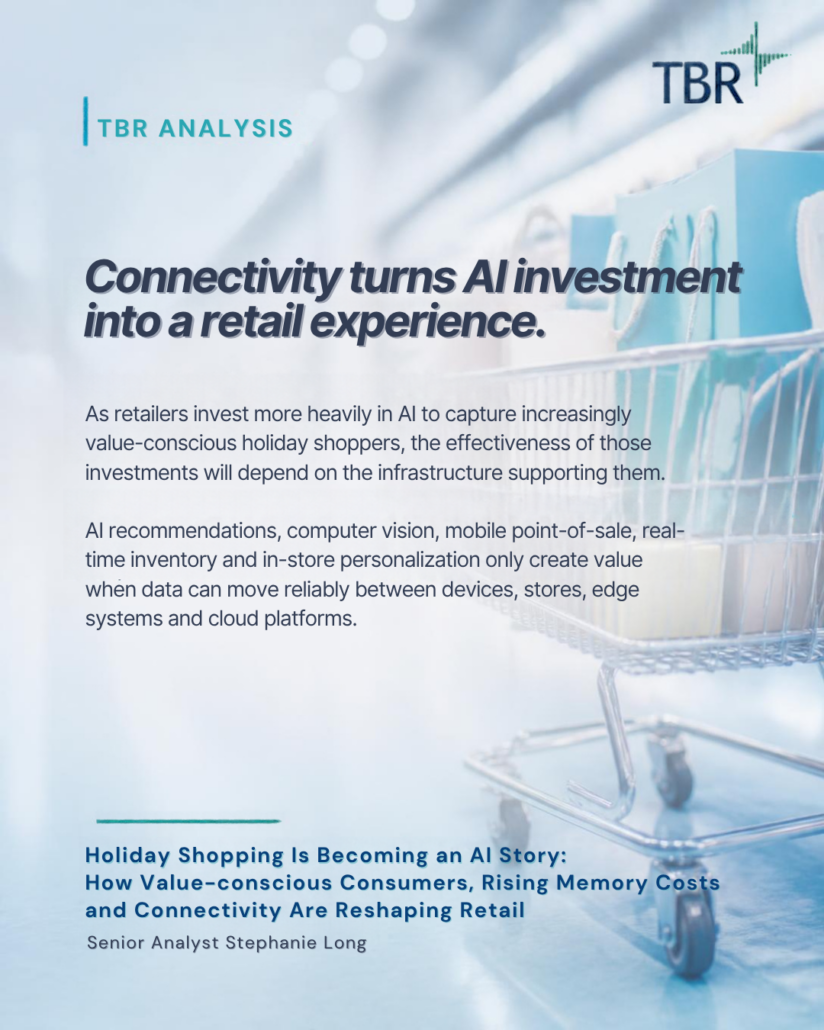
Connectivity turns AI investment into a retail experience
As retailers invest more heavily in AI to capture increasingly value-conscious holiday shoppers, the effectiveness of those investments will depend on the infrastructure supporting them. AI recommendations, computer vision, mobile point-of-sale, real-time inventory and in-store personalization only create value when data can move reliably between devices, stores, edge systems and cloud platforms.
A 2026 Verizon Business study found that AI and machine learning applications are driving 67% of retailer network upgrades, while only 39% of retailers are satisfied with their edge computing support. Verizon is positioning 5G Business Internet and private networks for these workloads to address the gap in satisfaction.
AT&T’s Connected Spaces combines connectivity, edge infrastructure and Azure AI for environments including retail, and its collaboration with AWS connects fiber and 5G directly to cloud environments for business AI workloads.
T-Mobile similarly positions 5G, IoT and advanced network solutions for inventory management, mobile point-of-sale and computer vision. In this sense, connectivity becomes part of the same holiday spending story as retailers may compete through AI-enabled experiences, but networks ultimately determine how reliably those experiences reach consumers.
The holiday shopping cart now reaches back to the data center
Holiday shopping is becoming a useful snapshot of a much larger technology cycle. Consumers, who have been continuously squeezed by inflation for years, want better prices and more personalized experiences. Retailers are turning to AI to deliver both, and AI is driving investment in compute, memory, edge infrastructure and networks to support this shift in demand.
The connection from a shopper asking an AI assistant to find the best gift to a retailer’s cloud infrastructure, memory procurement and store connectivity may not be visible, but it is increasingly direct and essential as customers have higher expectations for seamless and positive customer experiences. For telecom operators, that makes retail AI more than an application trend. It is another reason reliable fiber, 5G, edge computing and resilient enterprise connectivity are becoming part of the commercial infrastructure behind everyday consumer experiences.
 Technology Business Research, Inc.
 Technology Business Research, Inc.