
 Technology Business Research, Inc.
Exploring KPMG’s Role in Quantum
In July KPMG hosted its 9th annual Tech and Innovation Symposium in Deer Valley, Utah, attended by more than 100 technology and business professionals, politicians, academics, KPMG technology alliance partners, KPMG professionals and a handful of analysts, including TBR. Three days of discussions, breakout sessions and informal chats covered AI, the space economy, quantum, cybersecurity, workforce transitions, the NBA, geopolitics and more. This is the second in a series of blogs focusing on specific elements, discussions and/or insights TBR noted during the event.
The urgency around quantum computing
“So right now, our quantum computers work … they do all the stuff that a regular computer does. They even show potential in many areas where we can demonstrate speed up, but we cannot justify an ROI with the existing quantum computers, and no one else can.” — Subodh Kulkarni, President & Chief Executive Officer, Rigetti Computing, during a panel discussion at the KPMG Tech and Innovation Symposium
If the hype around AI was a bit subdued this summer compared to last year’s event (see the first blog in this series), the urgency around quantum computing more than filled the gap. KPMG US CEO Tim Walsh’s initial question after the first expert speaker related to quantum. The opening breakout session for industry analysts, including TBR, focused on quantum, led by KPMG’s Aaron Kemp, senior director, Quantum Research, Enterprise Innovation. TBR found KPMG’s quantum message compelling, and maybe a touch frightening across three specific areas: post-quantum cryptography (PQC); quantum advisory; and quantum today, which, as the quote above makes clear, is here now.
Quantum’s disruption potential
“We received an RFI that really caught us caught us off guard about five years ago, asking a lot of deep questions about the coming PQC migration, what it was going to take for an organization to do that. We started looking at how are we going to answer those questions for our clients. PQC is obviously extremely complicated.” — Aaron Kemp, KPMG Senior Director, Quantum Research, Enterprise Innovation, during a panel session
In a discussion with TBR and during a couple of panels, Kemp stressed the massive disruptive potential of PQC. Likening the challenge to Y2K, he said IT services companies, consultancies and niche technology vendors would likely see huge opportunities in preparing for and then mitigating against the fallout from post-Q-day cybersecurity challenges. In TBR’s ongoing research and analysis of the U.S. federal sector IT services players, IBM, General Dynamics Information Technology, Booz Allen Hamilton, Accenture Federal Services and Leidos have been concentrating heavily on post-quantum cryptography, cryptographic agility, inventory and remediation services and quantum-safe networking. Even with those efforts focused on government buyers, the activities and investments by companies with significant commercial sector clients (such as Accenture and IBM) prove smart money has positioned for PQC opportunities.
During a panel discussion, Barak Bussel, co-founder of 7i Capital and board chair of the UCLA Center for Quantum Science and Engineering (CQSE), said, “We no longer can rely on the old kind of cryptography and the old encryption paradigms. We chatted about this before. We don’t use Enigma anymore. I mean, it’s a different world, and now it’s time to kind of migrate away from, you know, problems of factoring large numbers to a new kind of encryption methodologies that will take us to the next step.” Every panelist, and maybe every attendee at the Symposium, seemed certain that PQC and all that comes with it are frighteningly close.
“It’s estimated there’s 16,500 quantum researchers on the planet. When we separate those into the organizations, where does that talent come from, and how do you stay strategically aligned with quantum, the GPUs, AI, as we kind of move into this new paradigm of compute?” — Aaron Kemp, KPMG Senior Director, Quantum Research, Enterprise Innovation, during a panel session
According to Kemp, KPMG’s Quantum Advisory practice will focus on Fortune 200 companies, which will likely invest in their own quantum computing capabilities. In discussing this strategy with TBR and other analysts, Kemp noted the dearth of quantum talent, an assessment he echoed the following day during a panel discussion. To address that challenge, KPMG has been training professionals, particularly in the cybersecurity practice, on quantum capabilities and KPMG’s offerings.
The firm has also been advising clients on the near-term steps they can make to prepare for Q-day as well as for the business opportunities quantum computing will create in other sectors, such as academic research, government and life sciences. Kemp described a coming “massive opportunity” to retire technical debt, get rid of duplicate software licenses, clean up data, and streamline IT and cybersecurity within an enterprise — efforts KPMG can address with expertise and experience. In TBR’s view, KPMG’s quantum advisory story meets the moment: urgent, practical and preparing for an uncertain, but unquestionably disrupted, future. One nagging question remains for TBR: Is the rest of KPMG ready for quantum?
An analyst’s perspective: the calm before the storm
From my colleague, Principal Analyst Boz Hristov:
“PQC is a must-have discussion and investment, given the move to all-things-are-digital and especially the rise of digital currencies. We know blockchain solves for some of the cryptographies, but there are some strong, powerful quantum computers that could reverse the public keys to steal private ones and really defy the idea of blockchain. Given KPMG’s role in the financial services world — across its entire stack of offerings (tax, audit, consulting) — the firm needs to think about how to be part of the solution. Possibly the PQC play, which, in a perfect world, could battle bad actors and help blockchain-based crypto exchanges survive. Lots of GRC [governance, risk and compliance] opportunity here, no doubt. The challenge with PQC is that it can be expensive and very data heavy, making blockchain ledgers slow down and ultimately raise transaction fees. Migration hurdles can be another challenge as users would need to more often move to quantum-safe addresses.
“What is the expected play? The good-old hybrid playbook usually helps: develop and run PQC standards that run on classical computers but resist quantum decryption. Although this may not be the state KPMG’s quantum professionals want to operate in, it would be the cheaper option when it comes to scaling. Quantum is exciting, and there is huge potential, but firms like KPMG need to avoid turning it into another blockchain where a technology was looking for a problem to solve. TBR’s December 2025 Digital Transformation: Voice of the Customer Research noted 15% of buyers procured quantum to support their digital transformation [DT] programs in 2025, down from 18% in 2024. Since we started conducting the survey seven years ago, quantum has continued to be in the bottom half of the tech enabling buyers’ DT initiatives: not disappearing but also not top of mind. The complexities of the tech might make current buyers even more uneasy, and I think generative AI has given them plenty of change management challenges. Perhaps the generational shift at the buyer side really needs to happen before quantum picks up steam. In the meantime, KPMG has an opportunity to educate and prepare its clients. May have to do some pro bono work. But if the timing is right, it could be KPMG’s Y2K moment in terms of its relationship with IT buyers.”
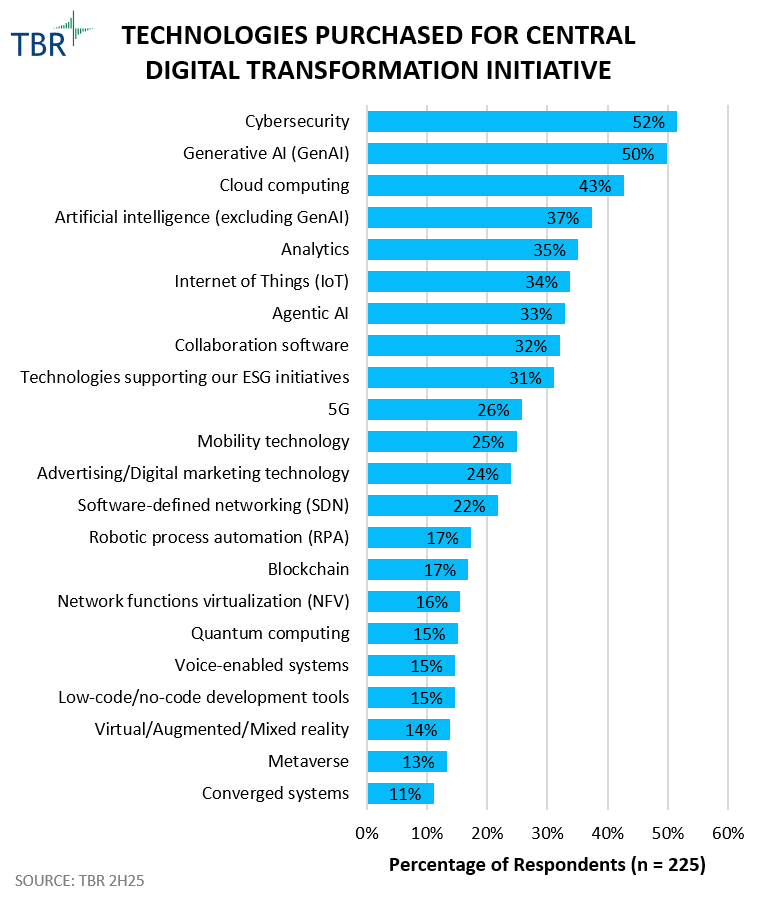
Technologies Purchased for Central Digital Transformation Initiative (Source: TBR)
Be curious
“Quantum’s been five years away for 30 years. Quantum is here. We’re actually working in it. So start looking into where it’s applicable in your organization. What’s going to drive for mandatory migrations, governance, but also what you do with it? And then be curious, which we’ve talked about this whole event. We don’t have a lot of algorithms yet. We don’t have a lot of ideas of what we can do with these. We talked yesterday about we’re going to give these to 18-year-olds with no biases of how computers work, and we’re going to see things we’ve never seen. So inspire your people to poke at it, to understand what’s going on. Get on, play with the free minutes that everybody can get, and accept that this is coming and is going to be part of our strategies going forward.” — Aaron Kemp, KPMG Senior Director, Quantum Research, Enterprise Innovation, during a panel session
During the discussion with analysts and on various panels, multiple quantum professionals extolled the idea of quantum computing operating alongside traditional and high-performance computing (HPC), allowing enterprise clients and others to select the best compute power and engine for the task. With TBR, Kemp mentioned IBM’s new data center combining HPC, Watson AI, and quantum computing as a model for helping clients use a “what fits, rather than a one-size-fits-all” approach. Kemp also said (maybe lamented?) that “quantum-enhanced solutions” are possible today, but the focus among quantum practitioners remains the hard problems only quantum may be able to solve, instead of the near-term practical uses.
During the larger panel discussion, as reflected in the quotes, the panelists described the current state as progressing faster than expected and delivering value, potentially, when paired with traditional computing capabilities. Pulling all the threads together, KPMG has positioned itself as ready to help clients prepare for when quantum shifts from an expensive idea to an immediate opportunity and threat. Can the firm create near-term revenue as PQC meets its Y2K moment, provide reliable and useful services through hybrid computing, and manage the ecosystem and orchestration layer in quantum? Maybe. At scale with clients? Likely. Are KPMG’s clients really ready for that? Are all of KPMG’s partners, principals and directors? Let’s see.
TBR doesn’t have quantum experts, and we don’t pretend to understand the physics. But we do understand business models and consulting. And KPMG appears to be in the right place to bring quantum value to its clients while expanding the firm’s reach, revenues and retention.
 Technology Business Research, Inc.