
The Paradox of AI Infrastructure: Hyperscalers’ Ambition Collides With the Power Grid and What This Means for Telcos
The AI infrastructure supercycle is entering a new phase. The central question is no longer whether hyperscalers have the capital or appetite to build AI infrastructure but whether the power grid can support what they intend to build.
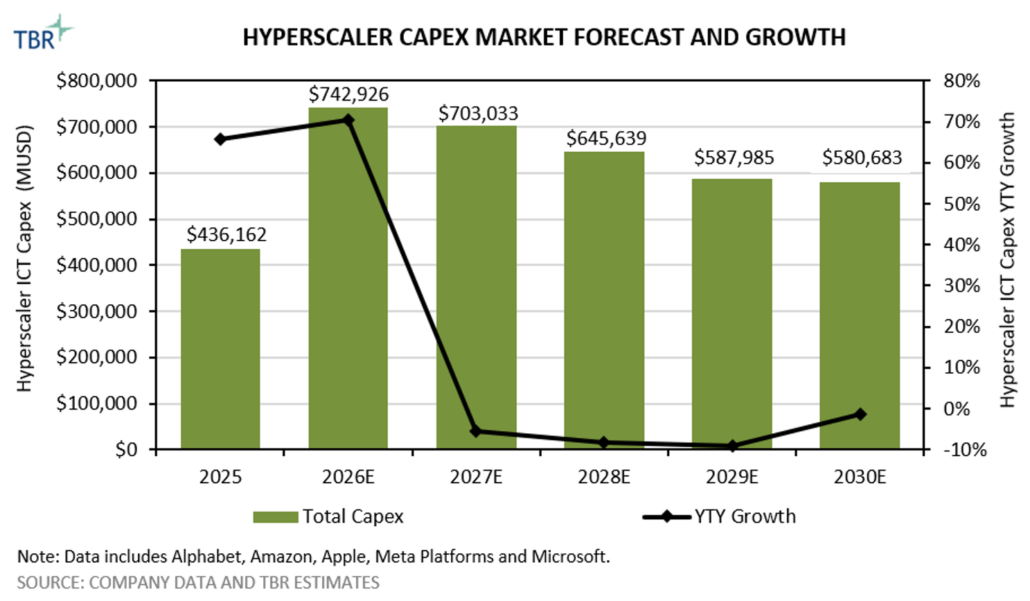
TBR’s latest Hyperscaler Capex Market Forecast 2025-2030 estimates that Meta, Alphabet, Microsoft, Amazon and Apple (MAMAA) will collectively spend approximately $743 billion in capex in 2026, up 70% year-to-year. Much of that investment is flowing into AI-related infrastructure, including data centers, servers, storage and networking.
But capital alone cannot build the AI economy. Increasingly, the constraint is energy.
Power is becoming the limiting factor
U.S. data center developers have requested 1,066 GW of electricity, equivalent to roughly 83% of existing U.S. utility-scale generation capacity. Yet an August 2026 Bloomberg study titled “Most Power Sought for US Data Centers Will Never Materialize” indicates utilities and grid operators can ultimately commit to only about 28% of that amount.
Some of that demand is undoubtedly inflated by duplicate or speculative applications. Even so, the underlying problem is clear: Generation capacity as well as grid infrastructure and interconnection timelines cannot expand at the pace AI investment currently requires.
Hyperscalers are already responding. TBR noted in the same forecast that Alphabet, Amazon, Microsoft and Meta are increasingly looking beyond conventional utility procurement and pursuing natural gas, renewables, energy storage, nuclear and geothermal resources.
That shift has significant competitive implications. Access to power is evolving from an operating requirement into a strategic differentiator. The companies that can secure reliable energy — and place compute where that energy is available — will be better positioned to translate AI capex into usable capacity.
For telecom operators, the collision between AI and energy creates both opportunity and strategic risk
The first wave of generative AI infrastructure has been dominated by centralized training clusters, helping to delay the long-anticipated shift toward more distributed edge cloud infrastructure. That dynamic could begin to change as AI moves increasingly from training toward inferencing.
Inference workloads that require lower latency, faster response times, or proximity to users and devices will create greater incentives to distribute compute closer to endpoints. At the same time, power constraints could push AI infrastructure into a wider range of locations based on not only proximity to demand but also access to available electricity. That combination could make the AI infrastructure footprint substantially more distributed.
For telecom operators, this creates an important opening. Hyperscalers will need greater network capacity to connect AI infrastructure spread across data centers, edge locations and new power-rich geographies. Telecom networks therefore become increasingly important not simply as pipes connecting compute but also as infrastructure that enables hyperscalers to place compute wherever power, economics and workload requirements are most favorable.
A more distributed inference architecture could also alleviate some pressure on large, centralized power hubs by spreading portions of AI compute across a broader infrastructure footprint. It will not solve the underlying energy shortage, but it could change how — and where — that constraint is managed.
Conclusion
The next infrastructure bottleneck for AI may not hinge solely on computational power but could be significantly influenced by energy availability.
As the demand for new AI capabilities rises, power constraints will likely reshape the geography of data centers and accelerate the distribution of inference workloads. Moreover, the strategic importance of telecom networks will increase as they connect an increasingly fragmented AI infrastructure landscape.
Consequently, the upcoming phase of the AI infrastructure supercycle could be characterized as much by access to megawatts and connectivity as it is by the availability of GPUs.
 Getty Images, via Canva Pro
 Technology Business Research, Inc.
 Alemedia.ID via Canva Pro
 Getty Images Signature
 Technology Business Research, Inc.