
AMD Enters the Execution Phase of its Full-stack AI Strategy
AMD used Advancing AI 2026 to show how its broad compute portfolio is coming together around agentic AI. The company moved its first Helios rack-scale systems into production, introduced 6th Gen EPYC CPUs and Instinct MI400 Series GPUs, expanded its open networking and software strategy, and outlined how AI-assisted development can make AMD hardware easier to use. Together, these announcements moved the event beyond the accelerator-focused discussion that has historically defined AMD’s competition with NVIDIA.
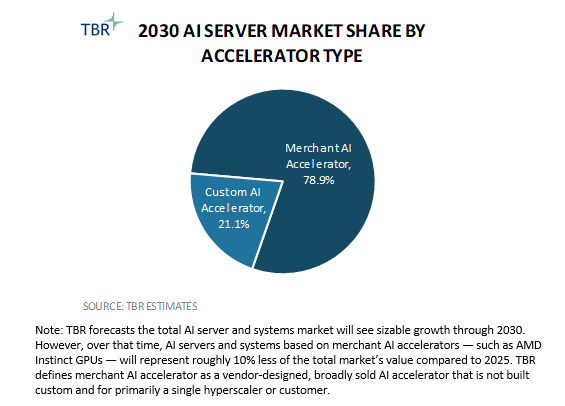
The progression since Advancing AI 2025 was most visible in Helios. Last year, AMD introduced Helios as the rack-scale architecture combining Instinct GPUs, EPYC CPUs, Pensando networking and ROCm software. This year, AMD said Helios is in full production, established shipment timing and an annual road map, and highlighted planned deployments from Microsoft, OpenAI and Anthropic alongside validation work with Meta. AMD estimates that the AI accelerator market will reach roughly $1.4 trillion by 2030, and Helios gives the company a system-level platform through which to pursue that opportunity. However, while TBR believes AMD will win share from NVIDIA in the AI accelerator market through 2030, we view AMD’s total market estimate as a best-case scenario.
AMD also argued that its strong position in the data center CPU market will benefit the company as agentic AI expands AI compute demand beyond GPUs with agentic workflows repeatedly invoking models while also executing code, calling tools and interacting with enterprise applications. Reflecting this broader role for general-purpose compute, AMD estimates that the server CPU market will exceed $200 billion by 2030. Together, Helios and AMD’s agentic AI strategy broadens the company’s opportunity across the infrastructure stack, from frontier AI racks to general-purpose servers and local systems.
Helios turns AMD’s component portfolio into an open rack-scale architecture
Helios gives AMD the system-level platform it previously lacked. The initial configuration combines 72 Instinct MI455X GPUs and 18 6th Gen EPYC Venice host CPUs. Pensando Salina data processing units (DPUs) handle front-end networking, storage and security services; Vulcano AI NICs (network interface cards) provide scale-out Ethernet connectivity across racks; and UALink over Ethernet (UALoE) switch trays connect the GPUs within the rack. Each MI455X includes 432GB of HBM4, giving Helios 31TB of GPU memory, 50% more than the 20.7TB in an NVIDIA Vera Rubin NVL72 rack. AMD said shipments will begin late in 3Q26 and ramp up during 4Q26, with systems offered by OEM and manufacturing partners including Hewlett Packard Enterprise (HPE), Lenovo, Supermicro, Bull, Sanmina and Wiwynn.
The integrated architecture changes AMD’s competitive argument. Instead of competing primarily on accelerator specifications while relying on customers and OEMs to optimize the surrounding infrastructure, AMD can now define how compute, memory, networking, power and cooling operate together. This is increasingly important as AI performance and cost are determined at the rack and data center levels. For a Kimi K2 Thinking workload, AMD estimates that Helios can deliver up to 30% more inference tokens per dollar than an NVIDIA Vera Rubin NVL72 rack. Although the result is an AMD projection based on estimated throughput and hourly pricing — making it directional until systems are benchmarked in production — the claim demonstrates the shift in AMD’s value proposition from accelerator specifications toward rack-level serving economics.
AMD plans to carry this system-level approach forward through an annual platform road map. Helios 500, which will represent AMD’s second-generation Helios rack, will combine Instinct MI500 GPUs, EPYC Verano CPUs, and Pensando Como and Monza networking in 2027, while Helios 600 will follow in 2028 with MI600 GPUs, EPYC Ferrara CPUs, and Pensando Palma and Levanzo networking. This cadence coordinates AMD’s CPU, GPU, networking and software road maps around a consistent system architecture while giving customers greater visibility into future power, cooling and capacity requirements.
Openness is central to how AMD differentiates itself and plans to scale Helios across a broader ecosystem. Within the rack, Helios uses UALoE to connect GPUs into a high-bandwidth scale-up domain. UALink provides an open alternative to NVIDIA’s proprietary NVLink scale-up fabric, creating a role for merchant silicon and networking suppliers that NVIDIA fills primarily with its own technology. Across racks, Pensando Vulcano AI NICs provide scale-out Ethernet networking and support Ultra Ethernet Consortium (UEC)-ready RDMA (remote direct memory access), aligning Helios with UEC’s open, multivendor architecture. Conversely, while NVIDIA also uses standards-based Ethernet, the tight integration of NVIDIA switches, SuperNICs and software within its Spectrum-X platform lacks the flexibility offered by AMD. As such, TBR believes AMD’s open approach better aligns the company with networking and system suppliers that compete with NVIDIA’s vertically integrated rack-scale portfolio.
AMD’s open approach also extends to the physical rack and its partner implementations. Helios is based on the Open Compute Project’s Open Rack Wide specifications, with AMD defining the core 72-GPU architecture and networking topology. OEMs, ODMs and other manufacturing partners can differentiate around rack integration, power and cooling, management, deployment, and support, while hyperscalers and large service providers can integrate Helios with their own cluster networking, storage, orchestration and cloud services. This gives large buyers more influence over how Helios is incorporated into their infrastructure and allows multiple partners to commercialize the platform without requiring AMD to sell a single fixed, branded rack, leveraging the same commercialization approach NVIDIA has proved to be successful but with an added layer of openness.
Customer commitments validate Helios and the breadth of AMD’s data center portfolio
Microsoft offers the broadest validation of AMD’s data center strategy, with the companies’ expanded partnership both validating Helios as an integrated architecture and showing that AMD can win CPU and networking placements independently. Azure plans to deploy Helios at scale for frontier-model inference, Azure AI services and customer applications. Microsoft will also introduce new Azure virtual machines based on 6th Gen EPYC and broaden its use of Pensando DPUs across Azure networking services. Azure availability also gives AMD a route to enterprise demand beyond the small group of customers capable of deploying Helios directly.
AMD complemented Microsoft’s cloud-platform endorsement with commitments from leading model developers. OpenAI expects to bring Helios online beginning in 4Q26 and accelerate deployments during 2027, while Meta is testing Helios workloads and validating 6th Gen EPYC platforms. The Anthropic agreement goes further, with a planned deployment of up to 2 gigawatts of MI455X GPUs in Helios systems — with the first gigawatt beginning deployment in 1H27 — in addition to the companies establishing a multiyear engineering collaboration through which Claude will be used to optimize Instinct workloads and accelerate ROCm development. AMD also committed to investing up to $5 billion in Anthropic, using its balance sheet to deepen technical and commercial alignment with a major prospective infrastructure customer. The move follows a playbook NVIDIA has also used, pairing capital investment with technical collaboration and commitments to deploy its infrastructure.
Taken together, these engagements show that AMD is participating earlier in system design, workload optimization and capacity planning with several of the world’s largest AI infrastructure buyers. The announcements span different stages, from testing and planned availability to dated deployment commitments, but collectively establish Helios as a credible second source to NVIDIA at the rack level. These anchor customers also provide workloads and engineering input that can help AMD harden its overall AI platform before bringing it to a broader market.
Agentic AI broadens AMD’s opportunity across EPYC, ROCm and distributed AI
AMD framed agentic AI as a change in infrastructure demand that extends beyond model inference. The company estimates that inference will account for roughly 60% of global AI compute capacity in 2026 as usage shifts from training models toward putting them to work. Agents intensify that change because a single request can trigger repeated reasoning, tool calls, data retrieval and code execution. GPUs perform the model inference, while CPUs host and orchestrate the surrounding workflows.
AMD divided this CPU opportunity into three areas. AI host processors coordinate data movement and help keep accelerators fed; high-density agent sandboxes provide isolated environments for code execution and tool use; and general-purpose servers run the applications, databases and data services that agents access. The 6th Gen EPYC portfolio addresses these roles through different Venice configurations, ranging from high-frequency CPUs for GPU host nodes to processors with as many as 256 cores for agent sandboxes. AMD also emphasized x86 compatibility as an advantage because much of the enterprise software that agents will use already runs on x86 infrastructure.
AMD paired this CPU expansion with a software strategy aimed at its most persistent competitive limitation: the engineering work required to move and optimize applications for its GPUs. The strategy combines two ecosystem-oriented principles — openness and abstraction — with a new AMD-led automation layer.
ROCm’s open-source model means AMD does not have to build its software ecosystem alone. Customers, cloud providers and software developers can inspect how ROCm works, adapt it for their workloads and contribute fixes or performance improvements. NVIDIA also supports widely used open AI frameworks, but the core CUDA tool kit remains proprietary and NVIDIA-controlled. In contrast, ROCm gives outside engineers greater ability to improve the underlying GPU software and lets AMD draw on its ecosystem to close functionality and performance gaps. However, AMD remains responsible for integrating those contributions into a reliable platform that performs competitively.
Abstraction reduces the amount of application code tied directly to either ROCm or CUDA. Frameworks and programming tools such as PyTorch and Triton provide common interfaces, while AMD and NVIDIA optimize the hardware-specific software beneath them. This makes applications more portable, although platform-specific kernels, libraries and performance tuning remain necessary, meaning AMD must continue improving its compilers, runtimes, communications libraries and kernels even as abstraction makes them less visible to application developers.
ROCm.AI adds automation to these ecosystem-oriented principles through AMD Skills, the ROCm CLI and Console, and the Hyperloom optimization system. AMD Skills brings validated ROCm knowledge into coding agents such as Claude, Codex and Cursor; the CLI and Console provide repeatable setup, execution and diagnostic paths; and Hyperloom profiles inference workloads, identifies bottlenecks and tests targeted changes to host code and GPU kernels. Together, these tools can reduce the manual setup, troubleshooting and tuning previously performed by specialized engineers, albeit they still depend on the quality of AMD’s underlying compilers, runtimes, libraries and kernels.
Beyond data center CPUs and software, AMD extended the same portfolio-expanding strategy across enterprise servers, local systems and physical AI. For example, the company announced Instinct MI350P, a dual-slot PCIe accelerator designed to add inference capacity to existing air-cooled enterprise servers, and Ryzen AI Halo, a deskside developer platform powered by Ryzen AI Max PRO 400 Series processors for developing and running models and agents locally. Additionally, the company highlighted how it is working with Cisco to develop fleetwide observability, governance, security and network controls so enterprises can manage Ryzen AI Halo systems as part of their broader infrastructure. Finally, AMD announced the Kria AI Robotics Developer Platform, extending AMD’s portfolio into physical AI by combining CPU, GPU, neural processing unit (NPU) and FPGA (field-programmable gate array) compute. Together, these offerings support AMD’s argument that agentic workloads will span deployment locations and require different types of compute.
Production execution will determine whether AMD’s platform breadth translates into sustained share
Advancing AI 2026 showed that AMD has assembled the architecture and road map required to compete at rack scale. Helios connects the company’s GPUs, CPUs, networking and software into a system-level platform, while expanding partnerships with Microsoft, OpenAI, Anthropic and Meta provide credible paths to large deployments. ROCm.ai gives AMD a new way to reduce the engineering effort required to bring up and optimize applications on Instinct GPUs. Agentic workloads also expand the AI-driven opportunity for EPYC beyond its role as a host CPU for accelerators, allowing AMD to address the agent sandboxes, applications, databases and data services surrounding GPU inference.
TBR believes these developments strengthen AMD’s position as a second source to NVIDIA but do not yet prove that customers will treat AMD as a primary platform across a broad range of workloads. However, the nature of the second-source opportunity is changing nevertheless, with buyers planning complete AMD rack architectures and deployment, expanding the opportunity beyond capacity-constrained Instinct purchases. Over the next 12 to 18 months, AMD must ramp Helios on schedule, deliver consistent rack-level performance and support across partner implementations, and incorporate customer-specific optimization work into standard ROCm releases and validated deployment practices. AMD must also show that agentic AI can create incremental demand for EPYC outside Helios, where its x86 compatibility, installed base and breadth of server configurations give it a broader starting position than NVIDIA has with Vera. If AMD can convert its initial Helios deployments into follow-on orders, broaden EPYC’s role across agentic AI workflows and reduce the software barriers to Instinct adoption, Advancing AI 2026 will mark the point at which its portfolio investments began translating into meaningful AI infrastructure share gains.
 Canva Pro