KPMG Collaborates with Microsoft to Develop Governed Agent Operating Model at Scale
KPMG and Microsoft and the next phase of partner-led AI transformation
KPMG is repositioning itself from a Microsoft Dynamics-centric systems integrator to a broader AI-led transformation partner that has extensive experience with Microsoft technologies. As KPMG’s Microsoft alliance moves toward an AI-era operating model measured by sustained adoption and governed outcomes, the strategic questions for partners and competitors are centered on whether KPMG’s governance-led, platform-enabled approach becomes a repeatable bet in regulated and board programs — and, if so, how quickly peers can counter with comparable operational frameworks and field-ready narratives.
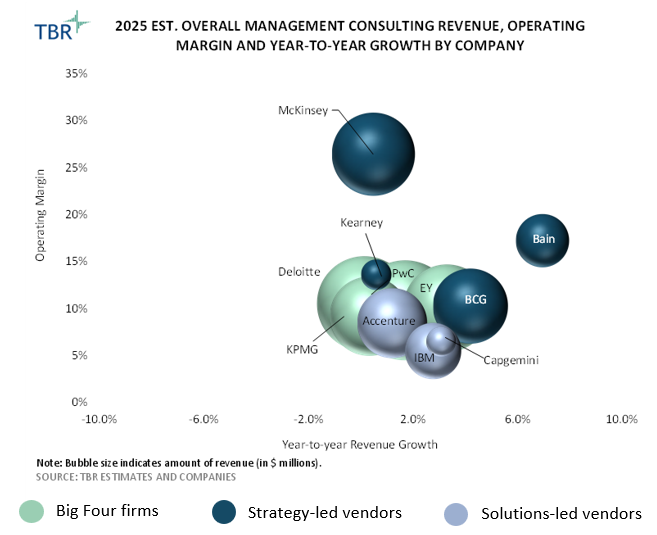
Recently, TBR had a chance to hear directly from KPMG’s Microsoft alliance leaders including Cherie Gartner, Global Lead Partner for Microsoft, KPMG LLP; Marco Amoedo, Global Chief Technology Officer, Microsoft, KPMG International; and Sven Rohl, Global Microsoft AI Business Solutions Lead, KPMG International, about how KPMG’s 20-plus-year alliance with Microsoft has evolved into a 360-degree relationship, framed by four interrelated fields of play including Reimagining the Enterprise, Platforms with Purpose, Modernization at Scale, and Secure by Design Enterprise. The following analysis reflects on this discussion and TBR’s ongoing research on KPMG and the Big Four, including our semiannual Management Consulting Benchmark and ecosystem intelligence reports.
Trust beyond scale
Framing the alliance as a global 360-degree relationship is a familiar phrase in alliance management, but KPMG tries to use the phrase differently, beyond just a relationship and more as a structure that enables shared accountability. Building off a decade-plus-long collaboration around Microsoft Dynamics applications, KPMG has now made Azure consumption the center of gravity, and executives described the metric as “the underpinning layer.” Aligning its internal success criteria with how Microsoft measures platform expansion means KPMG is implicitly shifting what it asks clients to do: not just approve a program and go live, but rather adopt, consume, expand and operate.
In the AI era, that distinction can become decisive as all parties look for pilots to be projectized. With KPMG firms managing a pool of over 40,000 Microsoft-trained consultants, including over 6,800 Dynamics experts and more than 14,000 Microsoft certifications, the KPMG global organization reinforced the scale of and commitment to the relationship by reemphasizing a multiyear, deliberate diversification push to grow Azure-led work. Certifications and specializations are not only a proof point but also a metric within KPMG’s multibillion-dollar investment with Microsoft, where Azure consumption remains a KPI to measure success.
We see this as a subtle but important narrative blend where KPMG is not disowning the legacy but rather using it as proof of proximity to business systems while moving the growth story upstream into cloud, data, security and AI. We believe if KPMG is successful with its messaging, the result will be a partner story that is designed to meet the next procurement threshold: Show me you can run this safely and prove it is worth it.
Further, rather than organizing around discrete Microsoft products (e.g., Azure, Dynamics, M365), KPMG is also designing integrated offerings that map to the go-to-market motions of Microsoft’s solution areas including Cloud & AI platforms, AI business solutions, and Security. We view these offerings as an opportunity for KPMG to deploy its Powered Enterprise framework structured around transformation discussions that begin with business priorities and end with one or more technology solutions, rather than leading with technology.
Although this approach is not unique to KPMG, it allows the firm to lean on its value proposition, something partners appreciate as they look to avoid coopetition. With knowledge management also testing the trust and alignment among partners, solution architects within KPMG and Microsoft are helping the companies build a robust foundation. Growth acceleration will come from ensuring field sellers within both organizations are equally able to tell each partner’s story as well as their own.

Platform-enabled integrated offerings bring the partners closer together
As the AI market moves from proof of concept to a portfolio of agents embedded into core workflows, buyers’ concerns are changing. They are now seeking vendors that are less focused on deploying solutions and more on helping them address concerns around governance and data residency control without disrupting the architecture, cost calculations, or operating processes across a multivendor environment, all while avoiding turning the program into a fragile dependency chain. This is where most AI transformation narratives collapse.
Vendors typically over-index on capability demonstrations and under-invest in the operating model. That weakness is precisely where KPMG firms are investing. The firm’s broader operating model strategy — its efforts to standardize, consolidate and reduce fragmentation across its global organization of member firms — starts to matter even more in this context especially as AI at scale punishes decentralization. KPMG’s direction is designed to make “One KPMG” more real operationally as the firm recognizes that this is the only way to make agentic delivery repeatable as it seeks to act more like a platform-led business.
The core bet: productizing transformation and productizing trust
KPMG’s alliance partnership with Microsoft is built around two assets that function as the firm’s packaging layer for the AI era: KPMG Velocity and KPMG Workbench. KPMG Velocity provides AI-enabled products and services through a platform ecosystem that integrates KPMG’s insights, methods, expertise, capabilities and data with advanced technology. KPMG Workbench is the firm’s global AI platform, designed to scale global adoption and integration of AI and underpin KPMG client delivery solutions.
For KPMG, the key strategic point is not the existence of Velocity, as peers similarly package methods in platforms, but rather what Velocity is positioned to do: make Microsoft’s technology consumable in terms of measurable outcomes. The most important aspect of KPMG Workbench is not that it uses AI but rather the kinds of capabilities the platform offers that signal production readiness, especially those targeting skeptical buyers, as Workbench is designed to address key questions around trust and compliance, economics and sovereignty.
In summary, if KPMG Velocity is the packaging layer that makes transformation repeatable, KPMG Workbench is the operating layer that makes transformation defensible. KPMG now has the opportunity to use these platforms consistently across member firms, both with Microsoft and with other key partners.
The alliance motion that matters: Azure-central, multivendor, and designed for reality
Another strategic message KPMG’s Microsoft alliance leaders discussed is that they do not expect buyers to lean on a single vendor, even if Microsoft is the anchor. They repeatedly emphasized a multiparty ecosystem go-to-market strategy with Microsoft alongside SAP, ServiceNow and others. The pattern is consistent with the emergence of the multiparty alliance construct that TBR has observed within the past 18 to 24 months and has discussed at length within our Ecosystem Intelligence research stream.
Overall, KPMG treats Azure as the compute and platform foundation but acknowledges that the enterprise estate is triangulated by design. This is an important positioning, especially as the market has shifted from platform selection to platform negotiation where large enterprises will not rip and replace existing solutions but will look for vendors that can orchestrate their tech stack. Any vendor that assumes it can win by forcing a monoculture could lose relevance.
KPMG’s approach is therefore less Microsoft-only than it is Azure-central. It is a strategy built for deal reality and positions the firm to create outcomes without demanding architectural purity. This strategy could strengthen KPMG’s reputation with procurement departments, especially in regulated environments, where buyers must balance modernization with risk management and existing vendor commitments.
Reconciling outcome-based consulting with consumption-based cloud
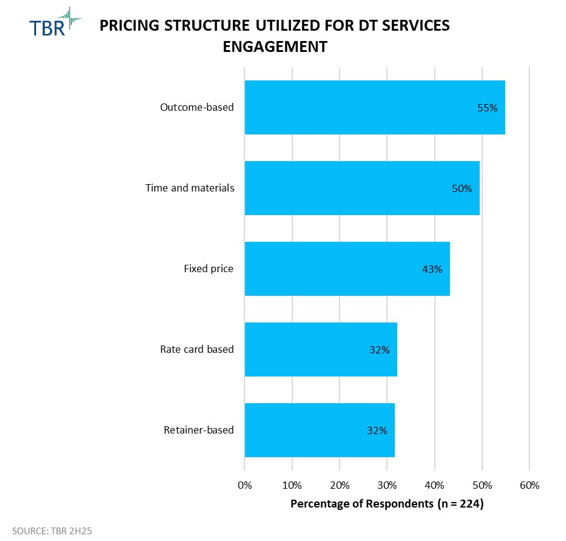
During the briefing, KPMG highlighted two approaches that close the gap with its aspiration to drive outcome-based pricing at scale: where every solution must deliver a measurable return, and where Azure is the core growth metric of Microsoft’s consumption-based economics. This leads to a defensive dynamic where clients increasingly expect AI-enabled efficiencies to translate into lower costs and fewer people, forcing KPMG to justify its pricing by clearly demonstrating the value of its platforms and IP, and an offensive dynamic, in which the firm invests heavily in managed services and Consulting as a Service models that bundle AI-driven solutions with ongoing delivery, aligning more naturally with Microsoft’s consumption-led view.
These two shifts are reflected in KPMG’s expansion of subscription-based offerings, such as KPMG Clara, KPMG Digital Gateway for Tax and a KPMG Digital Gateway for Law, and sector-specific AI managed services (e.g., trade surveillance and fraud monitoring for banks) built on KPMG platforms and Azure. These efforts are supported by new go-to-market capabilities like partner and staff sales academies focused on solution and subscription selling and the introduction of dedicated technology sellers in some member firms — changes that mirror hyperscaler and ISV selling motions. For KPMG to succeed at scale, it will likely need to continue evolving culturally and operationally beyond its traditional alliance partnership model, a shift the firm has already begun to address.
Long-term structural changes can help KPMG stay relevant with Microsoft as a copilot
Over the next 12 to 24 months, we expect professional services vendors’ partner strategies and enterprise buying to reorganize around roles and operating standards. First, partner segmentation will harden. Enterprises will increasingly select multiple partners for distinct roles: scale operators to industrialize, governance lighthouses to de-risk production and specialists to provide domain depth. The “one partner does everything” narrative will weaken.
Second, consumption will be scrutinized through a value lens. Azure consumption will become less about quota and more about the quality of the investment. Workbench-style telemetry and metering are early indicators of where buyer expectations are heading: cost attribution and measurable value per agent, per workflow and per portfolio.
Third, commercial models will shift faster toward managed operations and subscription-like constructs. Although value and usage are measurable and continually optimized, time-and-materials commercial constructs will become harder to defend as the default model.
Beyond 24 months, the most consequential shift is that “assurance-grade” operations may become a prerequisite for transformation itself. As agents operate inside financial processes, HR, security and supply chains, buyers will demand auditability and governance in ways that resemble assurance disciplines. The linkage of KPMG Workbench across advisory and audit-adjacent contexts is not incidental and hints at how KPMG believes it can compete.
At the same time, sovereignty-by-design becomes procurement leverage. Data residency routing and region-specific controls are not just technical features, but they will become deal accelerants, particularly in Europe and regulated industries. Finally, the source of lock-in shifts. The sticky asset will not be the implementation project but rather the operating standard: governance models, telemetry dashboards, value measurement frameworks and agent life cycle processes. Whoever defines those standards will own the long-term relationship, even if the underlying technology is theoretically interchangeable.
KPMG is positioning its Microsoft alliance for the next phase of enterprise AI adoption, in which production readiness, governance and demonstrable value are expected to differentiate winners from laggards. KPMG Velocity is framed as the mechanism for making transformation repeatable, while KPMG Workbench is positioned as the means to make transformation governable and auditable. Within this narrative, Azure consumption functions as the key performance indicator aligning KPMG’s incentives with Microsoft’s platform economics, and a multivendor triangulation strategy aligns KPMG’s go-to-market approach with enterprise buyer realities.
If KPMG can convert these elements into field-ready plays and consistently repeatable client outcomes, it may emerge as a uniquely valuable Microsoft partner for regulated, board-visible programs, shifting competitive pressure onto peers to differentiate through operational trust rather than delivery scale. Overall, KPMG appears to be attempting to move the competitive battleground from implementation speed to governed operations. If the market evolves in this direction, partners and competitors will need to clarify their roles and demonstrate credibility in an environment where agentic transformation is treated less as a discrete project and more as a continuously governed system.