
Gemini for Industries: Context, Governance and the Changing Role of SI Partners
Throughout 2026, Google’s Gemini for business has evolved from a set of components to a unified solution for practical AI. Today, it is used by 90% of the Fortune 100 and has become the fastest-growing product in Google Cloud history. Two complementary pieces exist: the application — which is designed to be the “front door” for the workplace, drawing on context from Workspace as well as other productivity apps (e.g., M365, Slack) — and the platform for building, customizing and operating AI. New FinOps capabilities and the inclusion of the Antigravity harness in all subscriptions are recent examples of how Google Cloud is addressing both sides of the portfolio, unlocking a strategic flywheel where Gemini creates demand and fuels usage of the Gemini platform. If Google Cloud can effectively deliver both as part of a unified solution, helping customers combat agent sprawl while staying true to its roots of openness and flexibility, it will take a big step to address one of AI’s central challenges: how to translate capable AI models into something that can scale at enterprise levels.
Reshaping context
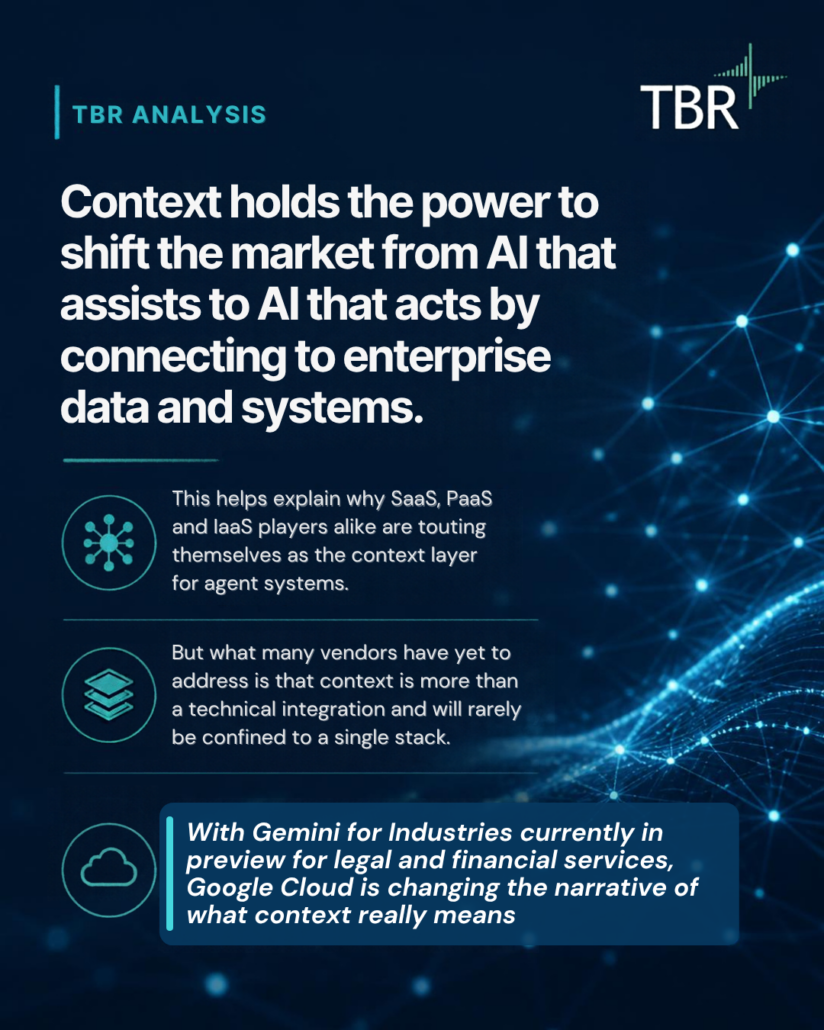
Context holds the power to shift the market from AI that assists to AI that acts by connecting to enterprise data and systems. This helps explain why nearly all vendors —SaaS, PaaS and IaaS players alike — are touting themselves as the context layer for agent systems. But what many vendors have yet to address is that context is more than a technical integration and will rarely be confined to a single stack.
With Gemini for Industries currently in preview for legal and financial services, Google Cloud is changing the narrative of what context really means. It views context as more than just a set of Model Context Protocol (MCP) servers connecting to trusted data — though those secure MCP connectors are critical for ensuring that agents respect existing entitlements, keeping licensed data licensed and permissioned data permissioned. True context is also access to a broader set of methods, rules and skills relevant for a unique set of workflows.
With the Gemini architecture, Google Cloud can deliver this context in a unified way, letting developers build agents that extend to the business through the application. If partner execution is successful, combining industry knowledge with governance access to enterprises systems could offer a confidence boost to enterprises looking to deploy AI agents in production.
The role of partners
Gemini for Industries revolves around three core principles: skills, security and governance, and partners. The skills side of the equation is supported by forward-deployed engineers (FDEs) that cobuild alongside clients. For instance, in legal, elite law firms are moving beyond merely adopting software to actively co-building these solutions as seen in Google Cloud’s newly announced collaboration with Cooley to develop capabilities for complex litigation. It is also being supported by a growing set of out-of-the-box capabilities like the Financial Research agent that offers full explainability and over 50 foundational skills.
Meanwhile, security and governance stem from secure MCP integrations with more than a dozen enterprise platforms and industry data sources (e.g., Moody’s, S&P Global). Successful partners will bring both together and make Gemini deployable.
These vendors may claim different levels of industry expertise that complement Gemini, but their commitment to the platform is better reflected in internal adoption. Google reports the number of seats adopted by services partners grew 9x year-to-year. This suggests there is strong app adoption among partners and an overall willingness to experiment with agents, but the real test will be which SIs can rally around the platform, building and governing in ways that elevate client value at a time when agent stacks slowly absorb traditional SI-type work.
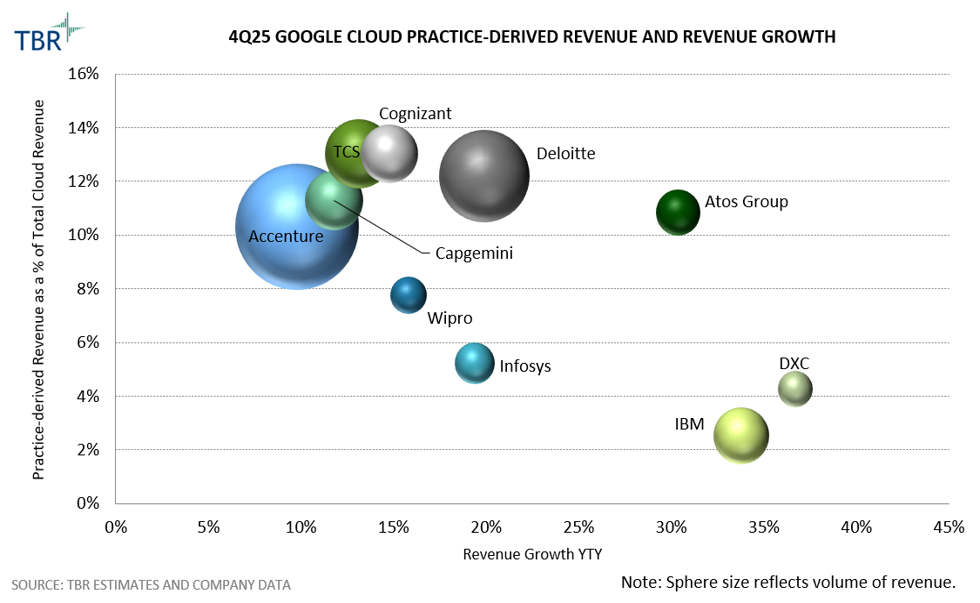
4Q25 Google Cloud Practice Derived Revenue and Revenue Growth (Source: TBR)
Industry is the accelerator, but governance is the differentiator
Deep industry expertise is essential to delivering client results, but it is becoming less of a point of differentiation among SIs. Gemini for Industries will test partners’ ability to deploy the right skills and, more broadly, will also test how effectively they can extend unique governance frameworks through their use of Gemini internally to clients.
More specifically, with agent identity (e.g., Gemini’s new “co-worker Workspace profile), SIs’ role in governance becomes increasingly real and more urgent as they now need to manage how these autonomous identities interact with business workflows, and do so securely.
More broadly, as federated retrieval, industry connectors and out-of-the-box agents, the governance opportunity for SIs starts to shift from governing each source to governing how the context across these sources is combined and used.
Systems integration or systems configuration?
By delivering a common platform for operating agents post-deployment, Google Cloud may help guide the shift to where many SIs are already heading: using implementation and integration as a loss leader with the end goal of driving more managed services.
Highlighting the urgency of the shift, a use case was just announced at Gemini at Work. It highlighted how On used Gemini to migrate 24 microservices; an external vendor reportedly quoted $500,000 for a component of the work, and On was able to complete the project without outside implementation resources.
With scenarios such as these, it remains to be seen how much foundational services revenues SIs can retain, but prebuilt solutions enabled by agents may be a catalyst for managed services with human in the loop for last-mile, high-value tasks.
 Codrut Evelina, via Canva Pro
 Technology Business Research, Inc.
 Technology Business Research, Inc.

 Technology Business Research, Inc.