
 Getty Images via Canva Pro
New Growth in Consulting Is Emerging from an Unexpected Place: Managed Services
Managed services teams embedded at clients are quietly evolving into the front line for strategy and advisory opportunities
This spring, TBR will mark 15 years of publishing the semiannual Management Consulting Benchmark, and the basic structure remains essentially the same. Although this consistency is remarkable, consulting seems to be the only business model left undisrupted. Sure, technology now permeates everything, the talent pyramid faces structural change, and a good large language model might be capable of replacing an entry-level consultant, but the biggest firms continue to grow and provide answers to “tell me what to do and how to do it.” Consulting went through a rough patch from 2023 to 2025, but now we’re looking at a resurgence. Even as some industry experts see the Big Four dying alongside SaaS and private equity cutting the fat from strategy consultancy, TBR sees a few reasons to be more than bullish on management consulting in 2026 and 2027. Let’s start with where those consulting opportunities increasingly come from.
For the last couple of years, TBR has heard more and more consultancies and IT services companies describe a gradual shift in managed services, with professionals on-site at clients uncovering new management consulting opportunities and becoming, in a sense, the tip of the spear — a role traditionally played by strategy consulting. This is a significant change. If the trend accelerates and reaches scale, business models will change. For now, managed services as an entrée to management consulting remains a tactic for some and an aspiration for others. Years of use cases, experience and results lead TBR to believe managed services will contribute significantly to the growth of management consulting going forward.
Management services will positively impact consulting engagements — just not for everyone
OK, so managed services brings new opportunities, but for which consultancies? A better question: Will managed services enable traditional IT services companies to finally break through meaningfully into management consulting? Yes, massive IT services companies that have flirted with McKinsey-like consulting capabilities over the last couple of decades will be able to uncover and deliver on consulting opportunities based on their deep understanding of clients’ IT environments and business challenges. And accelerated AI adoption at enterprise scale will increase transparency and uncover opportunities for every IT services company and consultancy.
A scaled managed services practice trained in spotting consulting opportunities and armed with AI-enabled solutions will unquestionably win some management consulting market share. More significantly, from TBR’s objective view, is whether the Big Four firms can manage their staffing, brand promise and technology alliances to take advantage of the managed services practices they’ve already built and use those opportunities to return to robust management consulting growth. Maybe, but probably not all four. The next two years will be telling, and TBR expects the existing differences between the Big Four will become even more pronounced.
All of that just to say: Managed services will increasingly lead to consulting engagements, growing the overall consulting pie — just not for everyone.
As we continue into 2026 and look ahead to 2027, we see the three main management consulting groups pursuing similar yet different strategies and three main trends influencing how they execute those strategies. The Big Four firms (Deloitte, EY, KPMG, and PwC) continue to invest in and emphasize their industry expertise as differentiators, particularly in management consulting. McKinsey & Co., Boston Consulting Group (BCG) and Bain have all increased their technology capabilities and stressed to their clients and alliance partners (yes, they now have technology alliance partners!) that they’re deeply versed in emerging technologies, including AI.
And the IT services-centric consultancies, such as Accenture, Capgemini and IBM, continue to expand and contract their consulting practices, always returning to the same “end-to-end” set of offerings. (Yes, those are generalities. For specific analysis of each company, see TBR’s semiannual Management Consulting Benchmark.) Across the entire management consulting space, TBR sees increasing client demand for outcomes-based pricing, particularly as AI enables greater transparency across every aspect of an enterprise; talent management (within consultancies) emerging as a strategic lever for consultancies’ own business model reinvention; and AI permeatingeverything.
Looking beyond 2026, TBR sees three reasons to bet on growing demand for management consulting. First, AI-related confusion, FOMO (fear of missing out) and adoption will create massive, seemingly relentless opportunities for consulting. If you doubt that, consider how well your own company has adopted AI and how much AI has changed just since January 2025. Second, the managed-services-to-management-consulting pivot described above, combined with AI, will enable more competitors to stand up capable and scaled management consulting practices. Does that mean more competition? Yes, but it also means more opportunities for the firms that have established permission and people and can continue investing in capabilities without balancing those dollars (and margins) against other core businesses. Third, and a continuation of the previous point, the management consulting space will fracture into more highly specialized consulting firms, better-staffed IT services companies, and technology providers adding strategy consulting to their arsenal.
Explore deeper data and analysis
Over the last 15 years, technology has permeated every aspect of management consulting. This trend has been so persistent and significant that TBR has been increasingly asked if our taxonomy, which includes Strategy Consulting, Operations Consulting, Organization and Change Consulting, and Technology Consulting, still holds up. Indeed it does. Because while every consulting engagement includes technology, business model reinvention remains rooted in business: business strategy and operations and organization. And woe to the business that thinks AI doesn’t mean change management. Answering those core questions — what do I do and how should I do it — will provide opportunities for … let’s be ambitious and say millennia to come.
And we have the data.
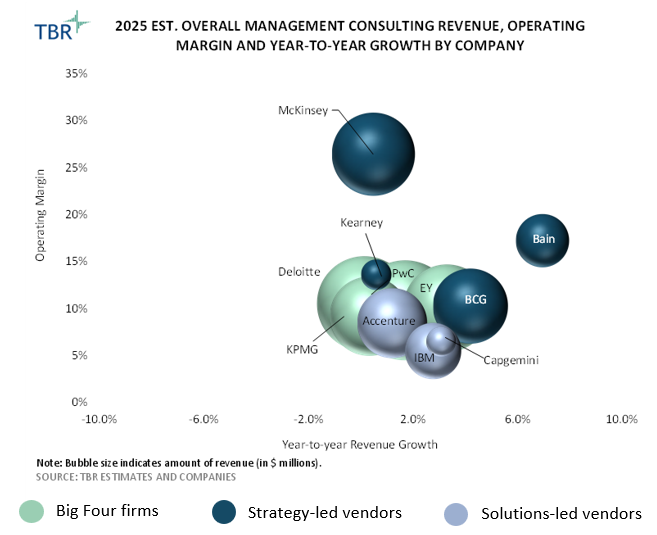
2025 Estimated Management Consulting Revenue, Operating Margin and Year-to-year Growth by Company (Source: TBR)
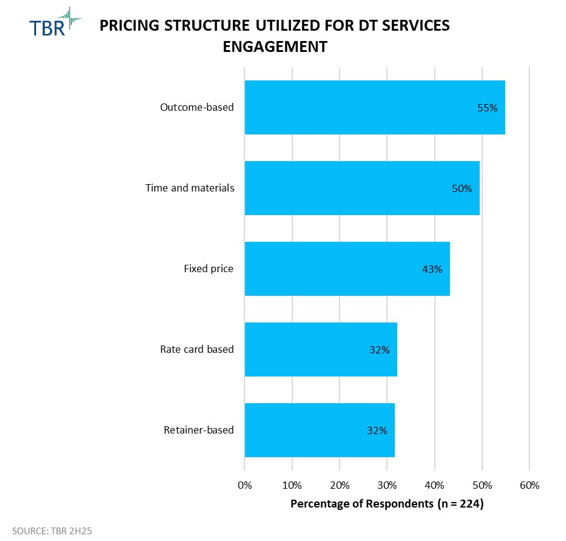
Pricing Structure Utilized for DT Services Engagement (Source: TBR 2H25)
With TBR Insight Center’s interactive data visualization tool, your team can quickly adapt thousands of IT services and consulting data points for tailored competitive analysis, go-to-market strategy and executive briefings. The tool enables you to curate relevant quantitative insights by company, business unit and/or market segment, creating a report specific to your needs and ensuring consistent frameworks across projects.
Click here to explore Insight Center’s data visualization tool, or start your free trial today to access this one-of-a-kind digital-first intelligence platform.
 Technology Business Research, Inc.
 Technology Business Research, Inc.