Capgemini to Acquire WNS for $3.3B, Tripling BPO Revenue and Accelerating AI Ambitions

Capgemini acquires WNS to accelerate its journey toward intelligent operations in BPO

On July 7, Capgemini announced its intent to acquire WNS for $3.3 billion. The acquisition will not only add scale to the company’s business process outsourcing (BPO) capabilities with more than 64,000 employees but also provide Capgemini with a broader client base. TBR estimates that Capgemini’s BPO revenue was $597 million in 2024, and WNS had $1.3 billion in BPO revenue in the same period, meaning acquiring WNS would more than triple Capgemini’s revenue in the segment. If the acquisition is approved, Capgemini will leverage WNS’ client base to jump-start its intelligent operations model, going beyond the traditional BPO model dependent on labor arbitrage and introducing generative AI (GenAI) and agentic AI capabilities to build autonomous workflows.


The acquisition undoubtedly serves as an important stepping stone to transform Capgemini’s BPO offerings, which are housed in its Operations & Engineering segment, yet Capgemini must be strategic with its approach, balancing new clients’ expectations with the introduction of incremental GenAI and agentic AI capabilities. Capgemini’s recent investments in partner-enabled portfolio offerings position the company well for a large change in the segment, such as its new agentic AI offerings announced with Google Cloud in April and its NVIDIA NIM-powered industry-specific agentic AI solutions and agentic gallery. During Capgemini’s analyst session on the WNS acquisition, the company disclosed it had more than €900 million in GenAI bookings in 2024. Leveraging the acquisition to stimulate organic growth, however, will require Capgemini to be mindful of service quality during the integration process while continuing to build out its portfolio offerings to secure new bookings.

Careful integration will create synergies, but persistent portfolio investments and well-timed headcount adjustments will support new revenue model

Although Capgemini is no stranger to large acquisitions, it does not complete them often. In the past 10 years, Capgemini has only completed a couple of other similar-size purchases. Capgemini purchased IGATE in 2015, which at the time generated $1.3 billion in revenue and added 30,000 professionals. In 2020 Capgemini completed the acquisition


of Altran at €3.6 billion with €3.2 billion in revenue and approximately 50,000 employees. Capgemini purchased Altran with the intent of using the company’s intelligent industry solutions as well as bringing more transformation capabilities in AI, cloud, digital, edge computing and IoT. Altran also brought new capabilities in engineering and R&D services. The acquisition of Altran fueled a 71.8% year-to-year growth rate in Capgemini’s Operations & Engineering segment in 2Q20. Following the completion of the acquisition, the company added new solutions to its portfolio to maintain momentum.


In 4Q20, Capgemini released a set of intelligent industry offerings in 5G and edge as well as in driving automation systems. After completing the integration of Altran and capitalizing on the new synergies, the company formed the Capgemini Engineering segment, which incorporated the former Altran business. In 4Q21 Capgemini’s Operations & Engineering revenue increased 9.1%, and overall corporate revenue grew 15% year-to-year, of which 14.1% was organic. Although Capgemini was able to see initial growth in the segment, albeit lagging the company’s overall growth, the segment’s revenue is not much higher today. In 4Q21 Operations & Engineering revenue was €1.5 billion, and in 4Q24 it was slightly higher at €1.6 billion. If Capgemini wants to leverage WNS as part of its AI strategy, it may need to be more vigilant about sustaining momentum.


TBR expects Capgemini to take a similar approach with WNS as it did with Altran, first taking time to integrate the business while building out its GenAI and agentic AI capabilities, then adjusting its workforce to account for any talent overlap and prepare for structural changes brought about by increased automation. Capgemini will try to make its new workforce leaner, especially as WNS is expected to expand total headcount by 18.8% while only increasing revenue by 5.5%. Some of the adjustments will come naturally as hyperautomation capabilities will cannibalize traditional labor arbitrage. On the other hand, Capgemini will have more room to introduce new GenAI and agentic AI offerings in BPO, providing the company with the opportunity to learn best practices in a lower-stakes environment before introducing the technology to its other segments, Strategy & Transformation and Applications & Technology.

The BPO segment is an easier area for companies to test GenAI and agentic AI offerings and apply those lesson

s learned to other segments. Making an acquisition in this segment, as Capgemini has announced, is a way to get a head start, and other peers could follow suit. For example, Deloitte has prioritized expanding its Operate nearshore and offshore resources, but completing an acquisition of one of WNS’ peers, such as Genpact or EXL, would provide the company with more opportunity to innovate with a broader client base.


As IT companies seek to expand business services operations to boost their ability to deliver new technologies, they are competing on market share. Other companies, particularly Accenture, already have a much bigger presence in the segment. In 2024 Accenture’s BPO revenue was $10.7 billion; even with acquisitions, this level will be difficult for most other companies to attain. Potential investments from other firms that already have a large BPO business could threaten Capgemini’s strategy.


As part of Capgemini’s intelligent operations vision, the company wants to implement an outcome-based pricing model. Although this is a good long-term goal, the company faces many hurdles. Of WNS’ total revenue, 24% is derived from non-FTE-based pricing. However, the acquisition will greatly increase headcount, and Capgemini still needs to ramp up its agentic AI and GenAI offerings, meaning that implementing outcome-based BPO pricing is still years away. WNS will likely bring efficiencies to the company in other ways. WNS’ annual revenue growth has slowed in recent years, from year-to-year growth of 7.7% in 2023 to 1.1% year-to-year in 2024. Yet the company has a healthy operating margin, averaging 10.8% in 2024 and reaching 15% in 1Q25. The slowdown makes it a well-timed sell for WNS shareholders as BPO’s operating model is changing, but the company holds value in its wide client base.


WNS has a strong pipeline with a backlog-to-revenue ratio of 3.2. Capgemini has the opportunity to use this acquisition to facilitate innovation and deliver its emerging GenAI and agentic AI capabilities to clients, which are increasingly searching for more operational efficiencies. The acquisition could bring capabilities beyond initial inorganic revenue if Capgemini maintains service quality while investing in emerging capabilities in hyperautomation.

AMD Lays Out its Road Map to Erode NVIDIA’s Dominance in the AI Data Center

All eyes were again trained on San Jose, Calif., during AMD Advancing AI 2025, held on June 12, just three months after NVIDIA GTC 2025. The event centered on AMD’s bold AI strategy that, in contrast to that of its top competitor, emphasizes an open ecosystem approach to appeal to developers and organizations alike. The entire industry seeks increased competition and accelerated innovation in AI, and AMD plans to fill this void in the market.

Catching up with NVIDIA — can AMD achieve the seemingly impossible?

AMD’s Advancing AI 2025 event presented an opportunity for CEO Lisa Su to outline how AMD’s investments, both organic and inorganic, position the company to challenge NVIDIA’s dominant position in the market. During the event’s keynote address, Su announced new Instinct GPUs, the company’s first rack scale solution, and the debut of ROCm 7.0, the next generation of the company’s open-source AI software platform. She also detailed the company’s hardware road map and highlighted strategic partnerships that underscore the increasing viability of the company’s AI technology.


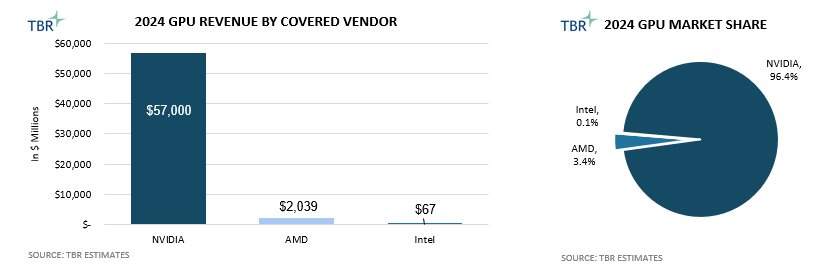
However, NVIDIA’s dominance in the market cannot be understated, and the AI incumbent’s first-mover advantage has created massive barriers of entry to the space that AMD will tactfully need to invest in overcoming. For instance, TBR estimates NVIDIA derived more than 25 times the revenue AMD did from the sale of data center GPUs in 2024. Nonetheless, AMD is committed to the endeavor, and the company’s overall AI strategy is clear: deliver competitive hardware and leverage ecosystem openness and cost competitiveness to drive platform differentiation and gain share in the market.

Acquired assets pave the way for Helios

Su’s keynote address began with the launch of AMD’s Instinct 350 Series GPUs, comprised of the Instinct MI350X and MI355X. The Instinct MI355X outperforms the MI350X but also requires liquid cooling, whereas the MI350X can be air cooled. As such, the Instinct MI355X offers maximum inferencing throughput and is specifically designed to be integrated into high-density racks while the MI350X targets mixed training and inference workloads and is ideal for standard rack configurations. Both GPUs pack 288GB of HBM3e memory capacity — significantly more than the 192GB offered by NVIDIA’s B200 GPUs.


The denser memory architecture of the AMD Instinct 350 Series is a key enabler of the chip’s comparable performance to NVIDIA’s B200 where AMD claims to deliver equivalent to approximately twice the compute performance of Blackwell, depending on the floating-point precision of the model being run. However, even more noteworthy was AMD’s introduction of its open rack scale AI infrastructure, which was made possible by the company’s 2022 acquisition of Pensando Systems.


Along with the acquired company’s software stack, Pensando added a high-performance data processing unit (DPU) to AMD’s portfolio. By leveraging this technology and integrating Pensando’s team into the company, AMD unveiled the industry’s first Ultra Ethernet Consortium (UEC)-compliant network interface card (NIC) for AI, dubbed AMD Pensando Pollara 400 AI NIC, in 4Q24, highlighting the company’s support of open standards.


At Advancing AI 2025, Su formally announced the integration of Pollara 400 AI NIC with the company’s MI350 Series GPU and fifth-generation EPYC CPU to create the company’s first AI rack solution architecture, configurable as an air-cooled variant featuring 64 MI350X GPUs or a liquid-cooled variant featuring up to 128 MI355X GPUs. The development of AMD’s rack scale solution architecture comes in response to the release of NVIDIA’s GB200 NVL72 rack scale solution, with both racks being Open Compute Platform (OCP)-compliant to ensure interoperability and simplified integration with existing OCP-compliant infrastructure.


Going a step further, at the event Su introduced AMD’s next-generation GPU — the Instinct MI400 series — alongside the company’s next-generation rack scale solution, both of which are expected to be made available in 2026. The Instinct MI400 series is slated to deliver roughly twice the peak performance of the MI355X, while Helios — AMD’s next-generation rack scale solution — will leverage 72 MI400 series GPUs in combination with next-generation EPYC Venice CPUs and Pensando Vulcano network adapters. Unsurprisingly, Helios will adhere to OCP standards and support both Ultra Accelerator Link (UALink) and UEC standards for GPU-to-GPU interconnection and rack-to-rack connectivity.


In comparison to the prerelease specs of NVIDIA’s upcoming Vera Rubin NVL72 solution, which is also scheduled to be released in 2026, Helios is expected to deliver the same scale-up bandwidth and similar FP4 and FP8 performance with 50% greater HBM4 memory capacity, memory bandwidth and scale-out bandwidth. However, with AMD GPUs delivering higher memory capacity and bandwidth than equivalent NVIDIA GPUs, this begs the question: Why do NVIDIA GPUs dominate the market?

Developers, developers, developers

At NVIDIA GTC 2025, CEO Jensen Huang said, “Software is the most important feature of NVIDIA GPUs,” and this statement could not be more true. While NVIDIA has benefited from first-mover advantage in the GPU space, currently the company’s GPU release cycle is only slightly ahead of AMD’s in terms of delivering roughly equivalent silicon to market from a compute performance perspective. However, AMD has a leg up when it comes to GPU memory capacity, which helps to drive inference efficiency.


Where NVIDIA’s first-mover advantage really benefits the company is on the software side of the accelerated computing equation. In 2006 NVIDIA introduced CUDA (Compute Unified Device Architecture), a coding language and framework purpose-built to enable the acceleration of workloads beyond just graphics on the GPU. Since then, CUDA has amassed a developer base nearing 6 million, boasting more than 300 libraries and 600 AI models, all while garnering over 48 million downloads. Importantly, CUDA is proprietary, designed and optimized to exclusively support NVIDIA GPUs, resulting in strong vendor lock-in.


Conversely, AMD’s ROCm is open source and relies heavily on community contributions to drive the development of applications. Recognizing the inertia behind CUDA and the legacy applications built and optimized on the platform, ROCm leverages HIP (Heterogenous-computing Interface for Portability) to allow for the porting of CUDA-based code, simplifying code migration. However, certain CUDA-based applications — especially those that are more complex — do not run with the same performance on AMD GPUs after being ported due to NVIDIA software optimizations that have not yet been replicated.

Recognizing the critical importance of the ecosystem to the company’s broader success, AMD continues to invest in enhancing its ROCm platform to appeal to more developers. At Advancing AI 2025, the company introduced ROCm 7, which promises to deliver stronger inference throughput and training performance compared to ROCm 6. Additionally, AMD announced that ROCm 7 supports distributed inference, which decouples the prefill and decode phases of inferencing to vastly reduce the cost of token generation, especially when applied to AI reasoning models. Minimizing the cost of token generation is key to maximizing customers’ revenue opportunity, especially those running high-volume workloads such as service providers.


In addition to distributed inference capabilities similar to those offered by NVIDIA Dynamo, AMD announced ROCm Enterprise AI, a machine learning operations (MLOps) and cluster management platform designed to support enterprise adoption of Instinct GPUs. ROCm Enterprise AI includes tools for model fine-tuning, Kubernetes integration and workflow management. The platform will rely heavily on software partnerships with companies like Red Hat and VMware to support the development of new, use-case- and industry-specific AI applications, and in stark contrast to NVIDIA AI Enterprise, ROCm Enterprise AI will be available free of charge. This pricing strategy is key in driving the development of ROCm applications and the adoption of the platform. However, customers may continue to be willing to pay for the maturity and breadth of NVIDIA AI Enterprise, especially as NVIDIA continues to invest in the expansion of its capabilities.

Partners advocate for the viability of AMD in the AI data center

Key strategic partners, including executives from Meta, Oracle and xAI, joined Su on stage during the event’s keynote, endorsing the company’s AI platforms. All three companies have deployed AMD Instinct GPUs and intend to deploy more as time goes on. These are effectively some of the largest players in the AI space, and their words underscore the value they see in AMD and the company’s approach of driving a more competitive ecosystem to accelerate AI innovation and reduce single-vendor lock-in.


However, perhaps the most noteworthy endorsement came from OpenAI CEO Sam Altman, who discussed how his company is working alongside AMD to design AMD’s next-generation GPUs, which will ultimately be employed to help support OpenAI’s infrastructure. While on stage, Altman also underscored the growing AI market with arguably the most ambitious, albeit somewhat self-serving, statement of the entire keynote: “Theoretically, at some point, you can see that a significant fraction of the power on Earth should be spent running AI compute.” It is safe to say that AMD would be pleased if this ends up being the case; however, for now, AMD is projecting the data center AI accelerator total addressable market will grow to greater than $500 billion by 2028, with inference representing a strong majority of AI workloads.

AMD has become the clear No. 2 leader in AI data center and is well positioned to take share from NVIDIA

AMD’s Advancing AI 2025 event served as a testament, reaffirming the company’s open-ecosystem-driven and cost-competitive AI strategy while also highlighting how far the company’s AI hardware portfolio has come over the last few years. However, while AMD’s commitment to an open software ecosystem and open industry standards is a strong differentiator for the company, it is also a major risk as it makes AMD’s success dependent on the performance of partners and consortium members. Nonetheless, TBR sees the reputation of AMD GPUs becoming more positive, but NVIDIA’s massive installed base and developer ecosystem make competing with the industry giant a significant feat.

Well-placed Investments in Emerging Tech Will Enable CGI to Accelerate Growth Long Term

Acquisitions, being attentive to clients’ bottom-line demands, and implementing AI into IP are backbone of CGI’s “built to grow and last” strategy

On June 5, CGI hosted its Industry Analyst Summit. CEO Francois Boulanger and CGI Board of Directors Executive Chair Julie Godin commenced the meeting, detailing how CGI’s business culture, proximity model and decentralized approach, acquisitions and cocreation with clients are key to the company’s growth strategy. Throughout each session CGI leaders highlighted the company’s emphasis on meeting client objectives, providing flexibility and codeveloping solutions as necessary. Cocreating on projects not only delivers more relevant solutions to the client but also provides CGI with new intellectual property (IP) that it can bring to other clients.


Notably, CGI is leaning into its proximity model by acquiring more companies that build out the company’s footprint in metro markets. This is particularly evident with the purchases of U.S.-based Daugherty and Novatec. Other acquisitions such as Momentum Technologies and Apside expand the company’s local presence in Canada. Access to more markets across the U.S., Canada and Europe, alongside new client-led solutions, is broadening the company’s opportunities, particularly around AI-related projects. CGI has also enhanced its data and AI capabilities through the strategic acquisitions of Apside, Novatec and Aeyon.


CGI shared insights into its recent AI endeavors, including an example involving the deployment of an air gap solution for the North Atlantic Treaty Organization (NATO). For this project, CGI collaborated with NATO’s Allied Command Transformation in Norfolk, Va., to construct and tune models that accelerate the classification, editing and analysis of documents using the knowledge agent AI Felix. Outside client-led solutions, CGI is embedding AI across its existing portfolio to enhance delivery to clients across industries.

As CGI remains largely unaffected by DOGE, enhancements across the company’s public sector portfolio allow it to dig deep on federal deals

Stephanie Mango, president of CGI Federal, led an hourlong panel discussion with executives representing CGI’s U.S. Federal, Canadian and European public sector operations. Globally, CGI’s various government clients are encountering similar challenges associated with rising levels of economic and geopolitical uncertainties and governmentwide changes. Common across the company’s roster of government customers is the enduring demand for IT modernization. CGI is currently helping governments transform outdated legacy IT infrastructures, prioritize digital transformation initiatives, address talent shortages in cybersecurity and AI, adopt zero-trust security architectures, implement sovereign AI and cloud solutions, enhance the security and resilience of government supply chains, and protect critical public sector infrastructure.


TBR believes having such a broad swath of activities provides CGI’s public sector practices globally with case studies and success stories to showcase when pursuing new opportunities, talent with relevant experience that can be redeployed to new government markets, and solutions codeveloped with government clients highly relevant to public sector agencies elsewhere. A common go-to-market approach CGI employs across all public sector markets is to help government IT departments and IT decision makers retain a modernization mindset as the company firmly believes governments must view digital transformation as a long-term, multiyear strategy. TBR believes CGI also effectively leverages its client proximity approach to codevelop solutions with government clients and to optimize its agility in responding to fast-changing market dynamics.


In the U.S. federal market, where the arrival of the Trump administration and its Department of Government Efficiency (DOGE) has caused sectorwide upheaval, TBR believes CGI Federal is well positioned to capture a growing share of digital modernization work that we expect to accelerate, after the initial shock of billions of dollars in budget cuts and reallocations. Although CGI was included on DOGE’s initial hit list of consultancies under scrutiny, CGI Federal only generates 2% of its sales from “discrete consulting services,” which TBR assumes is a reference to the type of management or strategic consulting services most vulnerable to DOGE.


CGI Federal generates over 50% of its revenue from outcome-focused engagements, which are typically structured as fixed-price contracts. According to TBR’s Federal IT Services research practice, federal IT contractors can expect a general shift from cost-plus to fixed-price arrangements as agencies adopt a more outcome-focused mindset regarding new IT outlays. When the federal IT procurement environment begins focusing more on outcome-based contracting, it will shift more risk of cost-overruns or delivery delays to the vendors — a potentially margin-erosive scenario for federal system integrators (FSIs) that fail to maintain strong program execution.


CGI Federal is confident it can adapt to outcome-focused contracting in federal IT but is uncertain how quickly the transition can be completed. CGI Federal has been a perennial margin leader in TBR’s Federal IT Services Benchmark due to its traction with its ever-expanding suite of homespun IP-based offerings like Sunflower and Momentum, and demand for these offerings will at least endure, but likely increase, under DOGE.


TBR anticipates additional opportunities for CGI Federal will stem from its proprietary Sunflower (cloud-based asset management) and Momentum (financial management) solutions, as improving asset and financial management are among DOGE’s chief objectives and are in high demand by civilian and defense agencies looking to enhance fiscal and supply chain management, especially to comply with DOGE-related mandates.


CGI Federal has ongoing engagements that the company will showcase to win future federal work. For example, CGI Federal is implementing a cybersecurity shared services platform for the Department of Homeland Security (DHS), while the Department of Transportation’s use of the Momentum platform will serve as the case study for similar engagements across the federal civilian market.


In the Department of Defense, CGI Federal expects to leverage its fiscal and asset management offerings to capitalize on the recent mandate from Secretary of Defense Pete Hegseth that all U.S. service branches pass financial audits, and the company will cite its recent success on the U.S. Marine Corps Platform Integration Center (MCPIC) engagement to illustrate the full range of its capabilities. In the U.S. state government market, CGI leaders also mentioned that an unnamed state government had established its own version of DOGE with similar efficiency objectives and noted that other states are likely to follow suit, creating an expanding addressable market for the company’s asset and fiscal management platforms to prevent fraud, waste and abuse and to maximize operational transparency.


CGI Federal’s 2024 acquisition of Aeyon added process automation and AI capabilities that TBR believes will have high relevance for not only U.S. federal agencies but also state governments. The company also provides low-cost onshore managed services in the U.S. from delivery centers in Lebanon, Va., and Lafayette, La., staffed by 2,000 CGI professionals. Low-cost onshore delivery is also common across CGI’s public sector operations in Canada, but less so in Europe.


TBR believes CGI’s alliances with cloud hyperscalers (Amazon Web Services, Google and Microsoft), platform providers (Salesforce, SAP and ServiceNow) and others (UiPath, TrackLight and NetApp) will be key to its future success in not only the U.S. federal market but also public sector markets globally. These partners are also enablers of the company’s IP-focused solution strategy — as important as client-partners in developing new technologies and solutions.


CGI does not believe the advent of generative AI (GenAI) marks the beginning of the end for traditional IT services. Rather, CGI intends to leverage its expanding GenAI capabilities to migrate its public sector portfolio of offerings away from lower-value services and embrace higher-value offerings designed to maximize the value and potential of GenAI for public sector agencies. Higher-value services will require CGI to lean more heavily into its well-established proximity model as clients may need more guidance to fully reap the benefits of new offerings as capabilities become increasingly complex. In the long term, CGI may turn to more offshore resources as clients demand greater support.

BJSS provides short-run revenue relief but demonstrating AI competency to clients will be key

Vijay Srinivasan, president of U.S. Commercial and State Government operations, led the session on CGI’s banking segment by highlighting the company’s dedication to servicing clients long-term and holistically, providing flexibility to address clients’ objectives rather than focusing only on selling financial services solutions. Following opening remarks, CGI discussed recent trends and concerns in the sector supported by annual interviews of business and IT executives. First, as many banks strive for increased personalization, they demand AI and real-time capabilities on mobile applications. Unsurprisingly, banking clients are facing challenges deciphering market expectations, given the unpredictable nature of ongoing tariffs. In turn, banking clients are looking for new ways to generate revenue and maintain profitability. The banking industry, alongside many others, is experiencing a deterioration of institutional knowledge with retirements, fueling demand for AI tools.


As banks demand more AI tools and other new technologies, they need to modernize legacy IT systems, migration support, and application modernization. These modernization efforts also help banks execute on their cost-cutting initiatives. During the second half of 2024, CGI modernized a U.S. financial services company’s loan origination system with CGI Credit Studio and implemented its Trade360 platform for Bladex.


Despite the recent interest rate cuts made by the European Central Bank (four reductions thus far in 2025) and by the U.S. Federal Reserve (three reductions in 2H24), ongoing uncertainty is driving the need for streamlined processes enabling cost efficiency. CGI shared an example where the company supported a Canadian bank to optimize over 110 core applications, many of which were running on legacy systems. CGI was able to reduce the bank’s run costs by more than 35% year-to-year. Although the transformation began eight years ago, CGI has a long-standing relationship with the client, and the deal serves as a blueprint for similar contracts in the industry. Leading digital transformation efforts that support bottom-line initiatives is particularly important in the current environment.


Although the financial services sector is experiencing ongoing volatility, the sector and the manufacturing, retail and distribution sector are roughly equal contributors to CGI’s overall revenue. Finding new revenue opportunities and honing strategy within the segment will be vital to sustaining growth. Many IT services companies, including CGI, experienced revenue decline in their financial services sector in 2024, CGI’s financial services revenue declined in 1Q24, 2Q24 and 3Q24 before increasing by low-single digits in 4Q24.


In January 2025 CGI completed the acquisition of BJSS, a U.K.-based engineering and technology consultancy with industry expertise in financial services. The acquisition contributed to 8.6% year-to-year growth in the sector. CGI is not the only company prioritizing acquisitions that boost struggling verticals. Accenture recently purchased U.K.-based Altus Consulting, which will improve digital transformation capabilities in the financial services and insurance industries. Accenture experienced similar segment revenue growth declines as CGI in the first half of 2024. TBR believes BJSS will have a meaningful impact on revenue in the short run, but CGI may need to be more persistent with adding new solutions. Although introducing AI capabilities enhances client experience, it may not signal AI competency in the same way as new solutions. CGI may benefit from using acquisitions and more portfolio investments, similar to its investments in the public sector, to foster organic growth.


TBR believes CGI’s coinnovation with clients will create new opportunities tailored to industry needs; however, at the same time, other vendors in the past year have been leveraging partnerships to expand market share and provide industry-specific solutions. For example, Cognizant and ServiceNow expanded their partnership to reach midmarket banking clients, and Accenture is collaborating with S&P Global to jointly pursue financial services clients. Joint offerings may motivate clients to invest in these solutions rather than only implementing AI into existing solutions.


CGI illustrated how BJSS adds value to the company’s capabilities in its banking vertical in the U.K., specifically related to end-to-end services and product deployment. BJSS’ emphasis on meeting client goals made it a strong cultural fit for CGI. The acquisition came six months after the purchase of Celero’s Canadian credit union servicing business, which deepened CGI’s reach in Canada. These recent acquisitions, alongside recent interest rate cuts and continued additions of AI capabilities in banking solutions, position CGI well for strong performance in the sector. Further, in the company’s most recent earnings call, Boulanger announced the company is seeing “early signs in quarter two of renewed client spending in the banking sector.”

Adaptability with manufacturing clients provides deal opportunities even in a challenging environment

After the public sector, the financial services and the manufacturing, retail and distribution sectors are CGI’s next-largest revenue contributors, according to company-reported data. Similar to financial services, revenue growth in the manufacturing, retail and distribution sector was also volatile throughout 2024. Manufacturing clients will continue to experience a challenging environment with tariffs also contributing to uncertainty. During the industry session, CGI leaders discussed the increased importance of supply chain resiliency, stating that clients are seeking alignment with the company’s talent, data and technology. Investments to improve resiliency, such as in data-sharing ecosystems and capacity management, will be vital for clients, serving as a revenue opportunity for CGI.


To capture more revenue opportunities, CGI is completing acquisitions that bolster its standing in manufacturing, similar to recent purchases made to expand in financial services. Although CGI leaders did not directly discuss it during the session, the company’s recent purchase of Novatec expands CGI’s reach into the manufacturing sector in Germany and Spain, specifically in the automotive industry. The acquisition brings capabilities in digital strategy, digital product development and cloud-based solutions, which will help CGI with growing demand for supply chain resiliency. Further, manufacturing sectors are beginning to experience the effects of knowledge loss associated with large numbers of retirements. Increased automation in the sector will help close gaps. CGI is investing in implementing AI across its manufacturing portfolio, as well as the entirety of the business.


CGI is finding its clients are at different places in their digital journey, and the divide is only increasing. To address this gap, CGI will need to lean into its adaptable nature to meet each client’s needs. CGI included two examples to demonstrate the company’s approach. CGI highlighted a key deal with the Volkswagen Group around digitization, where the two companies jointly created a governance model and collaborated on Agile DevOps. The two formed a new entity, known as MARV1N, a unit that will provide the group with the necessary development support for digitalization projects. Additionally, CGI modernized the group’s legacy systems while developing new IT systems designed to cut operation expenses. The example from the session emphasizes one of CGI’s main themes of the summit: helping clients holistically, specifically around providing meaningful outcomes that improve clients’ bottom line.


Similarly, CGI developed and is managing Michelin’s supply chain and planning production manufacturing, underpinning the client’s Customer Experience and Services & Solutions focus areas. CGI was able to increase supply chain resiliency by enabling inventory prediction and implementing AI and business performance monitoring. CGI also supported Michelin with a machine learning project. The collaboration reflects CGI’s mission to increase automation to improve productivity and enhance supply chain resiliency. In contrast, the demand for AI comes mainly from intrigue in manufacturing, rather than leveraging it to boost productivity. TBR believes it will become important for CGI to signal to manufacturing clients how AI tools can help boost productivity, which is what CGI did recently in an engagement with Rio Tinto. CGI deployed AI tools to help Rio Tinto reduce production breakdowns, helping the client capture additional revenue.

As CGI’s proximity model and ideology provide longevity, investing in the right next-generation technology will position the company competitively

CGI’s focus on cocreation, infusing AI into its IP, and recent acquisitions has fueled revenue growth that is currently outpacing most other IT service vendors, largely due to its robust acquisition pace that is surpassing that of its peers, many of which are prioritizing smaller acquisitions with specialized capabilities. Additionally, as concerns of a recession rise, other IT service companies are turning their attention to startups. For example, Accenture has been ramping up its investments in startups, recently investing in AI prediction company Aaru and Voltron Data, which has GPU-powered data processing capabilities.


Similarly, Capgemini is collaborating with ISAI, a France-based tech entrepreneurs’ fund, launching ISAI Cap Venture II centered on investing in B2B startups. Although CGI made brief mentions of its startup framework, CGI Unicorn Academy, and discussed its AI-powered service delivery approach, CGI DigiOps, the company has not made many public announcements about investments or new initiatives. Capturing new technology, especially amid economic uncertainty, could help CGI secure a competitive edge on future revenue opportunities.


In CGI’s FY2025, which ends in September, CGI is likely to maintain its M&A pace. Although acquisitions may help CGI gain an edge over its peers, especially if the targets are well aligned culturally and able to significantly widen CGI’s reach into metro markets, the accelerated revenue growth will need to be coupled with AI investments that signal productivity improvements to maintain momentum in the long term so that CGI can attract more clients based on its innovation capabilities. However, TBR anticipates CGI will continue to expand revenue faster than its peers during its fiscal year, likely growing 5.0% in Canadian dollars and 1.2% in U.S. dollars. Nevertheless, the event reinforced CGI’s reputable strength: forming strong, in-depth, long-term relationships with its clients.

EY Reinvents Its People Advisory Services, Leaning on a Single Methodology to Drive Successful Change

In late April, TBR visited with EY’s People Advisory Services (PAS) team at the firm’s Boston office. Rapid changes in the HR role, along with the need to effectively manage the workforce amid ongoing transformation and increased technology adoption, have driven greater investment in the function and a need to effectively manage the changes. The discussion centered on how these external drivers led to changes in EY’s services. First was a thorough review of the global EY Change Experience (ChX) method, which is an updated, data-driven change management approach that focuses on achieving business outcomes through behavior change. Second was a preview of EY’s CHRO (chief human resources officer) 2030 study, which was published in early June and emphasizes the need for talent readiness and business focus.

Transformation within EY’s PAS

Starting off the discussion, Randy Beck, EY’s Global Organization and People leader, spoke at length about the major market priorities and activities that have been the focus in 2025 to provide leading methodologies and thought leadership to their clients. EY’s PAS guides client workforce strategies, impacting people experience, organization and workforce transformation, HR transformation, rewards and people transactions, and people mobility.


A key area of emphasis was updating the change management service offering to align with market needs. This year, EY implemented a single global, modernized change management methodology, moving away from the over 33 different methodologies previously used across PAS engagements. This unified methodology distinguishes EY from its competitors, enhances global consistency, improves the employee experience, and ensures that clients’ transformations through PAS are more successful and enduring. The methodology seeks to create a data-driven, proactive rather than reactive approach to change, enabling clients to prepare and adjust to the transformation turning points. As part of the launch and to support consistency, EY retrained 2,600 employees in the practice across 60-plus countries using e-learning to recertify its staff. This mandatory training ensures EY’s practitioners will follow the same methodology moving forward.


In structuring the methodology, EY sought to embrace modularity and scalability, enabling the company to meet clients at their current maturity point and prepare them for future changes. EY consultants collaborate with clients as change management solution architects to design suitable project approaches, utilizing appropriate tools and technologies to address their requirements.


EY sets itself apart from its peers through the methodology, backing its transformation with data and technology and addressing the people side of organizational change. In the methodology, EY calls out Meaning, Empowerment and Growth as the change conditions, or guiding principles, which are applied at the individual, team and organization levels throughout a project to make change stick. Each project approach is also centered on delivering change components under the four change pillars: leadership, engagement, confidence and proficiency.


To align with the company’s overall vision and better guide change, EY ensures that members of clients’ leadership teams are in position to guide the transformation. Throughout the engagement, EY provides resources and training for clients, enabling them to support and uphold their transformations. Fostering confidence using data, metrics and established governance exemplifies the need for change and encourages support across the organization. Lastly, the need for skilled individuals to lead and uphold change highlights the importance of ongoing skills development, underscoring the pillar of proficiency.


EY shared six additional practices that differentiate the company in the market. One key feature that practice EY leaders demonstrated to TBR was the Network Analysis tool, which plays a critical role in driving effective organizational change. The tool maps trusted networks within the organization and identifies influential leaders, enabling them to champion change and help ensure it takes hold.


The development of the Modernization Change Experience methodology reflects EY’s PAS practicewide commitment to a more modular, proactive and people-centric approach to change. Using the platform, EY seeks to better guide change for its clients and establish “change as a muscle,” enabling the company to be proactive and a part of clients’ normal operations. While acknowledging that change is necessary, EY also recognizes that change can be personal, highlighting the importance of change as an experience that fully engages client talent to make the transformation more successful. Further, the platform drives the value of outcomes, reflecting an industrywide shift toward outcomes-based engagements and risk-sharing on projects.

Conclusion

As workforce and employee experience grow increasingly critical in the era of rapid technological advancement, EY’s refreshed approach within PAS — centered on a unified methodology and a stronger focus on people experience — helps distinguish the firm from its peers and better aligns with technology-driven transformation initiatives. Further, taking a global approach to retraining and methodology creates a more unified approach within the firm to better engage with clients and navigate market change.


EY has structured its portfolio to meet clients where they are in their transformation journey, delivering solutions that empower them to embrace change and lead their own initiatives effectively. Integrating experience and continuous change into people advisory and workforce transformation strengthens EY’s competitive edge while enabling clients to sustain long-term progress, anchored by technology.

AI & Data Sovereignty in Technology Partnerships and Alliances

Watch Now: AI & Data Sovereignty in Technology Partnerships and Alliances


Commercial Model Alignment Begins to Trump Technology Integration

In this TBR Insights Live session Principal Analyst Boz Hristov and Senior Analyst Catie Merrill discuss AI and data sovereignty in technology partnerships and alliances. Additionally, TBR’s team examines how the intersection of regional regulations and emerging AI capabilities is reshaping partner ecosystems.


As governments and enterprises demand greater control over data, global systems integrators (GSIs) are increasingly relying on locally based employees to meet sovereignty requirements, ensure compliance and build trust. Boz and Catie explore how this shift is influencing partner strategies, resourcing models and AI deployment approaches across regions. They also dive into the commercial implications for technology vendors and GSIs, as aligning commercial models is becoming just as critical as technical integration.


The session below on alignment with GSIs includes:

  • An exclusive look at our newly expanded regional breakdown of GSI headcount and revenue, part of TBR’s Cloud Ecosystem Report, and what the data reveals about hyperscaler practices in the Americas, EMEA and APAC
  • A look at how European Union AI and data regulations are impacting staffing and training within GSI practices
  • An overview of our new ServiceNow Ecosystem Report and its implications for partners and alliances
  • Key insights from our Voice of the Partner research, including what’s next in AI ecosystem management and multiparty collaboration
  • A discussion on the increasing importance of commercial model alignment over technology integration and how ServiceNow is moving into the core enterprise SaaS market among the likes of SAP, Salesforce, Workday, Adobe and others


Watch now


Excerpt from AI & Data Sovereignty in Technology Partnerships and Alliances

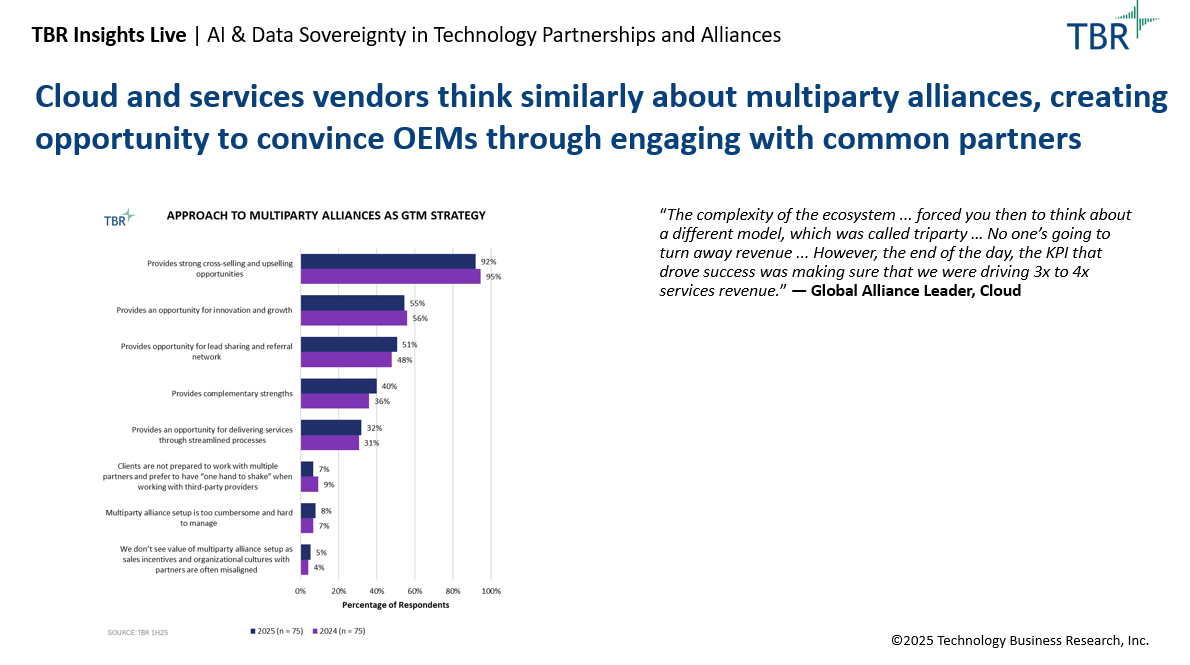
Cloud and services vendors think similarly about multiparty alliances, creating opportunity to convince OEMs through engaging with common partners

“The complexity of the ecosystem … forced you then to think about a different model, which was called triparty … No one’s going to turn away revenue … However, the end of the day, the KPI that drove success was making sure that we were driving 3x to 4x services revenue.” — Global Alliance Leader, Cloud

TBR Insights Live preview: AI & Data Sovereignty in Technology Alliances and Partnerships

Visit this link to download this session’s presentation deck here.

TBR Insights Live sessions are held typically on Thursdays at 1 p.m. ET and include a 15-minute Q&A session following the main presentation. Previous sessions can be viewed anytime on TBR’s Webinar Portal.


AI Inferencing Takes Center Stage at Red Hat Summit 2025

In late May, Red Hat welcomed thousands of developers, IT decision makers and partners to its annual Red Hat Summit at the Boston Convention and Exhibition Center (BCEC). Like the rest of the market, Red Hat has pivoted around AI inferencing, and this conference marked the company’s entry into the market with the productization of vLLM, the open-source project that has been shaping AI model execution over the past two years. Though Red Hat’s push into AI inferencing does not necessarily suggest a deemphasis on model alignment use cases (e.g., fine-tuning, distillation), which was the company’s big strategic focus last year, it is a recognition that AI inferencing is a production environment and that the process of running models to generate responses is where the business value lies. Red Hat’s ability to embed open-source innovation within its products and lower the cost per model token presents a sizable opportunity. Interestingly, Red Hat’s prospects are also evolving in more traditional markets. For instance, Red Hat’s virtualization customer base has tripled over the past year, with virtualization emerging as a strategic driver throughout the company’s broader business, including for communication service providers (CSPs) adopting virtualized RAN and within other domains such as their IT stacks and the mobile core.

Red Hat pivots around AI inferencing

Rooted in Linux, the basis of OpenShift, Red Hat has always had a unique ability to resolution assets to expand into new markets and use cases. Of course, AI is the most relevant example, and two years ago, Red Hat formally entered the market with Red Hat Enterprise Linux (RHEL) AI — the tool Red Hat uses to engage AI developers — and OpenShift AI, for model lifecycle management and MLOps (machine learning operations) at scale. These assets have made up the Red Hat AI platform, but at the Red Hat Summit, the company introduced a third component with AI Inference Server, in addition to new partnerships and integrations further designed to make agentic AI and inferencing realities within the enterprise.


AI and generative AI (GenAI) are rapidly evolving, but the associated core challenges and adoption barriers, including the high cost of AI models and the sometimes arduous nature of providing business context, remain largely unchanged. Between IBM’s small language models (SLMs) and Red Hat’s focus on reducing alignment complexity, both companies have crafted a strategy focused on addressing these challenges; they aim not to develop the next big AI algorithm, but rather to serve tangible enterprise use cases in both the cloud and the data center.


Everyone is aware of Red Hat’s track record of delivering enterprise-grade open-source innovation, and if Red Hat’s disruption with Linux over two decades ago is any indication, the company is well positioned to make real, cost-effective solutions for the enterprise based on reasoning models and AI inferencing.

Red Hat productizes vLLM to mark entry into AI inferencing

Though perhaps lesser known, most large language models (LLMs) today are leveraging vLLM, an upstream open-source project boasting roughly half a million downloads in any given week. At its core, vLLM is an inference server that helps address “inference-time scaling,” or the budding notion that the longer the model runs or “thinks,” the better the result will be. Of course, the challenge with this approach is the cost of running the model for a longer period of time, but vLLM’s single-server architecture is designed to optimize GPU utilization, ultimately reducing the cost per token of the AI model. Various industry leaders — namely NVIDIA, despite having its own AI model serving stack; Google; and Neural Magic, which Red Hat acquired earlier this year — are leading contributors to the project.


Leveraging its rich history of turning open-source projects into enterprise products, Red Hat launched AI Inference Server, based on vLLM, marking Red Hat’s first offering from the Neural Magic acquisition. AI Inference Server is included with both RHEL AI and OpenShift AI but can also run as its own stand-alone server. Though perhaps inclined to emphasize IBM’s watsonx models, Red Hat is extending its values of flexibility, choice and meeting customers where they are to AI Inference Server. This new offering supports accelerators outside IBM, including NVIDIA, AMD, Intel, Amazon Web Services (AWS) and Google Cloud, and offers Day 0 support for a range of LLMs. This means that as soon as a new model is released, Red Hat works with the provider to optimize the model for vLLM and validate it on Red Hat’s platform.


Building on vLLM’s early success, Red Hat launched LLM-d, a new open-source project, announced at the Red Hat Summit. LLM-d transcends vLLM’s single-server architecture, allowing inference to run in a distributed manner, further reducing the cost per token. Due to the cost, most will agree that inferencing will necessitate distributed infrastructure, and there are several recent examples across the tech landscape that have alluded to this. LLM-d is being launched with support from many of vLLM’s same contributors, including NVIDIA and Google (LLM-d runs on both GPUs and TPUs [tensor processing units]).

Partnership with Meta around MCP is all about empowering developers and making agentic AI enterprise-ready

If Google’s launch of A2A (Agent2Agent) protocol is any indication, Anthropic’s Model Context Protocol (MCP), which aims to standardize how LLMs discern context, is gaining traction. At the Red Hat Summit, Red Hat committed to MCP by announcing it will deliver Meta’s Llama Stack, integrated with MCP, in OpenShift AI and RHEL AI.


To be clear, Red Hat supports a range of models, but Meta went the open-source route early on, bringing Llama Stack, an open-source framework for building specifically on Llama models, into the Red Hat environment. This not only exposes Red Hat to another ecosystem but also provides APIs around it. Enlisting Meta at the API layer is an important aspect of this solution, as it enables customers to consume the solution and build new agentic applications with MCP playing a key role in contextualizing those applications within the AI enterprise. It is still early days for MCP, and making the protocol truly relevant in enterprise use cases will take some time and advancement in security and governance. But Red Hat indirectly supporting MCP within its products signals the framework’s potential and Red Hat’s role in bringing it to the enterprise.

Who would have thought we would be discussing virtualization in 2025?

In 2025 and the world of AI, you don’t often hear of a company putting virtualization at the top of its strategic imperatives list. However, everyone has seen how Broadcom’s takeover of VMware has caused a ripple in the market, with customers seeking cheaper, more flexible alternatives that will not disrupt their current cloud transformation journeys. In fact, when we surveyed enterprise IT decision makers, 42% of respondents indicated they still intend to use VMware, but most plan to do so in a reduced capacity. Of those planning to continue using VMware, a notable 83% are still evaluating other options*.


“Options both have increased the prices across the board, 20% to 30%, which is pretty significant. So, you could say myself and my peers are not very happy with the Broadcom method on that, and we’re looking at, you know, definitely options to migrate off VMware when possible. We’re definitely looking at Citrix, and then options from Red Hat and Microsoft.” — CTO Portfolio Manager, Consumer Packaged Goods


As a reminder, after Red Hat revolutionized Linux in the early 2000s, the company’s next big endeavor was virtualization. With the rise of cloud-native architectures, Red Hat quickly pivoted around containers, and this is where the company remains most relevant today. However, through the KVM (kernel-based virtual machine) hypervisor, which would eventually be integrated with OpenShift, virtualization has always been a part of the portfolio. Over the past year, given the opportunity surrounding the VMware customer base, Red Hat has actively revisited its virtualization roots in a few primary ways.


First, given the risky nature of switching virtualization platforms, Red Hat crafted a portfolio of high-touch services around OpenShift Virtualization, including Migration Factory and a fixed-price offering called Virtualization Migration Assessment. These services from Red Hat Consulting, which are offered in close alignment with global systems integrator (GSI) partners, help customers migrate virtual machines (VMs) as quickly as possible while minimizing risk, which largely stems from helping customers migrate VMs before modernizing them.


Secondly, Red Hat has focused on increasing public cloud support. Red Hat announced at the summit that OpenShift Virtualization is now available on Microsoft Azure, Google Cloud and Oracle Cloud Infrastructure (OCI), in addition to previously announced support for IBM Cloud and AWS, officially making the platform available on all major public clouds. Making OpenShift Virtualization applicable across the entire cloud ecosystem reinforces how serious Red Hat is about capturing these virtualization opportunities. These integrations will make it easier for customers to use their existing cloud spend commitments to offload VMware workloads to any cloud of their choice while maintaining the same cloud-native experience they are used to.


Of course, there will always be a level of overlap between Red Hat and the hyperscalers, but ultimately the hyperscalers recognize Red Hat’s role in addressing the hybrid reality and enterprises’ need to move workloads consistently across clouds and within data centers, and they welcome a more feature-rich platform like OpenShift that will spin the meter on their infrastructure.

With virtualization, Red Hat is allowing partners to sell infrastructure modernization and AI as part of the same story

At the conference, we heard from established Red Hat customers that have extended their Linux and container investments to virtualization. Examples included Ford and Emirates NBD, which has over 37,000 containers in production and is now migrating 9,000 VMs to Red Hat OpenShift Virtualization for a more consistent tech stack. Based on our conversations with customers, these scenarios — where VMs and containers run side by side — are not an easy sell and require a level of buy-in across the organization.


That said, if customers can overcome some of these change management hurdles, this side-by-side approach can offer numerous benefits, largely by creating greater consistency between legacy and cloud-native applications without significant refactoring. Though some GSIs may be better suited to the infrastructure layer than others, partners should recognize the opportunity to use OpenShift Virtualization to have client discussions around broader AI transformations. One of the compelling aspects of Red Hat is that even as it progressed through different phases — Linux, virtualization, containers and now AI — the hybrid platform foundation has remained unchanged. If customers can modernize their infrastructure on the same platform, introducing AI models via OpenShift AI becomes much more compelling.

Virtualization remains a key driver of telecom operator uptake of Red Hat solutions, but AI presents a significant upsell opportunity

Over the past few years, Red Hat has leveraged its virtualization technology in the CSP market, making significant progress in landing new CSP accounts and expanding its account share within this unique vertical. The company’s growth in this market has been aided by factors such as Broadcom’s acquisition of VMware, which initially caused a wave of CSPs to migrate to Red Hat due to the uncertainty surrounding VMware’s portfolio road map. Broadcom’s price hikes are causing a second wave of switching that TBR anticipates will continue for several years.


However, Red Hat has also succeeded in more deeply penetrating the telecom vertical due to its savvy marketing, which at times emphasizes that its solutions are “carrier-grade,” along with persistent efforts to raise awareness within the CIO and CTO organizations of CSPs that virtualization and hybrid multicloud strategies will have significant ROI for CSPs. This has led to strong adoption of Red Hat OpenStack and OpenShift, although the Ansible automation platform has lagged in terms of CSP adoption, as this customer segment prefers to use the free, open-source version of Ansible.


As CSPs iterate on their AI strategies, Red Hat has the opportunity to play a significant role, including with its new Red Hat Inference Server, as CSPs increasingly embrace edge compute investments. CSPs need to invest upfront to capitalize on the cost efficiency and revenue generation opportunities offered by AI, and Red Hat can help guide them in this direction. CSPs have difficulty moving quickly when new, disruptive technologies emerge, and, with AI specifically, have trouble evaluating and testing AI models themselves due to a lack of in-house expertise. Additionally, they feel constrained by regulations and are concerned about compromising data privacy. Red Hat’s dedicated telecom vertical services can help alleviate these concerns and accelerate CSPs’ investments in AI infrastructure.

Final thoughts

Based on our best estimate, roughly 85% of AI’s current use is focused on training and only 15% on inferencing, but the inverse could be true in the not-too-distant future. Not only that, but AI inferencing will likely occur at distributed locations for the purposes of latency and scale — which, due to its hybrid platform and ability to help customers “write once, deploy anywhere,” remains core to Red Hat’s value proposition. That is one of the compelling aspects of a platform-first approach; even as new components such as AI models are introduced, the core foundation remains unchanged.


Though all of Red Hat’s new innovations, including AI Inference Server and the LLM-d project, do not necessarily suggest a deemphasis on model alignment with assets like InstructLab, it is clear Red Hat is pivoting to address the inference opportunity. With its trusted experience productizing open-source innovation and its ability to exist within a broad technology ecosystem of hyperscalers, OEMs and chip providers, Red Hat is in a somewhat unique position to help transition AI inference from an ideal to an enterprise reality.


Further, Red Hat’s virtualization prospects are growing, as TBR’s interactions with customers continue to indicate that they are looking for new alternatives. If the hyperscalers’ recent earnings reports are any indication, the GenAI hype is waning, and we suspect many enterprises will refocus on infrastructure modernization to ultimately move beyond basic chatbots and lay the groundwork for the more strategic applications that inferencing will enable. It will be interesting to see how Red Hat capitalizes on new virtualization opportunities with its hyperscaler and services partners as part of a joint effort to bring customers to a modern platform, where VMs and containers can coexist and drive discussions around AI.


*From TBR’s 2H25 IT Infrastructure Customer Research

A Challenger Mindset Transforms HCLTech’s Approach to Financial Services to Achieve Success Through AI

HCLTech hosted industry analysts and advisers on May 13 at the ASPIRE at One World Observatory in New York City. Throughout the afternoon, HCLTech executives, leaders and clients spoke at length about the company’s financial services positioning, direction and activities amid disruption from AI and digital acceleration.

Introduction

During the event, HCLTech leaders consistently highlighted how the company’s culture, deep engineering expertise and unique approach to AI set it apart from its peers and strengthen client relationships. These points were echoed by two financial services clients during a panel discussion. Differentiation remains a challenge for all vendors, yet HCLTech emphasized that although the company may not be different in what it does, it is unique in its approach.

Balancing risk, innovation and talent investment

The event began with a presentation by HCLTech CEO and Managing Director C Vijayakumar (CVK), who gave an overview of the company’s current positioning and future plans. The session centered on HCLTech’s evolution toward an engineering and platform-based mindset and its transformation from a traditional model that no longer remains relevant amid a changing balance between revenue and talent volumes. To adapt its business model and better align itself with the needs of clients and the market, CVK announced HCLTech’s goal of doubling its revenue with only half of its previous headcount.


As roles within the organization have begun to change with the integration of new technology, including AI, HCLTech has had to begin transforming the company’s structure. Revenue per employee has always been a KPI for HCLTech to ensure the company decouples revenue growth from headcount growth. HCLTech’s attention to the metric is reflected in its ability to maintain peer-leading levels relative to Cognizant, Infosys, Tata Consultancy Services (TCS) and Wipro IT Services (ITS), whose trailing 12-month (TTM) revenue per employee was $59,304, $60,338, 49,692 and 45,270, respectively, in 1Q25 — each below HCLTech’s figure of $62,360.


It is a lofty goal to deliver the same quality of service at the same speed with fewer people, even with the support of AI tools and strong partnerships. To achieve this goal, HCLTech will rely on its culture and talent, combined with its strategic technology investments including AI, digital and software solutions. CVK emphasized that HCLTech’s culture is deeply embedded in the company’s DNA, making it difficult for competitors to replicate. This culture fosters strong client trust and deepens relationships, as it consistently comes through in conversations with clients. By building on this foundation, HCLTech effectively leverages AI technologies to strengthen existing partnerships and secure new projects.


HCLTech’s client management and retention strategy reflects the company’s ability to embed itself within the client environment and serve as a key partner. HCLTech’s deep relationships have enabled the company to better identify and address client challenges as well as opportunities to recommend transformations to clients. As complexity increases across the technology landscape, HCLTech has had to evolve its approach to both new and existing clients. Client willingness to adopt AI tools can be tempered by concerns over managing multiple platforms and the associated risks.


As a result, HCLTech often takes a more measured and gradual approach with new clients, focusing on building trust and easing them into transformation. In contrast, with existing clients, HCLTech adopts a more assertive strategy — leveraging its deep understanding of their technology landscapes and industry-specific needs to drive adoption and deliver results more rapidly.


CVK closed his presentation by emphasizing the need to be proactive and carry a “paranoid mindset” to stay ahead of technology trends and remain relevant. HCLTech’s ability to build strong relationships with clients enables the company to guide transformations, equipping clients with the tools and services to be proactive and effectively leverage technology across their organizations. With a greater focus on outcomes, HCLTech’s positioning and relationships with clients provide a foundation for the company to grow its wallet share with clients as it balances risks with innovation and invests for future growth.

Demand for modernization and AI influences client needs within the financial services space

Srinivasan (Srini) Seshadri, HCLTech’s chief growth officer and Financial Services lead, discussed the company’s 50,000-person Financial Services practice, which as HCLTech’s largest industry group generated $2.9 billion in revenue during FY25. During the presentation, Seshadri emphasized five main features of the company’s Financial Services practice that help it drive value for clients: engineering DNA, outcome orientation, challenger mindset, verticalized services and innovation. The benefit of verticalized services stood out to TBR. A few years ago, HCLTech moved all its service lines under one vertical, creating a unified go-to-market strategy, enabling it to deepen its client relationships and positioning around transformation. As vertical and industry expertise does not provide differentiation on its own, HCLTech took it a step further, pairing its industry experience with service lines to better communicate its portfolio and drive value. Taking this approach pulls together HCLTech’s strengths and drives outcomes.


Key items influencing HCLTech’s Financial Services activities include adapting to changing regulations, increasing use of Global Capability Centers, and creating and implementing composable products. Aligning its portfolio and resources to help clients navigate current trends and operate more effectively guides HCLTech’s client approach.


For example, with the permeation of generative AI (GenAI) and increased adoption of the technology by clients seeking to remain relevant, Seshadri spoke about the evolution of GenAI from a buzzword to actual engagement and usage, including using GenAI to reimagine an autonomous future for Financial Services. HCLTech seeks to integrate GenAI solutions and tools within its clients’ operations, depending on maturity level and understanding, to drive end-to-end value chain transformation.


Helping clients use AI to make internal processes better and more efficient and to achieve their goals enhances HCLTech’s value proposition in the financial services industry and enables the company to gain new projects in sensitive areas such as regulation, governance and security.

Prioritizing the main areas within engineering, platform modernization and GenAI aligns HCLTech’s financial services expertise with its key service line strengths around business optimization, design and innovation and enables the company to support client transformations. Seshadri closed his presentation by acknowledging that transformation “is up to the client to implement.” HCLTech’s approach to deal generation is shaped by its deep understanding of culture and clients’ readiness to sustain transformation. By viewing AI as a means to enhance processes and operations — and by factoring in the longevity of each client relationship — HCLTech tailors the pace and intensity of technology integration. This ability to meet clients where they are and ensure lasting transformation distinguishes HCLTech from its peers.

Experience is key to client engagement

Building on Srini’s discussion, Ananth Subramanya, HCLTech’s EVP of Digital Business Services, talked about the industrywide shift in consumer loyalty from a physical product to the experience, with the experience driving the engagement. As clients increasingly demand rapid, relevant transformations that drive business outcomes, Subramanya emphasized the importance of balancing speed with stability — acknowledging that while stability may at times constrain velocity, it is essential for sustainable progress. The strategy helps users build resilience, enabling the customer experience (CX) to permeate the product and platform layers to ensure it influences each aspect of the client transformation.


HCLTech’s CX-centric delivery approach — anchored in both business processes and user interface (UI) design — deeply embeds the experience within clients’ operations and functions. This foundation empowers clients to engage more effectively and drive meaningful change. Additionally, by enabling end users to experience improvements more rapidly, the approach fosters stronger client loyalty and supports the development of long-term, strategic projects.

AI permeates approach to transformation

Diving more deeply into the impact of AI on financial services activities and client investments, Vijay Guntur, HCLTech’s CTO and head of Ecosystems, discussed the primary needs within financial operations: operational efficiency, accelerated innovation, CX and risk management. Key challenges around data quality and collection, the use of legacy system, and scalability also remain critical within the financial services space. HCLTech’s investments across AI platforms and solutions have enabled the company to deliver on these needs while embedding industry knowledge to address key client concerns. The company’s four main AI and GenAI offerings are AI Force, AI Foundry, AI Labs and AI/GenAI Engineering. Through these offerings, HCLTech helps clients execute on decision making and handle complex workflows.


Using its AI Labs, with six different locations in the U.S., the U.K., Germany, India and Singapore, HCLTech can build and scale AI for clients, helping them work through early stages and identify where they can add value through the use of technology. The labs encapsulate HCLTech’s AI portfolio offerings and create opportunities for the implementation of tools and solutions with the goal of driving value. As clients undergo transformation and modernization services, lowering risk while increasing AI efficiency across IT operations, the labs showcase HCLTech’s portfolio offerings and solutions, helping clients lead AI transformations.


The primary AI offering, AI Force, launched in March 2024, takes a platform approach to apply AI technologies within software development and engineering life cycle processes. Further development of the platform has enabled interoperability and greater adoption and AI usage. Guntur emphasized that the platform improves efficiency and shortens time to market, allowing clients to more quickly respond to market needs and remain relevant against peers. With agentic AI emerging as a much-needed use of the technology, AI Force’s ability to embed agentic workflows enhances efficiency and adds value.


The second product, AI Foundry, accelerates product development and remodels the value stream using AI and data. With a focus on value streams, modernizing data, and AI that is built within a cognitive infrastructure, AI Foundry uses technology to help clients improve their business operations.


HCLTech has a long history working with AI, building off its DRYiCE platform, the company’s original automation platform. This heritage equips HCLTech with the background and trusted technical expertise, backed by its engineering prowess. to deliver on clients’ AI transformation needs. Further, HCLTech can pursue larger-scale and more aggressive AI-led transformations, helping the company accelerate ahead of its peers in terms of client engagement and growth.

Consulting serves as an entry point to broader financial services activities

In a panel discussion with financial services clients, HCLTech leaders discussed the company’s consulting services and main service line areas. Although consulting has not been a primary investment focus for HCLTech, the company has selectively built out consulting capabilities to address clients’ end-to-end modernization and technology needs. For example, in March 2019, HCLTech acquired Strong-Bridge Envision, a digital consulting firm that complemented its digital and analytics capabilities. Embedding this expertise across its portfolio strengthens the company’s ability to drive AI and platform adoption.


The company’s AI Labs are a central part of HCLTech’s consulting offerings. Through the labs, HCLTech delivers technology consulting services, helping clients to identify areas where they would most benefit from AI. As many clients, particularly within the financial services space, look to accelerate innovation to create new products and business models that enable them to remain relevant, technology consulting services bring in essential offerings to help address key areas of client transformations.


Looking at the data aspect, consulting is required for many clients to organize and manage datasets. Ensuring data is protected and structured remains vital to valuable and trusted AI usage, increasing the importance of HCLTech’s ability to deliver on data needs in a timely manner.

While these consulting investments may offer limited scale, they are sufficient to remain competitive with peers and to guide clients effectively on AI adoption. This expertise aligns well with the company’s client management strategy, particularly in expanding relationships with existing clients — where HCLTech can lead with a proactive and open-minded approach.

Conclusion

HCLTech concluded the event with a wrap-up by CMO Jill Kouri, who noted key points about HCLTech’s positioning and direction as the company navigates client needs around AI. The main comment that struck TBR analysts referenced the need for a challenger mindset companywide. This approach will help HCLTech transform the way it delivers services and solutions to clients. Leading with a proactive and paranoid mindset embodies the challenger focus, allowing HCLTech to stay ahead of AI and technology trends while complementing its existing strengths.


The goal of doubling revenue with half the people will certainly present challenges for HCLTech, but the company’s culture and robust AI portfolio, which provides the technology, engineering expertise and resources needed to deliver on consulting services, will help the company move in the right direction. Further, leveraging an AI-intrinsic point of view, as opposed to an AI-first point of view, secures HCLTech’s positioning around AI and its trust-based relationships with clients, to effectively address key market needs around efficiency and modernization.

Telcos Risk Losing the AI Race Without Strategic Shift; $170B at Stake by 2030

Watch Now: Telcos Risk Losing the AI Race Without Strategic Shift; $170B at Stake by 2030


Realizing the AI opportunity

AI presents a once-in-a-generation opportunity for the telecom industry to achieve two key objectives: generate new revenue and reduce costs. However, there is a real risk that most communication service providers (CSPs) globally will miss out on the full benefits of AI. Although leading CSPs have been investing in AI, most of these investments appear to be myopically focused on quick-hit wins. This strategy is acceptable in the short term, but true opportunity capture will be contingent on broader-scope initiatives, coupled with upfront investment.


In this TBR Insights Live session Principal Analyst Chris Antlitz discusses how CSPs are integrating AI into their internal operations and their products and services. Chris also shares insights from the latest edition of TBR’s Telecom AI Market Landscape, which focuses on the opportunity sizing of key new revenue and cost-efficiency use cases.


In this free session on AI opportunity for the telecom industry Chris will answer:

  • Where does the telecom industry currently stand in terms of generative AI (GenAI) adoption?
  • How big is the opportunity for telcos to generate new revenue from AI by 2030?
  • How significant is the opportunity for telcos to reduce costs through AI by 2030?
  • Who stands to gain if telcos don’t change?


Watch Now


Excerpt from Telcos Risk Losing the AI Race Without Strategic Shift; $170B at Stake by 2030

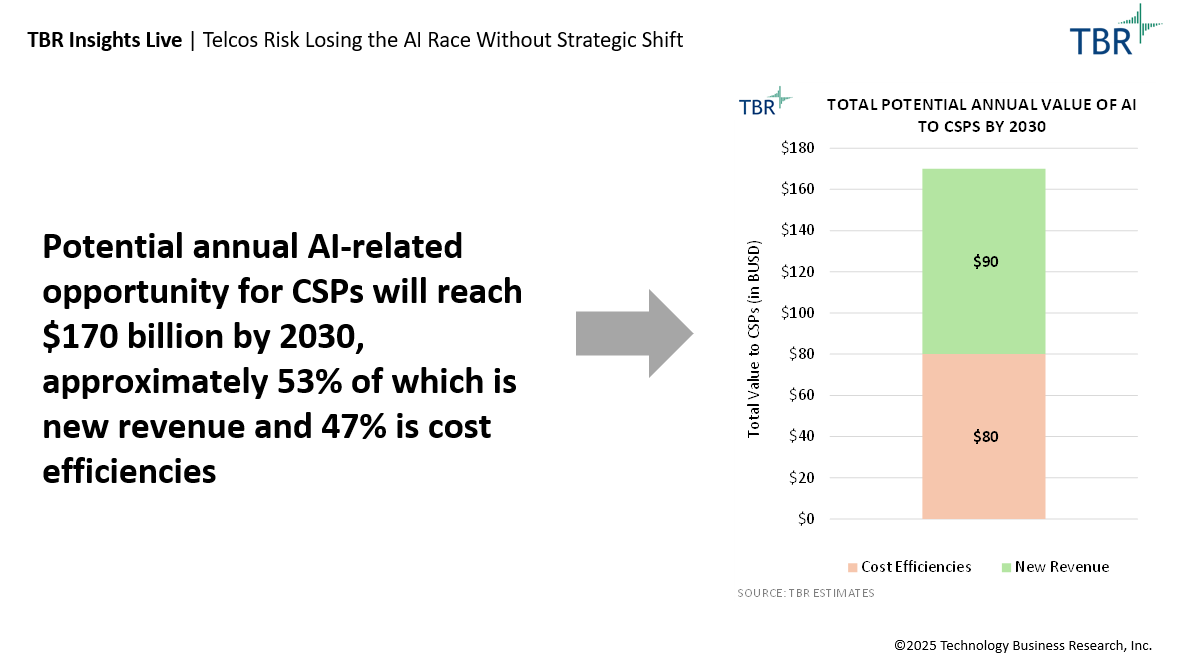
Potential annual AI-related opportunity for CSPs will reach $170 billion by 2030, approximately 53% of which is new revenue and 47% is cost efficiencies


Visit this link to download this session’s presentation deck here.


TBR Insights Live sessions are held typically on Thursdays at 1 p.m. ET and include a 15-minute Q&A session following the main presentation. Previous sessions can be viewed anytime on TBR’s Webinar Portal.


Sage Analyst Summit: Keeping the Winning Playbook While Evaluating Emerging Changes to the Game

Connect, grow, deliver

TBR spent two days in Atlanta, listening to and speaking with Sage’s management team as part of the company’s annual Analyst Summit, and we walked away impressed. This is a company that knows itself and its strengths. It knows where it needs to improve. It knows where the pain points and constraints are, and has always done a good job of navigating between the two.


Most importantly, the company knows its customers, which should come as no surprise considering how long Sage has been serving its SMB install base. Sage has leveraged these strengths and established a large, sticky install base from which to pursue opportunities adjacent to its core business.


Sage is focused on three interlocking areas — connect, grow, deliver — which President Dan Miller described during the event:

  • Connect through trusted partner networks
  • Grow by winning new logos through a verticalized suite motion
  • Deliver real, measurable productivity using AI

Each pillar represents a separate part of the company’s go-to-market strategy, but Grow stands out as the most vital to the company’s growth trajectory. Landing and expanding with new logos is the company’s greatest source of revenue growth, with vertical-specific and business operations solutions offering some of the greatest upsell potential. Aligned with this strategy, the company is a disciplined but active acquirer, onboarding new IP to enhance these sales motions.


Long-term, AI presents opportunities for the company to upsell into its finance and accounting (F&A) core. As Sage leans into its strengths while building for the future, its ability to scale AI and industry depth across a known and trusted customer base may prove to be the company’s most valuable asset.

Landing with F&A, then expanding with payroll, HR and operations management

Sage’s land-and-expand strategy starts with a stronghold in finance and builds outward through operational adjacencies. Most customers enter through core accounting —typically via Intacct — and expand into areas like payroll, HR, and inventory or distribution management as their needs mature. Vertical-specific modules are critical to this motion, especially in midmarket industries where Sage can tailor functionality to operational nuances.


The company reinforces expansion by packaging these capabilities into suites, streamlining procurement and positioning itself as more than just a financial system. Sales teams are trained to identify expansion triggers early; signs like API adoption, workflow customization or manual process bottlenecks often indicate opportunities. Although the company’s product maturity varies across the portfolio, Sage has seen success in service- and product-centric verticals, enabling the company to upsell and cross-sell. This approach, combined with a focus on ease of integration and strong partner involvement, is helping Sage grow account value without overpromising in its product road map.

AI at Sage: Workflow-first, ROI-driven

Sage management spent much time discussing its ambitions in AI. From TBR’s perspective, the tone was very grounded. Although the company will never be at the cutting edge of AI innovation, management did a great job of articulating the current opportunities to upsell AI capabilities. Finance and accounting workflows offer many sales opportunities for Sage to pursue, and the company is investing in R&D to capitalize on them. Similar to many of its application peers, Sage intends to approach agentic AI and generative AI development on a use-case-by-use-case basis. In Sage’s case, this is even more prudent as SMB customers face greater budgetary restrictions and require ROI to be realized in the first year.


Sage management highlighted AP automation, time-saving prompts and variance analysis as key areas where the company is achieving success with AI-powered automation. Like several peers, the company’s Copilot solution serves as the unified user interface (UI) for engaging embedded AI tools. Long-term, management expects to see this UI become more adaptive, guiding the user through an automated workflow. Guided prompting was another area of focus, and the company is building a library of prompts for end users to leverage as they perform specific tasks. Under the hood, the company intends to run its AI tools on internally trained models built on top of a third-party. CTO Aaron Harris discussed two of these tools: Sage Accounting LLM and APDoc2Vec.


As a reminder, Sage partnered with Amazon Web Services (AWS) over a year ago to collaborate on F&A models, and management highlighted the continued effort to build a new multitenant, dependency-based stack.


Long-term, TBR expects this work to be pivotal in reducing the cost of running AI workloads, while internally developed models with lower parameter counts than big-name large language models (LLMs) will further enhance cost efficiency at inference. Meanwhile, Sage is still figuring out how to monetize AI, but the industry default is to implement a tiered system. Some high-compute copilots may eventually carry usage-based fees, especially in forecasting, but for now, the priority is to show clear value and price accordingly.


In 2025 no conversation is complete without recognizing the platform implications of agentic workflows. Behind the scenes, Sage is preparing for an agent-first architecture by integrating emerging frameworks, such as Model Context Protocol (MCP) or Agent 2 Agent (A2A), directly into its platforms. The long-term goal is to coordinate these through super agents and plug into the broader agent ecosystem (Salesforce, Microsoft, Google), but this is still only part of the long-term road map.


That said, the company is building for the future, with an emphasis on data model consistency, dependency-based deployment, and orchestration layers capable of managing multi-agent chains. This is all being done with AWS in the background, keeping the platform anchored at the infrastructure layer.

Sage deepens its partner relationships

Sage’s partner and go-to-market strategy is built for focus and leverage. The company cannot cover every vertical or service need on its own, so partners are central to how it sells, delivers and scales. The revamped Sage Partner Network is tighter, with clear roles across sell, build and serve motions, and expectations tied to growth, not just activity. Multiyear vertical plans, coinvestment and execution discipline are now baseline requirements.


Internally, the GTM engine runs through SIGMA, which ties product planning to what the direct and partner channels sell. Sales teams are trained to package suites, identify expansion triggers, and position the platform by vertical need, rather than a feature checklist. To prepare for the platform’s evolution, Sage is already laying the groundwork for a more extensible ecosystem, including plans for an agent marketplace that would give partners a direct path into the next wave of product delivery.

Staying the course and preparing for what lies ahead

Sage’s story at its annual Analyst Summit was not necessarily one of reinvention. Land and expand has been the company’s strategy for years, and it has worked well so far. By anchoring in finance, expanding through vertical suites and operation management, and keeping partners close to the motion, Sage is executing with clarity around who it serves and how it wins. Meanwhile, the platform is evolving, AI is taking shape, and the architecture is catching up to the ambition. None of the company’s claims felt like overpromising.


In a market filled with transformation stories, Sage is running a disciplined play. The question is whether it can maintain that discipline as it scales and converts its product investments, especially in AI and agentic workflows, into tangible value for the customers it already knows best.

SAP Sapphire 2025: Legacy Application Leader Moving Confidently Into a Data and AI Future

Staking a claim in a best-of-suite future

At SAP Sapphire 2025, one thing became immediately clear: SAP is no longer chasing the cloud market — it is positioning itself to define it. While best-of-breed has long been the enterprise default, a growing segment of the market is leaning toward consolidation: fewer vendors, tighter integration, faster outcomes. SAP sees an opening. With its dominance as a system of record and a broad portfolio spanning platforms and line-of-business (LOB) suites, the company believes it is uniquely equipped to serve these best-of-suite buyers and made a compelling case at Sapphire that it is actively working to turn this vision into reality.


SAP’s messaging has focused heavily on customers already operating in the cloud, shifting attention away from the sizable portion of its base still tethered to ECC (ERP Central Component). The forward-looking emphasis may be warranted. Although cloud migrations remain a strategic priority, they have been at the center of SAP’s story for the better part of a decade. While the customer mix still skews toward legacy deployments, TBR estimates that cloud revenue accounts for more than 60% of SAP’s total corporate revenue, presenting a solid base from which to expand contract sizes.


In addition to migration efforts, the company has built out a suite of integration, robotic process automation and data assets — many with high attach rates — that are driving much of its commercial cloud momentum. While TBR believes SAP will continue steadily transitioning legacy customers to the cloud, its land-and-expand strategy among new logos (born-in-the-cloud, midmarket) and existing customers leaning into modernization will provide ample growth opportunities to build on top of migration-related gains. For this reason, TBR believes SAP was justified in prioritizing its platform-centric cloud strategy at Sapphire 2025. The company has built a compelling cloud business, and that road map deserves to be in the spotlight.

Building an agentic flywheel

SAP’s central metaphor this year — the “flywheel” — describes a loop in which enterprise applications feed business data into a semantic layer, which powers AI agents that act on the data and push outcomes back into the apps. Put simply: if you own the context, you control the outcome. SAP believes its depth of structured business data gives it a defensible advantage in the race toward agentic AI. Fragmented stacks, the company argues, are the Achilles’ heel of enterprise automation. SAP promises to reduce the cost and complexity of AI adoption by delivering deeply integrated, outcome-oriented capabilities across its entire suite of products.

The state of Joule as a UI for the AI era

SAP wants 2025 to be the year agents move from prototype to production. Joule remains the user interface (UI), but it is now positioned as an orchestration layer, not just a chatbot. The company showcased use cases ranging from accounts receivable prioritization to automated financial close and proactive risk flagging. These scenarios emphasized traceability. For example, each step is visible to the end user, and each recommendation is auditable. That transparency, enabled by LeanIX, signals SAP’s commitment to building enterprise-grade controls around automation.


Today, most of these agents are operating in relatively structured environments. Financial workflows, inventory management and procurement tasks offer well-bounded problems. The leap to agents that navigate fuzzier terrain — customer onboarding, scenario planning or partner collaboration — has not happened yet. Agentic systems will continue to be built on a use-case-by-use-case basis, which takes time. SAP is developing more tasks and, at the event, showed a demo of Joule working through a tariff shock scenario. It featured each member of a fictional C-Suite reacting in real time using embedded AI: the CFO reallocating capital, the chief revenue officer rerouting demand, the COO managing supply constraints, and the chief human resources officer rebalancing skills.


In TBR’s opinion, the demo felt like an oversimplification of a complex issue, but we were still impressed by the information an agent could gather and the actions it was able to execute. Obviously, agentic AI stands to be highly disruptive to SaaS workflows, and TBR believes SAP is playing the game well. Long-term, the breadth of the company’s ERP and LOB portfolios offers a massive amount of whitespace for innovation, enabling the company to continue attacking the opportunity on a use-case-by-use-case basis as it rides the wave.

Prioritizing semantic cohesion over data consolidation

SAP has spent years refining its data strategy. While Datasphere offered value in real-time processing, it was never intended to serve as a central data platform — especially with Snowflake, Databricks and Google Cloud leading in that space. The launch of Business Data Cloud (BDC) acknowledges this external reliance, advancing the same ambition Datasphere once aimed for: a harmonized, semantically enriched, agent-ready data layer.


BDC’s zero-copy architecture and native integrations with platforms like Databricks reflect this evolution. SAP is betting on semantic fabrics, not data lakes. Knowledge graphs across HR, finance and procurement add structure, while embedded governance ensures auditability. This plays to SAP’s strengths. The offering feels tailored to existing customers and midmarket newcomers, especially those with aggressive AI ambitions.


That said, harmonized data remains one of the hardest problems in enterprise IT. BDC assumes a level of data maturity that many SAP customers have not yet achieved. A large portion of the install base remains on premises, but for those already in the cloud — or willing to invest — the value proposition is becoming clearer. And SAP’s traction among net-new logos suggests the offering resonates with digital-native buyers looking to operationalize AI quickly.

Turning channel partners into strategic collaborators

The biggest partner takeaway from Sapphire was that SAP is no longer content with resell-and-implement motions. It wants deeper collaboration. The flywheel — applications, data, AI — only spins fast enough when partners are embedded into engineering, orchestration and execution. That shift has forced SAP to rearchitect how it manages partner access, tools and territory, with trust becoming a central pillar of its partner strategy.


SAP is also handing over the sales motions for its innovation stack. Partners now have access to the same internal tools used to build and deploy agents: Joule Studio, Prompt Optimizer, LeanIX, SAP Build and WalkMe. This is not only enablement but also an invitation to build within the stack. But access comes with expectation. These tools require fluency, not just familiarity. SAP wants to work with a deeper class of partner that can move from implementation to cocreation.


Equally important: territory. SAP is expanding partner-led coverage, particularly in North America and Europe. The new SAP Referral Program, scheduled to launch in 3Q25, formalizes this shift. Strategic partners will now own more of the Customer Value Journey — sales, delivery and post-sales engagement — especially in midmarket and vertical contexts.


Perhaps the most strategic move, though, is cultural. SAP is not just training partners; it is also increasingly transferring responsibility. KPMG is delivering structured Joule certifications. Accenture is codeveloping production agents. Capgemini is integrating Databricks into SAP’s data stack. Meanwhile, PartnerEdge, SAP’s overall partner program, is evolving to reward cloud performance, AI capability and vertical differentiation. Success in these areas will see the greatest investment and visibility from SAP.

SAP moves ahead with strategic clarity

All told, Sapphire 2025 marked a turning point, not because SAP introduced a radically new vision but because the company finally appears ready to execute on the one it has been quietly building for years. The narrative has matured, the tools are in place, and the platform is coherent. And the partners, customers and product ecosystem are starting to move together. Some heavy lifting remains, such as around migrations, data harmonization and partner fluency, but if SAP can stay focused on delivering scalable value through agentic AI, integrated data platforms and partner-enabled execution, the next chapter of the company’s growth story will look a lot less like catching up to the cloud and a lot more like leading in it.