Key Discussions on Strategic Alliance Management, the Emerging India Opportunity, Monetizing GenAI in Cloud and More Now Available On Demand

Technology Business Research, Inc. (TBR) is pleased to announce on-demand availability of all of our 4Q24 TBR Insights Live webinars. 4Q24 topics included strategic alliance management, the U.S. telecom B2B market, the emerging India opportunity, monetizing generative AI (GenAI) in cloud, the evolving IT infrastructure landscape, the private cellular networks market, and the hyperscaler ecosystem landscape.


Click any of the linked titles below to watch the full videos today.


Strategic Alliance Management: Case Study of a TBR Use Case

Learn: How both services revenue and industry-vertical revenue can guide your firm’s alliance strategy; how quarterly ITO revenue can help your firm benchmark partner teams for QBRs with validated and independent data; and which global systems integrator may be the right partner for your firm, and why the biggest partner may not be the best


State of the U.S. Telecom B2B Market: Trends and Strategies Impacting the Competitive Landscape

Learn: B2B revenue comparison of leading U.S. operators; macroeconomic and telecom industry trends that are impacting B2B customer segments, including SMBs, large enterprises and the public sector; and the impact of recent and upcoming partnerships and mergers & acquisitions on the competitive landscape of the U.S. telecom B2B market


$130+ Billion Emerging India Opportunity – India-centric vs. Global IT Services Firms: Who Wins and Why

Learn: The strategies, investments and internal activities global management consultancies and global systems integrators have leveraged to address the local Indian market; the market minefields and systemic challenges that may slow growth in consulting and IT services; and the consultancies and IT services companies TBR believes will lead and lag in the market


Monetizing GenAI: Cloud Vendors’ Investment Strategies and 2025 Outlook

Learn: The investments cloud vendors are making in their infrastructure, partnerships and portfolios; the business models that enable vendors to best monetize GenAI technologies; and TBR’s projections for industry changes in 2025


Evolving IT Infrastructure Consumption Services: Expectations for 2025

Learn: How infrastructure consumption services are evolving to meet AI demand and the increasing role they are playing in sustainability


Private Cellular Networks: Growth Drivers, Challenges and Opportunities Expected Through 2028

Learn: Which verticals are leading and lagging in private cellular network adoption; which ecosystem players are positioned to capitalize on market trends; and key growth drivers and detractors expected through 2028


Hyperscalers Building Out Their Global Networks: What this Means for the Telecom Industry

Learn: Key insights from TBR’s latest Hyperscaler Digital Ecosystem Market Landscape and how hyperscaler-owned and -operated networks will impact the telecom industry


TBR Insights Live sessions are held typically on Thursdays at 1 p.m. ET and include a 15-minute Q&A session following the main presentation. A recording of the session is sent to all registrants the day after the live airing.


To find out what we are discussing in the upcoming months, visit the TBR Insights Live page of our website.


PwC Positions Trust and Cybersecurity as Pillars for Success in AI and Business Transformation

Analyst Summit Boston: PwC positions trust and cybersecurity as pillars for success in AI and business transformation

PwC has unquestionably built a brand around trust, as reflected in the two main themes woven throughout the Boston PwC Analyst Summit: risk and cybersecurity. In TBR’s view, PwC’s fundamental value proposition around trust and client intimacy reflects the firm’s strong governance, risk and compliance (GRC), cybersecurity and technology capabilities. TBR views risk and cybersecurity offerings as natural enablers for client discussions around business model reinvention and — when complemented by credible customer zero use cases across multiple domains, including AI — an extension of trust throughout a client’s ecosystem.


Despite its traditionally risk-averse culture, PwC was relatively quick to roll out an internal version of ChatGPT to all employees, and TBR believes the firm likely uncovered substantial best practices in how to manage change and limit downside risk associated with generative AI (GenAI).


Recognizing that cyber risk is no longer solely a technology issue but also a businesswide concern with financial and reputational consequences, PwC leaders repeatedly stressed that governance, not technology, must take the lead in ensuring robust cybersecurity strategies, supported by an ecosystem of partners. During a managed services use-case discussion, a client noted that PwC brought specific technology expertise and experience working with other business customers on this client’s specific problem. PwC’s relevant experience offered the client distinct benefits around risk mitigation, as part of their larger managed services engagement.

Additional highlights from PwC’s Boston event:

  • An emphasis on data sustainability and GenAI is central to PwC’s long-term investment strategy, forming the foundation of every business line. PwC’s role as what TBR calls a “technology orchestrator” reflects the firm’s commitment to navigating the intersection of renewable energy, AI and other emerging technologies to help clients adapt and grow.
  • Geopolitical tensions, particularly between the U.S. and China, remain a critical concern, with bipartisan consensus in the U.S. about addressing these issues underscoring the urgency. Despite challenges with R&D expense rules and state-level regulatory complexities, PwC has been advising clients to embrace sustainability and prepare for scenario planning.
  • Mike Thiessen, PwC’s U.S. Chief Clients and Markets leader, noted that PwC’s approach to GenAI focuses on building bespoke workflows, integrating technical development with legal safeguards, and prioritizing user-driven curation. PwC recognizes that each GenAI project is unique, requiring tailored approaches and experience in addition to technical features. Under these conditions, PwC ensures AI implementation is secure and effective, aligning with the firm’s broader AI strategy.
  • C. Lapierre, one of PwC’s U.S. Sustainability leaders, noted that mandatory reporting on climate action can serve as a catalyst for enterprises to get their data and sustainability strategy in order. Many companies now understand the scope and depth of the work needed to meet net-zero commitments, which were often made before the necessary parties had a full understanding of the difficulties and opportunities involved.

Artificial intelligence: Big bets, massive change, and all comes back to trust

On artificial intelligence (AI), PwC leaders during the Boston event noted that AI is reshaping everything, from brand and market positioning to operational strategy. PwC committed to a $1.5 billion investment in AI, an increase from its original announcement of $1 billion, underscoring the technology’s importance to the firm’s future.


The vendor is also focused on delivery excellence, specifically enhancing systems like SBLC to make them more intelligent and efficient. PwC noted that the U.S. firm spends 17 million hours annually bringing ISV partners into the production stage of engagements, clearly an area ripe for AI-driven optimization. Additionally, PwC leaders said that new partnerships around developing language models are revolutionizing SBLC, creating a new foundation while refactoring older offerings. According to PwC, this shift reflects the broader evolution of AI from an emerging technology to a general-purpose one that is now central to business strategies.


PwC leaders elaborated on potential business model implications of wider AI adoption, including the erosion of scale as a differentiator as AI-driven agentic workflows allow small companies to simulate large-scale operations. In addition, faster adoption rates help businesses more quickly realize the efficiency AI brings to back-office operations.


In TBR’s view, trust continues to be the linchpin for AI’s success; absent trust, AI’s potential will remain unrealized. As noted above, in previous TBR reports, and by PwC leaders repeatedly during the Boston event, PwC’s brand is built around trust.


Demonstrating the criticality of AI to PwC, firm leaders noted nine high-stakes AI investments, each worth $50 million, aimed at driving either top-line growth or cost reduction. One of the standout initiatives is Elly, an AI-powered system with a digital worker equivalent (DWE) of 2,500 — with each DWE representing 2,000 hours of work. This demonstrates the firm’s bullish outlook on AI’s return on investment.


Further, PwC leaders believe AI’s impact extends to enterprise resource planning (ERP) systems. While earlier designs emphasized efficiency, the focus has now shifted to functionality and achieving the best outcomes. In building these systems, PwC is ensuring that both design and implementation align with the firm’s strategic objectives. TBR agrees with PwC’s assessment of the potential for AI to massively improve ERP systems, provided enterprises fully trust their AI platform to handle mission-critical and proprietary data. Again, the emphasis is on trust.

Analyst Summit London: PwC leaders highlight megatrends and business model reinvention in effort to navigate transformation

In London, PwC leaders shared the following megatrends and commentary from the firm’s perspective:

  • Climate change is negatively affecting social stability.
  • Increasing demand for silicon chips and power, combined with a limited supply of chips and GenAI, is compounding clients’ risk factors.
  • There is a global need to rethink power, global food supplies, demographics and migration, and industrial processes.
  • Increase for on-demand mobility is quickening the pace of change in the automotive and oil & gas verticals.


To address the megatrends and capture opportunities, PwC is investing in three key areas both globally and in EMEA: sustainability, trust and business model reinvention (BMR). BMR requires helping clients operate in new ecosystems to find future areas of growth and reconsider how products and services will change. According to PwC EMEA leaders, AI, data and technology cut across all three, and every enterprise must be able to operate and be successful in these areas.


Going deeper on BMR, PwC EMEA leaders noted that, according to PwC’s most recent Global CEO Survey, approximately 45% of CEOs do not believe their business will be viable in the next 10 years without reinvention, up from 39% of respondents in 2023. Not surprisingly, clients are asking for PwC’s advice on strategic planning and how to invest today to be successful tomorrow. PwC has a methodology to assist clients with their transformations, starting by sitting with clients and discussing their needs to gain a deep understanding of their design and implementation abilities and industry knowledge and co-creating an approach that is industry-led and industry-focused.


According to PwC EMEA leaders, the PwC BMR framework helps clients identify business growth areas, such as the development of new ecosystems and the creation of new products and services to pursue value and underpenetrated areas of revenue. For example, through a client session, PwC walked through a BMR transformation in which PwC helped create a new company from scratch following a sale of the business. Through the new business, the client sought to overcome rising cost pressures as well as crop and agricultural challenges that were disrupting its ability to deliver its products. Additionally, changing its primary delivery method to include a different product allowed the new company to focus on driving value and creating new revenue streams.


In a separate client example, PwC created a new platform to transform how a university engaged with prospective students. Through the platform, the university sought to advance its technology, position for the future, strengthen trust, and improve online engagement and opportunities. PwC used its BMR framework in both of these client examples, guiding the evolution of existing business environments to identify needs and pursue next steps to future-proof operations.


On a technology-specific note, PwC EMEA leaders highlighted the firm’s Industry Edge approach, explaining that PwC’s first step is building a differentiated way to enable transformation outcomes tailored for each industry. PwC applies data and tech assets, gathers use cases to understand the best way to make decisions, and establishes preconfigured solutions that support business transformation, all while leveraging technology alliances.


The key, according to PwC EMEA leaders, is that the firm provides not only a consulting approach but also all of PwC’s capabilities, including technology, regulatory, risk and even tax services. Critically, in TBR’s view, PwC is not going to clients and selling Industry Edge; instead, the firm is adapting elements of Industry Edge that are applicable to specific clients.


PwC EMEA leaders noted that “every day PwC follows two principles”: 1) emphasizing client centricity, which PwC and TBR both recognize sounds obvious and is not differentiating but, according to PwC, is a key to success; and 2) a one-firm approach: a global network of firms that come together to seamlessly deliver services to clients. Pursuing these initiatives enables PwC to deliver reinvention and transformation services through an industry play, leading with the right approach to drive value, cocreation and evolution services.

TBR’s expectations for PwC in 2025

In TBR’s view, PwC’s twin analyst events at the end of 2024 showed a firm shifting into a new gear, perhaps reflecting leadership changes or the changing environment for professional services as the GenAI age begins to mature and PwC’s strategic investments and its own business model reinvention begin to take shape.


PwC’s early epiphany around artificial intelligence centered on understanding both the necessity of accessing client data and the implication that if a client’s data were a mess, AI would be useless. The firm steadily invested in the expertise and capabilities needed to assist clients with their AI journeys, accelerating that investment when GenAI hit the market. Notably, PwC continued its deeply ingrained practice of investing substantially in its own people, bringing AI and then GenAI solutions to the firm’s professionals and leaning into the customer zero approach.


Now PwC is fine-tuning its own business model and looking to accelerate technology adoption, redefine (or at least continually improve) global operations and grow its Managed Services business. In TBR’s view, it is not a reinvention … yet. Critically, as PwC transforms itself the firm remains grounded in its core value to clients: trust.

AI & GenAI Market Landscape

TBR Spotlight Reports represent an excerpt of TBR’s full subscription research. Full reports and the complete data sets that underpin benchmarks, market forecasts and ecosystem reports are available as part of TBR’s subscription service. Click here to receive all new Spotlight Reports in your inbox.

Updated: March 2026

AI adoption continues to reshape the alliances ecosystem, strengthening the case for multiparty alliances

Alliance ecosystems are restructuring around agentic AI capabilities and IT services companies, and consultancies must build region-specific AI ecosystem strategies that rely on hyperscalers, startups and IP-led frameworks.
 
Agentic AI strengthens the hyperscaler-SI relationship while also increasing competitive tension as hyperscalers embed more autonomous capabilities into their own platforms.
 
DXC Technology (DXC) intensified its reliance on hyperscaler alliances and added AI-specific partners to compensate for limited internal R&D capacity, deepening relationships with AWS, Microsoft Azure and Google Cloud to scale cloud and AI delivery. DXC also increased use of AI partnerships (e.g., ServiceNow) to accelerate AI-focused Fast Track solutions and introduced DXC Complete, simplifying SAP cloud migrations to Azure while embedding AI-enabled managed services.


HCLTech deliberately shifted from a technology-agnostic partner posture toward named, best-of-breed AI partnerships, tightly coordinated with acquisitions and industry strategy, and expanded partnerships with hyperscalers, Databricks and Snowflake, complemented by startups and academic institutions. HCLTech’s alliances are now structured to codevelop and cosell AI-enabled industry solutions, rather than only supporting horizontal services, and the company launched at least eight AI-enabled solutions aligned with ecosystem partners, including InsightGen (AWS-based) for financial services.
 
Kyndryl expanded from bilateral partnerships to orchestrated, multiparty alliances that combine AI, infrastructure and industry expertise, partnering with Hewlett Packard Enterprise (HPE) and NVIDIA to deliver HPE Private Cloud AI, an enterprise AI factory solution. In addition, Kyndryl strengthened its Microsoft alliance to enable AI-driven service delivery and automated data protection.
 
Microsoft broadened its alliance strategy beyond OpenAI-centric AI to a multimodel, governance-first ecosystem. For example, Microsoft partnered with Workday to deliver unified AI-agent governance across Azure AI Foundry, Copilot Studio and Workday systems of record, and expanded partnerships with Anthropic and NVIDIA, adding Claude models to Azure and securing GPU capacity.

Hyperscaler AI revenue is expanding rapidly as OpenAI and other model developers greatly expand their compute spend for model training

Hyperscaler AI Opportunity
 
AI revenue recognized by the hyperscalers has been growing at a blistering rate (TBR estimates it will increase 73% year-to-year in 2025), and backlog commentary suggests the current elevated growth trajectory will continue over the coming years. Today, an oversized share of this AI revenue is driven by AI model developers, such as OpenAI and Anthropic, securing massive amounts of infrastructure capacity for current and future training workloads, adding concentration risk to hyperscalers’ backlog. Although financing appears to be secured at this point, the scale of the investments relative to the model developers’ current revenue base compounds the inherent concentration risk and suggests AI usage will scale dramatically over the next several years. Any downward change in sentiment or market volatility could have oversized impacts, pushing recognized revenue to deviate from current backlog projections.


Ultimately, diversifying AI revenue streams will be a major strategic objective for the hyperscalers, pushing them to penetrate deeper into the enterprise inference market. According to TBR’s recent cloud customer survey, over 77% of enterprise respondents reported that AI exceeded their value expectations, suggesting that early experimentation is yielding positive business outcomes. Hyperscalers’ top strategic objectives are to take advantage of this momentum, work with partners to unlock new use cases and continue to build new infrastructure.


If you believe you have access to the full research via your employer’s enterprise license or would like to learn how to access the full research, click the Access Research button.

Access Research


As enterprises begin to pursue on-premises and hybrid AI, OEMs deepen roles in advisory, deployment and industry solutions built on NVIDIA AI Enterprise

AI Infrastructure Services Opportunity
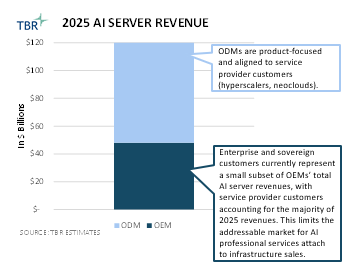
OEMs’ opportunity to participate in agentic AI solutions is closely tied to the slowly but steadily growing segment of enterprises and sovereigns seeking on-premises AI capabilities. This customer group is more likely to invest in a broader range of services from OEMs, including AI advisory and life cycle services, which primarily focus on NVIDIA AI Enterprise and its NVIDIA Blueprints.
 
TBR expects OEM services engagements centered around AI will be built as extensions of areas where the vendors already have strengths in solution building. These vary to some degree by OEM but largely center on manufacturing, retail, healthcare and financial services. In some cases, such as AI-based edge solutions, OEMs may be able to lead end-to-end engagements with their AI services portfolios. In other cases, OEMs will focus on delivering infrastructure-centric services in support of partnerships, with broader engagements led by systems integrators.
 
On-premises and hybrid AI adoption will remain in a ramp-up period in 2026. Even with NVIDIA Blueprints as a baseline, most end customers are unlikely to have the skills to deploy these AI solutions in-house. This will lead to services engagements to assist in solution deployment and further expansion of OEMs’ own AI libraries to create more plug-and-play AI solutions for industry use cases.

TBR estimates the potential annual AI-related opportunity for CSPs will reach $170B by 2030, approximately 53% of which is new revenue and 47% is cost efficiencies

CSPs have been largely sidelined from the new revenue opportunity presented by AI since the emergence of GenAI in 4Q22, but this is starting to change, evidenced by significant deals won by Lumen and Zayo to provide transport between data centers for AI workloads. There are also some green shoots of demand for hyperscalers to leverage CSPs’ network facilities (e.g., wire centers and central offices) and other real estate assets to colocate AI infrastructure closer to end users, as evidenced by efforts being made by Verizon and AT&T.
 
All CSPs that are investing in AI currently expect to reap cost efficiencies from the technology. The new revenue opportunity is more nuanced and is CSP- and market- specific in nature. APAC-based CSPs are likely to be the largest beneficiaries of new revenue from AI due to government protections, stimulus and cultural orientations toward early adoption of emerging technologies.

2Q24 Telecom Infrastructure Services Benchmark

TBR Spotlight Reports represent an excerpt of TBR’s full subscription research. Full reports and the complete data sets that underpin benchmarks, market forecasts and ecosystem reports are available as part of TBR’s subscription service. Click here to receive all new Spotlight Reports in your inbox.

Persistent TIS revenue contraction will cease in 2025 as growth catalysts emerge

While TIS revenue continued to shrink among the vast majority of benchmarked vendors, TIS operating margins continue to recover as the business mix becomes more favorable and India’s coverage builds wind down

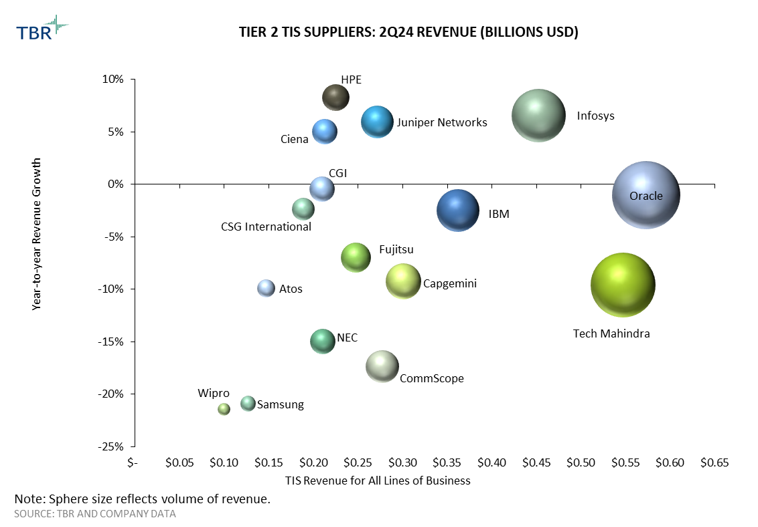
Aggregate telecom infrastructure services (TIS) revenue among benchmarked vendors declined 4.8% year-to-year in 2Q24, falling across all segments and regions. All but six vendors saw TIS revenue decline year-to-year in 2Q24. Several vendors, including Nokia, Ericsson, Samsung and Ciena, are seeing sharply lower revenue in India as 5G RAN rollouts by Reliance Jio and Bharti Airtel have gone post-peak. This will create difficult comparisons for vendors through at least 3Q24. Huawei and ZTE are also seeing their maintenance revenue in India evaporate as their installed bases of LTE and optical equipment is replaced by trusted vendors.
 
Simultaneously, vendors such as Cisco, CommScope, Fujitsu, NEC, Nokia and Samsung continued to be hampered by U.S. Tier 1 communication service providers (CSPs) significantly reducing or shifting their capex budgets following a peak in spend in 2022. Lower spend on 5G RAN deployments in China, which also peaked in 2022, is impacting a narrow set of vendors, including China Communications Services (CCS), Ericsson, Huawei, Nokia and ZTE, as new deployments in the country are focused on capacity enhancement, which is typically less intense from a TIS perspective.
 
The shift that is occurring as CSPs wind down their 5G coverage rollouts in the key countries of China, the U.S. and India and focus on densification is helping drive operating margin growth. Declining deployment activity, which tends to carry the lowest margins among TIS segments, in these markets — especially India — is helping to improve operating margin.
 
In 2Q24 deployment services constituted 17.7% of aggregate revenue, down 110 basis points year-to-year. Benchmarked vendors’ aggregate TIS operating margin increased year-to-year for the third consecutive quarter, following six consecutive quarters of declines. Aggregate operating margin grew from 10.8% in 2Q23 to 11.6% in 2Q24.
 
TBR attributes the increase in large part to a favorable revenue mix, with maintenance services growing to 34.1% of aggregate revenue, up 100 basis points year-to-year. The 5G gear vendors have built out in the aforementioned countries over the past few years is leading to follow-on support revenue.

With CSP 5G spend post-peak in India, the U.S. and China, RAN-centric vendors universally saw their TIS revenue decline in 2Q24


Graph: Tier 2 Telecom Infrastructure Services 2Q24 Revenue (Source: TBR)

Tier 2 Telecom Infrastructure Services 2Q24 Revenue (Source: TBR)


2Q24 Total Benchmarked Revenue for IaaS and PaaS (Source: TBR)India-based IT services firms Tata Consultancy Services (TCS) (a Tier 1 supplier in 2Q24), Infosys, Tech Mahindra and Wipro are winning deals from CSPs to support their evolutions to digital service providers. These vendors are helping customers migrate network and IT applications to the cloud and implement new business models. These firms have recently been hampered in part by lower application integration spend as CSPs in key markets such as the U.S. and Europe adopted a cautious cash flow management posture and paused some digital transformation activity.
 
Like Tier 1 vendor Amdocs, Tier 2 vendor CSG is a SaaS-centric, primarily BSS-focused, company offering revenue management and digital monetization products in a scalable managed services model. CSG has expanded account share among key clients in the U.S. over the last several years — namely, cable operators Charter and Comcast — and abroad, particularly in APAC and with an unnamed client in CALA, where CSG is ramping up a relatively large BSS contract. CSG’s TIS revenue declined in 2Q24 due to lower revenue from an unnamed global telco in Europe.
 
Samsung has executed on significant 5G work for CSPs that are based primarily in the U.S., India, South Korea and Japan. Samsung’s TIS revenue declined year-to-year in 2Q24 due to slowing spend at Verizon, which is Samsung’s largest customer by revenue, as well as in India, where Samsung participated in 5G RAN rollouts for Bharti Airtel and Reliance Jio, though at lower levels than Ericsson and Nokia.
 
Like RAN vendors in India, Ciena’s TIS revenue in the country declined significantly as 5G-adjacent projects wound down. Ciena offset this decline with strong software-related services revenue growth in developed countries.
 

If you believe you have access to the full research via your employer’s enterprise license or would like to learn how to access the full research, click the Access Research button.

Access Research


Vendor SL&C revenues largely declined as large-scale 5G and greenfield rollouts wound down and new network business models and arrangements proliferated

Site location and construction (SL&C) work is often subcontracted to local vendors (such as CCS) with better access to resources in a given area. The SL&C market is in decline as temporary gains driven by 5G deployments in China and the U.S. as well as some greenfield deployments have concluded.
 
Pockets of growth include fiber rollouts for broadband access, backhaul and/or fronthaul, and the deployment of small cells. However, the relative volume of spend on these tasks is significantly lower than that for traditional SL&C for macro cell sites.
 
TBR has a negative long-term outlook for the SL&C market as CSPs shift their focus to adding incremental capacity to their existing macro sites, partially offset by growing CSP investment in small cell sites. This densification primarily consists of software upgrades and/or requires adding new radios to existing sites. CSP consolidation also weighs on the SL&C market.
 
New network architectures and business models, including network-sharing arrangements, neutral host providers, satellites to provide coverage for rural and/or remote locations, and third-party infrastructure owners such as tower companies increasingly owning cell sites and promoting the colocation of operator equipment, also reduce the need for net-new sites.

North America TIS revenue continued to decline in 2Q24, but at an improving rate as growth catalysts begin to emerge, including in Canada, where recent M&A and vRAN investments are driving growth

Benchmarked vendors logged a 1.4% year-to-year decrease in aggregate TIS revenue growth in North America in 2Q24, a dramatic improvement from an 8% decline in 1Q24 as year-to-year comparisons turned more favorable and Ericsson began to receive meaningful revenue from its Cloud RAN rollout for AT&T.
 
Still, revenues declined due to numerous factors, including Verizon’s and AT&T’s C-Band rollouts being post-peak as well as T-Mobile’s build-out of its 2.5GHz spectrum being post-peak. In addition, CSPs are awaiting government funding before expanding their fiber footprints, and DISH drastically reduced spending in 2H23 and 1H24 after it reached a key coverage milestone in June 2023 and it neared bankruptcy before receiving new funding in 2H24.
 
TIS spend in the region is positioned to grow in 2025 as comparisons become more favorable and CSPs focus on building out fiber access, including by leveraging the BEAD Program, through which CSPs will receive federal funds that are currently being disbursed to states to bring broadband to the unserved and underserved.
 
The BEAD Program has seen numerous delays and will likely run through the mid-2030s, later than the original 2028 time frame. The program will benefit a somewhat different slate of vendors compared to the midband 5G build-out, as fiber will be the primary technology deployed. Nokia will be one of the biggest beneficiaries due to its embrace of Build in America requirements. Ciena will also benefit, due in part to its 4Q22 acquisitions of Benu Networks and Tibit. Meanwhile, Ericsson and Samsung will have no role in BEAD-related fiber deployments, though they could participate in fixed wireless access (FWA) build-outs.
 
5G development continues in Canada through measures including builds in the 3.5GHz spectrum band, BCE’s capital investment acceleration program, Telus’ vRAN build leveraging HPE and Samsung, and the replacement of equipment from China-based vendors. Tier 2 operators in Canada are also advancing their 5G strategies.
 
Canada CSPs are focused on deploying fiber across their footprints and will expand 5G services to new spectrum bands, including the 3.8GHz band, which Bell Canada began deploying in 1H24. Rogers’ acquisition of Shaw Communications is also driving spend due to investment commitments made by the merged entity and Videotron, which acquired a piece of Shaw.

Spotlight: 2Q24 Cloud Infrastructure & Platforms Benchmark

TBR Spotlight Reports represent an excerpt of TBR’s full subscription research. Full reports and the complete data sets that underpin benchmarks, market forecasts and ecosystem reports are available as part of TBR’s subscription service. Click here to receive all new Spotlight Reports in your inbox.

Acquiring to fill portfolio gaps and deliver complete end-to-end solutions at any layer of the PaaS stack is a top strategy for IT’s biggest players

Enterprise migrations and large-scale M&A are influencing the IaaS & PaaS market, as is GenAI, but disillusionment is coming and may cause customers to re-evaluate their IT priorities


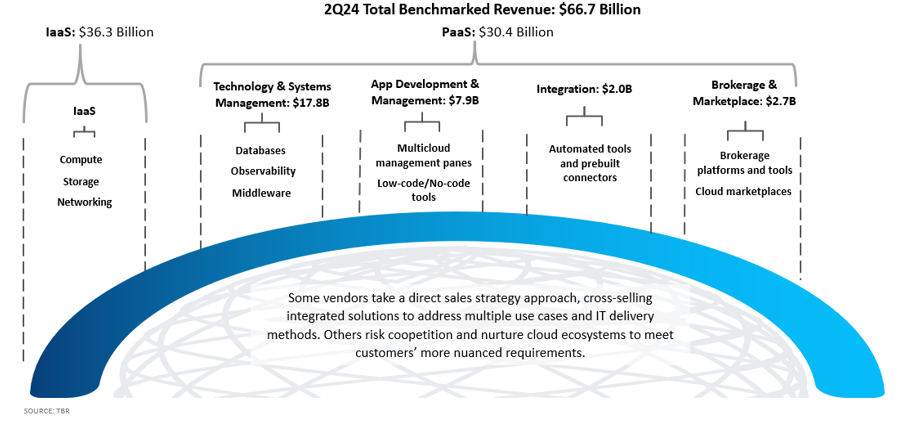
Graph: 2Q24 Total Benchmarked Revenue for IaaS and PaaS (Source: TBR)

2Q24 Total Benchmarked Revenue for IaaS and PaaS (Source: TBR)


IaaS Market

Among benchmarked IaaS vendors, average revenue growth increased 21% year-to-year in 2Q24, marking the fourth consecutive quarter of acceleration. There are two primary factors at play: enterprise IT modernization activity, which is much stronger now than it was this time last year, and generative AI (GenAI). Top hyperscalers Amazon Web Services (AWS) and Microsoft are capturing legacy Oracle and SAP workloads as customers continue to migrate to the cloud to not only outsource their IT operations but also drive lasting business value.
 
Though the geopolitical outlook is increasingly uncertain, we expect customers will continue to prioritize more traditional “lift and shift” migrations, and steps vendors are taking to deliver more integrated solutions could help. For instance, by the end of 2024, Oracle’s database services will officially be available on AWS, Microsoft Azure and Google Cloud Platform (GCP), which could be a big growth tailwind for these vendors. For context, converting Oracle’s remaining database support install base to the cloud represents a roughly $18 billion incremental revenue opportunity for these hyperscalers, including Oracle itself.
 
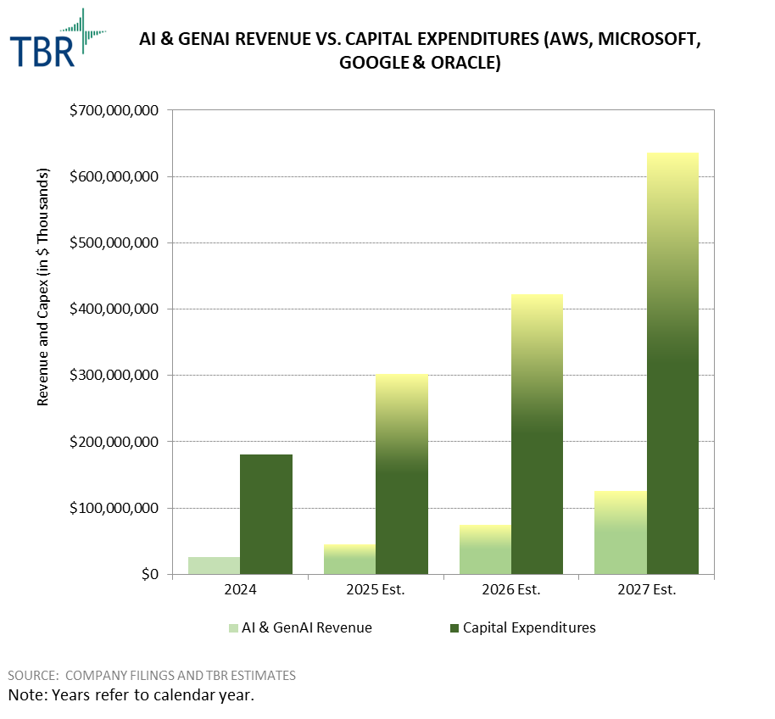
Regarding GenAI, investments in AI compute and new data centers are translating into top-line growth. Most vendors report they have multibillion-dollar AI and GenAI businesses, though this is minuscule compared to the tens of billions of dollars these vendors are investing. Vendor capex guidance for 2025 suggests that the level of investment will only increase, although we do expect this is when GenAI fatigue will hit and many customers may begin to re-evaluate their IT priorities.

PaaS Market

The PaaS market is similarly growing behind GenAI adoption, as many customers who still have a fear-of-missing-out mentality are spinning up new workloads natively in the cloud with services like Amazon Bedrock, Microsoft Azure OpenAI and Google Vertex AI. The PaaS market will similarly be impacted by GenAI disillusionment, but we believe this trend will also cause customers to focus more on the data layer, prompting them to take a second look at strategies around governance, data quality and integration for long-term AI success.
 
Another key trend driving PaaS market growth is M&A. IT leaders are acquiring to enter new markets and access IP they can ultimately sell as part of an entire end-to-end suite of offerings, as customers continue to crave more simplified, integrated solutions. By far the best example is Cisco’s acquisition of Splunk, which added $960 million to Cisco’s top line in 2Q24 and is quickly making Cisco a rising force in PaaS with its observability portfolio. IBM’s proposed acquisition of HashiCorp, which is expected to close by the end of 2024, would be another transformative deal that would put IBM squarely into the Terraform space and deliver synergies with Red Hat that will be attractive to unsatisfied VMware customers.
 

If you believe you have access to the full research via your employer’s enterprise license or would like to learn how to access the full research, click the Access Research button.

Access Research


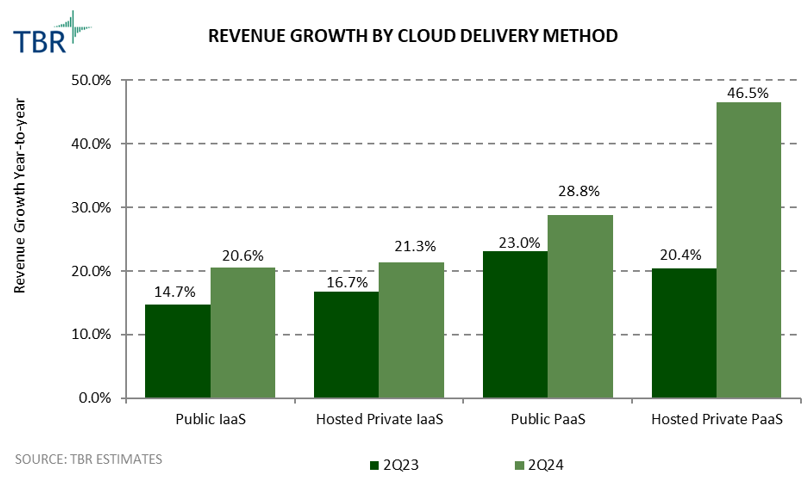
Though often regarded as less secure, public cloud environments offer an array of automated tools, giving customers the opportunity to better secure their assets than they can on premises

Public IaaS: As the cloud market matures, customers are becoming more comfortable with moving to public cloud infrastructure. Security remains a leading barrier to migration; however, many customers recognize that the public cloud offers the opportunity to better secure their infrastructure and data, due to automation and emerging capabilities such as Infrastructure as Code.
 
Public PaaS: Organically, public PaaS remains the fastest-growing segment as public cloud IaaS capabilities improve and vendors tailor their services to developers.
 
Hosted Private IaaS: Private IaaS growth is supported by enterprises’ rising acceptance of hybrid-enabling solutions such as AWS Outposts and Azure Stack, although some customers still consider these solutions immature. Customers continue to demand solutions that address data sovereignty, governance and compliance use cases.
 
Hosted Private PaaS: Single-tenant PaaS is a popular option for customers looking for more customization yet a greater degree of scalability over their on-premises environment. Many enterprises use dedicated clouds as an intermediary step to the public cloud, and as such, segment growth could start to slow. The acceleration in PaaS revenue for 2Q24 is largely influenced by Splunk, which can run in a customer’s environment as both a private and public cloud.
 

Graph: Revenue Growth by Cloud Delivery Method, 2Q24 (Source: TBR)

Revenue Growth by Cloud Delivery Method, 2Q24 (Source: TBR)

IaaS revenue growth rates will not return to what they once were, while PaaS tells a different story as acquisitions and the modernization of critical workloads fuel growth

AWS retains the majority of mindshare in legacy infrastructure workloads, but Azure and GCP continue to be competitive on net-new AI workloads in the cloud

AWS makes up the majority of IaaS vendor revenue, at an estimated 58% in 2Q24, but this is down over 1,200 basis points from the year-ago quarter.  For many legacy customers looking to rehost and/or replatform applications, AWS continues to be top of mind due to its establishment, infrastructure availability and breadth of developer-friendly services. But when it comes to net-new workloads already in the cloud, Microsoft and increasingly Google Cloud, will be competitive.
 
Though SAP and IBM still offer either dedicated or multitenant IaaS to their customers (see TBR’s Cloud Components Benchmark for IBM’s on-premises cloud infrastructure business), the Big Three, and increasingly Oracle, are consolidating the market. Alibaba’s sluggish growth in the China market caused the company to cede the No. 3 position to Google Cloud. While Alibaba’s growth is rebounding, we do not expect the company to take back the position it once held. At the rate Oracle’s OCI is growing, it will not be long before Alibaba gives up share to Oracle in the IaaS market as well.