
 Technology Business Research, Inc.
Lenovo’s Hybrid AI Push Puts Industry Solutions and Services at the Center of Its Growth Ambitions
Lenovo’s 2026 Global Industry Analyst Conference (GIAC) centered on hybrid AI and the company’s continued investment in becoming a solutions- and services-led technology provider. Building on its engineering and manufacturing strengths, Lenovo is combining software and services with a broad hardware portfolio spanning smartphones to data center infrastructure to differentiate its customers and industries.
Hybrid AI guides Lenovo’s investment in solutions and services around its hardware portfolio
In his opening presentation, Chairman and CEO Yuanqing Yang described the ongoing cloud infrastructure build-out as the strongest driver of current AI demand and pointed to enterprise AI as a material source of future demand.
Lenovo believes enterprises will run AI across devices, on-premises infrastructure and public clouds — a hybrid AI architecture — choosing where to process information based on data security, latency and operating costs. This core belief drives Lenovo’s investment strategy of building software, solutions and services around its wide-ranging hardware portfolio, spanning smartphones, PCs, workstations, servers and storage to support customers’ choices about where AI runs.
For example, Lenovo is positioning itself for broader enterprise AI adoption by leaning into its Hybrid AI Advantage framework, which combines the company’s hardware, software and services to support the deployment of solutions from its AI Library.
By leveraging its intellectual property and wide array of independent software vendor (ISV) partners, Lenovo is essentially cataloging repeatable, configurable AI solutions for specific industries and use cases, reducing development work and, in some cases, providing a clearer picture of expected costs and business benefits to help customers deploy AI more quickly and confidently.
However, although investment in AI and solution development headlined GIAC ’26, Lenovo’s hardware legacy and the strength of its engineering and manufacturing capabilities clearly remain core to the company’s positioning in the market.
In his opening presentation, Yang argued that Lenovo has turned market volatility into a competitive advantage through its global-local operating model and control over product design, procurement and manufacturing, supporting the company’s strengthening top-line momentum.
Given Lenovo’s ongoing investments in Hybrid AI Advantage, expanding role in high-volume AI service provider deals, and global reach and engineering and manufacturing strengths, TBR sees enterprise AI adoption as Lenovo’s strongest opportunity to move up the value chain from hardware vendor to solution provider — a long-standing priority in the company’s corporate strategy.
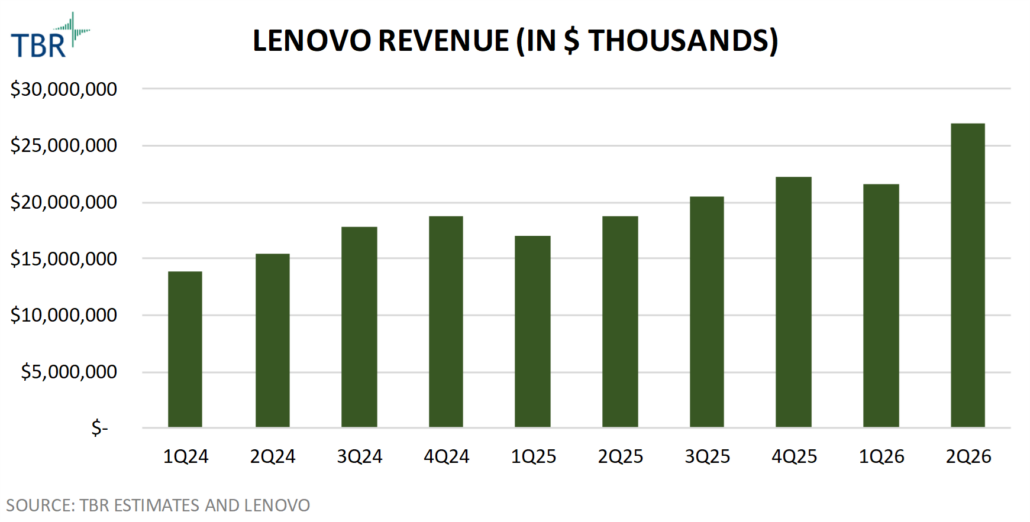
Lenovo Revenue (Source: TBR Estimates and Lenovo)
ISG combines manufacturing flexibility with distinct models for cloud and enterprise customers
Manufacturing and supply chain control give Lenovo flexibility to respond as demand changes across its businesses, with the company’s differentiated global-local model combining the advantages of global sourcing with regional manufacturing and operations.
Rebalancing component allocations companywide helps manage supply constraints, while Lenovo’s expanded North Carolina Smart Campus in Whitsett exemplifies the company’s investment in regional manufacturing, adding server production capacity closer to U.S. customers.
During his presentation, Infrastructure Solutions Group (ISG) President Ashley Gorakhpurwalla also emphasized standardization and compatibility as important foundations of the infrastructure industry, allowing customers to expand their environments while continuing to work with their preferred technology providers. This idea underscores Lenovo’s nuanced approach to differentiation, where the company competes through system design, manufacturing and deployment expertise while preserving compatibility with a broader ecosystem of hardware and software partners.
Building on its engineering, manufacturing and supply chain capabilities, Lenovo serves customers through two complementary business models: ODM+ for cloud service providers and OEM for enterprises and small businesses. Under ODM+, the company pairs in-house design with manufacturing to build customized infrastructure around customer workloads and technology road maps.
Gorakhpurwalla said Lenovo works with eight of the world’s top 10 public cloud providers, with dedicated customer teams supporting the relationships and engineering work ranging from motherboard design to complete racks and clusters. For large AI deployments, Lenovo’s role sometimes continues through installation, optimization and lifecycle services.
For enterprises and smaller businesses, Lenovo’s OEM model provides standardized products through the company’s network of channel partners. Customers may have identified an AI use case but need help selecting and deploying the infrastructure and software to support it. Lenovo AI Express, introduced ahead of the conference, simplifies the purchasing process by combining validated infrastructure, software options and deployment support with faster ordering and delivery.
AI Express starts with the model a customer plans to run, the data it will use, and the response time the use case demands. Lenovo then matches the workload to a configuration within its Hybrid AI Factory portfolio, allowing customers to begin with a suitable deployment size and add capacity as usage grows.
In addition to its efforts to simplify AI deployment, Lenovo is expanding its storage portfolio to support a wider variety of enterprise workloads and to better compete with both pure-play storage vendors and other multiline OEMs whose portfolios span entry-level to high-end offerings. The Infinidat acquisition adds high-end storage systems built around proprietary storage software focused on availability, cyber recovery and business-critical workloads, broadening Lenovo’s storage portfolio alongside its existing ThinkSystem storage and ThinkAgile hyperconverged infrastructure portfolios.
Beyond traditional enterprise workloads, these availability and data protection capabilities also support enterprise AI deployments, where models and agents depend on reliable access to information from customers’ existing applications and systems. At the same time, Infinidat is drawing on Lenovo’s manufacturing capacity and supply chain, which executives said has helped it pursue larger deals, while Lenovo’s global reach gives Infinidat access to additional customers. However, it is worth noting that Lenovo and Infinidat remain in the post-acquisition integration phase with more synergies on the horizon, such as with Infinidat shifting completely to Lenovo underlying hardware.
Together, Lenovo’s global-local model and its ODM+ and OEM capabilities help the company manage supply constraints and serve customers with different purchasing and deployment needs. These capabilities allow Lenovo to compete for both large-scale service provider deals and higher-margin enterprise and SMB deals and have enabled Lenovo to grow ISG’s top line at a double-digit rate for 10 consecutive quarters.
SSG pairs repeatable AI solutions with services to broaden customer engagements
Lenovo’s Solutions and Services Group (SSG) is expanding beyond product support, with a growing emphasis on professional services around solutions for specific business processes and the ongoing management of customers’ technology environments. That shift is evident in the segment’s revenue mix, with more than 62% of SSG’s revenue coming from its Managed Services and Projects and Solutions businesses in 2Q26. Lenovo is pursuing further growth by continuing to develop its product-related services, digital workplace and hybrid cloud businesses while investing in the intellectual property and industry expertise needed to broaden its AI solutions portfolio.
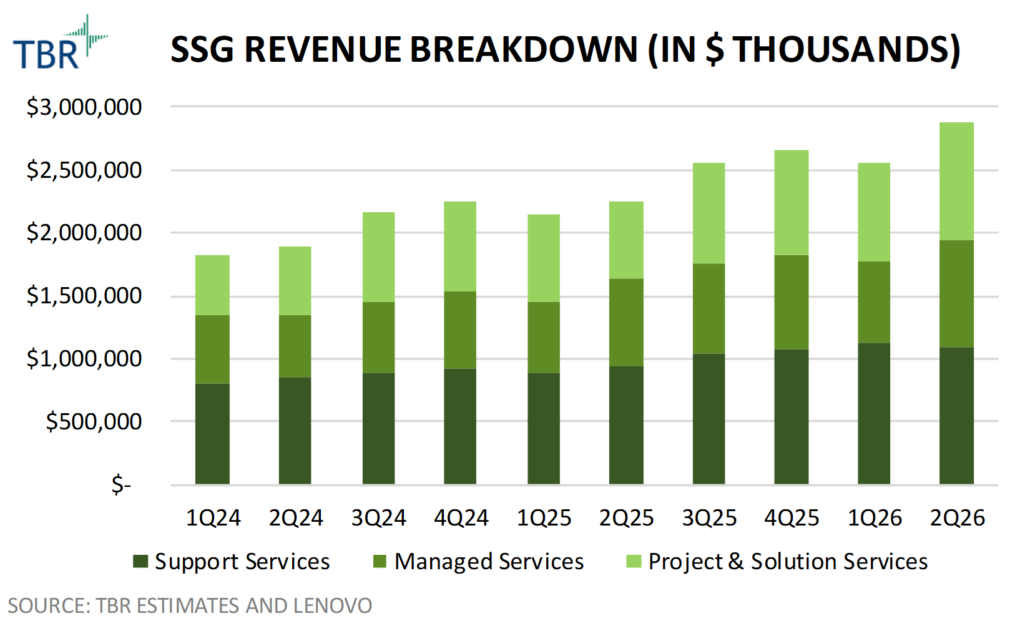
Lenovo SSG Revenue Breakdown (Source: TBR Estimates and Lenovo)
Kevin Nelson, who leads SSG’s go-to-market organization, described customer discussions that have moved from testing generative AI to incorporating agents into operating workflows. As customers seek measurable operational improvements, Lenovo is focusing solution development in industries such as retail, manufacturing and sports, hiring professionals with experience in those sectors. Nelson said the new hires can identify where AI could improve a process and how a deployment should fit with the customer’s existing systems, helping Lenovo develop solution designs that can be adapted across multiple customers.
Through the company’s AI Library, Lenovo combines its own and partner technologies into repeatable solutions intended to be sold alongside the company’s hardware and services. The portfolio also draws on Lenovo’s internal AI deployments, with the company acting as customer zero before packaging selected implementations with services for customers. By drawing on its own deployment experience, Lenovo can adapt an established solution design to customers’ data, systems and processes, reducing the engineering and implementation work needed for each engagement.
Additionally, Lenovo is adapting solutions developed for customers in its target industries to serve other sectors. For example, Lenovo’s Intelligent Command Center, first deployed for FIFA, has been adapted for manufacturing, where it connects production, robotics and maintenance information to help identify bottlenecks and prevent disruptions. Similarly, after using computer vision and edge inference to stabilize referee-camera footage for live broadcasts during the World Cup, Lenovo is adapting its computer-vision capabilities for retail banking, where analysis of branch activity can inform staffing decisions, reduce customer wait times and improve service efficiency.
Lenovo’s industry offerings also create opportunities to broaden customer engagements that begin with infrastructure. Nelson described one engagement in which a customer’s interest in infrastructure led to discussions about sovereign cloud services, retail solutions and logistics. The customer wanted to use several parts of Lenovo’s portfolio across its businesses, and subsequent workshops generated additional AI projects. The example highlights the company’s One Lenovo strategy, which brings its business groups together to sell and deliver hardware, software and services solutions.
To help customers put AI projects into operation, SSG offers advisory, implementation and managed services as part of Hybrid AI Advantage. AI Discover and AI Advisory help customers prioritize use cases and prepare their data, while AI Fast Start provides a packaged proof of concept for testing an initial AI solution. AI Deploy & Scale supports implementation, with TruScale offering a way to consume the infrastructure as a service without funding an upfront purchase. Once solutions are in regular use, AI Managed helps customers maintain and optimize their AI environments.
SSG also helps customers evaluate token economics when planning and operating AI deployments, particularly as agents may make repeated model calls to complete a task. For example, Lenovo is evaluating samples of customers’ AI requests to recommend models for specific agents and workflows and estimate which workloads could run on private infrastructure. The assessments weigh processing costs against the accuracy and response times customers need, helping customers estimate the cost of completing tasks successfully before investing in a deployment.
TBR believes model selection and cost optimization will become increasingly important, creating a strong opportunity for Lenovo to generate ongoing advisory and managed services engagements for SSG as customers expand their use of AI.
IDG supports local enterprise inference while building Lenovo’s personal AI ecosystem
For enterprises evaluating where to run AI workloads, workstations and AI PCs broaden customers’ options for local inference. The AI workstation portfolio sits within Lenovo’s Intelligent Devices Group (IDG) and includes systems that function more like traditional edge servers, bringing inference closer to operational data. The company identified workstations as an investment priority, with the overlap between workstation and infrastructure use cases also prompting closer coordination between IDG and ISG on how the systems are brought to market.
Lenovo’s investments in personal AI also demonstrate the breadth of its strategy beyond enterprise deployments. IDG President Luca Rossi outlined the group’s ambition to build a personal AI ecosystem that makes its devices more useful together and gives customers a reason to choose Lenovo. The company sees the smartphone as essential to winning share in personal AI because it is the device users carry throughout the day, giving Motorola a central role in Lenovo’s strategy. To connect the smartphone with Lenovo’s broader device portfolio, Qira, Lenovo’s personal AI system, is designed to retain context and coordinate actions across devices and applications based on what users want to accomplish.
As IDG pursues growth in software and services to diversify beyond PC hardware and improve profitability, Lenovo is supporting both enterprise and personal AI through shared software development across its business groups. Chief Technology Officer Tolga Kurtoglu described investment in software that retains relevant information from earlier AI interactions and helps prevent sensitive data from leaking through AI applications. Product teams can reuse the software across products, reducing repeated development work and helping Lenovo bring new solutions to market more quickly.
Enterprise AI advances Lenovo’s transition to a higher-value solutions and services business
GIAC ’26 highlighted Lenovo’s strengthening position in the traditional and accelerated infrastructure markets and its maturing strategy that leverages its ODM+ and OEM businesses to serve both service providers and enterprises. Lenovo’s global-local operating model and robust engineering and manufacturing capabilities give the company flexibility in sourcing, production and delivery, while the breadth of its hardware portfolio gives customers choices about where to run AI, from on-premises infrastructure to workstations and personal devices.
By combining its hardware portfolio with industry solutions and advisory and managed services, Lenovo can help customers deploy and operate AI solutions across their businesses. Reusable solution designs can speed deployments, while managed services keep Lenovo involved as customers expand their environments and manage operating costs.
Although client devices and traditional infrastructure undoubtedly remain core to Lenovo’s business, TBR sees Lenovo’s enterprise AI investments accelerating the company’s business transformation to a higher-value, solutions- and services-led technology provider.
 Technology Business Research, Inc.
 Technology Business Research, Inc.