Dell and NVIDIA continue to deepen AI infrastructure alignment
Dell’s partnership with NVIDIA remains central to its AI strategy and competitive positioning. Dell’s AI portfolio spans AI-capable workstations to rack-scale AI infrastructure, all designed to optimize performance with the NVIDIA technology stack. Dell is integrating hardware design, power efficiency, cooling architecture and NVIDIA software stacks into optimized infrastructure platforms designed for enterprise AI workloads at scale.
Several themes presented during Dell Technologies World mirrored messaging introduced earlier this year at NVIDIA GTC, including discussions around NVIDIA NemoClaw. Dell aligned closely with NVIDIA’s position that the integrated, secure environments offered by NVIDIA’s suite will give enterprises confidence to adopt the integrated agentic technology rather than risking exposure to data misuse and lack of governance when using open-source tools.
Dell Chief Operating Officer Jeff Clarke also focused on the company’s workstation portfolio and localized inference capabilities, framing AI workstations as both an economic and governance advantage for enterprise developers and AI power users. Dell leaders emphasized that the company’s AI-optimized workstation portfolio is capable of running models with up to 1 trillion parameters in highly optimized Deskside Agentic AI configurations. More importantly, they directly tied workstation deployments to token economics, arguing enterprises can achieve breakeven against public cloud AI costs within months while simultaneously eliminating concerns around runaway inference spending.
Dell leaders combined the economic argument with messaging around confidentiality, security and validated enterprise use cases. As enterprises become more cautious about exposing proprietary data to external AI platforms, Dell is positioning private AI infrastructure as both a governance and financial strategy.
Dell expands its broader AI ecosystem strategy
During Michael Dell’s keynote, the company founder and CEO summarized the company’s ecosystem play, stating “the next era of infrastructure is going to be built by deep
partnerships between companies that are advancing accelerated computing and the companies that know how to deploy it across the real world.” The company is not attempting
to compete across every layer of the AI stack. Instead, it is focusing on infrastructure execution and ecosystem orchestration while relying on strategic partnerships to provide
private and hybrid AI experiences that rival public cloud. This strategy was evident in the announcements around Google Gemini deployments on PowerEdge infrastructure,
including air-gapped configurations supporting sovereign and regulated environments. Dell Technologies is targeting enterprises that want access to leading AI models without
sacrificing control over data locality and governance.
Dell leaders also highlighted expanded integrations through the Dell AI Ecosystem Program with partners including Palantir, xAI, Hugging Face and ServiceNow. These partnerships
are critical because enterprise AI adoption increasingly depends on validated architectures, workflow integration and operational simplicity rather than stand-alone infrastructure
purchases. Dell’s ever-expanding partner play also includes its go-to-market channels. Chief Partner Officer Denise Millard announced a new program for advisory and system
integrator partners that will reward partners that work with Dell on longer, more transformational customer engagements versus the highly transactional nature of its broader
partner program. That shift aligns Dell more closely with how enterprises make decisions about AI purchases: through organizational transformation, workflow redesign and
governance planning.
Ongoing infrastructure innovation strengthens Dell’s competitive position
Dell Technologies World 2026 also reinforced the breadth of Dell’s infrastructure portfolio and the company’s continued focus on optimizing AI performance through both hardware
and software innovation.
On the hardware side, Dell expanded its PowerEdge portfolio with the addition of the PowerEdge M-Series platform designed for high-density computing environments and
introduced the new Dell Exascale Storage platform, targeting the growing market for ultra-high-performance AI storage infrastructure. This storage platform will compete directly
against recently launched AI factory-grade storage offered by competitors, with Dell’s system offering 6TB of throughput per second, per rack unit.
The company also expanded its networking strategy through the introduction of PowerRack for Networking. Although historically Dell has been associated primarily with compute
and storage, the company is increasingly positioning networking as a core component of integrated AI factory architectures.
On the software side, Dell continues expanding the Dell Automation Platform as a centralized management experience spanning both traditional data center infrastructure (Dell
Private Cloud) and distributed private cloud environments (Dell Distributed Private Cloud). Dell leaders highlighted integrations across the key private and hybrid cloud players,
including Microsoft, Nutanix, Red Hat and VMware.
Conclusion
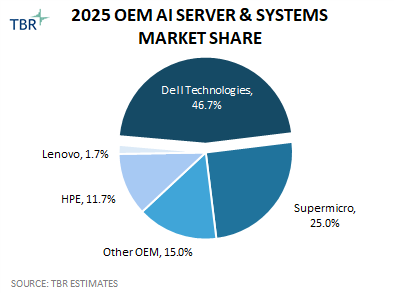
Dell Technologies World 2026 reinforced that Dell’s early and aggressive investments in AI infrastructure are translating into tangible competitive advantages across the enterprise market. The company has successfully leveraged its scale, manufacturing capabilities and NVIDIA partnership to establish itself as one of the dominant infrastructure providers supporting both large-scale AI training environments and the emerging enterprise inference opportunity. Importantly, Dell is now extending that momentum beyond servers into storage, networking, software orchestration and ecosystem integration.
Dell’s advantage comes from execution. The company has established meaningful scale in AI systems, strengthened its ecosystem partnerships and built operational expertise across both service provider and enterprise deployments. Dell’s integrated infrastructure strategy positions the company to remain highly relevant in the next phase of AI adoption. The market remains highly competitive, but Dell is clearly one of the vendors that is best aligned with enterprise AI’s operational realities.

 Technology Business Research, Inc.
 Technology Business Research, Inc.