
HPE’s AI Infrastructure Strategy Takes Shape as Juniper Moves to the Center
HPE uses Discover to reposition around AI infrastructure architecture
HPE Discover Las Vegas 2026 demonstrated how Hewlett Packard Enterprise (HPE) is investing to sharpen its position in AI, framing enterprise and sovereign AI adoption as a full-stack architecture challenge. The event’s central message was that enterprises moving AI from experimentation to production need modern infrastructure that moves data efficiently, supports distributed inference, governs autonomous agents, protects sensitive workloads and operates across hybrid environments. This framing allowed HPE to present its increasingly broad portfolio — comprising networking, compute, storage, software and services — through a single AI foundation narrative, further clarifying how the Juniper acquisition supports the company’s strategic AI vision.
Networking was central to HPE Discover’s AI foundation message. Aruba continues to anchor the company’s position in campus, branch and edge connectivity, while Juniper expands the company’s reach deeper into enterprise and service provider environments. HPE tied the networking-adjacent components of its portfolio into the same strategy, pointing to the ProLiant, Alletra Storage, GreenLake and CloudOps portfolios as supporting layers of a more integrated AI infrastructure stack. GreenLake Intelligence exemplifies the future direction of this portfolio, extending GreenLake beyond consumption and management and to agentic operations that can correlate telemetry, identify root causes, recommend remediation and support workflows such as network assurance and virtual machine (VM) migration.
HPE also used Discover to align portfolio strategy with go-to-market execution, particularly around synergies with channel partners, which are the company’s entry point into the midmarket. Starting Nov. 1, 2026, HPE’s and Juniper’s partner programs will be unified under HPE Partner Ready Vantage, a critical step toward enabling cross-selling of HPE’s full portfolio. HPE also expanded channel-only routes to market for HPE Private Cloud PC3000, HPE SimpliVity PC1000 and HPE Zerto Software, building on the channel-only model used for VM Essentials, which has proven successful in both the enterprise and midmarket and is accelerating the company’s acquisition of new private cloud customers. These updates also support HPE’s broader AI strategy, as the company will rely heavily on partners to sell across the combined portfolio, especially as Juniper becomes more central to HPE’s infrastructure differentiation.
Networking becomes the centerpiece of HPE’s AI infrastructure story
Networking was the most prominent strategic theme at Discover and the area where HPE most clearly highlighted the impact of the Juniper acquisition. HPE’s core argument is that AI performance increasingly depends on the network because data, tokens, models and decisions need to move across distributed infrastructure. This gives HPE a stronger point of differentiation among infrastructure OEMs as enterprise AI conversations expand beyond GPU availability to include data movement, congestion, security, inference placement and operating efficiency.
HPE’s AI networking announcements support three related priorities. First, the company is using Juniper to strengthen its position in AI data center infrastructure, including scale-up, scale-out and scale-across networking. Juniper’s QFX, PTX and SRX series of networking products enable HPE to address switching, routing and security across rack-scale AI systems, large training clusters, distributed data centers and service provider environments. Second, HPE is bringing AI networking closer to inference workloads and the edge, where latency, proximity to data and distributed deployment models are more important. Third, HPE is embedding Juniper networking more directly into its broader AI infrastructure stack, using data center switching, automation and assurance capabilities to position the network as an integral part of AI deployment rather than a stand-alone connectivity layer.
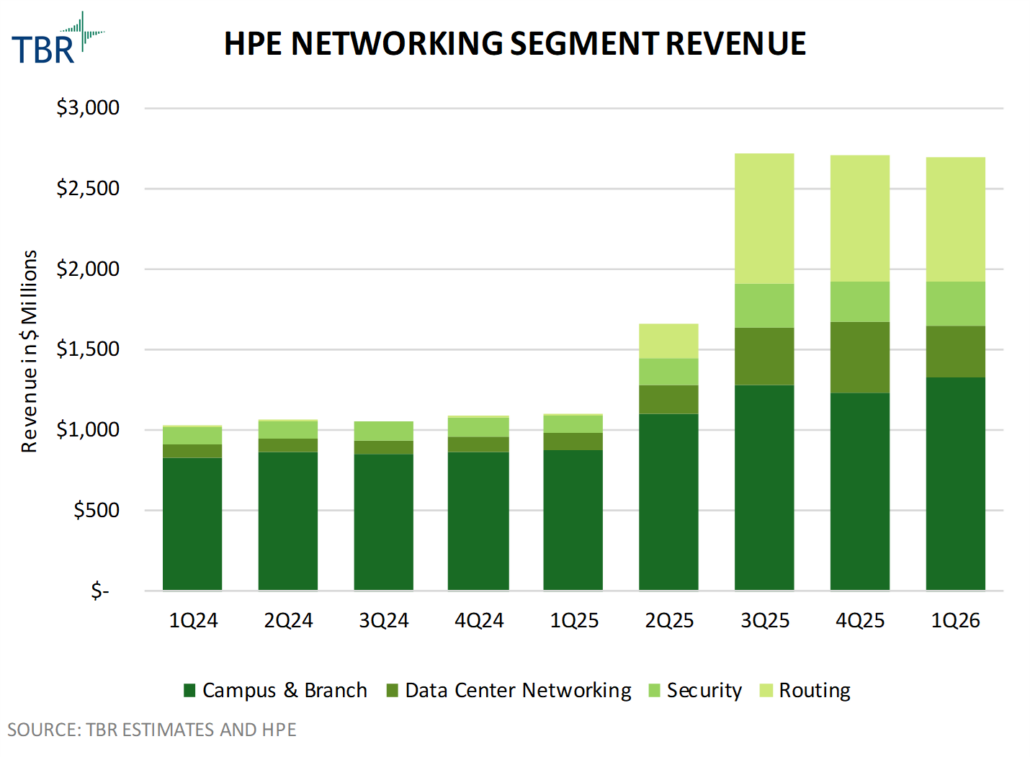
The Aruba and Juniper integration story was also more tangible at Discover than earlier in the acquisition cycle, with updates showing how HPE is beginning to cross-pollinate Aruba and Juniper software capabilities, bringing AI-native visibility, automation and trusted actions across campus, branch and wired environments. For instance, HPE announced support for HPE Networking CX wired access switches on the HPE Mist platform and Marvis AI-powered self-driving capabilities for HPE Aruba Central. HPE also extended self-driving operations into the data center by integrating HPE Mist Networking Data Center Assurance with HPE Compute Ops Management and GreenLake, reinforcing the idea that self-driving networking is becoming part of a broader autonomous infrastructure operations strategy.
Security rounded out the networking message. HPE positioned zero trust, SASE and Juniper SRX security capabilities as part of the same AI-era networking architecture, arguing that networks must connect more distributed systems while enforcing access, reducing exposure and simplifying policy operations. The company’s unified SASE platform, built on HPE Networking EdgeConnect and advanced firewall technology, reinforced that message by converging SD-WAN and cloud-delivered security in an AI-native management model. Across the networking announcements, HPE treated the network as a strategic control point for AI infrastructure, not simply a connectivity layer.
HPE builds the agentic enterprise story around Private Cloud AI
The second major theme at Discover was agentic AI, with HPE positioning Private Cloud AI as the platform for enterprises seeking to move agents into production while maintaining governance, security, observability and cost control. HPE’s premise is that AI agents are becoming part of enterprise workflows, yet many are being developed and deployed outside formal IT control. Private Cloud AI enables HPE to bridge this gap by focusing on agent governance, enterprise data grounding, inference scale and operational resilience.
HPE Private Cloud AI, co-engineered with NVIDIA, is the center of this strategy. The platform now supports capabilities such as secure local agent registration, centralized governance and security policies, human approval for higher-risk workflows and tighter controls over users, agents and sensitive actions. HPE also integrated the platform more closely with NVIDIA’s agentic AI ecosystem, including NVIDIA Vera CPUs, the NVIDIA Agent Toolkit, Nemotron open models, NemoClaw, OpenShell and NVIDIA Confidential Computing. These enhancements position Private Cloud AI as more than just an infrastructure bundle; they give HPE a more complete story around governed agent execution, secure runtime environments and enterprise-grade AI operations.
At Discover, HPE highlighted its strengthened data and inference layers as part of its Private Cloud AI narrative. The company positioned Alletra Storage MP X10000 and HPE Data Fabric Software as foundational for preparing, enriching and governing enterprise data for AI applications. HPE also addressed inference economics through capabilities such as multinode inference, unified model access, centralized credentials and policies, shared KV (key value) cache and infrastructure optimization. Together, these updates enable HPE to provide customers with a clearer path to move from AI pilots to production environments, where latency, cost, governance and data quality become more difficult to manage.
Resilience and ecosystem depth rounded out HPE’s agentic AI message. HPE positioned Zerto as a recovery layer for agentic environments, enabling customers to detect rogue agent actions and rewind to a clean state with continuous data protection. HPE also broadened its AI Factory message beyond enterprise Private Cloud AI, using its at-scale and sovereign AI factory offerings to address customers with larger multitenant infrastructure needs or stricter data sovereignty, compliance and control requirements. The Unleash AI ecosystem, which now includes more than 60 partners and hundreds of use cases, demonstrates how HPE partners such as CrowdStrike, Fortanix, Digital Realty and Equinix can support secure deployment, data control and broader AI adoption across customer environments.
HPE extends the Discover message to include power, sustainability and quantum
HPE also used Discover to look beyond near-term AI infrastructure constraints and address long-term challenges related to power, cooling and advanced computing. The company highlighted the growing energy demands of AI and highlighted Siemens Energy as a customer that is applying HPE infrastructure to engineering, simulation and digital twin use cases. The message was that AI infrastructure will be shaped not only by compute performance but also by power availability, cooling efficiency, data center design and operational sustainability.
HPE Labs and supercomputing also play into this longer-term story. HPE discussed using AI to improve resource management across data center environments, including identifying idle patterns and reducing energy and water consumption without compromising performance. The company also tied its AI strategy to its high-performance computing (HPC) heritage, using the Cray portfolio and broader supercomputing capabilities as a bridge to more advanced scientific and industrial workloads. Quantum computing was another supporting theme at the event, with HPE announcing expanded relationships with Intel, IQM, Qblox, Quantinuum, QuEra Computing, Quantum Machines, Rigetti and Riverlane to advance hybrid classical-quantum computing. The collaborations are intended to integrate HPC and quantum systems, support hybrid algorithm codesign, improve software interoperability and benchmark system-level performance across HPC and AI environments. While this was not the primary commercial story at Discover, it reinforced HPE’s attempt to position itself as an infrastructure company for the next generation of complex computing workloads.
Conclusion
HPE’s Discover message was broad, but the structure was clear. The company is repositioning around AI infrastructure architecture, with networking serving as the foundation, GreenLake as the hybrid operating layer, Private Cloud AI as the governed agentic AI platform and partners as the scale mechanism to bring the combined HPE and Juniper portfolio to market.
The Juniper acquisition is HPE’s most important strategic lever. HPE used Discover to shift Juniper from an acquisition narrative to the center of its AI infrastructure strategy. The QFX switching announcements, PTX and SRX positioning, Aruba Central and Mist integrations, Data Center Assurance updates and the unified SASE platform all support HPE’s larger claim that it can provide the network fabric, operations intelligence and security layer required for AI at scale. Private Cloud AI was the second major step forward. HPE is no longer positioning the platform solely as a way to bring AI to enterprise data. It is making Private Cloud AI the control point for agentic AI, supported by governance, local agent registration, NVIDIA agent software, Vera-based compute, Alletra-powered data pipelines, Zerto resilience and inference optimization. That gives HPE a more enterprise-specific AI story than a generic infrastructure capacity story.
The biggest test will be execution. HPE is presenting customers with an integrated architecture spanning networking, cloud, AI systems, data, software, security and partners. TBR believes that is the right direction for enterprise AI, but it also creates challenges around simplicity, packaging and go-to-market execution. HPE will need to make the architecture easier to buy, deploy and operate, especially for enterprise customers that want AI outcomes without adding integration complexity. However, HPE’s networking position also creates a strategic tension.
The business is a differentiator, but it increases overlap with NVIDIA, HPE’s most important AI ecosystem partner, particularly in scale-out networking. The tension is even more evident as AMD leverages HPE for scale-up networking in its next-generation Helios rack system, which competes directly with NVIDIA NVL systems. HPE can benefit from being more silicon-agnostic than some peers, but that positioning also requires careful ecosystem management.
HPE is also making one of the more explicit bets among major infrastructure OEMs that enterprise AI will shift from the public cloud toward on-premises and edge environments. That strategy supports HPE’s margin profile by avoiding overexposure to high-volume service provider infrastructure deals, but it also limits the scale benefits available to vendors more aggressively pursuing hyperscaler and AI cloud build-outs.
Overall, the Discover announcements showed that HPE possesses the pieces needed to build an AI infrastructure and is beginning to connect them. The next question is whether HPE can turn that architecture into easier buying motions, faster deployments and measurable production outcomes for customers.
 Technology Business Research, Inc.
 Getty Images via Canva Pro