
 Technology Business Research, Inc.
Forward-deployed Engineers: The Last Mile of the AI Value Chain
Hyperscalers and ISVs add new title to their technology consulting bench: forward-deployed engineer
Although agentic AI platforms have proliferated across the enterprise software and platforms industry, monetization has been primarily concentrated within the narrower agentic coding space. Even there, where early adoption has transitioned to annual run rate (ARR) in the tens of billions of dollars, growing usage has been constrained by cost concerns and capped token budgets. In some cases, AI capability has grown faster than many enterprise customers can digest efficiently. In other cases, agentic engagements are stalling because the value is not proven. As a result, many customers are experiencing greater uncertainty around AI adoption and showing an inclination toward capping usage versus expanding token consumption, even in the most mature part of the market.
Against this backdrop, hyperscalers, ISVs and model leaders have begun rapidly positioning forward-deployed engineers (FDEs) as embedded technical builders who work directly inside customer environments to identify high-value AI use cases, build or configure agentic systems, contextualize those systems on enterprise data, and help move deployments from pilot to production. FDEs are being framed as hands-on engineers who code, debug, test, iterate and ship alongside customer teams. To many, this definition may prompt the question: Are FDEs meaningfully different from the cloud architects, solution engineers and consultants whom vendors have deployed into enterprise transformation projects for years? In many respects, the answer is no, but the name change suggests a new urgency among technology vendors to accelerate and influence enterprise AI architectural strategy.
In TBR’s opinion, the decision to pursue a more embedded services posture with FDEs suggests two things: Agentic AI technology has reached a point where vendors are willing to raise the stakes and work directly with customers to enable hands-on adoption support, and AI value remains very hard to deliver. By putting boots on the ground, vendors are betting that the right FDE paired with the customer’s technical talent can identify the opportunities for agentic automation that overcome these adoption hurdles, expand usage, and convert AI experimentation into repeatable commercial value.
Forward-deployed engineers are the solution architects for the AI era
The distinction between FDEs and solution architects that vendors might point to can be traced back to Palantir, which popularized the role through its high-touch, FDE-led operating model. Each Palantir engagement starts with the company’s portfolio of modular microservices, and the solution that comes out of the engagement is a unique configuration of these microservices combined with custom-built microservices to form a bespoke platform. The emphasis is on the customized nature of the platform at the end of the engagement. By using Palantir’s nomenclature, the industry is leaning into the idea of a bespoke agentic system, one built alongside the client and contextualized on the client’s data.
The market’s FDE go-to-market strategy will look different than Palantir’s FDE operating model
In TBR’s opinion, the push toward FDEs does not represent an industrywide shift toward Palantir’s operating model, and TBR expects the company to remain an “n of 1.” It is possible a more customized platform strategy will emerge within select, strategic customer relationships, but most vendors will target a broader market than a bespoke approach requires, keeping the emphasis on selling repeatable solutions. In fact, for some vendors, internal FDEs will act more like development resources than go-to-market resources. These vendors are deploying FDEs with select clients with the goal of codeveloping agentic capabilities that can be packaged and sold elsewhere without the burden of field engineers. Microsoft’s industry model strategy is a strong example of this in action, with the company relying on customer-partners to provide the domain data necessary for training smaller, niche AI models.
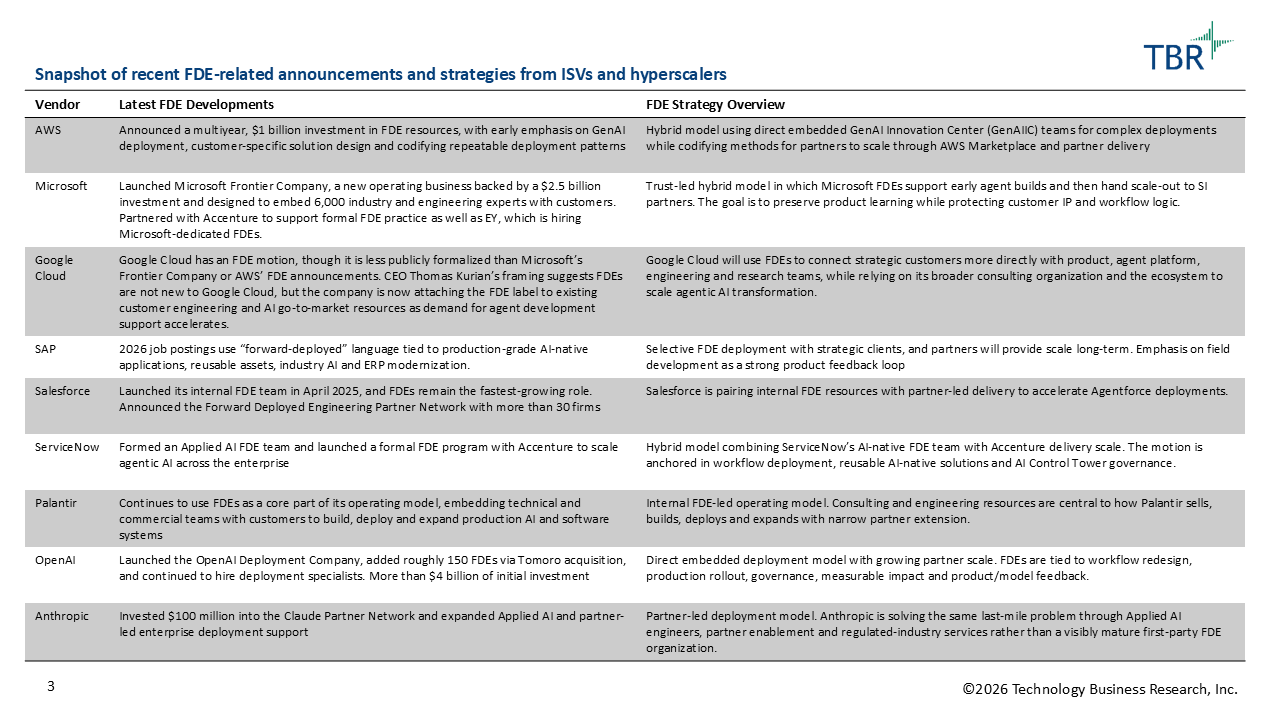
Hyperscalers are inserting FDEs into a much broader AI go-to-market apparatus that already includes professional services, solution architecture, partner delivery, field engineering, marketplace programs, industry teams and customer success. Microsoft’s Frontier Company is a clear example of this approach. Microsoft is not positioning FDEs as a stand-alone Palantir-style business model but rather as part of a broader enterprise AI deployment push that embeds industry and engineering experts more directly with customers. Amazon Web Services (AWS) is taking a similar ecosystem-oriented approach, pairing internal FDE investment with a partner-led motion designed to scale delivery through trained consulting partners. Google Cloud’s FDE job postings place the role inside Google Cloud Consulting or AI go-to-market and describe FDEs as embedded builders focused on moving generative AI (GenAI) products into production-grade customer environments. These examples suggest hyperscalers are not trying to replicate Palantir’s operating model outright. Instead, they are adopting aspects of Palantir’s FDE approach and scaling them through existing technical field organizations and partner ecosystems.
The strategies of hyperscalers and most ISVs are markedly more partner-driven as the leaders look to add a scale multiplier via formal FDE resources with existing strategic partners. Salesforce was early with its launch of a new FDE Partner Program. Microsoft’s Frontier announcement followed the launch of Accenture’s formal Microsoft FDE practice, as well as Microsoft’s FDE-oriented partnership expansion with EY. For their part, services firms are already emphasizing the size of their FDE benches, the number of certified resources they can mobilize, and the breadth of capacity they can bring to market as the market shifts toward the evolving opportunity.
Services partners bring scale, industry expertise and an agnostic opinion to FDE engagements
When technology vendors’ announce billion-dollar investments in consulting capacity, the natural reaction is to assess the new potential for competitive friction, but TBR suspects the current trend, which places more influence in the hands of partners, will prevail. Digital transformation projects have long combined technical resources among alliance partners, and many existing joint go-to-market positions will be preserved as the solution architect title shifts to FDE.
The services vendors still hold an important position, armed with greater domain expertise and a technology-agnostic approach. Before the FDE buzz gained steam, TBR was hearing more from services leaders about how they were transitioning from a purely agnostic adviser toward a posture that is still technology-agnostic but somewhat opinionated, meaning enterprises were expecting providers to come to the table knowing the right solution configuration to meet their transformation goals. If services providers can build robust benches with resources trained in agentic AI, an opinionated position could become their point of entry, offering an opinion without a conflict of interest in selecting the right AI model and harnessing architecture for the use case.
FDE engagements should be equal parts coinnovation and change management
In TBR’s opinion, services partners are also better positioned to support the nontechnical aspects of AI transformation. Agentic AI requires customers to rethink workflows, roles, permissions, approval processes, risk controls and success metrics. A technically sound agent that does not fit how employees actually work, how decisions are governed or how accountability is assigned will struggle to scale. This makes FDEs part engineer, part translator and part change agent. The coinnovation component is still central, but the value of that work depends on whether the customer can absorb the change. Many enterprises are still learning where AI should augment work, where it should automate work and where human oversight remains necessary.
This is another area where the FDE label may overstate what is new. Consultants and architects have long helped customers manage technology-enabled change. The difference in the AI era is the speed and ambiguity of the work. FDEs are often helping customers discover the use case while building it, making changement management less of a downstream activity and more of a core part of the engagement. Vendors that treat FDEs only as technical builders may miss the larger adoption challenge.
Forward-deployed engineering is likely to be a loss leader for technology vendors, while monetization pressure for services partners will promote repeatable frameworks
The economics of forward-deployed engineering will vary by provider type, making monetization as important as operating model design. For technology vendors, FDE or FDE-like support is unlikely to appear as a stand-alone line item in every engagement. Instead, the cost can be embedded in broader software, cloud consumption, enterprise agreement, marketplace, premium support or strategic account economics. This gives vendors room to subsidize embedded technical resources when the downstream value is large enough, including higher product adoption, faster consumption growth, larger renewals, stronger account control, reusable product feedback and customer proof points that can be applied elsewhere.
That equation is more complicated for services partners. SIs and consulting firms cannot usually recover FDE investment through core platform pricing, model usage or cloud consumption in the same way a hyperscaler, AI model provider or enterprise software vendor can. Their FDE-like resources, therefore, need to be monetized more directly through advisory, implementation, managed services, engineering, governance or transformation fees. Vendor-funded incentives, training subsidies, marketplace programs and cosell motions can help partners build capacity, but partners still need a clear commercial model for converting embedded AI engineering into billable, repeatable services.
This difference will shape how the market scales. Technology vendors can selectively subsidize FDEs in strategic accounts to drive product learning and consumption. Services firms need broader repeatability and utilization discipline. As a result, the partner-led forward-deployed engineering market is likely to look less like free embedded engineering and more like AI transformation services with stronger technical depth, faster prototyping cycles and closer alignment to vendor agentic AI platforms.
FDE involvement raises the stakes in every engagement
The promise of forward-deployed engineering is that vendors can get closer to the customer’s highest-value AI opportunities. The risk is that getting closer also raises expectations. Once a vendor embeds technical talent into a customer’s environment, the engagement becomes harder to frame as a generic software deployment. The vendor is no longer just selling a platform and enabling a partner. Instead, it is participating more directly in the customer’s attempt to prove AI value. That dynamic increases the pressure on both sides. Customers will expect clearer business outcomes, faster iteration and more accountability for results. Vendors will need to be more selective about which accounts and use cases receive FDE support, as not every opportunity will justify the scarce technical resources. Partners will need to understand where their role begins and ends, especially when vendors want to retain control over product learning and strategic customer relationships. Poorly scoped FDE engagements could create delivery risk, margin pressure and customer disappointment if the promised AI outcomes do not materialize.
Forward-deployed engineering also changes the economics of AI adoption. The model makes sense when embedded engineering produces reusable assets, consumption growth, expansion opportunities or strategic customer proof points. It becomes harder to justify when each engagement remains bespoke. This is why repeatability is the key test. If FDE teams help vendors identify patterns that can be turned into packaged agents, industry templates, implementation playbooks or product enhancements, the model can support software-led growth. If not, forward-deployed engineering risks becoming an expensive services layer attached to products whose stand-alone value remains difficult to prove.
Conclusion
Forward-deployed engineering is becoming the preferred language for the final mile of AI adoption, but the label should not obscure the underlying uncertainty. Vendors have embedded technical resources into customer transformations for years, and much of today’s forward-deployed engineering activity builds on that history.
What has changed is the urgency. Agentic AI has widened the gap between product capabilities and production value, forcing vendors to place more technical talent closer to customer workflows.
TBR does not expect the broader market to move fully toward Palantir’s FDE-led operating model. Palantir will likely remain an “n of 1,” with most vendors adopting narrower, more selective versions of the FDE role that fits existing partner ecosystems and software business models. The market will settle into a spectrum: Palantir at one end, early forward-deployed engineering explorers at the other, and most major AI and enterprise software vendors in the middle, using internal FDEs for strategic coinnovation while relying on partners for scale.
The durability of forward-deployed engineering will depend on whether vendors can turn high-touch engagements into repeatable value. If FDEs help customers identify validated use cases, manage organizational change and generate reusable product assets, the model could become an important layer in enterprise AI adoption. If forward-deployed engineering remains a rebranded services motion, its impact will be more limited. The next phase of competition will therefore be less about which vendors announce FDE teams and more about which vendors prove that those teams can convert AI experimentation into scalable, value-accretive outcomes.
 Getty Images via Canva Pro