 Technology Business Research, Inc.
Accenture vs. Deloitte Showdown: Operating and Executing in the AI World
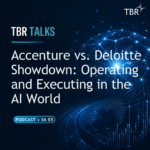

In this week’s episode of “TBR Talks: Decoding Strategies and Ecosystems of the Globe’s Top Tech Firms,” host Patrick Heffernan is joined by Principal Analyst Boz Hristov, TBR’s leading expert on Accenture and Deloitte for a discussion on which company is pulling ahead in operation and execution in AI. This discussion is part of TBR’s Vendor Showdown Series, where TBR analysts assume the role of head of strategy for one of the companies they cover and use TBR research and data to build a competitive intelligence case for that company’s position in the market.
“The broader internal adoption and deployment of various tools across the organization and adoption at scale for the different tool sets that Deloitte has invested and deployed and, you know, from a risk perspective and just the encouragement of the deployment and adoption of those tools, I think it’s a big factor because as we know, AI is kind of leveling the playing field right now. So, understanding of how the knowledge and the relationship with your clients translates into new opportunities is a key element, right? So, a broader adoption of the tools, I think it’s important. It’s basically what that leads to is optimizing, or I would say the judgment layer, essentially,” said TBR Principal Analyst Boz Hristov.
Episode highlights:
- Making the case for Accenture or Deloitte
- Weaknesses observed within each company
- 2027 predictions for Accenture and Deloitte
This episode is now available on demand across all major streaming platforms. Listen and learn today!
Accenture vs. Deloitte Showdown: Operating and Executing in the AI World
TBR Talks Host Patrick Heffernan: Welcome to TBR Talks: Decoding Strategies and Ecosystems of the Globe’s Top Tech Firms. Where we talk business model disruption in the broad technology ecosystem from management consultancies to systems integrators, hyperscalers to independent software vendors, telecom operators to network and infrastructure vendors, and chip manufacturers to value-added resellers. We’ll be answering some of the key intelligence questions we’ve heard from executives and business unit leaders among the leading professional IT services and telecom vendors.
I’m Patrick Heffernan, Principal Analyst, and today we’ve got an episode of TBR’s Vendor Showdown series, where we take our newest AI research portfolio and apply it through the lens of competitive intelligence. Today we’ll be looking at Accenture vs Deloitte with Boz Hristov, Principal Analyst for TBR’s Digital Transformation practice.
How the Showdown works
Welcome to the Showdown series here, as we’re calling it right now at TBR Talks, as we talk about two different companies, and we put them head to head. And if you’ve listened to some of the other episodes you know it’s two TBR analysts taking on the role of the head of strategy at a company that they cover and making the case for why they’ve got the right strategy going into 2027, why they’re in a good position in the market, and then attacking the other company or perhaps at least positioning them versus the other company, and then talking about in round three, a prediction for 2027. And I’m joined today not by two analysts, but by one analyst. Boz and in the ether here is the Boz bot that can talk to us about Accenture and Deloitte, two companies that Boz has covered since he joined the firm a long time ago. And what we’re going to do today is we’re going to put Boz in both positions. And so, for round one, we’ll do what we’ve done before, the same with round two and round three, but it’s only going to be Boz arguing against himself.
Round 1: Making the case for Accenture and Deloitte
So round one. Let’s tee this up. Boz, I’m going to say that right now you are the head of strategy for Accenture. And I want you to make the case for why Accenture’s position in the market based on TBR’s research is positive, is a market leader right now. So, go.
Boz Hristov, TBR Principal Analyst: Sure. Thank you, Patrick. Thanks for having me debating myself. We’ll see which, who’s going to win the human or the bot. We’re not going to assign, you know, a human on the bot to either company, but let’s just, you know-
Patrick: We’ll figure that out.
Boz: Fair enough. So, Accenture. So, the way I think about Accenture is really, you know, obviously when we look at Accenture is how we actually go to market, what it’s all about. And the most recent recalibration of the business model through the Reinvention Services is a massive transformation internally of the entire operating model and the way the company goes to market, the way the company most importantly engages with clients, but that engagement with clients is also being applied internally. So, the reorganization of Accenture to account for AI is almost, it’s kind of like rebuilding a company within to operate and to execute in the world of AI and not just use tools for the sake of tools. So that’s the, kind of, number one piece.
That transformation, I would say, that Accenture is pursuing and it’s in the middle of it right now, Reinvention Services is a fairly new initiative. I’ll say it’s the- it provides a more of a clear path for the revenue composition, the change in the revenue composition. That’s the end goal, essentially, right? Converting all internal AI assets into more of the delivery methods and how the company capitalizes and drives the IP. And then thinking about the scale as being a strategic advantage, not just as a cost base. What I mean by that is, I would say, there’s a lot of talk about reshuffling the pyramid and whatnot, and Accenture is not immune to that, obviously, but the scale is so large that it obviously allows Accenture to design the right model moving forward because there’s so many people that can pick and choose in the right position and with the right skill sets and the right transformation. So, that’s kind of like the kind of three main points for Accenture I would say that I think allows it to drive in the direction of like, okay, there’s a lot of moving pieces, there’s some legacy work of a customer zero use case is being applied to the reorganization to apply to the customers.
Patrick: Excellent. Now flip your mind around, put yourself in the seat of the head of strategy at Deloitte. And now you’re looking at the firm, the member firm, the entire global Deloitte.
Boz: Yeah.
Patrick: And saying, all right, as a global firm, what is it that we’re doing right? What is the case for why Deloitte is going to lead in the market going forward?
Boz: Yeah. So, as you know, I mean, Deloitte being part of the Big Four group, we, you know, Deloitte prides itself as a- knowledge management is a key element, right? Consultants, knowledge management, those two go hand in hand, even before the times of AI, right?
Patrick: Right.
Boz: So, the broader internal adoption and deployment of various tools across the organization and adoption at scale for the different tool sets that Deloitte has invested and deployed and, you know, from a risk perspective and just the encouragement of the deployment and adoption of those tools, I think it’s a big factor because as we know, AI is kind of leveling the playing field right now. So, understanding of how the knowledge and the relationship with your clients translates into new opportunities is a key element, right? So, a broader adoption of the tools, I think it’s important. It’s basically what that leads to is optimizing, or I would say the judgment layer, essentially. So, the more people are tuned in to understand what the rest of the organization is doing, the better judgment and the better access to that judgment, you know, provides the insights to develop that judgment, essentially. And then I think the results are, what we’re seeing right now is that it’s better change management, change management outcomes. Both internally, you know, looking at their- Deloitte’s what we call Human Intensity Reduction Index. And, you know, it’s something that, you know, here in TBR, it’s like it’s hovering around low single digits at the moment but has certainly been improving since the advent of ChatGPT. And then, you know, that’s something that is an indication of even for an organization that is historically more fragmented. I think that change management outcome is a good way to measure through the Human Intensity Reduction Index.
Patrick: So, what I’ve heard is fascinating because we think of Accenture and Deloitte being very similar companies. And what you just described was Accenture as very much an IT services company, as an organization, focused on revenue sources, focused on scale as an advantage. And Deloitte very much as a consultancy focused on knowledge management, on optimizing the judgment layer. So, we definitely have some stark contrast.
Round 2: Looking at weaknesses
Now, round two. We’ll go in the reverse order here. Staying as the head of strategy for Deloitte, what do you say is Accenture’s weakness that either Deloitte can exploit or not exploit, but more importantly, just what is Accenture’s weakness?
Boz: Yeah, I think the way I think about it is going back to the comment I made a moment ago from a Deloitte perspective, you know, looking at that stack of service offerings, I mean, Accenture does not have tax services. Accenture does not have audit and assurance services. And while audit has to be kept aside, the assurance element is where I think there’s, you know, a great connecting piece between assurance and cybersecurity and governance that Deloitte has a much stronger value proposition around just given its legacy kind of a business model, right? So, I think this is an opportunity there. I wouldn’t argue against Accenture’s larger global scale because as I, you know, Deloitte also has been building the offshore delivery for a while and it has been looking into how to optimize and Deloitte has certainly been building up the managed services business and whatnot, but I think on the pieces of the portfolio around tax and tax managed services as an opening to, you know, and I know this is- you can probably say that’s not a weakness because that’s by design of the business model. But I think there’s an opportunity that can be developed on a portfolio that can actually, you know, Accenture could potentially go after, but they’re not at the moment.
Patrick: You did mention scale though, but for Accenture’s weakness, could weakness become a scale if they need to maintain that size and yet clients want smaller engagements, clients want cheaper prices because of AI.
Boz: Yeah.
Patrick: Does that sort of put a pressure on Accenture’s scale?
Boz: To a degree. I mentioned earlier how the scale actually allows the pyramid reshuffling a little bit more of leeway, of freedom, of exactly making the right choices to address what you just mentioned and how to be better positioned. I mean, looking at the Accenture’s Human Intensity Reduction Index here at TBR, it’s very similar to where Deloitte is, low single digits. So, both organizations from a HIRI perspective, they are neck to neck, not surprising there.
Patrick: Yep.
Boz: Again, the business models are very similar, but again, Accenture is kind of like looking into the tapping more into mid-market and developing more IP and trying to be a little bit more data-first and IP-first kind of a model. I think that’s going to test their readiness for the scale and how they can actually showcase elasticity, agility of both the pricing model and the delivery model and everything that kind of like encompasses.
Patrick: All right, now you’re back at Accenture.
Boz: Yup.
Patrick: Head of strategy there, and you’re saying to your board, this is the weakness of Deloitte that either we can exploit or at least we need to understand.
Boz: So, I would say I think Accenture’s bets that the company has been doing in the last 6 to 9, 12 months, I would say, especially the most recent acquisitions and just thinking about where the opportunities are for the company. I think there’s a great opportunity to go after the assurance element. I think the investments that the risk management and the risk that’s associated with all things AI is a great opportunity because Accenture comes in with the processes, comes with the rigor on execution part along the way that while this space is predominantly dominated by the Big Four, I think there’s an opportunity for, especially with the investments in cybersecurity companies, there’s like the whole stack around IT and OT and then all things governance is kind of the end goal. But the most recent investments with Anthropic, I would say that Accenture announced just this past week in the joint investment between Anthropic and Accenture, I think where Accenture can be both a model evaluator and model deployer and involved in the model development, I think that’s an opening for going after that assurance space through Accenture. It’s more of a backdoor to get to what I’m discussing right now. But I think as models become a new battleground and models mean not who can develop the faster, better, cheaper model, more about on the governance layer. I think that’s a huge opening for Accenture that it can actually climb up the stack and be more present in that assurance/risk management space.
Patrick: And you mentioned Deloitte as part of the Big Four, which is a brand wrapper that they have that they can lean on. And it’s a brand in and of itself. And Deloitte in and of itself is a massive brand. But does Operate in any way dilute that brand and is a weaker brand message from Deloitte an opportunity for Accenture?
Boz: So that’s Deloitte’s managed services, essentially, right?
Patrick: Right.
Boz: You’re referring to. So, well, it’s- if there’s one firm out of the Big Four to have the, you know, the position and the trust within the ecosystem, it’s probably Deloitte to lead with Deloitte Operate. And there is certainly a risk associated with getting into the more managed services, but as we could see in the market, the rest of the Big Four are also doubling down on managed services. So that suggests that Deloitte’s Operates strategy and brand has had very little impact on the branding part of the Big Four. I think the Big Four as a whole, I think they’re transforming within as well. So, the Deloitte Operate and as much as can backfire on the branding and the consulting led, I think the tagline under the- the value chain approach that Deloitte is taking from Operate to transform actually is proposing a new engagement model, a new delivery model with clients that actually helps them to really embrace the idea of like, we’re here to support you and then create new opportunities for consulting. So, it’s almost like a Trojan Horse for Deloitte, but it’s less of a negative impact on this consulting brand.
Round 3: Predictions for Deloitte and Accenture in 2027
Patrick: Yeah, all right, round three. We’re going to go into predictions now for 2027. And before we do that, I do want to point out, you’ve mentioned HIRI, the Human Intensity Reduction Index. And it’s important to note that these two companies are not actually in the same peer group in our AI Disruption Index when it comes to comparing the disruption that internal adoption of AI has wrought on these companies. And that’s because we see Accenture in its own peer group with Capgemini, Atos, DXC, NTT Data, and the rest. And then Deloitte, of course, is with the Big Four and McKinsey and BCG. That doesn’t mean we can’t compare HIRIs across because HIRI is, as a metric, is applicable across all of the companies we cover. All right, round three predictions. Let’s start again with Deloitte and tell me what is the strategic move or what is the thing, the standout thing that Deloitte is going to do or should do in 2027 to accelerate their growth and accelerate their position in the market?
Boz: I think they started as a firm, they are tapping into the whole space tech economy. I think we’re going to see more of that. They launched three satellites already. There’s six more being on tap to be launched out and the whole idea of like, you know, getting into the data center skyline in space. I know it’s kind of a wild out there idea, but we know it’s going to happen. We saw the SpaceX launch this past week, and that’s the whole kind of setting the path for that. So, for Deloitte being part of it, it is, I think it’s going to become even more important as part of the growth agenda as they try to become more of the orchestrator of that, you know, AI, OAI ecosystem, right? It’s a little bit of a, you know, of a question mark, just as I think about, you know, on my side, why do you want to keep assets on your books, so to speak? So that’s a little bit of always like a red flag for a company like that. But it seems like there is an appetite for the broader business. So I think maybe part of that whole capital expenditure that we all are witnessing in the market will allow Deloitte to be a little bit more, gain more of a primary access to what’s really happening, I was going to say on the ground, but actually in the space from a cybersecurity perspective, a data center managed services, OT, kind of like really kind of extending the whole physical and AI and the IT AI, so to speak, right, and the software AI. So that’s kind of I think we’ll see more of that, I would say, from Deloitte doubling down on the space tech economy.
Patrick: Okay, now you’re the head of strategy for Accenture, and you’re saying to the board, this is the big bet we need to make, or you’re just Boz at TBR saying, this is what I’m going to see as the big bet by Accenture.
Boz: Well, I would say that Accenture will double down on things a little bit more close to the Earth. And while I won’t exclude Accenture making a bet in the space tech as well, I think that’s going to be part of it and just looking at how the ecosystem is evolving. I think focusing on some of the initiatives that Accenture has rolled out, I think it will be more focused on execution. You know, again Reinvention Services is a massive transformation. So, it’s going to take a lot of that effort there. I think the focus on mid-market, on OT and kind of securing that position in the IT/OT market that’s really evolving with the extension to the physical AI, I think it’s going to be huge for Accenture and most recently Accenture launched Accenture Construct as a separate business unit. And I think that’s going to be where their focus is. But again, execution is probably a bigger bet for Accenture. And again, tangentially, there’ll be more space tech and others that they’ve been investing in in the last couple of months.
Determining the showdown winner
Patrick: Okay. Boz and the Boz bot, well argued on both sides. And now for the final round, I get to declare a winner. And by winner, I mean who I think is going to actually outpace the other going into and throughout 2027. And so, I got to say, you mentioned Trojan Horse 2026. Year of the Odyssey, that’s, but that was 2026. Now we’re moving into 2027.
Boz: *laughs*
Patrick: And look, here’s what I think Deloitte has got very much in its favor. It’s got a leg up on governance, risk, and compliance, no question. It’s definitely a first mover within the peer set, in the larger peer set when it comes to space. And I think the Operate as a Trojan Horse is really an important point because as all the Big Four firms begin to do more managed services and begin to be more like an IT services company, even as you still describe Deloitte at the beginning as so much of a consultancy, I think having that Operate in position in place, you know, in the same way that EY was sort of early to analytics and AI-
Boz: Yep.
Patrick: And that allowed them to make mistakes and learn faster, I think Deloitte is learning from its missteps and from its successes in Operate and that’s a good thing. On the other hand, we got Accenture and Accenture is far more grounded. I think you mentioned Reinvention Services is not only changing the way they’re delivering to clients, but changing the way they’re operating inside. A fast follower on space is probably a good thing. A slighter, smaller bet right now might be a better thing. And just this idea of they’re going to execute. You know the way I think, I love a company that stays in its own swim lane, does what it does well. I love the idea of sort of fast following, especially on some place like space. So today, Boz, I got to tell you, the winner is Accenture. And what do you think of that?
Boz: Well, I think I don’t disagree with your positioning and declaring a winner. At the end of the day, I think both companies are very similar, as we talked in the beginning. The execution part is key, I think, but you also need to think about the long-term plays as well. I didn’t mention one technology, quantum.
Patrick: True.
Boz: I was thinking about where and how to think about quantum from either company. And both companies have made some investments. I know Accenture had like quantum labs a while back.
Patrick: Right, yup. A while back.
Boz: I’ll see which one of those two will kind of push the envelope on quantum sooner than the other one. A little bit more, you know, fast forward, kind of like, setting the pace.
Patrick: Right.
Boz: I think that could- might give, a little bit more of a lag on the innovation front, on the innovation front.
Final thoughts
Patrick: Okay. We’ll come back to this in April of 2027, and we’ll talk about who’s still ahead.
Boz: Yup.
Patrick: Is it still Accenture? Is it now Deloitte? Thank you very much, Boz.
Boz: Thank you.
Patrick: Next week, we’ll be talking about Leidos versus GDT with John Caucis and James Wichert.
Don’t forget to send us your key intelligence questions on business strategy, ecosystems, and management consulting through the form in the show notes below. Visit tbri.com to learn how we help tech companies, large and small, answer these questions with the research, data, and analysis that my guests bring to this conversation every week.
Once again, I’m your host, Patrick Heffernan, Principal Analyst at TBR. Thanks for joining us and see you next week.
 Technology Business Research, Inc.