IT Services Vendor Benchmark

TBR Spotlight Reports represent an excerpt of TBR’s full subscription research. Full reports and the complete data sets that underpin benchmarks, market forecasts and ecosystem reports are available as part of TBR’s subscription service. Click here to receive all new Spotlight Reports in your inbox.


Post updated: Nov. 15, 2025

A rebound in financial services and activities around improving productivity and optimizing costs drove revenue performance for IT services vendors during 2Q25

Outlook: TBR estimates trailing 12-month (TTM) revenue growth for the benchmarked IT services vendors will be 2.6% year-to-year in 2025, higher than 2024 revenue growth of 0.9% year-to-year. The market dynamics have not changed since 3Q23, when the uncertain macroeconomic environment began to pressure discretionary spending and consulting activities while fueling a wave of outsourcing demand around infrastructure and application modernization, productivity improvement and cost optimization. Clients are showing increased interest in large transformational offerings to increase productivity and reduce costs, and this trend is increasing the share of managed services deals in IT services providers’ signings mix. Manufacturing faces ongoing downward pressure in Europe, particularly in the automotive sector, but demand for supply chain optimization and digital transformation continues to fuel growth in the sector globally. Vendors are experiencing a rebound in demand from clients in the financial services sector such as banks seeking to improve customer experience (CX) through the use of agentic AI solutions. Although agency spending and headcount cuts by the Department of Government Efficiency (DOGE) negatively impacted the performance of some IT services providers in the U.S. public sector in 1H25, we expect new consulting opportunities to emerge in the long term around efficiency improvement, including systems enhancement, technology modernization and AI adoption. However, some vendors are warning that solicitations, award activity and adjudications have been slowing and that there will be some challenges in 2H25, and expect that consulting engagements will face increased scrutiny.


Key Vendors: Accenture remained the largest vendor in TBR’s IT Services Vendor Benchmark in terms of revenue and headcount and was No. 7 in TTM revenue growth in 2Q25. Accenture’s relentless execution will help the company maintain stakeholder trust as it enters the next phase of its business model rotation and pursues opportunities with upper-midmarket clients. NTT DATA was No. 2 in TTM revenue and No. 14 in TTM revenue growth in 2Q25. NTT’s recent purchase of the remaining shares of NTT DATA creates uncertainty around NTT DATA’s decentralized structure, which currently includes both domestic and overseas operations and enables NTT DATA to tailor service offerings to specific regional markets. Tata Consultancy Services (TCS), which was No. 3 in TTM revenue and No. 16 in TTM revenue growth in 2Q25, demonstrates a strong commitment to innovation through significant investment in research and development, which has incrementally created valuable intellectual property that supports the company’s cutting-edge platforms and solutions.


Market Overview: TTM IT services revenue grew 2.5% year-to-year in 2Q25, compared to year-to-year increases of 1.6% in 1Q25 and 0.9% in 2Q24. Accelerated momentum in financial services and activities around IT modernization and efficiency improvement enabled vendors to alleviate pressures from tight discretionary spending and extended buyer decision cycles. Vendors were able to stabilize profitability in 2Q25, with 20 of the 31 benchmarked vendors improving TTM operating margins year-to-year due to tight expense management, productivity initiatives and stable utilization, and increased use of automation, generative AI (GenAI) and agentic AI solutions.


If you believe you have access to the full research via your employer’s enterprise license or would like to learn how to access the full research, click the Access Research button.

Access Research


Solutions enabled by technology partner capabilities increase IT services providers’ value proposition around addressing specific infrastructure, operational and business challenges

Quarterly focus: Alliances

TBR Assessment: According to TBR’s 2Q25 Cloud Ecosystem Report, “Enterprise buyers are becoming increasingly conflicted in their expectations of how vendors can best support their technology needs. … In a nutshell, vendors cannot rely on a one-size-fits-all AI ecosystem strategy across regions. Success will require region-specific approaches: IP-led initiatives in APAC, orchestration frameworks in Europe, and startup-centric marketplaces in the Americas. All must be underpinned by interoperable APIs and strong governance to help IT services providers capture and monetize local demand. Executing against such expectations while continuing to rely on a traditional labor-arbitrage model will test professional services firms’ readiness to transform their own operations while maintaining trust with hyperscalers, which continue to explore the opportunity to drive professional services revenue by simplifying the sales process and marketplace through the use of agentic AI.”


Examples of recent vendor activities
IBM is expanding activities with technology providers to augment its cloud and AI capabilities and support clients through all stages of transformation and optimization. Since April IBM has expanded its relationships with Microsoft, Amazon Web Services (AWS), Oracle, Salesforce and SAP. IBM Consulting established a Microsoft practice with 33,000 certified experts dedicated to technologies such as Azure OpenAI, Azure Cloud, Copilot, Fabric and Sentinel. IBM, which has approximately 12,000 AWS-trained professionals, introduced tools and frameworks for building and managing AI agents and integrating them with technologies available on the AWS Marketplace. IBM Consulting is providing AI Integration Services to help clients establish agentic AI capabilities and is offering the IBM Consulting Advantage solution to transform processes through agentic AI on AWS. IBM and Oracle provide agentic AI and hybrid cloud solutions by bringing IBM watsonx to Oracle Cloud Infrastructure. IBM, which has more than 10,000 dedicated Oracle consultants, is expanding its consulting services to enable the use of AI agents across platforms and transform business processes. IBM has more than 7,000 Salesforce-certified professionals and is developing its Salesforce capabilities by introducing AI agents based on IBM watsonx Orchestrate that work with Salesforce technologies and IBM Granite models. IBM has more than 18,000 SAP-certified consultants and, together with SAP, launched a hyperscaler option for moving SAP S/4HANA workloads from on-premises IBM Power servers to the cloud.


Although client trust wavered in the past several quarters due to uncertainty around Atos Group’s transformation, the company received stable support from its technology partners, which will drive portfolio expansion and position the company for growth. In July Atos Group was awarded the Golden Certificate from SAP and was certified for the 10th consecutive time as a SAP Global Operations Partner. The award reflects Atos Group’s dedication to its partnership with SAP, which has spanned more than 20 years, and established managed services capabilities with over 10,000 professionals with SAP expertise. Also in July, Atos Group renewed its status as a Google Cloud Managed Service Provider, driven by capabilities around providing cloud-native services, infrastructure solutions and digital modernization. In April Atos Group received Microsoft’s Private Cloud Solution Partner Designation due to its track record of providing Azure Cloud in data centers globally. Expanding capabilities around Google Cloud and Microsoft diversifies Atos Group’s infrastructure services capabilities and creates opportunities for growth outside of commoditized and low-growth traditional infrastructure services segments. Over the past several years the company has been decreasing its dependency on legacy infrastructure services and reviewing and exiting low-growth and low-margin contracts in the segment.ications strengthens Cognizant’s Neuro AI platform.

Although managed services activities contributed to an acceleration in 2Q25 overall TTM revenue growth year-to-year, 15 of the 31 benchmarked vendors ranked below the average
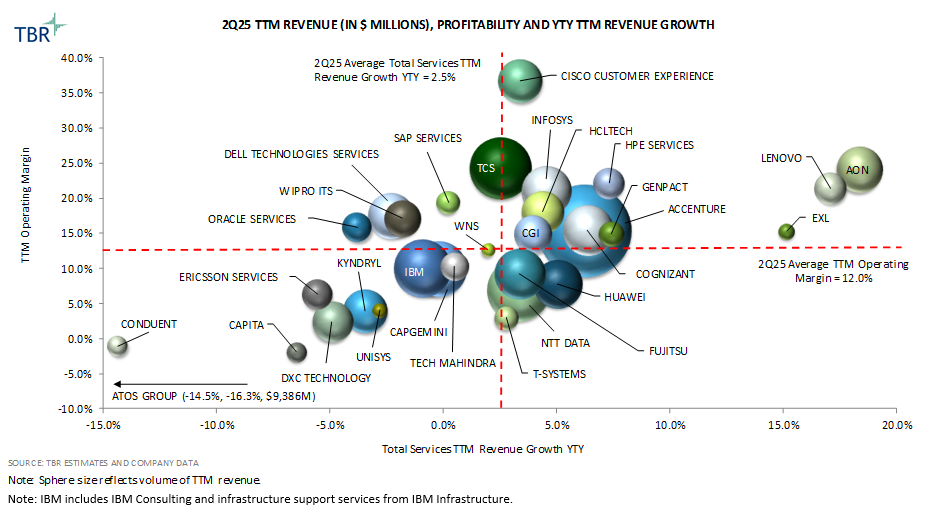
 

IT Services Revenue and Growth

Trailing 12-month Revenue , Profitability and Year-to-year Trailing 12-month Revenue Growth for Benchmarked IT Services Vendors (Source: TBR)


Vendor spotlight excerpt

Accenture pursues new revenue growth opportunities with upper-midmarket clients, while TCS leverages its cloud and AI expertise and solutions to pull long-term managed services deals

Key Findings and TBR Assessment

Accenture, NTT DATA and TCS retained their No. 1, No. 2 and No. 3 revenue contribution positions, respectively, compared to 1Q25. Vendors will be challenged to maintain sales growth momentum in 2026 as Accenture navigates macroeconomic headwinds and internal operating model adjustments. Building a pipeline in the midmarket will gradually augment Accenture’s performance. TCS leverages its scale and cost-efficient global talent to offer flexible, competitive pricing, which will be a key advantage as clients scrutinize budgets during uncertain economic times.

IBM moved up from No. 5 to No. 4, Capgemini rose from No. 6 to No. 5, and Fujitsu dropped from No. 4 to No. 9. Although IBM Consulting’s revenue growth has been negatively impacted by clients’ extended decision making, the business continues to benefit from clients’ emphasis on cost-efficient, high-impact technology investments. Pursuing opportunities in the public sector in Europe, specifically in the defense subsegment and around sovereignty solutions, will positively affect Capgemini’s revenue expansion in 2H25.

Cognizant and Infosys each moved up by one position, to No. 6 and No. 7, respectively, compared to 1Q25. Cognizant is capturing opportunities in vendor consolidation, cost reduction and efficiency improvements, and is leveraging its AI expertise and Neuro AI platform to effectively win new projects with existing clients. Infosys is deploying industry-centric, cloud-ready, GenAI-enabled services and solutions within established IT buyer relationships while also relying on customer-zero use cases.
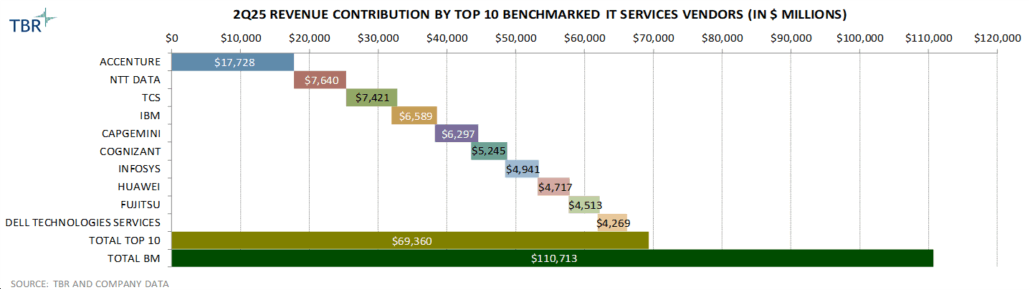
Revenue Contribution for IT Services Vendors

Revenue Contribution by Top 10 Benchmarked IT Services Vendors (Source: TBR)


Revenue segment views excerpt

C&SI revenue growth year-to-year accelerated from 2Q24 to 2Q25, indicating clients are becoming more open to signing discretionary funded engagements

C&SI: Although discretionary spending remained tight, some of the IT services providers saw pockets of growth in C&SI in 2Q25, leading to an increase in C&SI revenue share and revenue growth year-to-year acceleration compared to 2Q24. Portfolio development, client relationship building and skills development to drive transformational engagements aided revenue performance in 2Q25. For example, Accenture is partnering with Deloitte and Korn Ferry to support Saudi Aramco’s employee experience transformation program using LearnVantage capabilities. Capgemini is working with GN Hearing to improve the company’s customer experience and order processing by implementing a Salesforce global order management system.

BPO: Vendors’ BPO businesses continue to benefit from the ongoing shift in buyer priorities from innovation and growth to business resiliency and optimization. Automation, GenAI and agentic AI capabilities within BPO will shift vendors’ service delivery models and generate productivity improvements; however, GenAI and agentic AI threaten the core value proposition centered on human-backed service delivery. IBM Consulting will combine AI Integration Services with capabilities from its partner ecosystem to enable clients to reengineer business processes, improve the user experience, and orchestrate systems comprising AI assistants, agents and data.

Application outsourcing (AO): Application outsourcing revenue growth accelerated year-to-year to 2Q24. Enterprise applications are core to broader digital transformation engagements and create expansion opportunities for vendors. Preparing clients’ applications and data streams for cloud and AI integration continues to fuel managed application services opportunities.

IT outsourcing (ITO): Integration of new infrastructure, enabled by vendors’ cloud and consulting practices, provides a natural starting point for companies to build their managed services pipeline. Demand for IT optimization and IT operations efficiency through AI and automation, and security services continues to fuel ITO revenue opportunities. For example, in July Atos Group renewed its status as a Google Cloud Managed Service Provider due to its capabilities around delivering cloud-native services, scalable infrastructure solutions and digital modernization to enterprises globally through advanced support, optimization and AI-driven management of Google Cloud environments.
1H24 Cloud Data Services Market Landscape

TBR Spotlight Reports represent an excerpt of TBR’s full subscription research. Full reports and the complete data sets that underpin benchmarks, market forecasts and ecosystem reports are available as part of TBR’s subscription service. Click here to receive all new Spotlight Reports in your inbox.

Vendors lead with the data lake architecture and emerging frameworks to sell a message of data intelligence amid rampant GenAI adoption

The race for Apache Iceberg mindshare is on

Data lakes remain a valuable way for enterprises to simultaneously store structured and unstructured data, particularly as the latter increases due to generative AI (GenAI) and large language models (LLMs). Data lakes are also directly attributable to the rising popularity of Apache Iceberg, an open-source format regarded by developers for its ability to store data in tables and freely move that data across any data lake architecture.
 
Whether a customer is creating their own data lake (e.g., on Amazon Web Services [AWS]) or deploying a data lake platform as a product (e.g., Databricks), Iceberg is playing an increasingly larger role in helping customers navigate their big data estates with the most limited vendor lock-in.
 
How the two data lake giants — Snowflake and Databricks — are investing best speaks to the budding role of Apache Iceberg and its growing community. Earlier this year Snowflake adopted Apache Iceberg as the native format for its platform and subsequently launched Polaris, a tool that allows customers to catalog that data stored in Iceberg tables.
 
In only a matter of days, Databricks, which was born out of Delta Lake, an Apache Iceberg alternative, moved into the space with its acquisition of Tabular. Tabular was created by the founders of Apache Iceberg, marginalizing Snowflake’s recent investments and intent to attract more Iceberg-heavy users, which generally include digital and cloud-native companies. The hyperscalers, primarily AWS and Microsoft, work closely with Snowflake and Databricks and benefit from their respective integrations to boost interoperability for joint customers through Iceberg.
 
For example, Microsoft announced its data platform Fabric, which is based on a data lake architecture (OneLake), will support Iceberg via Snowflake. This is a major win for Snowflake that elevates the company’s role as an ISV partner in the Microsoft Fabric ecosystem and further challenges Databricks, which due to its native first-party integration with Azure, has always had a rich and unique relationship with Microsoft.

A select number of vendors are leading the shift to data intelligence

Though somewhat influenced by a degree of marketing hype vendors use to differentiate themselves, data intelligence has become an emerging topic in the market, led by GenAI. At its core data intelligence refers to the use of AI on data to deliver insights tailored to the business, but the other core component of data intelligence is the underlying data architecture foundation.
 
Databricks is largely associated with formalizing the concept of data intelligence and even markets its platform as the Data Intelligence Platform to convey the value of having both the data lakehouse architecture and the AI components (in Databrick’s case, Mosaic AI) that allow customers to build, train and fine-tune models. Other vendors have similarly adapted their messaging around data intelligence.
 
For example, as part of what it now calls its Data Intelligence vision, Oracle Analytics announced Intelligent Data Lake, a reworking of existing OCI (Oracle Cloud Infrastructure) services like cataloging and integration, to create a single abstraction layer that will support both Apache Iceberg and Delta Lake formats.
 

If you believe you have access to the full research via your employer’s enterprise license or would like to learn how to access the full research, click the Access Research button.

Access Research


Hyperscalers are taking different approaches to address the symbiotic relationship between data architecture and AI

Microsoft and Google Cloud are integrating and productizing their data services as complete solutions, exposing a lack of maturity in AWS’ fragmented approach

Microsoft made a big move when it launched Fabric, which essentially integrates seven disparate Azure data services — from data warehousing up to analytics — as part of a single platform underpinned by a unified data lake. Today, Fabric has amassed over 14,000 paid customers and a growing ecosystem of global systems integrators (GSIs) and ISVs building and selling applications on top of the platform.
 
Google Cloud, which has always had a strong play in data analytics, is trying to better unify key data and analytics capabilities in BigQuery to deliver a more complete, single-product experience. This includes BigLake, Google Cloud’s storage abstraction layer and services like Dataplex, so customers can apply governance tasks like lineage and profiling in Dataplex without having to leave the BigQuery interface.
 
Though Google Cloud’s approach may lack the level of integration compared to Microsoft Fabric, it is clear to see the direction the company is heading to help customers simplify their data estates, and ultimately capture more analytics and AI workloads.

AWS’ approach is different. Though offering the broadest set of data tools and services, from storage and ingestion up to governance, AWS is still lacking the platform mindset and strategy of its peers.
 
To be fair, the company has been working to better integrate services within its own ecosystem by improving data sharing between the operational database and the data warehouse (e.g., “zero-ETL” integration between Aurora and Redshift), but customers continue to stress that they have to take on more burden in the back end when crafting a data architecture on AWS.
 
This dynamic only reinforces the importance of AWS’ partnerships with complete data cloud platforms like Snowflake and Databricks, but of course Microsoft is also making sure it keeps these companies elevated within the Fabric ecosystem.

The GSIs are playing a prominent role in multiple facets of data, which could speak to maturing ecosystems and hyperscalers’ efforts to productize the entire data life cycle

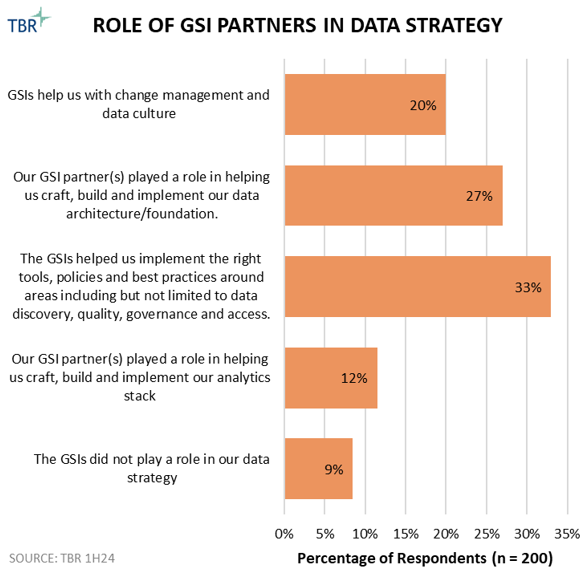
Customers indicated that the GSIs play a prominent role in all aspects of the data strategy from change management to data architecture to governance. Just 12% of respondents say the GSIs were involved in their analytics stack, but this seemingly low percentage could be for many different reasons.
 
First, establishing the data architecture, or re-architecting disparate IT assets, such as data warehouses, is top of mind for many customers right now as they recognize it is a necessary step in GenAI deployment.
 
Secondly, the hyperscalers and pure play data platform companies are becoming more adept at delivering integrated solutions that deliver upper-stack capabilities, such as analytics based on a holistic data lake architecture. Microsoft Fabric, which has a growing ecosystem of both GSI and ISV partners, is a top example.
 
TBR’s newly launched Voice of the Partner Ecosystem Report found that cloud providers expect data strategy and management to be the biggest growth area coming from partners over the next two years. In fact, data strategy and management ranked higher than GenAI on its own, which is telling of what the cloud providers expect from their partners.
 

Graph: Role of GSI Partners in Data Strategy, 1H24 (Source: TBR)

Role of GSI Partners in Data Strategy (Source: TBR 1H24)

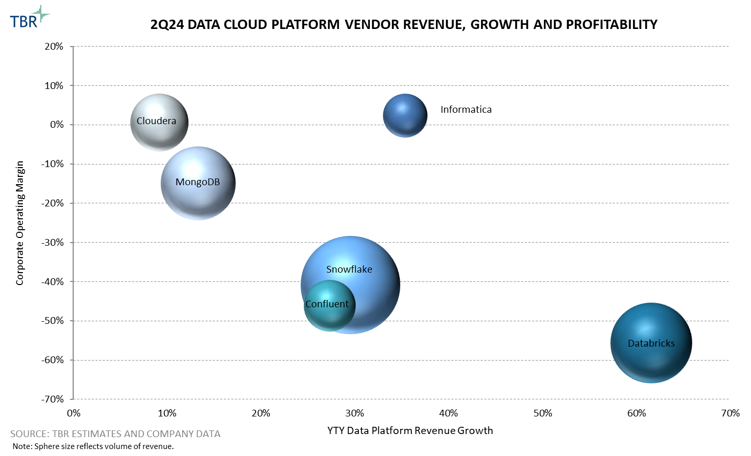
Though Informatica’s cloud-first vision will erode lucrative license and support revenue streams, the company is showing early signs in its ability to expand margins

Despite no longer selling perpetual licenses and actively migrating its support base to Information Data Management Cloud (IDMC) in the cloud, Informatica’s gross margins continue to expand.
 
Meanwhile, GAAP operating margin increased over 300 basis points year-to-year in 2Q24 as Informatica continues to benefit from economies of scale, and sign larger, more strategic contracts with customers.
 
Recognizing that it is navigating a highly competitive landscape, Snowflake’s investments in R&D are increasing. For context, Snowflake’s R&D accounts for a notable 50% of total revenue.
 

Graph: Data Cloud Platform Revenue, Growth and Profitability, 2Q24 (Source: TBR)

2Q24 Data Cloud Platform Revenue, Growth and Profitability (Source: TBR)

3Q24 Federal IT Services Benchmark

TBR Spotlight Reports represent an excerpt of TBR’s full subscription research. Full reports and the complete data sets that underpin benchmarks, market forecasts and ecosystem reports are available as part of TBR’s subscription service. Click here to receive all new Spotlight Reports in your inbox.

Expansion accelerated in the federal IT market in 3Q24 as renewed M&A activity by several federal IT vendors augmented strong, stable demand for digitally based IT modernization

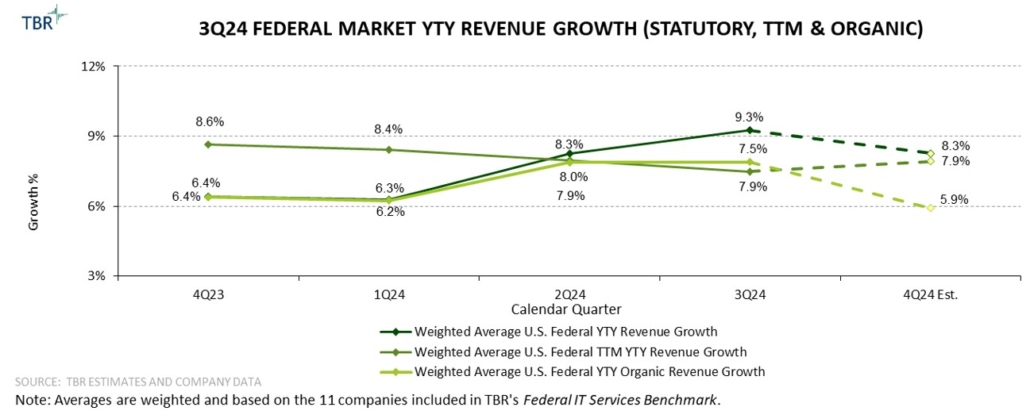
Statutory year-to-year revenue growth for the 11 benchmarked vendors in the U.S. federal market on a weighted average basis rose 100 basis points sequentially, increasing from 8.3% in 2Q24 to 9.3% in 3Q24. Acquisitions by AFS (Cognosante), BAH (PAR Government Systems Corporation [PGSC]), CACI (Quadrint in 1Q24 and Azure Summit Technologies [AST] in 3Q24), CGI Federal (Aeyon), General Dynamics Technologies (Iron EagleX) and KBRWyle (LinQuest) generated an inorganic tailwind to overall market growth of roughly 180 basis points in 3Q24.
 
Federal IT executives (e.g., CACI CEO John Mengucci) have indicated that the M&A market became more buyer-friendly during 2024, prompting several benchmarked vendors to leverage acquisitions to address portfolio gaps in multiple areas, including digital transformation (DT) and emerging technologies for classified defense and intelligence operations. Vendors have been acquiring, and will continue to hunt for, smaller peers with scalable cloud and digital modernization capabilities as well as deep existing (and likely cloud-related) relationships with federal agencies.
 
Underpinning inorganic market growth is enduring robust demand for digitally transformative technologies in AI, cloud, analytics and data science, as well as the continued need to upgrade baseline IT infrastructures across the federal sector to accommodate digital modernization.
 

Graph: 3Q24 Federal Market Year-to-year Growth (Source: TBR)

3Q24 Federal Market Year-to-year Growth (Source: TBR)

Civil agencies continue to aggressively invest in cybersecurity, health IT and Agile-based software systems, leading to sustained double-digit civil sector IT spending growth

Weighted average growth in the civilian sector accelerated 80 basis points sequentially, rising from 9.6% in 2Q24 to 10.4% in 3Q24. Vendors including BAH and Leidos have posted multiple quarters of double-digit growth in their respective civil units as of 3Q24, with robust rates of growth expected to persist well into 2025. Sector growth was sustained at or near 10% throughout federal fiscal year 2024 (FFY24) as demand among civil agencies remains robust for comprehensive zero-trust and cyber incident support solutions, particularly by the U.S. Department of Homeland Security (DHS), the Department of Health and Human Services (HHS), the IRS and NASA.
 
Attracting and retaining cybersecurity talent also remain top priorities for nearly all civilian agencies, which are tapping vendors like AFS, BAH and Deloitte Federal for human resource advisory services. NASA launched an eight-year, $2 billion program, NASA Consolidated Applications and Platform Services (NCAPS), during 3Q24 to develop and deploy Agile-based software for over 200 IT systems, with vendors including CACI among the primary awardees.
 
Health IT is generating new revenue and profit streams for the benchmarked vendors, and agencies including the HHS (and its subagencies, CMS, the CDC and NIH) are seeking agencywide AI and analytics adoption services. The top five benchmarked vendors in year-to-year civilian sector revenue growth in 3Q24 were AFS (25%), BAH (16.1%), SAIC (10.8%), Maximus (9.3%) and CACI (7.9%).

Federal IT spending remained robust throughout FFY24, and the market appears poised for another strong year in FFY25, even as CY25 begins with yet another continuing resolution

TBR projects weighted average year-to-year federal IT services revenue growth for the 11 benchmarked companies will decelerate to between 8% and 8.5% in 4Q24, down from 9.3% in 3Q24. We anticipate weighted average year-to-year revenue growth in the defense sector will fall to between 6.8% and 7.3% in 4Q24, down from 8.6% in 3Q24, while civilian revenue growth remains between 10% and 10.5% in 4Q24, in line with the 10.4% increase in 3Q24.
 
Four leading federal systems integrators — BAH, CACI, Leidos and SAIC — as well as smaller federal IT peer KBRWyle elevated their respective revenue growth forecasts for their current fiscal year when tendering 3Q24 fiscal results, indicators that the federal IT macro environment will remain mostly growth-friendly through FFY25.
 
The new federal fiscal year began with a continuing resolution (CR) that extended government funding until Dec. 20, when a subsequent CR was enacted to fund federal operations until March 14, 2025. Further CR extensions in FFY25 would cause budget delays that could impede the ability of federal IT contractors to convert backlog into revenue, but most vendors expect revenue growth to remain on a solidly upward growth trajectory in FFY25.
 

If you believe you have access to the full research via your employer’s enterprise license or would like to learn how to access the full research, click the Access Research button.

Access Research


Pressures on resource management teams at federal IT contractors continue easing as the federal technology labor market returns to pre-pandemic rates of employee attrition and retention

Federal IT vendors are expanding training of their workforces across a variety of emerging technologies, including AI, analytics, cloud, EW, SIGINT and communications. The competition for talent in federal IT continues to cool, according to executives at several vendors, who have indicated that current trends in the labor market in federal technology are reminiscent of those seen in 2020. Recruiting and upskilling initiatives at federal IT vendors emphasize skills in AI/GenAI, machine learning and security technologies.

Spotlight on IT and professional services vendors serving the public sector: Resource management

Leidos CFO Chris Cage noted in the company’s 3Q24 earnings discussion that employee retention levels remain at all-time highs, as the federal IT labor market continues to cool after the hyper-competitive, post-pandemic period. BAH CFO Matt Calderone indicated his firm received over 100,000 applications in one month during 3Q24.
 
Amanda Christian, CACI SVP of Contracts and Subcontracts, is leading an effort to consolidate the company’s finance, accounting, contracts and subcontracts activities to enhance cross-collaboration and improve the company’s already strong win rates on net-new awards and recompetes.
 
Peraton continued to support Dakota State University’s CybHER Security Institute this summer to encourage young girls to pursue careers in cybersecurity. The company has recently ramped up its efforts to develop a cybersecurity talent pipeline. Peraton has promised to double its related apprenticeships, hire over 200 interns, set up an initiative to help people pivot into cybersecurity, and expand its ties with community colleges over the course of 2024.


2H24 Hyperconverged Platforms Customer Research

TBR Spotlight Reports represent an excerpt of TBR’s full subscription research. Full reports and the complete data sets that underpin benchmarks, market forecasts and ecosystem reports are available as part of TBR’s subscription service. Click here to receive all new Spotlight Reports in your inbox.


Turmoil over VMware’s licensing changes for VCF could cause customers to shift to other hyperconverged platforms or even to move away from HCI altogether and toward public cloud

Artificial intelligence

Although AI has been part of HCI workloads for some time, industry hype has brought more attention to both AI-enabled workloads and AI running as its own workload. Respondents cited AI as the top workload being run on HCI, and indicated AI is enabling a number of other workloads, including database management, business intelligence/ analytics, business apps (CRM, ERP), data backup, disaster recovery and IoT.
 
When it comes to generative AI (GenAI), the majority of the respondents’ organizations had already implemented GenAI into some of their business workflows or are evaluating how to do this. Organizations face different adoption challenges depending on their size. For example, large enterprises look for solutions that ensure data privacy and accuracy of results, while smaller organizations consider cost, skill set needed to operate the solution and how data must be structured.

Hybrid cloud

Nearly 70% of respondents are utilizing HCI for hybrid cloud, and HCI vendors continue to roll out enhancements to their hybrid cloud offerings with partners such as Microsoft Azure, VMware, Nutanix and Red Hat. At the same time, complex integration with existing infrastructure was the top challenge respondents faced with HCI rollouts in 2024. Additionally, 26% of respondents indicated they have not yet realized the benefits of integrating their HCI into a hybrid cloud. As HCI systems are increasingly becoming the foundation for numerous hybrid cloud and edge computing solutions, vendors must be prepared to simplify and enable system deployment, becoming more complex due to integrations with other systems and platforms.

VMware

VMware’s licensing changes for VMware Cloud Foundation (VCF) and other software have created significant upheaval among customers, with over half of respondents surveyed indicating they are exploring alternatives. While this may create opportunities for competing HCI solutions, such as Azure Stack HCI or Nutanix Cloud Infrastructure, customers frustrated with licensing fees may also choose to shift HCI workloads to a public cloud alternative instead of to another on-premises solution.
 

If you believe you have access to the full research via your employer’s enterprise license or would like to learn how to access the full research, click the Access Research button.

Access Research


While the rate of on-premises data center consolidation has declined for 2 consecutive years, the rate of data center expansion has increased

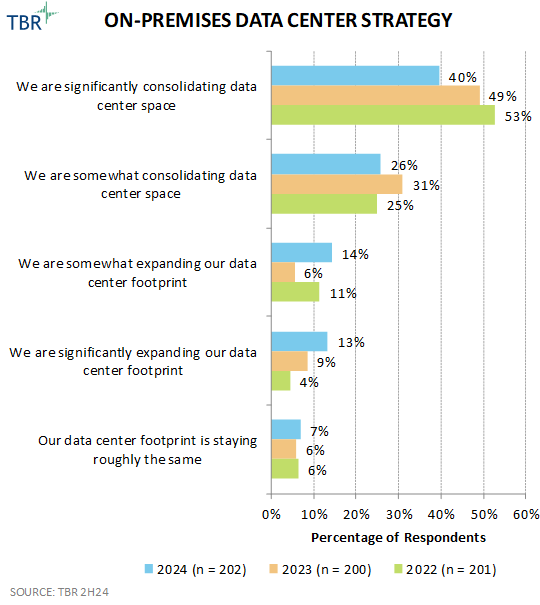
Over the past two years, the percentage of respondents who are significantly consolidating their on-premises data center space has decreased from 53% in 2022 to 40% in 2024. At the same time, the percentage of respondents who are significantly increasing their on-premises data center footprints has grown from 4% in 2022 to 13% in 2024.
 
Overall, data center consolidation is still the prevailing trend, with 66% of respondents somewhat or significantly consolidating their on-premises data center space. However, respondents are trending toward more of a middle ground, which is likely driven by a combination of factors including hybrid cloud adoption, workload placement optimization, cloud repatriation and upgrading older data center infrastructure to denser systems.
 
Graph: On Premises Data Center Strategy, 2H24 (Source: TBR)

HCI customer respondents’ managed services uptake increased approximately 5% in 2024 compared to 2023

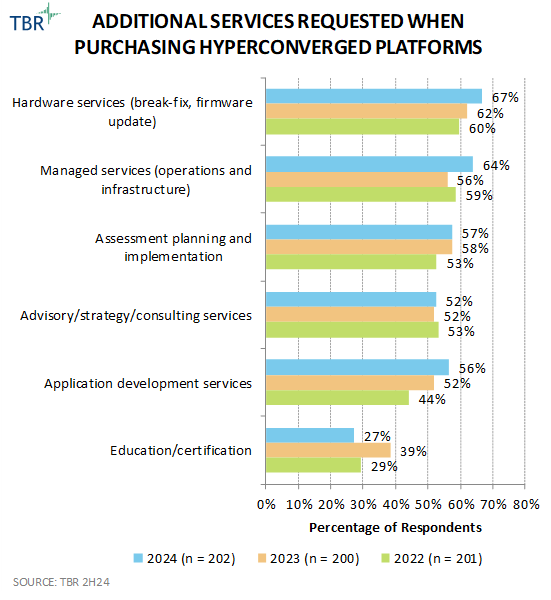
Hardware services such as break-fix and firmware update continue to be the most commonly attached services to purchases of hyperconverged platforms, while managed services ranks a close second.
 
Vendors continue to leverage “as a Service” offerings to drive increased services attach on hyperconverged platform sales. As customers increasingly opt in to managed services contracts, education and certification services attach has fallen.
 
Consumption of assessment planning and implementation services as well as advisory, strategy and consulting services remained largely flat on a year-to-year basis in 2024, demonstrating consistent demand for such offerings as customers continue to seek support in evaluating new use cases.
 

Graph: Additional Services Requested When Purchasing Hyperconverged Platforms, 2H24 (Source: TBR)

Additional Services Requested When Purchasing Hyperconverged Platforms, 2H24 (Source: TBR)

As organizations’ data volumes continue to increase, respondents expect to leverage HCI more heavily, taking advantage of the highly scalable nature of these platforms

Data backup and disaster recovery was the second most common workload respondents reported running on their hyperconverged infrastructure, and the top workload customers plan to move to hyperconverged platforms.
 
While DevOps was ranked No. 8 in overall workload adoption on HCI, respondents have identified it as a future growth area as the second most popular workload expected to be moved to hyperconverged platforms.

5G & 6G Telecom Market Landscape

TBR Spotlight Reports represent an excerpt of TBR’s full subscription research. Full reports and the complete data sets that underpin benchmarks, market forecasts and ecosystem reports are available as part of TBR’s subscription service. Click here to receive all new Spotlight Reports in your inbox.


FWA remains the dominant 5G use case

Communication service providers (CSPs) in many countries (developed and developing) globally will leverage 5G FWA to provide competitive high-speed broadband services. CSPs increasingly view 5G FWA as a viable and, in many cases, more cost-effective alternative to traditional fixed broadband services. In many cases, FWA also provides CSPs with a time-to-market advantage versus traditional, fixed-access operators in greenfield environments such as rural areas. According to the June 2025 Ericsson Mobility Report 141 CSPs globally are currently offering 5G FWA services, up from 128 CSPs offering 5G FWA services a year ago.

FWA connection growth will remain robust in the U.S. as T-Mobile and Verizon expect to reach a total of 12 million and up to 9 million customers, respectively, by the end of 2028. FWA development in the U.S. will be aided by factors including new rules for the Broadband Equity, Access and Deployment (BEAD) Program that are more favorable to FWA as well as the establishment of an 800MHz pipeline of midband spectrum under the One Big Beautiful Bill Act, which will create more capacity to support FWA.

Other regions are experiencing significant growth in FWA customers, including Europe and the Middle East and Africa. India is also a prime market for FWA due to its limited broadband infrastructure as Reliance Jio reached 5.6 million 5G FWA connections as of March 2025 and aims to add 1 million new 5G FWA connections monthly.

Investments in 6G are likely to be muted due to uncertain ROI

TBR expects CSPs will be reluctant to invest in large-scale 6G infrastructure deployments when the time comes because they are still struggling to generate a ROI on their 5G investments. CSPs will be focused on monetizing existing 5G investments into the 6G cycle as clear use cases and tangible ROI will need to be evident before 6G is deployed at scale.

The above sentiments were captured by a joint statement issued by the Next Generation Mobile Networks (NGMN) Alliance, a consortium comprised of about 20 global operators as of August. The document includes statements such as the following: “6G standards must be globally harmonised. It is expected to be built upon the features and capabilities introduced with 5G, alongside new capabilities to deliver new services and value. Such technological evolutions should be assessed with respect to their benefits versus their associated impact. 6G standards must learn from the mistakes of 5G, including multiple architecture options, features that are never used and use cases that have no market pull. … The industry needs to develop solutions that have tangible pull from potential customers, as there is increasing concern from operators about the affordability of investment in networks for the sake of technology development.”

TBR believes enterprises are likely to lead in 6G adoption over CSPs as they have more use cases to justify 6G investment, especially in regard to private networks in areas including manufacturing and heavy automation facilities. TBR expects the level of government involvement in the cellular networks domain (via stimulus, R&D support, purchases of 6G solutions and other market-influencing mechanisms) to significantly increase and broaden, as 6G has been short-listed as a technology of national strategic importance.

The commercial deployment of 6G-branded networks will likely begin around 2030 (following the ratification of 3GPP Release 21 standards, which is tentatively slated to be completed by the end of 2028). However, it remains to be seen whether 6G will be a brand only or a legitimate set of truly differentiated features and capabilities that bring broad and significant value to CSPs and the global economy. Either way, the scope of CSPs’ challenges is growing, and governments will need to get involved in a much bigger way to ensure their countries continue to innovate and adopt technologies deemed strategically important.

If you believe you have access to the full research via your employer’s enterprise license or would like to learn how to access the full research, click the Access Research button.

Access Research

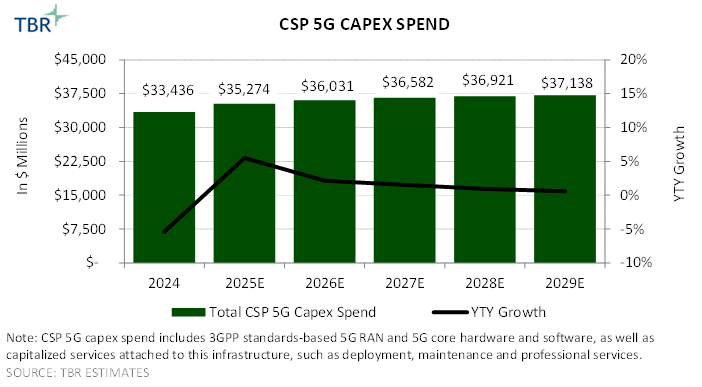
Global CSP spend on 5G infrastructure is growing slowly following a dip in 2024 as CSPs reassess their capital allocation and become more conservative

A pull forward of capex into 2023 in the U.S. and India resulted in a decline in CSP 5G capex in 2024, but slow growth will resume in 2025 as CSPs gradually deploy additional 5G base stations for coverage and capacity as well as roll out 5G SA and 5G-Advanced technologies.

Though some CSPs will continue to test and commercially deploy the newest technologies for 5G, most CSPs are in no rush to deploy 5G SA or 5G-Advanced due to the lack of ROI-positive B2B use cases.

FWA is one key area that will receive increased attention and investment through the forecast period as more CSPs legitimize the technology as an economically viable means of bridging the digital divide and bringing more competitive broadband services to existing markets that have fixed access.

Graph: CSP 5G Capex

Graph: CSP 5G Capex for 2024-2029Est. (Source: TBR)


Operators remain slow in their transition to 5G SA, which is limiting revenue opportunities provided by areas including network slicing and 5G-Advanced

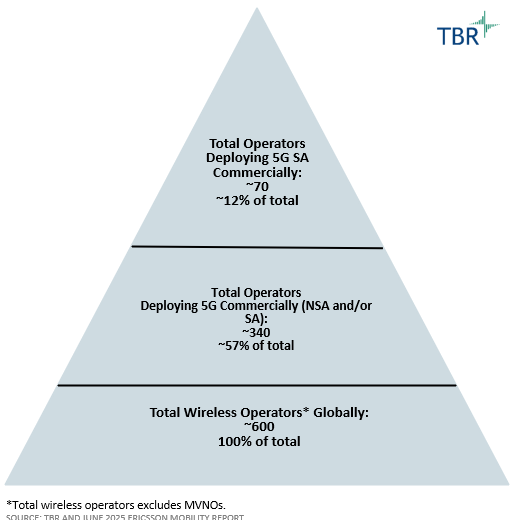
A continued lack of 5G SA deployments globally is a main barrier preventing the telecom industry from capturing new areas of value for their networks, such as B2B opportunities, network slicing and network APIs. However, many CSPs are hesitant to migrate to 5G SA due to uncertainty around ROI. According to the June 2025 Ericsson Mobility Report, out of the over 340 CSPs globally that have commercially launched 5G, only around 70, or about 21%, have commercially launched 5G SA so far.

Many CSPs are not in a rush to deploy 5G SA and are comfortable keeping their 5G Non-Standalone (NSA) networks for an extended period. Though 5G SA does provide some optimization benefits, such as throughput improvements to support data traffic increases, versus the NSA framework, many CSPs remain content with 5G NSA pending substantial, ROI-positive use cases that require the technology.

Limited 5G SA adoption will likewise hamper CSPs in implementing 5G-Advanced, which is dependent on 5G SA. Early deployments of 5G-Advanced began in 2024 and gradually expanded in 2025. 5G-Advanced will provide CSPs with benefits including faster data speeds, reduced latency and the ability to support use cases in areas such as AR/VR, edge computing and IoT.

Graph: 5G Deployment

5G Deployment (Source: TBR)

AI & GenAI Market Landscape

TBR Spotlight Reports represent an excerpt of TBR’s full subscription research. Full reports and the complete data sets that underpin benchmarks, market forecasts and ecosystem reports are available as part of TBR’s subscription service. Click here to receive all new Spotlight Reports in your inbox.

Updated: March 2026

AI adoption continues to reshape the alliances ecosystem, strengthening the case for multiparty alliances

Alliance ecosystems are restructuring around agentic AI capabilities and IT services companies, and consultancies must build region-specific AI ecosystem strategies that rely on hyperscalers, startups and IP-led frameworks.
 
Agentic AI strengthens the hyperscaler-SI relationship while also increasing competitive tension as hyperscalers embed more autonomous capabilities into their own platforms.
 
DXC Technology (DXC) intensified its reliance on hyperscaler alliances and added AI-specific partners to compensate for limited internal R&D capacity, deepening relationships with AWS, Microsoft Azure and Google Cloud to scale cloud and AI delivery. DXC also increased use of AI partnerships (e.g., ServiceNow) to accelerate AI-focused Fast Track solutions and introduced DXC Complete, simplifying SAP cloud migrations to Azure while embedding AI-enabled managed services.


HCLTech deliberately shifted from a technology-agnostic partner posture toward named, best-of-breed AI partnerships, tightly coordinated with acquisitions and industry strategy, and expanded partnerships with hyperscalers, Databricks and Snowflake, complemented by startups and academic institutions. HCLTech’s alliances are now structured to codevelop and cosell AI-enabled industry solutions, rather than only supporting horizontal services, and the company launched at least eight AI-enabled solutions aligned with ecosystem partners, including InsightGen (AWS-based) for financial services.
 
Kyndryl expanded from bilateral partnerships to orchestrated, multiparty alliances that combine AI, infrastructure and industry expertise, partnering with Hewlett Packard Enterprise (HPE) and NVIDIA to deliver HPE Private Cloud AI, an enterprise AI factory solution. In addition, Kyndryl strengthened its Microsoft alliance to enable AI-driven service delivery and automated data protection.
 
Microsoft broadened its alliance strategy beyond OpenAI-centric AI to a multimodel, governance-first ecosystem. For example, Microsoft partnered with Workday to deliver unified AI-agent governance across Azure AI Foundry, Copilot Studio and Workday systems of record, and expanded partnerships with Anthropic and NVIDIA, adding Claude models to Azure and securing GPU capacity.

Hyperscaler AI revenue is expanding rapidly as OpenAI and other model developers greatly expand their compute spend for model training

Hyperscaler AI Opportunity
 
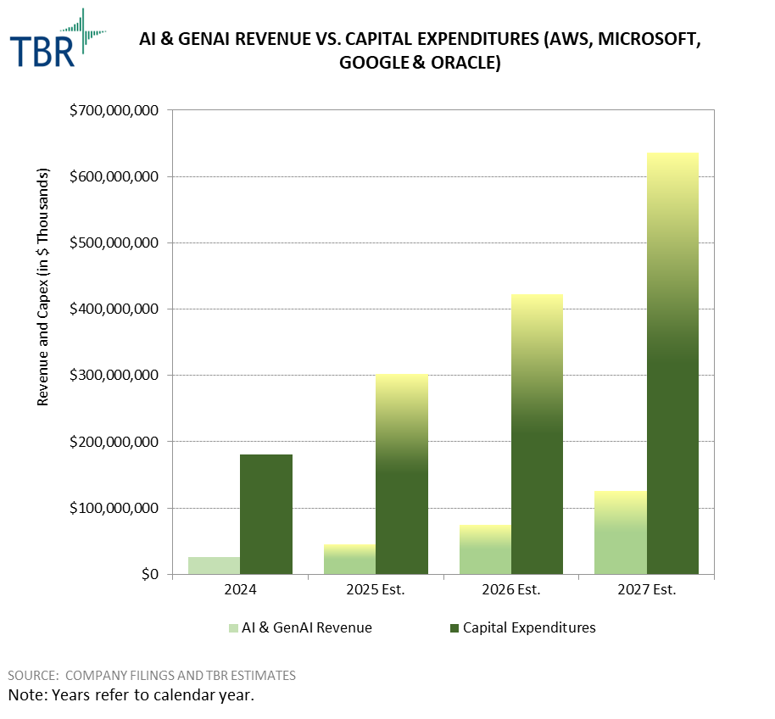
AI revenue recognized by the hyperscalers has been growing at a blistering rate (TBR estimates it will increase 73% year-to-year in 2025), and backlog commentary suggests the current elevated growth trajectory will continue over the coming years. Today, an oversized share of this AI revenue is driven by AI model developers, such as OpenAI and Anthropic, securing massive amounts of infrastructure capacity for current and future training workloads, adding concentration risk to hyperscalers’ backlog. Although financing appears to be secured at this point, the scale of the investments relative to the model developers’ current revenue base compounds the inherent concentration risk and suggests AI usage will scale dramatically over the next several years. Any downward change in sentiment or market volatility could have oversized impacts, pushing recognized revenue to deviate from current backlog projections.


Ultimately, diversifying AI revenue streams will be a major strategic objective for the hyperscalers, pushing them to penetrate deeper into the enterprise inference market. According to TBR’s recent cloud customer survey, over 77% of enterprise respondents reported that AI exceeded their value expectations, suggesting that early experimentation is yielding positive business outcomes. Hyperscalers’ top strategic objectives are to take advantage of this momentum, work with partners to unlock new use cases and continue to build new infrastructure.


If you believe you have access to the full research via your employer’s enterprise license or would like to learn how to access the full research, click the Access Research button.

Access Research


As enterprises begin to pursue on-premises and hybrid AI, OEMs deepen roles in advisory, deployment and industry solutions built on NVIDIA AI Enterprise

AI Infrastructure Services Opportunity
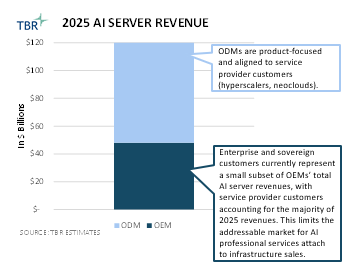
OEMs’ opportunity to participate in agentic AI solutions is closely tied to the slowly but steadily growing segment of enterprises and sovereigns seeking on-premises AI capabilities. This customer group is more likely to invest in a broader range of services from OEMs, including AI advisory and life cycle services, which primarily focus on NVIDIA AI Enterprise and its NVIDIA Blueprints.
 
TBR expects OEM services engagements centered around AI will be built as extensions of areas where the vendors already have strengths in solution building. These vary to some degree by OEM but largely center on manufacturing, retail, healthcare and financial services. In some cases, such as AI-based edge solutions, OEMs may be able to lead end-to-end engagements with their AI services portfolios. In other cases, OEMs will focus on delivering infrastructure-centric services in support of partnerships, with broader engagements led by systems integrators.
 
On-premises and hybrid AI adoption will remain in a ramp-up period in 2026. Even with NVIDIA Blueprints as a baseline, most end customers are unlikely to have the skills to deploy these AI solutions in-house. This will lead to services engagements to assist in solution deployment and further expansion of OEMs’ own AI libraries to create more plug-and-play AI solutions for industry use cases.

TBR estimates the potential annual AI-related opportunity for CSPs will reach $170B by 2030, approximately 53% of which is new revenue and 47% is cost efficiencies

CSPs have been largely sidelined from the new revenue opportunity presented by AI since the emergence of GenAI in 4Q22, but this is starting to change, evidenced by significant deals won by Lumen and Zayo to provide transport between data centers for AI workloads. There are also some green shoots of demand for hyperscalers to leverage CSPs’ network facilities (e.g., wire centers and central offices) and other real estate assets to colocate AI infrastructure closer to end users, as evidenced by efforts being made by Verizon and AT&T.
 
All CSPs that are investing in AI currently expect to reap cost efficiencies from the technology. The new revenue opportunity is more nuanced and is CSP- and market- specific in nature. APAC-based CSPs are likely to be the largest beneficiaries of new revenue from AI due to government protections, stimulus and cultural orientations toward early adoption of emerging technologies.

2Q24 Telecom Infrastructure Services Benchmark

TBR Spotlight Reports represent an excerpt of TBR’s full subscription research. Full reports and the complete data sets that underpin benchmarks, market forecasts and ecosystem reports are available as part of TBR’s subscription service. Click here to receive all new Spotlight Reports in your inbox.

Persistent TIS revenue contraction will cease in 2025 as growth catalysts emerge

While TIS revenue continued to shrink among the vast majority of benchmarked vendors, TIS operating margins continue to recover as the business mix becomes more favorable and India’s coverage builds wind down

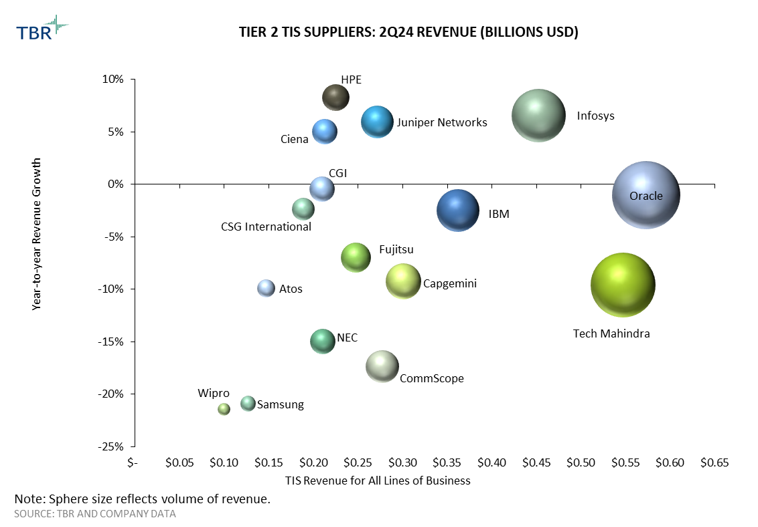
Aggregate telecom infrastructure services (TIS) revenue among benchmarked vendors declined 4.8% year-to-year in 2Q24, falling across all segments and regions. All but six vendors saw TIS revenue decline year-to-year in 2Q24. Several vendors, including Nokia, Ericsson, Samsung and Ciena, are seeing sharply lower revenue in India as 5G RAN rollouts by Reliance Jio and Bharti Airtel have gone post-peak. This will create difficult comparisons for vendors through at least 3Q24. Huawei and ZTE are also seeing their maintenance revenue in India evaporate as their installed bases of LTE and optical equipment is replaced by trusted vendors.
 
Simultaneously, vendors such as Cisco, CommScope, Fujitsu, NEC, Nokia and Samsung continued to be hampered by U.S. Tier 1 communication service providers (CSPs) significantly reducing or shifting their capex budgets following a peak in spend in 2022. Lower spend on 5G RAN deployments in China, which also peaked in 2022, is impacting a narrow set of vendors, including China Communications Services (CCS), Ericsson, Huawei, Nokia and ZTE, as new deployments in the country are focused on capacity enhancement, which is typically less intense from a TIS perspective.
 
The shift that is occurring as CSPs wind down their 5G coverage rollouts in the key countries of China, the U.S. and India and focus on densification is helping drive operating margin growth. Declining deployment activity, which tends to carry the lowest margins among TIS segments, in these markets — especially India — is helping to improve operating margin.
 
In 2Q24 deployment services constituted 17.7% of aggregate revenue, down 110 basis points year-to-year. Benchmarked vendors’ aggregate TIS operating margin increased year-to-year for the third consecutive quarter, following six consecutive quarters of declines. Aggregate operating margin grew from 10.8% in 2Q23 to 11.6% in 2Q24.
 
TBR attributes the increase in large part to a favorable revenue mix, with maintenance services growing to 34.1% of aggregate revenue, up 100 basis points year-to-year. The 5G gear vendors have built out in the aforementioned countries over the past few years is leading to follow-on support revenue.

With CSP 5G spend post-peak in India, the U.S. and China, RAN-centric vendors universally saw their TIS revenue decline in 2Q24


Graph: Tier 2 Telecom Infrastructure Services 2Q24 Revenue (Source: TBR)

Tier 2 Telecom Infrastructure Services 2Q24 Revenue (Source: TBR)


2Q24 Total Benchmarked Revenue for IaaS and PaaS (Source: TBR)India-based IT services firms Tata Consultancy Services (TCS) (a Tier 1 supplier in 2Q24), Infosys, Tech Mahindra and Wipro are winning deals from CSPs to support their evolutions to digital service providers. These vendors are helping customers migrate network and IT applications to the cloud and implement new business models. These firms have recently been hampered in part by lower application integration spend as CSPs in key markets such as the U.S. and Europe adopted a cautious cash flow management posture and paused some digital transformation activity.
 
Like Tier 1 vendor Amdocs, Tier 2 vendor CSG is a SaaS-centric, primarily BSS-focused, company offering revenue management and digital monetization products in a scalable managed services model. CSG has expanded account share among key clients in the U.S. over the last several years — namely, cable operators Charter and Comcast — and abroad, particularly in APAC and with an unnamed client in CALA, where CSG is ramping up a relatively large BSS contract. CSG’s TIS revenue declined in 2Q24 due to lower revenue from an unnamed global telco in Europe.
 
Samsung has executed on significant 5G work for CSPs that are based primarily in the U.S., India, South Korea and Japan. Samsung’s TIS revenue declined year-to-year in 2Q24 due to slowing spend at Verizon, which is Samsung’s largest customer by revenue, as well as in India, where Samsung participated in 5G RAN rollouts for Bharti Airtel and Reliance Jio, though at lower levels than Ericsson and Nokia.
 
Like RAN vendors in India, Ciena’s TIS revenue in the country declined significantly as 5G-adjacent projects wound down. Ciena offset this decline with strong software-related services revenue growth in developed countries.
 

If you believe you have access to the full research via your employer’s enterprise license or would like to learn how to access the full research, click the Access Research button.

Access Research


Vendor SL&C revenues largely declined as large-scale 5G and greenfield rollouts wound down and new network business models and arrangements proliferated

Site location and construction (SL&C) work is often subcontracted to local vendors (such as CCS) with better access to resources in a given area. The SL&C market is in decline as temporary gains driven by 5G deployments in China and the U.S. as well as some greenfield deployments have concluded.
 
Pockets of growth include fiber rollouts for broadband access, backhaul and/or fronthaul, and the deployment of small cells. However, the relative volume of spend on these tasks is significantly lower than that for traditional SL&C for macro cell sites.
 
TBR has a negative long-term outlook for the SL&C market as CSPs shift their focus to adding incremental capacity to their existing macro sites, partially offset by growing CSP investment in small cell sites. This densification primarily consists of software upgrades and/or requires adding new radios to existing sites. CSP consolidation also weighs on the SL&C market.
 
New network architectures and business models, including network-sharing arrangements, neutral host providers, satellites to provide coverage for rural and/or remote locations, and third-party infrastructure owners such as tower companies increasingly owning cell sites and promoting the colocation of operator equipment, also reduce the need for net-new sites.

North America TIS revenue continued to decline in 2Q24, but at an improving rate as growth catalysts begin to emerge, including in Canada, where recent M&A and vRAN investments are driving growth

Benchmarked vendors logged a 1.4% year-to-year decrease in aggregate TIS revenue growth in North America in 2Q24, a dramatic improvement from an 8% decline in 1Q24 as year-to-year comparisons turned more favorable and Ericsson began to receive meaningful revenue from its Cloud RAN rollout for AT&T.
 
Still, revenues declined due to numerous factors, including Verizon’s and AT&T’s C-Band rollouts being post-peak as well as T-Mobile’s build-out of its 2.5GHz spectrum being post-peak. In addition, CSPs are awaiting government funding before expanding their fiber footprints, and DISH drastically reduced spending in 2H23 and 1H24 after it reached a key coverage milestone in June 2023 and it neared bankruptcy before receiving new funding in 2H24.
 
TIS spend in the region is positioned to grow in 2025 as comparisons become more favorable and CSPs focus on building out fiber access, including by leveraging the BEAD Program, through which CSPs will receive federal funds that are currently being disbursed to states to bring broadband to the unserved and underserved.
 
The BEAD Program has seen numerous delays and will likely run through the mid-2030s, later than the original 2028 time frame. The program will benefit a somewhat different slate of vendors compared to the midband 5G build-out, as fiber will be the primary technology deployed. Nokia will be one of the biggest beneficiaries due to its embrace of Build in America requirements. Ciena will also benefit, due in part to its 4Q22 acquisitions of Benu Networks and Tibit. Meanwhile, Ericsson and Samsung will have no role in BEAD-related fiber deployments, though they could participate in fixed wireless access (FWA) build-outs.
 
5G development continues in Canada through measures including builds in the 3.5GHz spectrum band, BCE’s capital investment acceleration program, Telus’ vRAN build leveraging HPE and Samsung, and the replacement of equipment from China-based vendors. Tier 2 operators in Canada are also advancing their 5G strategies.
 
Canada CSPs are focused on deploying fiber across their footprints and will expand 5G services to new spectrum bands, including the 3.8GHz band, which Bell Canada began deploying in 1H24. Rogers’ acquisition of Shaw Communications is also driving spend due to investment commitments made by the merged entity and Videotron, which acquired a piece of Shaw.

Spotlight: 2Q24 Cloud Infrastructure & Platforms Benchmark

TBR Spotlight Reports represent an excerpt of TBR’s full subscription research. Full reports and the complete data sets that underpin benchmarks, market forecasts and ecosystem reports are available as part of TBR’s subscription service. Click here to receive all new Spotlight Reports in your inbox.

Acquiring to fill portfolio gaps and deliver complete end-to-end solutions at any layer of the PaaS stack is a top strategy for IT’s biggest players

Enterprise migrations and large-scale M&A are influencing the IaaS & PaaS market, as is GenAI, but disillusionment is coming and may cause customers to re-evaluate their IT priorities


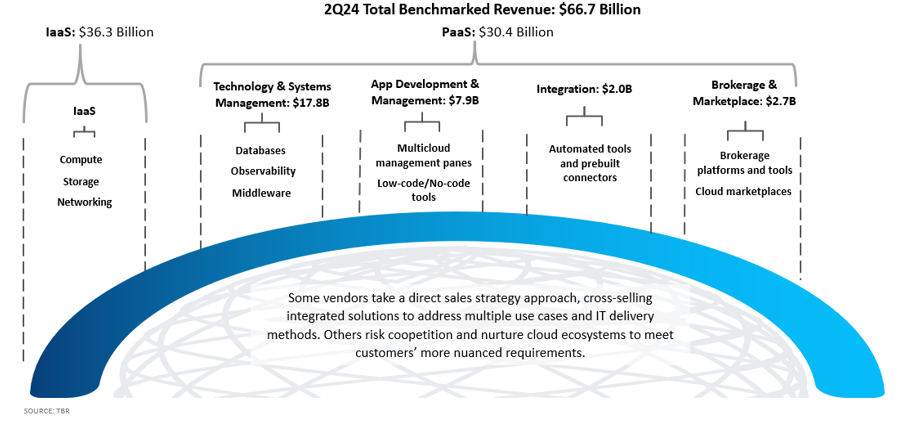
Graph: 2Q24 Total Benchmarked Revenue for IaaS and PaaS (Source: TBR)

2Q24 Total Benchmarked Revenue for IaaS and PaaS (Source: TBR)


IaaS Market

Among benchmarked IaaS vendors, average revenue growth increased 21% year-to-year in 2Q24, marking the fourth consecutive quarter of acceleration. There are two primary factors at play: enterprise IT modernization activity, which is much stronger now than it was this time last year, and generative AI (GenAI). Top hyperscalers Amazon Web Services (AWS) and Microsoft are capturing legacy Oracle and SAP workloads as customers continue to migrate to the cloud to not only outsource their IT operations but also drive lasting business value.
 
Though the geopolitical outlook is increasingly uncertain, we expect customers will continue to prioritize more traditional “lift and shift” migrations, and steps vendors are taking to deliver more integrated solutions could help. For instance, by the end of 2024, Oracle’s database services will officially be available on AWS, Microsoft Azure and Google Cloud Platform (GCP), which could be a big growth tailwind for these vendors. For context, converting Oracle’s remaining database support install base to the cloud represents a roughly $18 billion incremental revenue opportunity for these hyperscalers, including Oracle itself.
 
Regarding GenAI, investments in AI compute and new data centers are translating into top-line growth. Most vendors report they have multibillion-dollar AI and GenAI businesses, though this is minuscule compared to the tens of billions of dollars these vendors are investing. Vendor capex guidance for 2025 suggests that the level of investment will only increase, although we do expect this is when GenAI fatigue will hit and many customers may begin to re-evaluate their IT priorities.

PaaS Market

The PaaS market is similarly growing behind GenAI adoption, as many customers who still have a fear-of-missing-out mentality are spinning up new workloads natively in the cloud with services like Amazon Bedrock, Microsoft Azure OpenAI and Google Vertex AI. The PaaS market will similarly be impacted by GenAI disillusionment, but we believe this trend will also cause customers to focus more on the data layer, prompting them to take a second look at strategies around governance, data quality and integration for long-term AI success.
 
Another key trend driving PaaS market growth is M&A. IT leaders are acquiring to enter new markets and access IP they can ultimately sell as part of an entire end-to-end suite of offerings, as customers continue to crave more simplified, integrated solutions. By far the best example is Cisco’s acquisition of Splunk, which added $960 million to Cisco’s top line in 2Q24 and is quickly making Cisco a rising force in PaaS with its observability portfolio. IBM’s proposed acquisition of HashiCorp, which is expected to close by the end of 2024, would be another transformative deal that would put IBM squarely into the Terraform space and deliver synergies with Red Hat that will be attractive to unsatisfied VMware customers.
 

If you believe you have access to the full research via your employer’s enterprise license or would like to learn how to access the full research, click the Access Research button.

Access Research


Though often regarded as less secure, public cloud environments offer an array of automated tools, giving customers the opportunity to better secure their assets than they can on premises

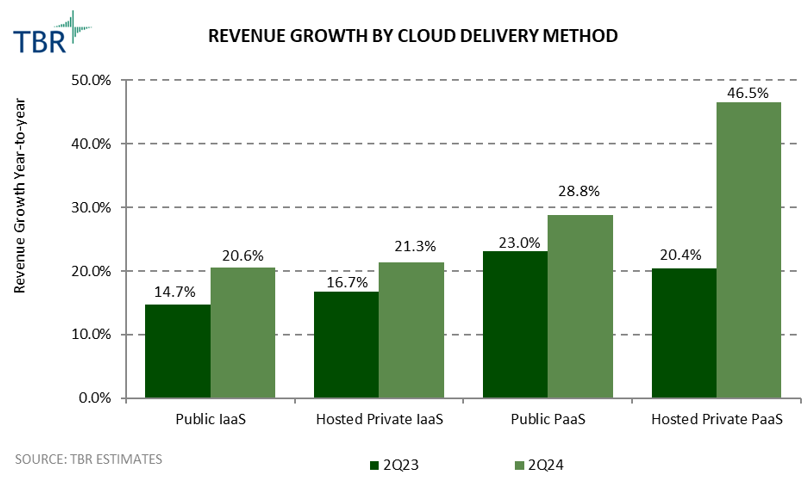
Public IaaS: As the cloud market matures, customers are becoming more comfortable with moving to public cloud infrastructure. Security remains a leading barrier to migration; however, many customers recognize that the public cloud offers the opportunity to better secure their infrastructure and data, due to automation and emerging capabilities such as Infrastructure as Code.
 
Public PaaS: Organically, public PaaS remains the fastest-growing segment as public cloud IaaS capabilities improve and vendors tailor their services to developers.
 
Hosted Private IaaS: Private IaaS growth is supported by enterprises’ rising acceptance of hybrid-enabling solutions such as AWS Outposts and Azure Stack, although some customers still consider these solutions immature. Customers continue to demand solutions that address data sovereignty, governance and compliance use cases.
 
Hosted Private PaaS: Single-tenant PaaS is a popular option for customers looking for more customization yet a greater degree of scalability over their on-premises environment. Many enterprises use dedicated clouds as an intermediary step to the public cloud, and as such, segment growth could start to slow. The acceleration in PaaS revenue for 2Q24 is largely influenced by Splunk, which can run in a customer’s environment as both a private and public cloud.
 

Graph: Revenue Growth by Cloud Delivery Method, 2Q24 (Source: TBR)

Revenue Growth by Cloud Delivery Method, 2Q24 (Source: TBR)

IaaS revenue growth rates will not return to what they once were, while PaaS tells a different story as acquisitions and the modernization of critical workloads fuel growth

AWS retains the majority of mindshare in legacy infrastructure workloads, but Azure and GCP continue to be competitive on net-new AI workloads in the cloud

AWS makes up the majority of IaaS vendor revenue, at an estimated 58% in 2Q24, but this is down over 1,200 basis points from the year-ago quarter.  For many legacy customers looking to rehost and/or replatform applications, AWS continues to be top of mind due to its establishment, infrastructure availability and breadth of developer-friendly services. But when it comes to net-new workloads already in the cloud, Microsoft and increasingly Google Cloud, will be competitive.
 
Though SAP and IBM still offer either dedicated or multitenant IaaS to their customers (see TBR’s Cloud Components Benchmark for IBM’s on-premises cloud infrastructure business), the Big Three, and increasingly Oracle, are consolidating the market. Alibaba’s sluggish growth in the China market caused the company to cede the No. 3 position to Google Cloud. While Alibaba’s growth is rebounding, we do not expect the company to take back the position it once held. At the rate Oracle’s OCI is growing, it will not be long before Alibaba gives up share to Oracle in the IaaS market as well.