 Technology Business Research, Inc.
TCS vs. HCLTech Showdown: AI-driven Disruption

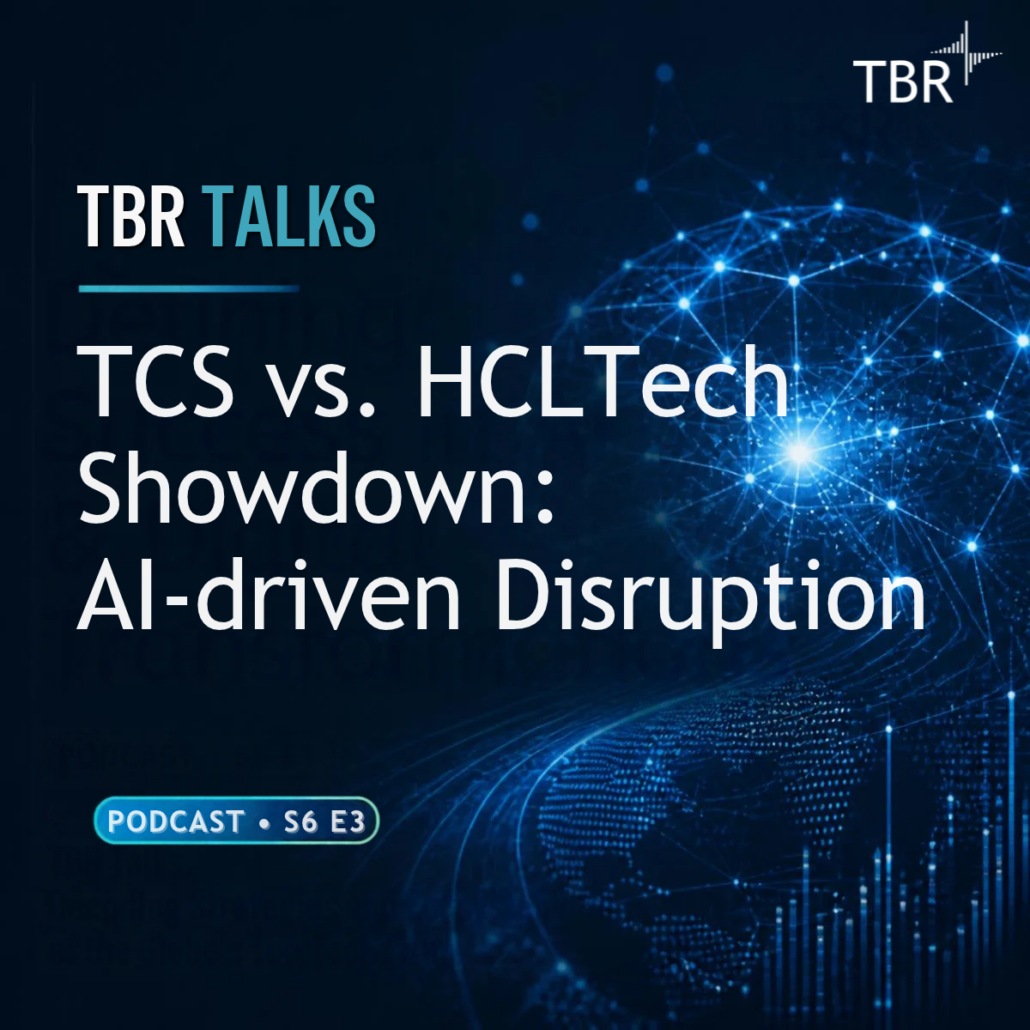
In this week’s episode of “TBR Talks: Decoding Strategies and Ecosystems of the Globe’s Top Tech Firms,” senior analysts Kevin Collupy and Kelly Lesiczka join host Patrick Heffernan to debate India-centric IT services vendors Tata Consultancy Services (TCS) versus HCLTech. This discussion is part of TBR’s Vendor Showdown Series, where TBR analysts assume the role of head of strategy for one of the companies they cover and use TBR research and data to build a competitive intelligence case for that company’s position in the market.
“For India-centric vendors, it doesn’t, to me, make a ton of sense to overcommit to outcome-based. Being an efficient, fast follower, as I mentioned, is what got them to this scale, got them to this success. You know, fixed-price, SLA-based contracts are really going to benefit from AI and automation, and that’s going to help buffer those margins, help that profitability to reinvest it into what clients are demanding from AI. So, to me, that’s the best approach, that mixed commercial model,” said TBR Senior Kevin Collupy.
Episode highlights:
- Differences in AI investments and strategies for TCS and HCLTech
- Weaknesses observed within each company
- 2027 predictions for TCS and HCLTech
This episode is now available on demand across all major streaming platforms. Listen and learn today!
TCS vs. HCLTech Showdown: AI-driven Disruption
TBR Talks Host Patrick Heffernan: Welcome to TBR Talks: Decoding Strategies and Ecosystems of the Globe’s Top Tech Firms. Where we talk business model disruption in the broad technology ecosystem from management consultancies to systems integrators, hyperscalers to independent software vendors, telecom operators to network and infrastructure vendors, and chip manufacturers to value-added resellers. We’ll be answering some of the key intelligence questions we’ve heard from executives and business unit leaders among the leading professional IT services and telecom vendors.
I’m Patrick Heffernan, Principal Analyst, and today we’ve got an episode of TBR’s Vendor Showdown Series, where we take our newest AI research portfolio and apply it through the lens of competitive intelligence. Today we’ll be looking at TCS versus HCLTech with Kevin Collupy and Kelly Lesiczka, both Senior Analysts for TBR’s Professional Services Practice.
How the Showdown works
All right, welcome to the TBR Showdown Series, as we’re calling it, where we gather a couple of analysts to talk about two companies that they report on, that they cover, and put them head-to-head and say, what’s their strategy now? What are some weaknesses they see in the other company? And where do they see them going in 2027? So, this will be three rounds. First round, each of the analysts will take on the persona of the head of strategy for the company that they cover, and they’ll make the case to the board of why the strategy is working, why the strategy is the right place for them to be, how they’re leading the market and why. Round two will be an opportunity to talk about weaknesses, either in their own company and how they’re overcoming them, a little sort of jujitsu, hey, I’m not as weak as I look kind of thing, or straight up attack the other company and say this is where they’re weak. And then the last round, it’ll be a prediction for 2027. At the end of which I will then declare a winner. So today we have Kevin Collupy and Kelly Lesiczka. Kevin is going to be arguing on behalf of TCS, Kelly, on behalf of HCLTech. And you know what, Kevin, since you’ve been dreading this more than anybody else, we’re going to let you go first.
Kevin Collupy, TBR Senior Analyst: Yeah, absolutely.
Round 1: Making the case for TCS and for HCLTech
Patrick: So round one. Take it away, Kevin.
Kevin: So why TCS stands out, their strengths, why they have the advantage. Three things immediately come to mind. It’s been true for over a decade. They’ve got scale. They’ve got excellent resource management. They’ve got great financial resilience/profitability. The scale, $30 billion company, really only second in the entire professional services market, IT services market to Accenture, neck and neck with NTT Data. Longstanding client relationships. They’re one of the few that’s still capturing those mega deals out there, those billion dollar plus deals. They’re truly enterprise ready and they run at a severe discount to those global players such as the Big Four.
You know, as far as resource management, longstanding strength of management, workforce has steadily been around that 600,000 figure. It will jump up 10,000, it will jump down 10,000 here and there, but it’s been hovering for about two years pretty consistently at 600,000. However, with that scale, their attrition remains on par and below a lot of the global GSIs, but on par with the India-Centric peers, low teens, which is pretty impressive being two to three times the size of a lot of the other India-Centric peers. And from an AI Disruption Index and TBR’s HIRI, Human Intensity Reduction Index, that’s key to improving skills. That productivity at that massive scale, it’s not about simply reducing headcount. TCS has really been doing well lately. Last fiscal year, they reported close to 70 million learning hours across their workforce, 5 million competencies gained. In the latest quarter, they noted that over 300,000 of its workforce have been, how did they word it, been trained in a higher proficiency of AI and ML. So, whatever that may mean, but it draws the attention to the resource management that they know it’s important. They’re putting the effort in on their staff and they are training.
And lastly is the financial resilience. They’ve stabilized their revenues. They had a bit of a choppy few quarters post that COVID boom, but they’ve really kind of found their way. They’re at the low single digit margin, low single digit year to year growth in terms of revenue. However, their margins, they’re pretty incredible to think it’s a 600,000 person organization based in India selling IT services and they’re operating at 25% operating margin. And management’s even said they have aspirational goals to be between 26% and 28%, which is pretty crazy. And that margin strength, it gives room for TCS to invest in that next wave from the internet to the cloud, now it looks like AI is going to be that next big thing and they’re getting ahead of it and they’re investing heavily. And that financial resilience and stability gives them that ability. And just last year now, TCS I want to say last October announced, how did they word it? They want to become the world’s largest AI-led technology services company. So, they’re kind of drawing the line in the sand, and they’re not necessarily being a fast follower in this case, which they’ve done so well in the past. They’re trying to be a leader. So that’s, yeah, that’s kind of my case, that financial capacity, labor force, scale, discipline, client access. It’s hard to replicate.
Patrick: And that last point on how they’re positioning themselves as an AI leader is what sort of puts them high up in our, in TBR’s AI Disruption Index when it comes to the y-axis of that little compass chart that we have.
Kevin: Yes.
Patrick: So, all right, that’s the case for TCS. Kelly, HCLTech.
Kelly Lesiczka, TBR Senior Analyst: Yeah, sure. It’s hard to follow, Kevin, your intimidating statistics there, but we’ll start. I’ll do the best I can. So, HCL has kind of shifted their go-to-market strategy similar to all the other companies following the surge in AI, how it’s impacting their clients and what they need to do moving forward. HCL’s partner ecosystem has been a vital part of their strategy for a long time now. It’s really grown and evolved beyond just their core, but they are closely aligning themselves with AWS, Google, and Microsoft. Google Cloud has been a long-term close partner for HCL, but it’s now further strengthened by the launch of its Gemini business unit, which they launched in April. It’s helping them to enhance their AI technology offerings, as well as focus more on some of those industry-oriented offerings within manufacturing, retail, and technology. Technology services has been a growing vertical for HCL over the past few years. And so, I think this close alignment is helping them to penetrate more around those targeted solutions, focusing on more specific needs and workflows. HCL’s primary goal is to become an AI orchestrator, at least for now, not prioritizing or favoring any platforms, but really focusing on the client needs. That’s always been a strength of the company is to really align themselves with their clients and give them what they need, even if it doesn’t necessarily align with the company’s portfolio, but to do- not giving them services that they shouldn’t have, but just making sure that they can meet the client where they are.
One more notable investment that I’ve found is around HCL’s data center investment. And it’s a strategic move for HCL. It’s really pushing them to work better with the local clients in India, particularly government and other regulated industries. Competition in the region is really ramping up both from IT services vendors as well as from now the consultancies are really making a stronger push there. And I think the way that HCL is approaching it is really strong for two main reasons. And the first one is just the capabilities that it’s providing. They’re getting the compute capacity as well as increasing their ability to deliver engineering software and managed services in the region. The investment centers on training AI and SLMs to help their clients create their own internal AI stacks, so going back to that orchestration role. And HCL’s approach is focused on more of a tiered approach, so looking at the smaller models that are more specific to problems or workflows within enterprises and then distributing different tasks to different models depending on what the needs are. So, it’s not just using one platform for all of it, but making sure that the workloads are better distributed.
The second reason that is pretty strong is around the financial strategy and the way that it’s supporting this, it’s not just putting forth all of that investment itself. It’s working with partners looking for different funding. And for example, HCL’s working with Sarvam to build out that physical infrastructure and it’s including a technology center as well as an AI data center in the region- so, in India. The additional resources are really helping to enhance HCL’s position as that orchestrator and provider. And it just I think it gives them a leg up, whereas they already are well known in India, it helps to ward off some of the competitive pressures there.
The last main strength that I wanted to call out for HCL is definitely their engineering and R&D. A lot of its competitors, both within India-centric vendors, as well as just some of the IT services have been investing in engineering services over the past few years, but it’s an advantage that HCL has already had in terms of building out those proprietary platforms, which it now has AI Force, and it’s creating more of the industry solutions based within this platform, so for example, their Agent Store. And so, it’s long-term investment and just experience around engineering is really helping it to I think get better grounding around AI as it can now do some of the more AI design and deployment tasks that it couldn’t, or it has an advantage doing it more quickly than it peers.
Patrick: Excellent. So, end of round one, what I’m hearing is TCS big and profitable. That’s basically what they are.
Kevin: Yep.
Patrick: And HCLTech is all about ecosystem orchestration and engineering. One thing I want to point out for people from TCS, among those 70 million learning hours, some of them could be listening to TBR Talks podcast. That could count.
Round 2: Looking at weaknesses
So round two. Now it’s an opportunity to either tell us why the other company has some weaknesses they won’t be able to address or talk about some other weakness either in your company that you’re covering or the market that’s forcing all companies to address some kind of challenge or weakness. So, we’ll flip it around now. Kelly, you get to go first. Take it away.
Kelly: Thank you. So, a weakness, I’m not going to attack TCS, I’ll focus on HCL. But for HCL, I think a challenge that they’ve had is around visibility outside of their existing clients as well as traditional services. HCL has executed on a large marketing effort program a few years ago. They’ve also been working with MetLife Stadium to help grow the brand recognition outside India and just around. I think to more modernize the brand, showing off some of the digital and experience capabilities that they have. There is still some limited recognition of HCL’s full digital and AI portfolio, especially outside of these established places, which can, I think it can slow them down in some spots. Even as HCL is seeking to evolve its portfolio to better align with AI needs, including adding different talent, its market perception as an AI orchestrator could use some more investment there. I think growing in the talent, using some of those partners, but again, you don’t want to rely too heavily on partners. But I think just kind of focusing on building their brand and recognition to show the full scope of their portfolio. Looking at the HCL software, I think sometimes it’s kind of forgotten in a sense, but it’s a strength that they have. It might just need a little bit more of a push.
Patrick: So would you say sort of thinking about like if they have a credible differentiation around, I hate that word but still, around AI, they have not yet monetized that they’re credible, what they’re doing in AI, they haven’t fully monetized in part because they just haven’t had the marketing behind their brand, right.
Kelly: Yeah, I would say so. I think they’re kind of shifting there. I think that the MetLife Stadium project is a good example, and it’s showing what they’re able to do, not just behind the scenes, but also the user interface and how people are interacting with it.
Patrick: Okay, Kevin, what do you got?
Kevin: Absolutely. So, kind of take the consulting approach here. I’m going to both try and tear down HCL and pick up TCS. We’ll see how it goes.
Patrick: We’ll see how long I let you do that, but let’s go.
Kevin: So, HCLTech, in my opinion, I think it’s got to be careful balancing its ambitions with the actual real-world economics. HCLTech, as Kelly had mentioned, definite strengths in engineering and proprietary AI and IP. But the challenge is its lower margin base and the need for simultaneous investments in a moving market that are necessary to keep up in AI. It could be a challenge. And to me, it’s noticeably among the India-Centric peers been focusing a greater amount on that outcome-based pricing that we hear so much about, and that creates a lot of risk. You know, it passes the risk from the client back to the service provider.
So alternatively, from TCS’s point of view, they’re happy with fixed price, fixed capacity, time and materials, transaction pricing, you know, for a majority of their contracts. It’s what’s gotten them to this point.
Patrick: True.
Kevin: And selectively, they do offer outcome, how do they term it, they term it as output-based commitments. You know, when TCS has enough visibility or pricing control to give it a proper risk management to that contract. For India-centric vendors, it doesn’t, to me, make a ton of sense to overcommit to outcome-based. Being an efficient, fast follower, as I mentioned, is what got them to this scale, got them to this success. You know, fixed price, SLA-based contracts are really going to benefit from AI and automation, and that’s going to help buffer those margins, help that profitability to reinvest it into what clients are demanding from AI. So, to me, that’s the best approach, that mixed commercial model. And I think TCS is doing it well. And I have pause right now on HCLTech’s strategy.
Patrick: Fair enough. Okay. And that wraps up round two.
Round 3: Predictions for TCS and HCLTech in 2027
So, round three. Let’s hear some predictions about what you- now, you can just be a TBR analyst. You don’t need to be the head of strategy. Take that hat off. So, you’re the TBR analyst looking ahead at these two companies. And what- sort of, the prediction can be anything from sort of basically, are they going to grow as fast? And what do you expect is going to change? Or what’s some kind of big bet that they might be making in 2027? So, Kevin, you get to go first again.
Kevin: Perfect. Yeah. So TCS in 2027. It’s going to look a lot like TCS in 2027.
Patrick: *laughs*
Kevin: And that’s a good thing. I think from the internal workings, they’re going to be, or hopefully be, less labor linear. That’s the biggest key for TCS to keep pace in that the next wave of what IT services, professional services is bringing. I don’t expect a major headcount collapse. I do expect slow, low mid-single digits revenue growth year to year. I expect more output from its existing labor force. You know, really the goal is revenue growth without that proportional headcount growth. That’s going to be the kind of the golden goose. And automation absorbs more of the coding, testing, monitoring, process work, while the employee skills are going to have to shift a little bit, which TCS has been trying to get ahead of, you know, towards engineering, orchestration, governance, you know, domain expertise, you know, more AI will be embedded into its internal IP, such as in WisdomNext, in BaNCS, in Cognix, all TCS products. You know, as Kelly had mentioned, HCLTech has been investing in infrastructure. Same with TCS. In the last year, maybe 18 months, announced TCS HyperVault, you know, AI-enabled data centers. And that helps expand, you know, TCS’s breadth. It’s not going to be, you know, a main profit driver, a main growth driver, but it’s just that ongoing necessary expansion that TCS is going to have to take, you know, to remain where they are.
And as far as the four models, kind of the way we look at in our AIDI disruption reports, from operating commercial delivery and partner models, the operating model is still people heavy, but increasingly human AI and skill centric. The commercial model, definitely going to still be times and material, fixed price, SLA, with a little bit of that outcome-based pricing where it makes sense from an economic point of view. Delivery model using Agentic, using standardized and repeatable solutions and platform-led delivery. Partner model, maybe a shift away from just the focus on the hyperscalers, now moving to the AI models, to silicon, to the software providers, to infrastructure, TCS can really play that sweet- the sweet spot for them is that AI-enabled technology orchestrator and at a discount to the Big Four, to the GSIs, to Accenture, but still with a high quality and know-how. The main risk is, you know, AI revenue could be project-based, could be shorter, could be lumpier. So, the key for TCS will really be converting those projects to that managed services. Really, that’s the happy place for TCS, that ongoing revenue stream. And that’s my thoughts.
Patrick: Take away that word discount and weirdly, I think you just described TCS as the Bain.
Kevin: Ha, yeah.
Patrick: Bain, B-A-I-N, the Bain Consulting of the IT services world. Never would have put those two together.
Kevin: Yeah. Discount, value.
Patrick: Take away the discount, talk about quality, talk about staying the same, just executing on what they do well. All right, Kelly, prediction for HCLTech for 2027.
Kelly: Yeah, sure. I think HCL, not to copy Kevin at all, but I don’t think we’ll see too many significant changes. I think at the core they’ll still be doing what they’re currently doing. I think they have a lot of investments in place that they need to kind of pan out, like the data center investment, for example. I think HCL Software is a good opportunity for them that they can leverage. There’s been more innovation within the practice, you could say, over the past few years, and I think that’ll help them, especially as they’re coming out with the Agent Store, for example, those industry solutions, I think they’ll see more. I think that’s a good avenue for them to go down and to really push. While its delivery model, HCL’s delivery model, has not really caught up to the shift in portfolio to account for all these new offerings and all, HCL does pay close attention to its talent profiles to help it better, I think deliver better on projects, especially as now they’re looking to pursue the AI-assisted delivery. Paying attention to those talent profiles helps. I liked, Kevin, your use of linear, oh what was it?
Kevin: Non-linear labor growth. Or revenue growth.
Patrick: Yeah, non-linear revenue growth.
Kevin: Yeah, so, you don’t have to sell more product and hire more bodies. That’s, you know, if you can disconnect those two, that’s going to be the key.
Patrick: Right.
Kelly: Yeah, HCL had a goal, I think it was last year, they had come out with a goal to increase revenue without increasing headcount. Currently, they’re not quite there yet, but I think the moves that they’re taking around AI could help them improve. And their HIRI, as Kevin had mentioned, has actually been above the India-Centric peer average. So, they’ve always been very good about not hiring ahead of demand and making sure that it’s not hiring too many people. And they have a good balance. And I think that’s partially what helps them stick close with its- keep its portfolio relevant while not stretching margins too tight.
The main note I think I wanted to call out for HCL was really it has been good at keeping its portfolio close with demand. I think I mentioned it a bit before. Their core capabilities always seem to be close to what client needs. A lot of their strengths in application services, IT optimization, data utilization, and engineering. And now it’s all- it all needs to be addressed as clients are looking into this AI project. So, they’ve just been good at keeping the core tight and relevant, I think is a good way to put it.
Determining the Showdown winner
Patrick: Excellent. All right. Thank you very much. So now we’ll wrap it up with the final decision. Who is the winner in this battle? And I have to say, so you guys know me well enough, there are certain things that just resonate with me, so, ecosystem, orchestration, engineering. Knowing that HCLTech’s HIRI, the Human Intensity Reduction Index, is actually in the not only market leading, but in the positive side, all of that is indicators to me of a company that is absolutely doing everything right. And orchestration and ecosystem and engineering is what so many companies, so many companies that are doing well are doing well, but also so many clients are looking for exactly that. Like that’s what we hear repeatedly across the entirety of everything we cover at TBR is that people are looking for those ecosystem plays. Engineering has become such a hot thing. And then orchestration is exactly where companies should be playing.
And then when Kevin brought up that HCLTech is pushing the envelope on outcomes-based pricing. I’m like, well, that takes it over the top. There’s no way I can’t pick HCLTech for the winner here until Kevin then explained how TCS has this idea of output-based commitments and is actually moving its commercial model towards that. And so, I think short term for maybe 2027, I would say HCLTech is definitely going to outpace TCS, but probably the rest of the India-Centric peers. But at the end of the day, you know, big and profitable is almost always going to win. And if big and profitable can actually shift its commercial model and embrace that outcomes-based pricing, even if they have to call it output-based commitments, it doesn’t matter. It’s still the way that the market is going. And I have to say long term, unquestionably, I think TCS is going to be the winner of this particular battle.
Kevin: Excellent.
Patrick: Are you happy with that decision?
Kelly: I’m content. I think it was the right decision.
Kevin: Yeah, I think it’s, as our favorite sports radio analysts would say, it’s kind of a scoreboard. If you’re in business, you need to make money and you need to be profitable and TCS does that well.
Final thoughts
Patrick: Fantastic. All right, thank you both so much.
Kelly: Thanks for having me.
Patrick: Next week, we’ll be taking a brief break from the Showdown Series when I’ll be speaking with Chris Antlitz about TBR’s upcoming coverage of Starlink.
Don’t forget to send us your key intelligence questions on business strategy, ecosystems, and management consulting through the form in the show notes below. Visit tbri.com to learn how we help tech companies, large and small, answer these questions with the research, data, and analysis that my guests bring to this conversation every week.
Once again, I’m your host, Patrick Heffernan, Principal Analyst at TBR. Thanks for joining us and see you next week.
 Technology Business Research, Inc.