

Convergence Takes Center Stage as U.S. Telecom Operators Pursue the Next Phase of Growth
The U.S. telecom market is entering a new phase in which convergence, broadband scale, and higher-value connectivity services such as AI infrastructure connectivity are becoming increasingly important competitive differentiators.
TBR’s latest U.S. Mobile and Broadband Operator Benchmark estimates U.S. operator connectivity revenue increased 0.7% year-to-year to $136.9 billion in 1Q26 as wireless service, equipment and broadband growth offset continued declines in legacy wireline and video services.
Revenue expansion slowed from 1.7% in 1Q25 as wireless service growth moderated and broadband competition intensified, increasing the importance of broadband scale, mobile-broadband cross-sell, and higher-value connectivity services as sources of incremental growth.
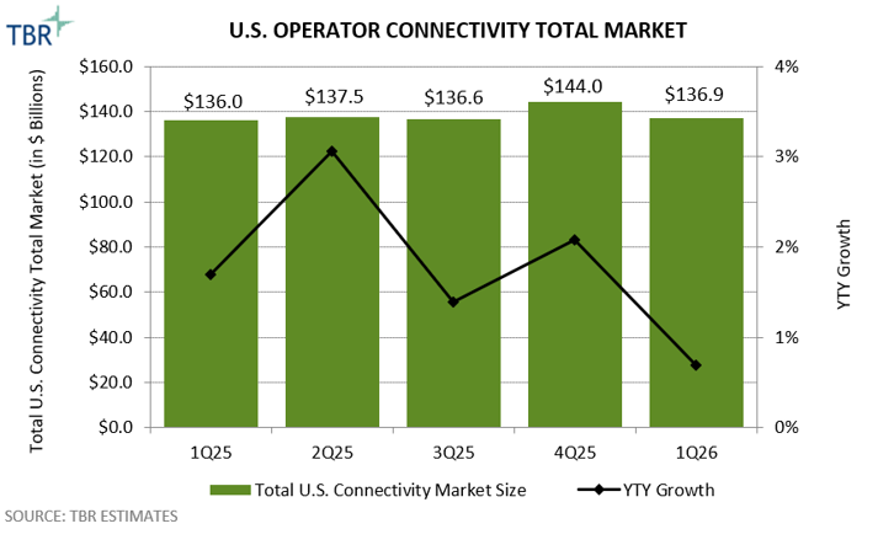
U.S. Operator Connectivity Total Market (Source: TBR Estimates)
M&A accelerates the convergence race
M&A is reshaping operator portfolios around converged connectivity and broader ownership of both wireless and broadband assets. Verizon’s Frontier acquisition and AT&T’s purchase of Lumen’s Mass Markets fiber business deepen their fiber portfolios, while T-Mobile’s fiber joint ventures involving Metronet and Lumos expand its reach beyond a primarily wireless and FWA model.
The pending Charter-Cox merger similarly increases cable scale across broadband and mobile. Collectively, these moves give operators greater control of both wireless and broadband infrastructure and position them to pursue integrated mobile-broadband strategies over the long term.
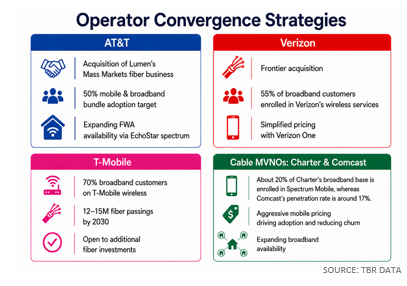
Operator Convergence Strategies (Source: TBR Data)
Fiber and FWA intensify the battle for broadband share
Broadband competition is increasingly shifting toward fiber and FWA as telcos expand coverage, and cable operators face continued subscriber pressure. FWA remains a key source of organic broadband growth, while fiber expansion and acquisitions are giving AT&T, Verizon and T-Mobile greater scale to compete for broadband households and support converged mobile-broadband strategies.
As fiber and FWA capture a larger share of broadband growth, Comcast and Charter are responding with aggressive mobile pricing to strengthen customer retention and defend their broadband subscriber bases.
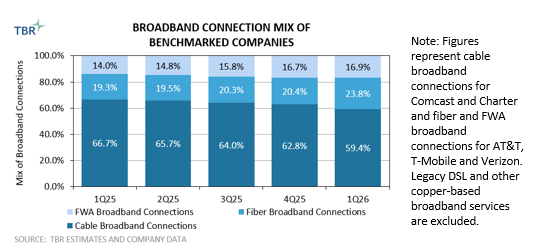
Broadband Connection Mix of Benchmarked Companies (Source: TBR Estimates and Company Data)
Wireline growth pivots toward next-generation connectivity
Wireline broadband revenue continues to expand for AT&T and Verizon as fiber connection growth more than offsets decreases in legacy broadband services such as DSL. T-Mobile is positioning for wireline broadband revenue growth through M&A and fiber expansion, broadening its presence beyond fixed wireless. In contrast, broadband revenue is declining at Comcast and Charter amid subscriber losses and intense competition from fiber and FWA. Other wireline connectivity revenue continues to decrease, driven by declines in mature services such as fixed voice, video and legacy data connectivity.
Over time, newer B2B solutions and advanced connectivity services will become increasingly important growth drivers. TBR sees AI infrastructure connectivity as one of the largest long-term wireline opportunities, driving demand for fiber, optical transport, data center interconnection, cloud on-ramps and edge computing. Cybersecurity, SD-WAN/SASE, managed networking and private cellular networks provide additional growth vectors.
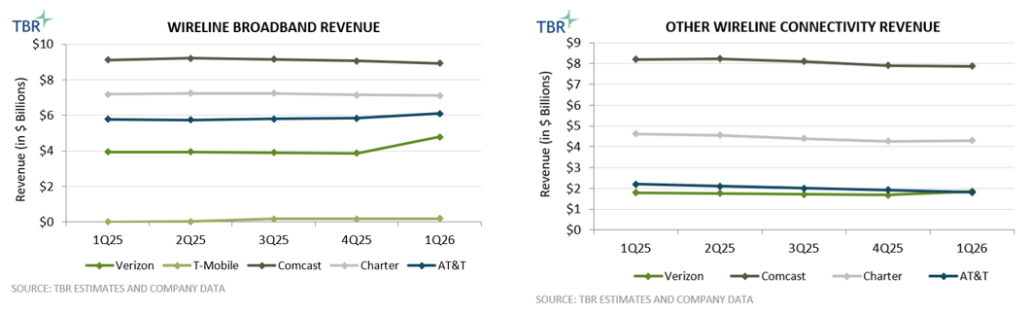
Wireline Broadband Revenue and Other Wireline Connectivity Revenue (Source: TBR Estimates and Company Data)
Conclusion
The next phase of U.S. telecom growth will increasingly depend on how effectively operators combine wireless and broadband assets to deepen customer relationships and capture new revenue opportunities. M&A and fiber expansion are accelerating this shift, giving AT&T, Verizon, and T-Mobile greater broadband scale while prompting Comcast and Charter to compete more aggressively through mobile.
As legacy wireline services decline, operators will also need to expand into higher-value connectivity segments, including AI infrastructure connectivity, advanced enterprise networking and managed services. Ultimately, broader connectivity portfolios will only create value if operators can translate them into higher mobile-broadband penetration, lower churn and sustainable revenue growth.