
2026 Predictions Series | Telecom
Telecom Industry Will Adapt to K-shaped Economy in 2026
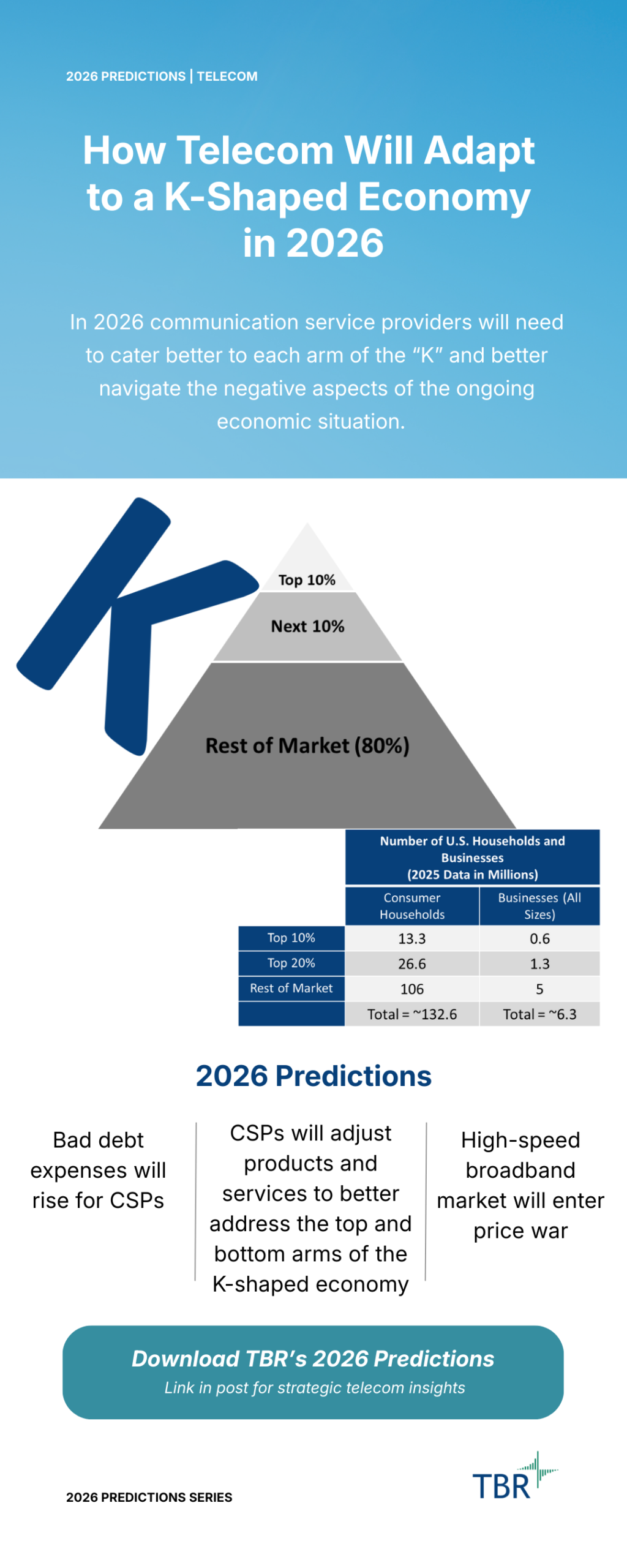
The K-shaped economy that emerged during the COVID-19 pandemic will likely become more pronounced through 2026, and the telecom industry will need to adapt to this new economic reality. Based on balance-sheet strength, earnings power, and real, inflation-adjusted wage growth and revenue increases, as well as a host of other economic KPIs, the top 10% to 20% of households and businesses are doing exceptionally well financially (on average) while the bottom 80% to 90% of households and businesses are doing worse financially (on average) compared to historical metrics. In 2026 communication service providers (CSPs) will need to cater better to each arm of the “K” and better navigate the negative aspects of this ongoing economic situation.
2026 Telecom Predictions
Prediction: Bad debt expenses will rise for CSPs
Trend: The majority of households and businesses (the lower arm of the “K”) are struggling financially and are having a harder time paying bills.
Driver: Economic trends accentuating winners and losers in what is commonly referred to as the K-shaped economy
Result: CSP bad-debt expenses will continue to rise, potentially meeting or exceeding levels witnessed during the Great Recession.
Prediction: CSPs will adjust products and services to better address the top and bottom arms of the K-shaped economy
Trend: CSPs offer more value-oriented and more premium devices and plans.
Driver: K-shaped economy pushes CSPs to adapt their offerings to cater to each arm of the “K” to stay competitive
Result: CSPs will try to grow ARPU with customers in the upper arm of the “K” and focus on scale and margin protection with those in the lower arm of the “K.”
Prediction: High-speed broadband market will enter price war
Trend: Customers increasingly gravitate toward price for value for high-speed broadband service.
Driver: K-shaped economy pushes CSP customers to re-evaluate what they pay and what they need for high-speed broadband
Result: Expect significantly higher demand for lower-cost high-speed broadband options, which will lead to increased switching activity

 Technology Business Research, Inc.