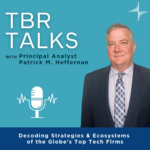
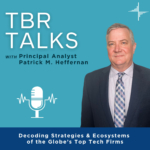
TBR Talks host Patrick Heffernan began his professional career in diplomacy, with Middle East postings as a foreign service officer with the State Department and counterterrorism assignments with the National Security Council and the U.S. Department of the Treasury. In this bonus episode of TBR Talks, Patrick gives his unique perspective on the impact of Saudi Arabia’s recent decision regarding PwC and on consulting and IT services firms. Patrick will also share insights into how Saudi Arabia may be changing the way in which it operates with global firms.
TBR Talks is produced by Technology Business Research, Inc.
Edited by Haley Demers
Music by Burty Sounds via Pixabay
Art by Amanda Hamilton Sy
TBR Talks Bonus Episode: Saudi Arabia & PwC: What does this mean for Advisory Services?
Saudia Arabia, IT services firms and consultancies: What’s next?
TBR Talks Host Patrick Heffernan: Hi, this is Patrick Heffernan from Technology Business Research with a special episode of the podcast because it’s not too often that my former career and my current career come together as much as they have just recently. If you looked on LinkedIn, you’ll know that I was with the federal government for 13 years, serving as a diplomat, including four years living in the Middle East. I also traveled to Saudi Arabia so many times people thought I actually lived there.
And then this past weekend, we got the news that the Saudi Public Investment Fund had essentially frozen out PwC for a year. And so, I got a lot of questions from both my colleagues here at TBR, but then also colleagues I’ve known for a long time, people who I’ve formerly worked with. And they were asking questions about what does this really mean?
And I think one of the mistakes that’s easy to make is to look at the story and think it’s about PwC, it really isn’t. This is a story about Saudi Arabia and the way I read this, again from my experience, having traveled extensively and having worked and lived in the Middle East, is that this is really an opportunity for the Saudi government to do two things.
One, they’re putting a shot across the bow of all the consultancies, all the others who have been looking to cash in on what seems like an endless flow of Saudi money. The Saudi government can’t simply disrupt everything and start canceling contracts willy nilly, but they can rein in some of that spending on foreign firms, in part by sending a signal that the days of free money, the days of that free cash flow all the time are really over. So essentially, they’re sending a warning to the companies that have been making a lot of money off of Saudi Arabia over the last couple of years.
The second thing is it sends a broader signal to the market and to the globe as a whole, and the investment community as a whole, about what’s happening in Saudi Arabia now around transparency and around accountability. Essentially, the Saudi government is saying we’re holding even these global accounting firms accountable. The good old days of the bazaar is over. We are now a highly functioning, highly modern economy. Now, you can take that all with a grain of salt. Although I am hearing from people in the investment community, in the insurance community, in the banking community, talking about the pressure they’re feeling to bring people to Saudi and to hire people in Saudi Arabia now, to be more local, to be more on the ground.
So clearly, there are a lot of messages that are coming from the Saudis right now. So, the bottom line for me, it’s really a mistake to read this as a simple Saudi Arabia and PwC thing. It really is a warning to all those consultancies and the IT services company that have been pouring investment money into the Middle East, into making bets on the growth of Saudi Arabia and the growth on others. And that warning is that you need to play by the local rules. And if you don’t know the local rules, just simply don’t play.
Final thoughts
So hopefully that’s a little bit of perspective based on all my experience in the Middle East and all my experience looking at big four firms from both a competitive and an ecosystem lens. If you have any questions, please feel free to reach out. Again, this is Patrick Heffernan with Technology Business Research. Thanks.
TBR Talks: Decoding Strategies and Ecosystems of the Globe’s Top Tech Firms
Join TBR Principal Analyst Patrick Heffernan weekly for conversations on disruptions in the broader technology ecosystem and answers to key intelligence questions TBR analysts hear from executives and business unit leaders among top IT professional services firms, IT vendors, and telecom vendors and operators.
“TBR Talks” is available on all major podcast platforms. Subscribe today!
https://tbri.com/wp-content/uploads/2025/03/tbr-talks-bonus-episode-saudi-arabia-pwc-what-does-this-mean-for-advisory-services-cover-scaled.jpg25602560TBRhttps://tbri.com/wp-content/uploads/2021/09/TBR-Insight-Center-Logo.pngTBR2025-03-07 16:20:542025-03-26 08:39:51Bonus Episode: Saudi Arabia & PwC: What does this mean for Advisory Services?
Astadia CEO Scott Silk joins Patrick for a discussion on cloud migration and the mainframe modernization needs of enterprises globally. A recent Amdocs acquisition, Astadia focuses on the mainframe modernization opportunity within the broader digital transformation services space. Scott also shares insights into Astadia’s core partner strategy and how a smaller firm partners with larger hyperscalers, global systems integrators and legacy OEMs.
TBR Talks is produced by Technology Business Research, Inc.
Edited by Haley Demers
Music by Burty Sounds via Pixabay
Art by Amanda Hamilton Sy
Mainframe Migration and Modernization
TBR Talks Host Patrick Heffernan: Welcome to TBR Talks: Decoding Strategies and Ecosystems of the Globe’s Top Tech Firms, where we talk business model disruption in the broad technology ecosystem, from management consultancies to systems integrators, hyperscalers to independent software vendors, telecom operators to network and infrastructure vendors and chip manufacturers to value added resellers. We’ll be answering some of the key intelligence questions we’ve heard from executives and business unit leaders among the leading professional IT services and telecom vendors.
I’m Patrick Heffernan, Principal Analyst, and today we’ll be talking about cloud migration and many other technology topics with Scott Silk, chairman and CEO of Astadia: an Amdocs company.
Introducing Astadia CEO Scott Silk
Scott, thank you so much for coming in, and I appreciate you being here on site at the TBR headquarters for this. Great opportunity for us to talk to people who are in the ecosystem that we cover, and in particular the company that you’re with, that you run Astadia, has been acquired by Amdocs. It’s been a client of ours for a long time, so we know Amdocs, but we haven’t known Astadia as much as we really need to. So maybe you give us a little bit of both your background, but then also what the company is doing now and sort of where it’s going.
Astadia CEO Scott Silk: Sounds good. Great to be here with you today, thank you so much for the time. So, my background, I’m a big company dropout. I started ironically selling mainframes at Unisys and kind of went up the management ranks at Unisys. And after 16 years I was voted off the boat and it was time to do startups. So, I did a series of startups ever since. The latest- how I got involved with Astadia was actually quite interesting. I was trying to retire in Naples, Florida, and I wanted to move to Naples because it was an opportunity for real estate appreciation. Because baby boomers retire, they drive property values up. And then after two weeks of retirement, my wife said, go get a job. And, I found Astadia and Astadia was interesting me because a lot of the companies in the mainframe migration space, the companies that would move workloads from mainframes to distributer or mainframes to cloud, had been in the business for over 30 years, but the mainframe never died. And I was just kind of curious that- I’m just wondering if the baby boomers retiring might have been the death of the mainframe. So, about ten years ago, I joined Astadia with the mission to build the greatest mainframe migration company and making a bet that when these boomers retire, the market was going to cooperate, and we could become the market leader.
Patrick: Yeah, it’s fascinating. And, a couple things. I am also a refugee from the big company’s space. I was actually with the federal government for a while, which is perhaps the biggest employer, and then with Deloitte for a while after that. So, now here at a much smaller firm, it’s fantastic. I’m curious too, because of your background especially with Unisys back in the day and now with Astadia, you’ve seen the way that the ecosystem has changed, not just around mainframes, around everything technology. And so, I’m curious when you think about the way that partnering and alliances and going to market together, how much that’s changed, and sort of how critical an alliance or ecosystem play is for Astadia.
Co-opetition
Scott: Ecosystems are very important, and we probably drive over 85% of our revenues through partners or with partner assistance, and it’s a delicate balancing act. For starters, our partners tend to fall into three buckets. They tend to be platform players, like IBM and Kyndryl. It could be the big SIs, like Capgemini or Cognizant. And it’s the hyperscalers, AWS, Azure and GCP.
Patrick: Right.
Scott: But, it is co-opetition because if you think about it, oftentimes we’ll partner with AWS, but they also have a competing product to what we do. So, it’s delicate there. Same with the GSIs. We do a lot with the Capgemini’s, as I mentioned, and the Cognizant’s of the world, but we are now owned by a GSI. So, we have to balance those types of things out. So, it’s co-opetition so everybody wins. And then finally- similar delicate balance with IBM or Kyndryl because we have great technology to move workloads off the mainframe. But in many cases IBM and Kyndryl want to control the speed at which that migration takes place. So, it’s changed a lot because it is co-opetition and it is a delicate balancing act.
Patrick: And the co-opetition part requires a different kind of mindset on the part of the people that do- that run alliances. In the past, it was sort of how much are we selling through you, now it’s got to be how are we partnering together to go-to-market. Is it- have you seen like a sort of a change in the way that people at a leadership level appreciate the importance of alliances?
Scott: Yeah, they’re real business people at this point. Because if you think about it, you need to structure win-win business partnerships. So, if you’re going to partner with one of your competitors, so to speak, it’s got to work for both of you. And that’s why we’re looking for more seasoned business people for these types of roles.
Astadia’s superpower
Patrick: Okay. Yeah. Makes sense. And then you talk about co-opetition because, what you do, maybe AWS has some of those services as well. So, there’s a company that we worked with a lot that that is really keen on talking about what their superpower is. And so, I’m curious, what is Astadia’s Superpower? Two questions. One. What is it? But then also, how well do you think your alliance partners can articulate that?
Scott: Great question. So, kind of a funny story. We made a decision to get into the refactoring space, which is the software that automates the movement of COBOL to Java or COBOL to C sharp. And we had a choice, do we make it or do we buy it? And we decided to acquire. And my investors at the time said something that I’ll never forget. They said, don’t come back to me in six months and say, “you bought the wrong company.” And I was taken aback by that because I’m thinking, I’m going to be thorough- what are they talking about? But what we found was interesting. We looked at companies like Blue Age and Modern Systems and TSRI and Cisco, ExperSolve, and they were okay. But what we found is five more companies that did refactoring, and then five more and then five more, and we ended up finding 22 companies that we had to go to school on, and we had to be thorough. And it took us the better part of two years to do a thorough evaluation on all 22 companies. So, when you get to superpower, though, here’s the way we looked at it. We wanted the tooling that was the most automated when moving COBOL to Java and C sharp. As close to 100% was the goal. We wanted automated testing because up to 50% of the time and cost of a project can be testing, and if we can automate that, that would really help deliver a great ROI. And probably the third one was enterprise class references. A lot of the people, a lot of these 22 companies we looked at, they were pretty good at POCs or pilots or nibbling around the edge or doing small projects, but we wanted somebody that could do Societe General, Liberty Mutual, AT&T, Citibank, Deutsche Bank, companies like that. And we found a diamond in the rough. We found a company called Anubex Space in Antwerp, Belgium. And they were a classic case of next generation technology, world class references. So automated, it was a generation ahead of anybody else out there. They probably weren’t the best on the go to market side, which allowed us to buy them, we could afford them.
Patrick: Yeah. So, in your experience, while you’ve worked with big companies and small companies, it sounds like most of your clients though, in your career, have been those larger clients, you’ve been working with enterprise clients.
Scott: Correct.
Patrick: How much have the buyers’ at those enterprise clients changed in the sense of like the decision makers themselves are so much more technologically savvy, experienced, like you’re not trying to sell them the technology anymore, right?
Scott: Correct.
Patrick: Yeah.
Selling business impact
Scott: Correct. We’re selling business impact, business results.
Patrick: Does that make your job harder that you have to be able to articulate it as business impact instead of “these are the speeds and feeds and what works best.”
Scott: It makes my job so much easier, it’s not funny.
Patrick: Yeah.
Scott: I’m the least technical person on the planet who’s run tech companies. So anytime I can have the conversation and be technology aware, but turn it a business or ROI discussion. I’m happy doing that. And to your question too, the buyers have changed. I guess I’m going to date myself when I use these terms. But back in the 80s it was the DP director and then the MIS director. Now the CIOs and CTOs that are involved in the decision-making process, they’re pretty business savvy as well. And up through the C-suite from CFO, COO, and CEO. They’re tech savvy. Yeah. So, it has definitely changed where it’s a blend of businesses, roles, technology.
Patrick: Yeah, it makes a lot of sense. So, at Technology Business Research, one of our- sort of the core way we described our superpower is, we look at companies by looking at their strategy, we look at their financial performance. We say, what should we expect out of that?
Scott: Yep.
Patrick: Do they have the right strategies, is their business model put to their strategy. Are they performing the way they should and all of those things together, including how they put it to market. You know, what can we expect out of them? So, when you think about- I know you can’t give me for financials and that’s fine. But when you think about Astadia’s core strategy, how the company/how the firm’s been doing so far and then where you expect it to go, like how would you lay those three things out?
Scott: Sure. So, when I joined Astadia, we had a little bit of an unfair advantage. And the unfair advantage was time. Nine years ago, ten years ago, baby boomers hadn’t retired in earnest yet. So, it gave us the time to really think about what building the ultimate mainframe migration company would look like. What type of leadership team did we need, what type of technology team did we need, what type of solution offerings and so forth. So, we were very pragmatic when we built it. When we launched our new capability, it worked out really, really well. With the exception of COVID, COVID flattened things out for a couple of years. But the strategy worked really well. And I tell people that it was one of the rarest experiences in my life where we threw up a strategy on the flip chart nine years ago. Bang! It came through. It was almost like we drew it up and
Patrick: Right.
Scott: You know, when we were acquired by Amdocs in November of last year. We were the largest player in the space, but we were also the fastest growing. We were growing at over 155%. And while our investors like that, I think the most important part was we were pulling away from the pack, which meant we were delivering value to customers.
Astadia and Amdocs
Patrick: So, it made sense then, I mean, for Amdocs, an incredibly smart play by them to acquire you guys. And again, this is where it’s going to get a little delicate. But, you’ve been through this before. So, what were the things that you expected to be harder about being acquired by Amdocs and it ended up being easier? And what were some of the things that you thought joining at Amdocs would unlock, you know, a certain acceleration for you guys and it wasn’t there.
Scott: Yeah. Great question. And probably the shock value is a little bit less for me because I’d been in a C-suite in a Fortune 100 company.
Patrick: Right.
Scott: But the rationale behind the merger made really good sense. And that was, let’s say we were walking into a large company and saying it’s a $50 million migration. And they look at us and say, well, you’re only $50 million. You really need the backing of a bigger company. So, Amdocs is a $5 billion company. So having that backing was important. The second thing that Amdocs brought to the table was system integration capability. When we would go into clients and move them from their mainframe to one of the clouds, we’d earn trusted advisor status. And then after that the customer would say, “well, I want to do managed services or I want to do generative AI. I want to do predictive analytics, I want to do DevSecOps,” and we’d have to bring in a partner. And now, while we still have a partner network of GSIs to do that work, if somebody wanted one throat to choke or vertical integration, they can buy it all from one location. And that’s Amdocs.
GenAI
Patrick: So, I want to come back to GenAI for a minute, but you brought up something that we’ve been fascinated by for the last couple of years, which is the shift in the way that consulting opportunities have emerged or the way that consulting opportunities have come about. And it used to be consultants were the tip of the spear. Right? They would go in and say, here are your problems, we’ll help you solve them, and by the way, there’s going to be some managed services and some other implementation stuff down the line. Now we’re seeing a lot of the managed services providers in the IT- the folks doing the implementation, they’re on the ground, in the thick of it. They know what’s going on, particularly managed services. And they can surface problems that can then bring the consultants in. In your experience so far with Amdocs, are you getting that ability to see with Amdocs’ clients, okay, here are some of the things that are that are surfacing or is Astadia bringing that capability to Amdocs?
Scott: That’s a great question. And we’re seeing both. It’s kind of the yin and the yang of we bring some, they bring some. We’re approaching them from different places, but that’s been one of the big leverage points of Amdocs. We’ve been super busy. I mean, you come in and, you know, we have more presentations and demonstrations and things like that than we have ever had. So, it’s been a busy time, which is a good thing.
Patrick: Yeah. Excellent. So, let’s wrap up with GenAI, you can’t have a conversation
Scott: Right.
Patrick: In the last two years without talking about generative or artificial intelligence, which is fine. I know it’s part of your business. I know it’s part of Amdocs’ business. But I’m curious if they’re- just to take- you referenced your age and so, I’m old enough too. So, let’s talk the big picture, the sort of grand technology scheme of things, you’ve seen lots of different trends come and go. This one is here now, so, we’re all fixated on it. But are there certain changes you think are going to happen within enterprises around IT because of GenAI that we’re just now beginning to appreciate, and then are there some use cases that you’ve seen that are like “okay, this this is what makes it all click for me.”
Scott: Yeah. It’s so true. There’s not one sales opportunity we can go on without people mentioning GenAI, I think it’s, you know, it’s gone through its hype phase a little bit. When people started talking about it, it was going to put us out of business. And you can migrate a Fortune 100 mainframe in 15 minutes with GenAI. I think it’s kind of off the hype curve right now where people see a role for it, but it’s not going to be ready for prime time probably for 2 or 3 more years.
Patrick: Yeah.
Scott: That said, and I’ll go back to our superpower, I mentioned that we’re very automated. We’re more automated than anybody, and we do automated testing. The benefit to the client is we can get you to the cloud faster, more cost effectively, and at less risk. So, while I lot of our competitors will be using GenAI to go for maybe 60% or 70% automation to 100% like automation, like we are. We really can’t use it there
Patrick: Right.
Scott: Because we’re already that automated. So, we’re looking at complimentary use cases to complement our core highly automated platform. One example might be when you move somebody to Java, and you may want to use GenAI to make it more modernized, more containerized microservices, things of that nature. That’s a wonderful use case. Another use case might be around test case automation, rather than having humans do the building of the test cases, have GenAI use that. So, we at this point see it as more of a complementary strategy to what we do. And then maybe, I mentioned 2 to 3 years, maybe the next generation of these platforms probably will be more GenAI centric. And it can be 2 or 3, if not more, years out.
Patrick: So, it’s a good accelerant to the automation that you already have in place. But it’s not replacing that.
Scott: Correct.
Modernizing the mainframe
Patrick: Right. Yeah, that makes sense. One more question, because just the way you framed that out, especially the thought about migrating to the cloud faster. One thing that we’ve heard in the last year or so, has been a certain fatigue on the part of IT buyers, that they’re saying, look, you sold us on cloud, you sold us on blockchain, you sold us on metaverse, you sold it- you know, you kept selling us on all these things that we had to buy. And so, they’re saying, like, now you’re coming to us with GenAI and now it’s going to cost even more. And there was a little bit of sort of fatigue combined with, take my technology I’ve already got and make it work. So how does Astadia play in that sort of, when you’ve got a client that says, look, take the tech I’ve already got and make it work better for me, is that is that a good opening for you all?
Scott: Yeah. I mentioned our tagline is mainframe to cloud, however, we do that because that’s just a very focused part of the market to capture. There are clients that will say, I want to stay in the mainframe, but swap out Broadcom or CA and just modernize on the mainframe.
Patrick: Right.
Scott: Or, I’ve got a boatload of these x86 servers laying around, can you take workloads off my mainframe and run them on x86. And we can do that as well. But if I can close on kind of a plug for Astadia.
Patrick: Yeah.
Scott: I mentioned our high degree of automation and I mentioned our automated testing. The biggest benefit to the client is predictability. So, in over 95% of our cases, since we’ve eliminated probably 75% of the humans that have to migrate a mainframe, because the software is doing the work, in 95% of those cases, we go in fixed price and fixed bid.
Patrick: Yeah.
Scott: We hold the risk. And that’s very refreshing to clients that always are getting billed to death. In our case, if we say the projects $10 million in two years, that’s what it’s going to be. If it’s $12 million, guess what we just lost $2 million.
Patrick: To me, that seems like it’s going to be amazingly compelling for clients where they are right now, which is, the industry told us cloud was going to save us money and in fact, that’s the biggest bill we have now. And the same thing back- like you said, it was going to cost this and now it costs that much more. If you guys are actually coming in saying this is what it actually costs and we’ll take the hit if it doesn’t. That sort of outcomes based pricing is- we think it’s going to increase, it sounds like you guys are already on the front edge of that.
Scott: Yeah. And our typical customers. I know there’s a lot of people that move to cloud and they’re like, holy smokes. It costs more than it did before. But on average clients save 60 to 80% annual operating cost. So, that’s a good place to be.
Final thoughts
Patrick: Huh. Alright, well thanks so much. We’re going to keep an eye on you guys.
Scott: Sounds good.
Patrick: As you could imagine and maybe, towards the end of the year, we’ll bring you back in to give us an update on where things are and talk about how GenAI just completely disappeared or whatever the case may be.
Scott: Sounds good Patrick.
Patrick: Excellent. Thank you so much.
Scott: I’ll look forward to it. Thank you.
Patrick: Tune in next week for another episode of TBR Talks. Don’t forget to send us your key intelligence questions on business strategy, ecosystems, and management consulting through the form in the show notes below. Visit tbri.com to learn how we help tech companies large and small answer these questions with the research, data, and analysis my guests bring to this conversation every week. Once again, I’m your host, Patrick Heffernan, Principal Analyst at TBR. Thanks for joining us and see you next week.
TBR Talks: Decoding Strategies and Ecosystems of the Globe’s Top Tech Firms
Join TBR Principal Analyst Patrick Heffernan weekly for conversations on disruptions in the broader technology ecosystem and answers to key intelligence questions TBR analysts hear from executives and business unit leaders among top IT professional services firms, IT vendors, and telecom vendors and operators.
“TBR Talks” is available on all major podcast platforms. Subscribe today!
https://tbri.com/wp-content/uploads/2025/03/mainframe-migration-and-modernization-featuring-scott-silk-ceo-of-astadia-cover-scaled.jpg25602560TBRhttps://tbri.com/wp-content/uploads/2021/09/TBR-Insight-Center-Logo.pngTBR2025-03-06 12:49:362025-03-06 15:06:12Mainframe Migration and Modernization, Featuring Scott Silk, CEO of Astadia
In this episode of TBR Talks, SoftwareOne Global Head of Industry Analyst Relations Dr. Jochen Wolf joins TBR for a discussion on developing a successful career in analyst relations and building an effective analyst relations team. Jochen shares his perspective on how to support executives, sales, partners and the broader market for today’s AR professionals and provides realistic insights into an often overlooked, yet critical role within the technology ecosystem.
Additionally, Jochen speaks with TBR Principal Analyst Allan Krans on the roles, responsibilities and challenges in creating a new analyst relations team for a well-established, rapidly growing cloud and SaaS services & software firm.
TBR Talks is produced by Technology Business Research, Inc.
Edited by Haley Demers
Music by Burty Sounds via Pixabay
Art by Amanda Hamilton Sy
https://tbri.com/wp-content/uploads/2024/12/building-an-analyst-relations-team-featuring-dr-jochen-wolf-global-head-of-industry-analyst-relations-for-softwareone-cover-scaled.jpg25602560TBRhttps://tbri.com/wp-content/uploads/2021/09/TBR-Insight-Center-Logo.pngTBR2024-12-20 15:00:002025-01-22 13:44:04Building an Analyst Relations Team, Featuring Dr. Jochen Wolf, Global Head of Industry Analyst Relations for SoftwareOne
Securing recompetes and maximizing execution on existing bookings are driving leading federal systems integrators (FSIs) ManTech and Peraton to success. From the challenges of private equity involvement to bidding on key government technology investments, TBR Senior Analyst James Wichert joins Patrick to discusses key trends leading into 2025.
TBR Talks is produced by Technology Business Research, Inc.
Edited by Haley Demers
Music by Burty Sounds via Pixabay
Art by Amanda Hamilton Sy
https://tbri.com/wp-content/uploads/2025/01/mantech-peraton-how-two-leading-federal-systems-integrators-are-navigating-the-us-public-sector-cover-scaled.jpg25602560TBRhttps://tbri.com/wp-content/uploads/2021/09/TBR-Insight-Center-Logo.pngTBR2024-12-13 15:00:002025-01-30 16:19:57ManTech & Peraton: How Two Leading Federal Systems Integrators Are Navigating the U.S. Public Sector
In this episode of TBR Talks, Principal Analyst Chris Antlitz details how 6G will be rolled out in light of 5G having not delivered commercialization successes to date. Chris also reviews takeaways from the recent 6G Summit hosted by Nokia and looks at energy and sustainability, funding and commercialization challenges as well as the still unmet expectations of 5G.
In this episode of TBR Talks, Senior Analyst Ben Carbonneau and Principal Analyst Boz Hristov join Patrick to discuss generative AI (GenAI) use cases in retail. Specifically, Ben outlines applications such as Computer Vision for inventory management, automated check-out systems, customer behavior applications, purchase recommendations and virtual try-ons.
Boz then segues into privacy concerns, providing insights into cybersecurity and what global systems integrators and management consultancies are offering in the retail vertical.
In this episode of TBR Talks, Senior Analyst Catie Merrill shares her takeaways from Oracle CloudWorld 2024. Catie discusses the recent announcement of Oracle’s partnership with Amazon Web Services and how these announcements are reinforcing the vendor’s strategic goals. She also looks at what this strategy means for the future of Oracle and its ecosystem partners.
TBR Talks is produced by Technology Business Research, Inc.
Edited by Haley Demers
Music by Burty Sounds via Pixabay
Art by Amanda Hamilton Sy
https://tbri.com/wp-content/uploads/2025/01/oracle-analysis-how-the-vendor-has-pivoted-and-where-it-is-headed-cover-scaled.jpg25602560TBRhttps://tbri.com/wp-content/uploads/2021/09/TBR-Insight-Center-Logo.pngTBR2024-11-22 15:00:002025-01-30 16:28:39Oracle Analysis: How the Vendor Has Pivoted and Where It Is Headed
In this episode of TBR Talks, TBR’s Bozhidar Hristov, Principal Analyst, and Kelly Lesiczka, Senior Analyst, discuss with Patrick the trio’s recent attendance at PwC’s Boston Analyst Summit. Risk and governance — long a strong suite of PwC’s — were extensively covered during the two-day event, and the TBR team shares their thoughts on what that means for the firm, their strategy and their partners. Additionally, Patrick, Boz and Kelly highlight key takeaways and overall thoughts from the event.
TBR Talks is produced by Technology Business Research, Inc.
Edited by Haley Demers
Music by Burty Sounds via Pixabay
Art by Amanda Hamilton Sy
https://tbri.com/wp-content/uploads/2025/01/pwc-boston-analyst-summit-top-takeaways-and-event-highlights-cover-scaled.jpg25602560TBRhttps://tbri.com/wp-content/uploads/2021/09/TBR-Insight-Center-Logo.pngTBR2024-11-15 15:00:002025-01-30 16:29:35PwC Boston Analyst Summit: Top Takeaways and Event Highlights
In this episode of TBR Talks, TBR’s Principal Analyst Angela Lambert and Senior Analyst Ben Carbonneau recap Lenovo Tech World 2024. The pair share their perspective on strategy announcements made during the event and discuss the launch of Lenovo’s auto initiative and AI PC. Additionally, Patrick inquiries about Lenovo’s partnerships, within the context of recent ecosystem announcements, including those with NVIDIA, Microsoft and more.
TBR Talks is produced by Technology Business Research, Inc.
Edited by Haley Demers
Music by Burty Sounds via Pixabay
Art by Amanda Hamilton Sy
https://tbri.com/wp-content/uploads/2025/01/lenovo-tech-world-top-takeaways-and-event-highlights-cover-scaled.jpg25602560TBRhttps://tbri.com/wp-content/uploads/2021/09/TBR-Insight-Center-Logo.pngTBR2024-11-08 15:00:002025-01-30 16:30:46Lenovo Tech World: Top Takeaways and Event Highlights
In this episode of TBR Talks, TBR Principal Analysts Bozhidar Hristov and Patrick Heffernan recap Fujitsu’s Executive Analyst Day, where the pair engaged with Fujitsu leaders such as the company’s chief strategy officer, CEO of Fujitsu Americas and SVP and head of Technology. Boz and Patrick examine Fujitsu’s North America strategy in comparison to its APJ strategy and give their candid analysis of earlier announcements and events.
Listen and learn with TBR Talks!
Learn more about Fujitsu’s organizational evolution, how it is adapting its business model to address emerging client demands, and details of its go-to-market strategy around Uvance in this recent TBR special report: https://bit.ly/3UzwEL7
We may request cookies to be set on your device. We use cookies to let us know when you visit our websites, how you interact with us, to enrich your user experience, and to customize your relationship with our website.
Click on the different category headings to find out more. You can also change some of your preferences. Note that blocking some types of cookies may impact your experience on our websites and the services we are able to offer.
Essential Website Cookies
These cookies are strictly necessary to provide you with services available through our website and to use some of its features.
Because these cookies are strictly necessary to deliver the website, refusing them will have impact how our site functions. You always can block or delete cookies by changing your browser settings and force blocking all cookies on this website. But this will always prompt you to accept/refuse cookies when revisiting our site.
We fully respect if you want to refuse cookies but to avoid asking you again and again kindly allow us to store a cookie for that. You are free to opt out any time or opt in for other cookies to get a better experience. If you refuse cookies we will remove all set cookies in our domain.
We provide you with a list of stored cookies on your computer in our domain so you can check what we stored. Due to security reasons we are not able to show or modify cookies from other domains. You can check these in your browser security settings.
Other external services
We also use different external services like Google Webfonts, Google Maps, and external Video providers. Since these providers may collect personal data like your IP address we allow you to block them here. Please be aware that this might heavily reduce the functionality and appearance of our site. Changes will take effect once you reload the page.
Google Webfont Settings:
Google Map Settings:
Google reCaptcha Settings:
Vimeo and Youtube video embeds:
Privacy Policy
You can read about our cookies and privacy settings in detail on our Privacy Policy Page.