Shutdown Ends, but Federal Contractors Face a Slow Return to Normal

Procurement delays and civilian-market freezes strain advisory-led FSIs, but mission-centric contractors leverage defense and intelligence demand to offset shutdown-related headwinds heading into FFY26

The 43-day U.S. federal government shutdown, the longest in history, came to a welcome end on Nov. 13, 2025, but for some federal systems integrators (FSIs), the shutdown’s impact could linger well into federal fiscal year 2026 (FFY26). According to the Professional Services Council, the national trade association for federal technology and professional services contractors, it will take three to five days for agency functions to return to normal for each day of the shutdown, implying that operations at some agencies may not return to normal until March 2026.

The impact on the FSIs during CY4Q25 varied by vendor, though most contractors reported little to no impact on programs deemed mission-essential (mostly defense, intelligence and law enforcement programs) or those not funded by discretionary budgets. In recent earnings commentaries, interviews and podcasts, FSIs also described procurement delays, slower customer adjudications on bids under review, and slower project starts for programs launching in CY4Q25. The civilian market was hit especially hard, and TBR believes that new civil IT programs will be scarce through at least the first half of FFY26 (CY1Q26) with minimal scope expansions or even cuts to existing engagements.

Not surprisingly, advisory-focused FSIs like Accenture Federal Services (AFS) and Booz Allen Hamilton (BAH) suffered moderate to significant growth headwinds, primarily in their respective civilian units, exacerbating the impact of cancellations and cuts to consulting engagements considered expendable by the Department of Government Efficiency (DOGE) earlier in 2025. BAH lowered its FY26 (ending March 31, 2026) guidance for revenue and top-line growth for a second straight quarter in its FY2Q26 (CY3Q25) earnings call. BAH also estimated that in FY26 the stoppage would cause a $30 million loss in revenue and $15 million loss in operating profit.

CACI’s performance in CY3Q25 (the company’s FY1Q26) and its outlook for FY26 (ending June 30) stand in stark contrast to the results tendered by AFS and BAH as well as BAH’s FY26 sales growth forecast (AFS does not provide guidance). CACI posted double-digit top-line growth for the ninth straight quarter in CY3Q25 and maintained its outlook for mid- to high-single-digit overall sales growth in FY26. The company also expects stronger operating cash flows and margin performance in FY26 compared to FY25. BAH anticipates a midsingle-digit decline in revenue in FY26, its first sales contraction since FY15.

TBR attributes CACI’s continued resilient performance and expected sales growth in FY26 to the company’s strong footprint in mission-critical areas of the Department of Defense, Intelligence Community and civilian sector (i.e., NASA, the Department of Justice and the Department of Homeland Security), which CACI will be able to leverage to fill any shutdown-related revenue gaps. CACI may suffer some delays in receivables collections in FY26, but not enough to derail its overall performance.

Like CACI, Leidos also tendered good results in CY3Q25 on the back of accelerating growth in its defense and intelligence operations and increasing traction in its digital transformation business. Leidos did not elevate its revenue guidance for FY25 (ending Dec. 31) but did raise its margin outlook and expects record profitability, despite the shutdown.

In TBR’s 3Q25 Leidos report we wrote, “By leaving its sales and growth outlook unchanged, the company is acknowledging the possibility of a negative impact from the federal shutdown, although TBR does not anticipate a significant disruption. Any shutdown-related headwinds in 4Q25 will be more than offset by robust growth in Leidos’ Defense Systems and National Security & Digital units, where large-scale wins in the unclassified and classified spaces are ramping up, inorganic revenue is accruing, and lingering DOGE-related headwinds on digital modernization programs are easing.” We do not anticipate any surprises when Leidos tenders its CY4Q25 and FY25 fiscal results in early February 2026. In fact, as the shutdown ended in November, we project Leidos’ FY25 sales and growth will be closer to the top of its guidance and may even surpass the high-end of its projected revenue range as momentum continues building in Leidos’ defense unit.

Agentic AI Becomes a Federal Priority, Reshaping the IT Services Value Chain for 2026

What is the demand for agentic AI from federal agencies?

Federal agencies have shown increasing interest in agentic AI, fueled largely by efficiency mandates from the Trump administration. These mandates, which originated primarily from the Department of Government Efficiency (DOGE), are expected to continue at least until the second half of federal fiscal year 2026 (FFY26). There are unconfirmed reports that DOGE has been disbanded and that the U.S. Office of Personnel Management has taken over DOGE’s responsibilities as of 3Q25. However, TBR believes that key leaders from DOGE have transitioned into other roles within the federal government and are still working to execute on DOGE’s core mission. The Trump administration continues to aggressively push agencies to accelerate their adoption of automation technologies and modernize their IT infrastructures. At the same time, federal systems integrators (FSIs) continue to invest heavily in the development of agentic and other AI technologies.


TBR anticipates AI-led modernization will take center stage in the federal IT market in FFY26, after the disruption from DOGE and the 43-day federal shutdown that began the fiscal year subsides. Federal agencies are increasingly embracing AI technologies to automate IT management and ensure mission success. Health and human services agencies will leverage AI to enhance benefits processing, while agencies in the Department of Defense (DOD) will use AI to streamline and secure defense supply chains and enhance battlefield operations.


FSIs, including Accenture Federal Services (AFS), Booz Allen Hamilton (BAH), CACI, CGI Federal, Leidos and SAIC, report growing demand for agentic AI across all federal sectors and are increasingly being tapped to develop and deploy new agentic AI systems in civilian, defense and intelligence operational environments.

Which parts of the value chain will AI disrupt? And who will capture the AI revenue?

AI is fundamentally transforming public engagement and workload processing across civilian agencies. Although many call center agents, dispute adjudicators, intake processors who manually input data, and regulatory clerks are being replaced, many are being upskilled in AI technology to enhance their productivity. Internally, FSIs are offering AI training to their employees to stay ahead of AI-based disruptions in these roles. Externally, FSIs are offering AI training to policy analysts, financial auditors, supply chain operators and regulatory compliance staff in federal agencies. Often, these people are being trained by the FSI’s consultants, who have developed AI expertise since the pandemic.


Vendors with extensive portfolios of offerings that deliver AI-enabled customer experience at scale (e.g., AFS’s multilingual service and workflow automation solutions; BAH’s automated regulatory approval platform) are generating early revenue and profit streams. Civilian agencies also need to consolidate disparate systems across their operations, prompting FSIs like AFS to emphasize enterprise AI and data transformation in their offerings for the Department of Education, the Internal Revenue Service, the United States Social Security Administration, the Centers for Medicare & Medicaid Services, the Department of Veterans Affairs (VA) and the U.S. Department of Homeland Security. FSIs are also actively establishing or enhancing partnerships with commercial AI leaders, such as Palantir, to build AI-ready data networks. Among the DOD, Intelligence Community and civilian law enforcement agencies, AI is enhancing and automating data analysis, operational decision making and mission execution.


AI is upending the IT modernization process: AI-assisted code generation and test automation are accelerating DevOps adoption; security implementations increasingly feature automated controls; AI is being used to scale, monitor and repair modernization platforms; and cloud implementations increasingly depend on AI for migration mapping. Software developers, cloud and platform engineers, program auditors and cybersecurity specialists at both federal agencies and within FSIs are enhancing their productivity and relevance by upskilling in AI.


The Trump administration wants to fundamentally transform federal contracting by adopting more outcomes-based engagement models, which TBR believes will be accelerated by AI-enabled efficiencies in agency procurement processes. While the administration has furloughed large portions of the federal acquisition workforce, the remaining contracting officers, pricing analysts and acquisition planners will be required to adopt AI-based platforms and methodologies, emphasizing data-driven requirements for vendor selection and AI-driven service-level agreements. TBR has observed FSIs introducing more AI “as a Service” solutions for federal procurement — a trend we expect will accelerate in FFY26.


The most labor-intensive activities in federal operations are facing significant disruption from AI, and FSIs such as AFS, CACI and SAIC are steadily introducing new AI-enhanced accelerators, product operating models and automation tools to reduce agency dependence on human resources and increase platform-led delivery of low-level tasks.

Vendors are leveraging AI in many ways, including:

  • AFS expects strong bookings for its Agentforce for Public Sector, which will enable AI-based automation in federal contact centers.
  • SAIC enhanced its alliance with ServiceNow in 3Q25 to bring new agentic AI technologies to defense and intelligence missions.
  • FSIs with strong footprints in federal health IT (e.g., Leidos, BAH and Maximus) are implementing AI technologies to reduce backlogs and automate claims processing services at the Department of Health & Human Services and the VA.
  • Leidos’ federal civilian, defense, intelligence and healthcare clients are scaling their use of next-generation agentic AI, creating opportunities for Leidos to strengthen the security of new AI platforms. The company’s recent acquisition of Kudu was made to enhance Leidos’ capabilities in AI-enabled offensive cybersecurity.
  • SAIC emphasizes its partner-agnosticism to derive opportunities from the adoption of emerging commercial AI in federal IT environments.

What services are needed in a new AI world? What is needed for the transition?

While demand for AI is growing rapidly, several factors are complicating its widespread implementation across federal agencies. For example, the Government Accountability Office (GAO) has repeatedly documented that federal agencies’ “legacy” IT systems are outdated and need to be modernized. The GAO has even recommended that Congress force agencies like the Department of Energy to outline modernization strategies, given the critical nature of their systems.


Robust, modern infrastructure is necessary to fully reap the benefits of AI. Federal agencies will need to pivot away from outdated mainframe systems and archaic software as part of their digital modernization efforts. With the Trump administration aiming to reduce the headcount of non-defense agencies by 107,000 in FFY26, the adoption of scalable and secure cloud infrastructure will accelerate to ensure that AI and other productivity-boosting technologies can be implemented across the federal civilian market.


More vendors like Peraton are operating as cloud services brokers to help agencies customize their cloud platforms with third-party services, capitalizing on demand for these cloud capabilities. Investments in 5G, zero-trust security, large-scale storage and more will also be necessary to ensure agencies have cloud infrastructure capable of leveraging emerging technologies. Similarly, agencies will need guidance from FSIs as they prepare their data for AI and educate their workforce on how to use it.


Federal agencies have traditionally refused to be locked into one hyperscaler’s platform, requiring FSIs to maintain relationships with all of them to avoid limiting potential opportunities with clients. As demand for AI rapidly increases, vendors are becoming more dependent on their partner networks. They have been deepening existing relationships and seeking new allies to gain an edge in AI and other emerging technologies that align with the priorities of the Trump administration.


General Dynamics Information Technology (GDIT) is one vendor tracked in TBR’s Federal IT Services Benchmark that has notably expanded its partnerships since 3Q24. For example, GDIT is working with ServiceNow to augment GDIT’s Cove AI Ops digital Accelerator with ServiceNow’s AI and machine learning IT operations platforms to optimize clients’ workflows while further exploring how AI can support federal agencies. The vendor is also working with Everfox to develop an AI solution that helps clients predict when discontented employees are likely to become insider threats, enabling preemptive security of sensitive data.


The Trump administration has strengthened the federal government’s ties with commercial technology companies through initiatives like Detachment 201: The Army’s Executive Innovation Corps and the Genesis Mission. As a result, vendors are likely to continue seeking closer relationships with these entities in FFY26, especially given the growing influence of the private sector on how both defense and civilian agencies adopt and utilize AI.


HCLTech Heads into 2026 with AI Advantages

HCLTech’s AI alignment and Foundry depth set the stage for a pivotal 2026

During an October update from HCLTech executives about the company’s overall AI strategy, TBR noted two areas that should differentiate HCLTech from its peers in the IT services and consulting space. Given the rapidly changing nature of the AI ecosystem, disruptive changes coming to IT services and consulting organizations, and broad uncertainty about AI adoption in the near term, any advantages HCLTech develops and leverages will be critical to the company’s ability to sustain market-leading growth.
 

Aligning alliance, acquisition and industry strategies around AI and then executing on that alignment should be one of HCLTech’s strengths. Taking full advantage of the breadth and depth of HCLTech’s AI Foundry should be another. HCLTech’s efforts in these areas have positioned it well in a wildly fluctuating market. TBR has written extensively about challenges in the AI space, particularly for IT services companies and consultancies. Based on TBR’s research, 2026 should be a pivotal year for HCLTech.

A tightly coordinated approach across acquisitions, alliances and industries sets HCLTech apart in AI

Acquisitions, alliances and industry strategies align in market-leading IT services companies, particularly around emerging technologies such as AI. Looking at HCLTech’s activities over 2025, TBR sees a layered approach to expanding AI-enabled solutions and offerings, guided by strategic decisions within acquisitions, alliances and industries. For example, in the last year the company acquired Nuance as well as Hewlett Packard Enterprise’s (HPE) Communications Technology Group, bolstering HCLTech’s AI capabilities and complementing previous acquisitions, such as Zeena and ASAP. Given the company’s modest acquisition pace relative to peers such as Accenture and Cognizant, by favoring AI-related acquisitions HCLTech has demonstrated its overall AI strategy encompasses an acquisition-forward approach.
 

In concert with those acquisitions, HCLTech has also increased the depth and breadth of its AI technology partnerships, most notably across its ecosystem of hyperscalers as well as Databricks and Snowflake. In presenting the company’s alliances strategy, HCLTech executives noted “best-of-breed partnerships” across applications & products, models, data, infrastructure, and physical AI. Although each partnership may not be singular in the highly competitive IT services and AI market, TBR believes HCLTech’s strategy of choosing specific, named partners and going to market together with joint offerings and solutions provides some differentiation from the traditional technology-agnostic approach. HCLTech takes it a few steps further by including startups and academic institutions in the company’s overall alliances strategy. Extending an understanding of the ecosystem beyond just the largest commercial players echoes HCLTech’s decision to expand its AI alliances strategy across acquisitions and industries.
 

“We’re actually building some very innovative industry solutions, going beyond the horizontal data analytics and AI value chain. Our plan, obviously, is to expand the industry-focused solutions so that you shift from the horizontal value chain of data analytics and AI to more packaged industry solutions that our customers can deploy faster to create the value with AI.” — HCLTech Executive, October 2025

Rounding out the trio of aligned strategies, perhaps with AI at the center of a Venn diagram, HCLTech’s industries strategy reflects the influence of alliances and acquisitions. In a recent presentation to TBR, HCLTech executives highlighted use cases across financial services, manufacturing, utilities, and life sciences & healthcare, tracking closely with the company’s largest and fastest-growing industries. In a coordinated approach across acquisitions and alliances, HCLTech has launched at least eight AI-enabled solutions specifically attuned to HCLTech’s ecosystem partners, such as InsightGen, an Amazon Web Services (AWS)-based tool for financial services clients. Further, HCLTech has established AI-enabled HCLTech Industry Focused Repeatable Solutions, demonstrating the company’s emphasis on playing to its strengths and developing additional revenue growth from its top industries.
 

In TBR’s view, HCLTech’s overall AI strategy benefits from a coherent and aligned story around alliances, acquisitions and industry plays. AI-enabled solutions, AI factories, AI platforms and AI partnerships have become table stakes for every scaled IT services company, making differentiation nearly impossible on those three areas alone. Orchestrating acquisitions and industry strategies along with alliance partners to help them sell customers on HCLTech’s value can truly become differentiators as part of the company’s long-term plan. In the near term, keeping these elements aligned will be essential for 2026 growth.

HCLTech’s AI Foundry emerges as a full-stack engine for talent, trust and future AI growth

AI Foundry was launched more than a year ago, and HCLTech now considers it a cornerstone of the company’s overall AI program, as noted in the recent HCLTech presentation to TBR. One HCLTech executive said the “evolved” AI Foundry has become about “managing the data-to-dollar value chain better. It’s powered by robust, world-class infrastructure that is hybrid and multicloud, giving customers flexibility to use HCLTech software or other ecosystem tools.”
 

“Legacy — and maybe more accurately, proven — skills and capabilities lend immediate credibility to what HCLTech brings to clients and partners with AI Force. Further, a significant part of what separates HCLTech from immediate peers is the company’s IP-driven services model, a strategic difference that becomes increasingly relevant as clients ask for more GenAI-enabled services and less labor-dependent services. HCLTech’s business model is not simply enhanced by AI Force and other IP-driven solutions; it might actually be saved by those capabilities as the entire IT services business model undergoes significant, AI-induced change.” — TBR special report, HCLTech AI Force: Scalable, Modular and Backed by Proven AI Expertise

With components including business templates, AI agent, AI policies & governance, and prebuilt analytics & AI utilities, HCLTech AI Foundry appears to capture nearly every aspect of an enterprise client’s AI needs. As an HCLTech executive said during a recent briefing, AI Foundry is “unique because it leverages specialized AI agents for different personas across the data life cycle, enabling automation, actionable insights and significant productivity improvements.” TBR cannot assess the uniqueness of HCLTech’s AI Foundry but notes that building this capability brings three immediate benefits to HCLTech.

  • First, AI Foundry’s completeness sends a clear message to clients and technology partners that HCLTech has the commitment to and the capabilities in AI to be a trusted, scale-delivering partner and provider. In a hype-filled market around an ever-changing emerging technology, the most compelling stories include breadth and depth, which AI Foundry offers.
  • Second, a high-functioning AI Foundry should help HCLTech recruit and retain AI talent. Every discussion TBR has with IT services companies, consultancies, technology decision makers, startups and ecosystem players includes a lament about the lack of AI talent. Demonstrating leadership commitment and a sustained willingness to invest should bolster HCLTech’s attractiveness to potential and existing talent.
  • Third, AI Foundry helps position HCLTech for growth. Four years ago, enterprises were not investing in generative AI (GenAI) licenses, and two years ago, IT services companies were selling robotic process automation but not robots (agentic AI). In a year, a new evolution of AI could reignite the AI hype cycle, and HCLTech is well positioned to take advantage given the completeness of its AI strategy, including AI Foundry. As one HCLTech executive recently said, “Our entire AI strategy is full stack … from physical AI to eventually the AI product, apps and application integration.” TBR would add that governance, prebuilt utilities and ecosystem tools within AI Foundry underscore how “full stack” HCLTech’s AI strategy has become.


Cloud Voice of the Partner

TBR Spotlight Reports represent an excerpt of TBR’s full subscription research. Full reports and the complete data sets that underpin benchmarks, market forecasts and ecosystem reports are available as part of TBR’s subscription service. Click here to receive all new Spotlight Reports in your inbox.

Partners remain hopeful about GenAI opportunity but still need to build trust through monetization

Key takeaways

  • Although generative AI (GenAI) is dominating partnership activities, the technology’s actual revenue contribution remains insignificant.
  • Cloud providers have done a better job of reducing competition with partners, but it still happens, particularly at the field level.
  • Everyone believes trust and transparency are key to a successful alliance, but cloud vendors place a lot of weight on more tangible factors, like pricing and coinvestment.
  • When three parties are involved, win rate and deal size potential increase, but orchestrating these relationships remains a challenge, largely from a sales perspective.


If you believe you have access to the full research via your employer’s enterprise license or would like to learn how to access the full research, click the Access Research button.

Access Research

Trust built on delivery, alignment and collaboration enables vendors and partners to present unified strategies and win complex enterprise deals

Drivers of a successful alliance

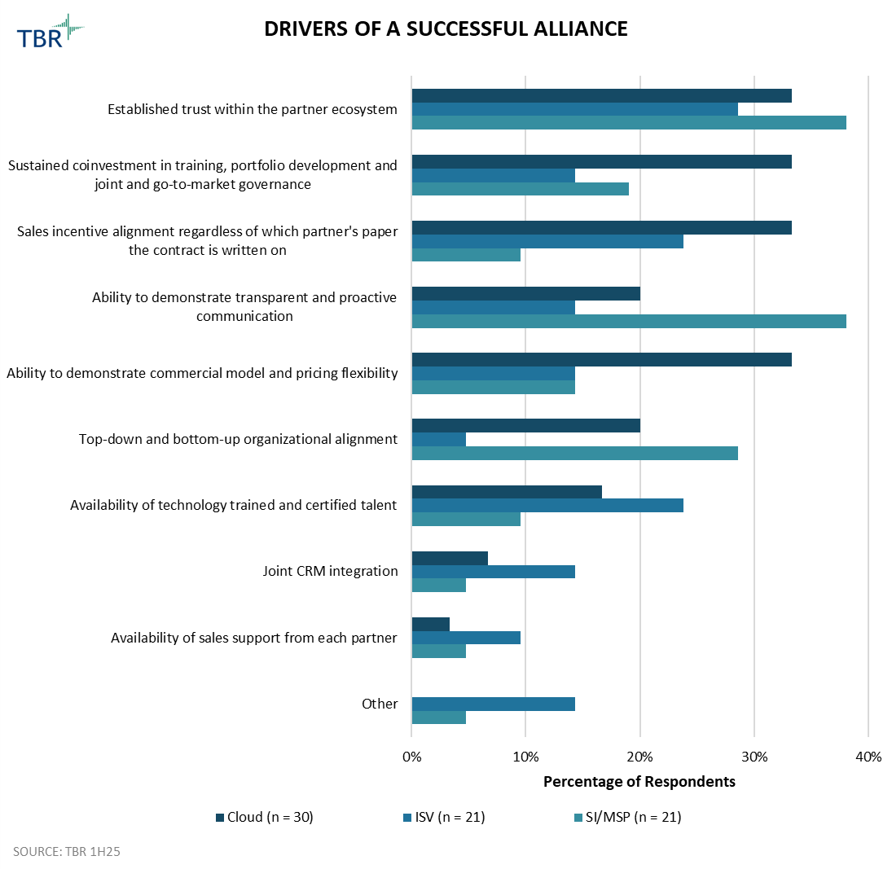
Across all vendors types, trust was deemed the most important attribute of a successful alliance. That said, compared to ISVs and systems integrators (SIs), cloud vendors value measurable drivers such as willingness to coinvest, alignment of sales incentives, and pricing model flexibility.
 
Services vendors are leading the charge with outcome-based pricing, though these vendors are far from delivering this model at scale. Although we expect some SaaS vendors will continue exploring outcome-based pricing, at least as part of a hybrid model, the infrastructure vendors are not equipped to implement a similar strategy, suggesting a potential challenge ecosystem participants will need to navigate.


Graph: Drivers of a successful alliance

Drivers of a Successful Alliance (Source: TBR 1H25)


Given their enterprise access, global systems integrators (GSIs) remain invaluable to hyperscalers, creating opportunities for SIs to expand in areas increasingly influenced by GenAI like managed services

Priority partner types

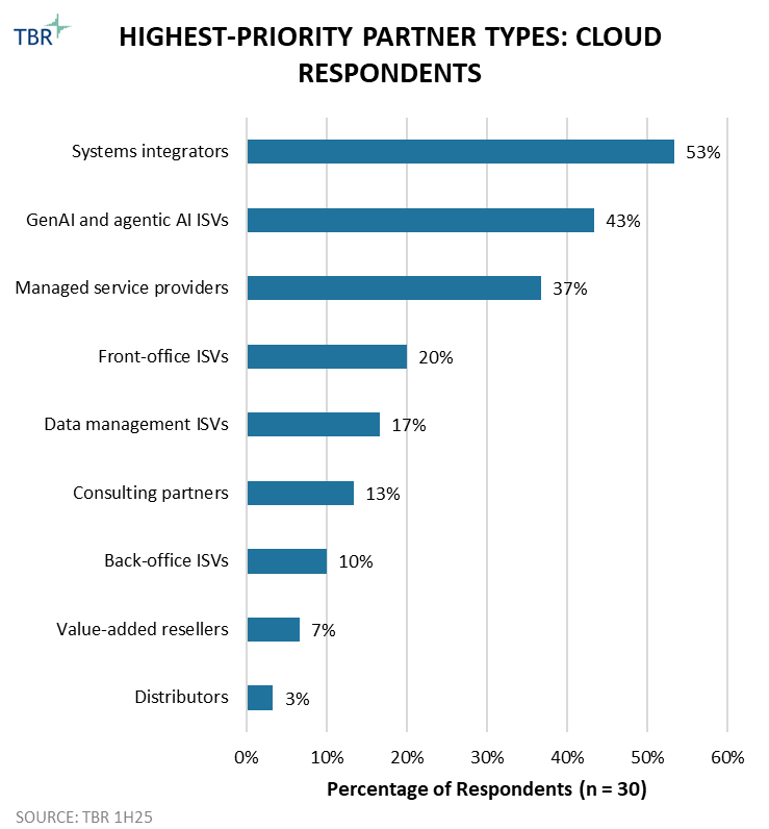
Customers are increasingly realizing that to take advantage of AI, they need their infrastructure and applications modernized in the cloud. With the vast amount of enterprise data still residing on premises, there is a lot of opportunity ahead, and the cloud vendors recognize the influence SIs have with enterprises still carrying large amounts of tech debt. In fact, the big three hyperscalers are expecting partner attach rates above 80% for large deals, a strong recognition that the SIs are using the C-Suite to close deals, largely within the Fortune 1000.
 
Cloud providers are also paying more attention to managed services providers (MSPs). To be clear, this is not just niche MSPs but also existing SI partners that are expanding further into managed services. We believe these results are largely driven by GenAI, which is creating a need for services vendors to not only help customize an AI model but also maintain that model as part of an ongoing initiative. AWS has been making heavy investments here by increasing Market Development Funds (MDFs) for MSP partners and validating MSP Specialization partners on the AWS Marketplace landing page for professional services.
 
GenAI ISVs have become an emerging priority, and that is one of the big ways AI is changing alliances: There is simply a bigger field to choose from. Our survey also found that cloud vendors’ priorities over the next three years will focus less on re-tiering existing partners or rethinking investments and more on bringing new partners into their programs. We believe this speaks to all the new model providers and AI startups cloud vendors are trying to attract.


Graph: Highest-priority Partner Types

Highest-priority Partner Types: Cloud Respondents (Source: TBR 1H25)


AI shifts alliances from an optional enhancement to a core requirement, forcing ISVs and partners to prove differentiated value beyond hype

Vendor perception

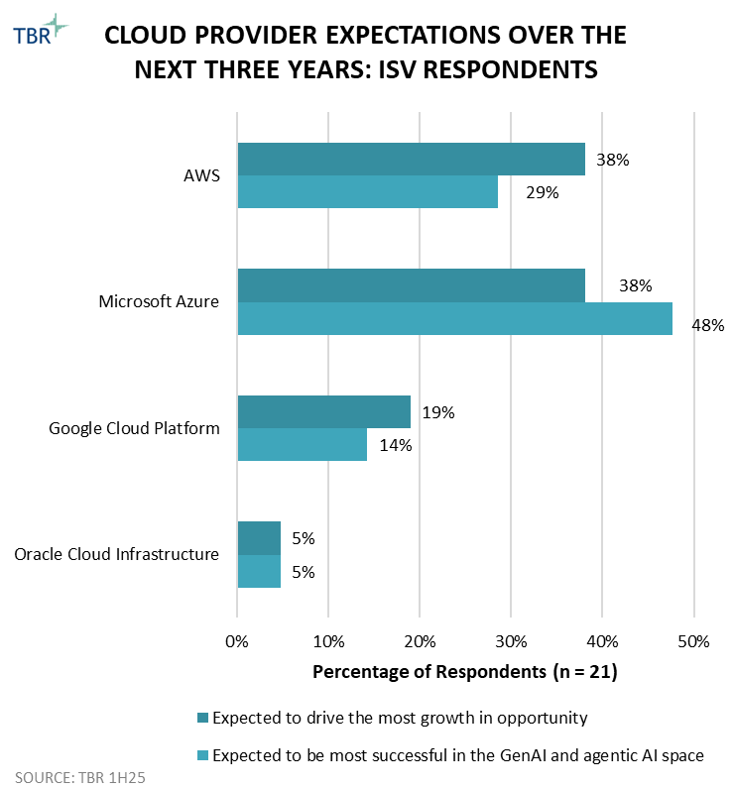
AI and GenAI are beginning to influence ISV partnerships, though most respondents still see themselves in the early innings. Nearly half of ISVs indicated GenAI has had no current impact on their alliance activity, underscoring the cautious pace of adoption. Where ISVs are engaging, the emphasis is largely on internal training programs and selective productivity use cases rather than external, cosell opportunities. ISVs are prioritizing workforce readiness and operational efficiency before extending GenAI into broader customer-facing partnerships. At the same time, expectations are shifting. A clear majority of respondents anticipate at least a moderate impact from GenAI on their alliances over the next three years, suggesting a steady transition from experimentation to applied use cases. Microsoft Azure was cited by nearly half of respondents as the cloud provider best positioned to capitalize, reflecting its Copilot-led attach strategy and strong marketplace presence.
 
Concerns remain pronounced, particularly around data security, IP ownership and regulatory alignment. These risks create friction in building joint solutions, as ISVs weigh the benefits of innovation against the potential liabilities of codeveloping with hyperscalers. Integration complexity adds another layer of hesitation, especially for smaller ISVs without extensive engineering resources. Overcoming these barriers will require trust frameworks that clarify accountability for data, intellectual property and compliance. For ISVs, the path forward lies in balancing internal GenAI experimentation with external signaling to partners, while building the governance models needed to scale alliances confidently. The result will be alliances that are both commercially viable and resilient to the risks that have so far hampered broader adoption.
 

TBR Graph: Cloud Provider Expectations

Cloud Provider Expectations Over the Next Three Years: ISV Respondents (Source: TBR 1H25)

Will the U.S. Government and Hyperscalers Push the Mobile Industry to the Forefront of 6G?

2025 Brooklyn 6G Summit, Brooklyn, New York, Nov. 5-7, 2025 — More than 300 in-person attendees and 1,600 virtual attendees from academia, technology standards bodies, the public sector, industry analyst firms, network infrastructure and device vendors, communication service providers (CSPs), satellite network operators, semiconductor firms, hyperscalers and other stakeholders of the broader wireless technology ecosystem gathered at the Tandon School of Engineering at New York University in Brooklyn for a mix of presentations, fireside chats and panel discussions regarding the future of wireless networks, with a focus on 6G. There were more than 35 exhibits on display from graduate students at various U.S. universities as well as from a range of telecom ecosystem entities showcasing 6G-related innovations. A broad range of other 6G-related topics were discussed, including the role of AI and machine learning in networks, sustainability (especially related to energy), standards development, spectrum policy, public-private collaboration, and nonterrestrial networks’ role in the ecosystem. The 12th annual event was hosted by Nokia and NYU WIRELESS. This year’s event provided the usual cellular ecosystem updates, but one of the major themes was how the telecom industry should approach converting wireless innovation into value, especially economic value. Bell Labs’ 100th anniversary was also commemorated at the event.

TBR perspective

There is no doubt that the global economy is in the midst of an AI super cycle. What is doubtful, though, is whether the telecom industry will rise to the occasion to support (and monetize) opportunities that arise from AI. There are several fundamental challenges endemic to the telecom industry that could keep it from participating in the AI economy in a significant way, and TBR believes the AI economy could disintermediate at least a portion of the telecom industry.


The AI ecosystem currently operates in 18-month innovation cycles, and the telecom industry remains mired in its decade-long generational cycles; this dissonance will create friction and could be the biggest impediment to the convergence of the AI economy with the telecom industry. Will the rapidly evolving AI ecosystem wait for the telecom industry to support it, or will it be forced to move beyond telecom incumbents and institutions to avoid being held back?

One thing is certain: AI will fundamentally change how networks are utilized, necessitating a new network architecture. The telecom industry, which includes the cellular ecosystem, moves incredibly slowly, and this slowness is diametrically opposed to how the AI ecosystem (and other tech theme areas) moves. Something is going to break, and the real questions are what and when.

Impact and opportunities

A new network architecture is required for AI, as current networks will not suffice

One key aspect of AI workloads, especially those emanating from end-user devices, is that they are uplink-intensive, meaning they rely more heavily on uplink resources from the network than on downlink resources. This is a fundamental issue because macro, cellular-based networks are optimized for downlink capacity (typically a 10-1 downlink-uplink ratio from a resource-allocation perspective). CSPs will need to make significant investments in new network technologies and rethink how spectrum resources are utilized, to optimize networks for uplink.

AI traffic also tends to require lower latency than current networks and can support higher bursts of traffic than video and other media consumption. AI networks require uplink bandwidth, lower latency (compared to current networks) and the ability to handle higher bursts in traffic patterns at scale, and none of these requirements can be achieved just by increasing capacity. These requirements are the opposite of how networks are architected today — optimized for downlink, best-effort or good-enough latency, and optimized for more predictable traffic patterns — necessitating significant investment by CSPs. This will be a gradual transition, as there is no silver bullet to address this problem quickly. The best approach seems to be decoupling the downlink from the uplink for transmit power differentials, which would enable network resources to dynamically adapt to traffic demands in real time. Additionally, there is concern as to how willing CSPs will be to invest in uplink when ROI is uncertain.

6G will primarily be a software upgrade

Unlike prior Gs, 6G is unlikely to be a massive hardware refresh, but will instead build on top of existing 5G RAN and 5G core (the 5G SA [standalone] architecture) infrastructure as a software upgrade. This is the most likely outcome as CSPs are highly unlikely to have the appetite or the financial wherewithal to invest in another massive network refresh with unclear ROI.

There will be some hardware elements to invest in, such as processing capability that enhances programmability and maximizes AI support, or radios that support new frequencies not covered by existing RAN via software-defined radio technology, but hardware investments will be a fraction of what was spent in prior cellular generations. As a result, TBR expects a shallower capex curve during the 6G cycle, more closely resembling the 5G Advanced spend curve thus far.

Trump likes 6G

The Trump administration has designated several technologies and resources as strategic national priorities. Much as he did during his first administration, designating 5G as a national strategic priority, Trump views 6G as equally, if not more important. 6G will be leveraged for a broad range of defense and public safety, as well as societal use cases, which makes investment and success with the technology a public issue. Integrated sensing and communication (ISAC) is a 6G-related use case of particular interest to the U.S. government, for national security considerations. The government is heavily involved in 6G R&D-related endeavors, both directly and indirectly, through proxy programs such as the Defense Advanced Research Projects Agency and the U.S. National Science Foundation, as well as government agencies such as the U.S. Department of War.

TBR expects the Trump administration to apply similar approaches to seeding and bolstering U.S. innovation in 6G, much like it has in the production of rare earth metals, AI, nuclear power, and other key technologies. As part of this, it is reasonable to expect U.S. government equity investments and policy support. The recent Nokia deal with NVIDIA and the U.S. and Nokia agreement both align with this policy.

Cellular standards fracturing goes beyond geopolitics

Cellular standards are not only being regionalized due to geopolitical and nationalistic considerations but are also showing cracks within regional ecosystems. For example, non-standardized technologies are increasingly coexisting with 3rd Generation Partnership Project (3GPP)-based cellular technology. Standards in cloud data centers, optics, chip design and end-user devices are fragmenting, creating technological walled gardens.

For example, hyperscalers now have enough global scale to justify pursuing their own technology standards, and it is reasonable that these companies could, at some point, rival or eclipse traditional standards bodies, such as the 3GPP, in ecosystem influence and market power. Potential catalysts for a change such as this could include the need for AI-native networks (thereby reducing dependencies on CSPs for infrastructure investment and innovation road map alignment) and the need to support the rapidly evolving AR/VR market, which holds multitrillion-dollar revenue potential for hyperscalers.

Unlocking stranded spectrum assets: A prerequisite for 6G leadership

The mobile industry continues to beat the drum for more spectrum, but it should instead focus on fully utilizing the spectrum already allocated. TBR notes there are vast tranches of spectrum in the U.S. market that are broadly underutilized, either for technical or economic reasons. And challenges will only worsen as the industry aims to bring upper midband frequencies into the fray, which have greater propagation challenges and are less suited for macro coverage.

The U.S. needs to do a better job, guided by government institutions like the Federal Communications Commission, of utilizing CBRS, C-Band, 6GHz and mmWave bands, which are woefully underutilized today. For example, only a relatively small portion of midband spectrum has been deployed in the U.S. market to date, implying that well over half of it has not yet been put to use. (CSPs are either sitting on it or hoarding it.) Most 4G and 5G network traffic in the U.S. today runs over low bands such as 600MHz to 800MHz and the lower midband (1GHz to 2.6GHz, especially 2.5GHz), with C-Band increasing but nowhere near its full utilization potential. MmWave bands hold promise, but for economic and technical reasons, they were used only in very specific situations, mostly for LAN capacity.

Additionally, spectrum warehousing entities like EchoStar (which recently reluctantly agreed to sell a portion of its vast spectrum holdings to Starlink and AT&T) and private equities are still sitting on large tranches of unused spectrum. The government should redirect its efforts toward addressing these market dislocations rather than straining to bring new spectrum to a market that might not even be used (case in point, CBRS). This should be a mandatory government push because dislocations created by negative externalities of capitalism threaten to keep the U.S. behind China in key technological domains; specifically, corporations with a scarcity mindset are hoarding, but not necessarily using, the spectrum resources they have. The U.S. is already behind China across several key technologies (e.g., 5G, hypersonic missiles, electric batteries and vehicles, rare earth element processing); it is unacceptable for the U.S. to also fall behind on 6G.

TBR believes that the spectrum already allocated to CSPs will be deployed once the business case for its use is secured. Spectrum resources will come out of the shadows once ROI is clear. The government can help in this regard.

Data protectionism is stifling innovation and holding back the U.S.

A major limitation for academia and the broader mobile ecosystem is the lack of raw data to leverage for innovation. Data is viewed as a strategic and valuable asset, and the reality is that companies and governments do not want to share their data for various reasons. This limits academia, research institutions and other companies in what can be used for educational purposes as well as their ability to innovate by training their models and fine-tuning their technologies. Here again, China has an advantage over the U.S. because its authoritarian model can accelerate the pace of innovation in targeted areas.

Conclusion

The AI and cellular ecosystems are moving at different speeds rather than converging onto parallel tracks, which is a major issue and could lead to a breaking point for the technology industry. If hyperscalers feel like CSPs are holding them back, they can and will, as history validates, work around CSPs and take greater control over their own destinies.

This could include building their own standards for network infrastructure, much like they have for IT infrastructure and at the endpoint-device level and build out AI-optimized networks far greater in scope than they have been building (see TBR’s Hyperscaler Digital Ecosystem Market Landscape and Hyperscaler Capex Market Forecast reports for more information). Since it is unlikely the telecom ecosystem will fundamentally change, as it is not geared to do so, greater disintermediation and changing competitive dynamics are likely to occur. It is very possible that 6G could be the last “G.”